Qatar Structural Steel Fabrication Market Size, Share & Growth Rate
The Qatar Structural Steel Fabrication Market was estimated at USD 324 Million in 2025 and is projected to reach USD 447 Million by 2032, growing at a CAGR of 4.7% from 2026 to 2032. This robust trajectory is primarily driven by Qatar's thriving construction sector, fueled by ongoing investments in infrastructure and real estate projects. The increasing preference for structural steel due to its strength, versatility, and cost-effectiveness further propels market growth, making it an essential component in various construction applications.
Qatar Structural Steel Fabrication Market Year-wise Growth Rate and Key Drivers
This graph highlights how the Qatar Structural Steel Fabrication Market has steadily grown over the years, supported by major growth factors.
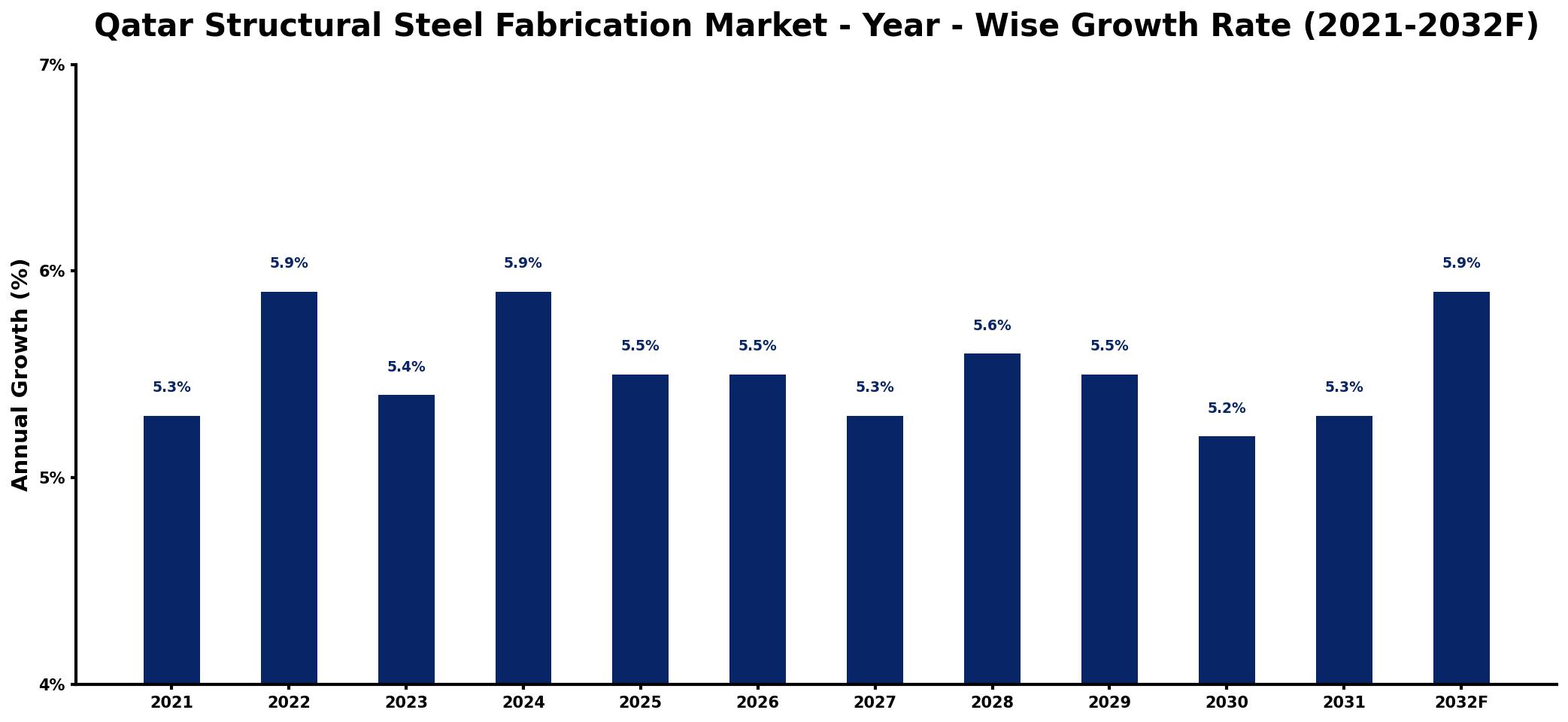
The table below presents the year‑wise growth rates along with the key drivers influencing the market
| Year | Growth Rate | Major Drivers |
| 2021 | 5.3% | Increased infrastructure development projects |
| 2022 | 5.9% | Rising demand from construction sector |
| 2023 | 5.4% | Growth in renewable energy investments |
| 2024 | 5.9% | Expansion of industrial facilities |
| 2025 | 5.5% | Boost in residential building activities |
| 2026 | 5.5% | Increased government infrastructure spending |
| 2027 | 5.3% | Surge in commercial property developments |
| 2028 | 5.6% | Growing urbanization trends observed |
| 2029 | 5.5% | Higher foreign direct investments |
| 2030 | 5.2% | Emerging technology adoption rising |
| 2031 | 5.3% | Increased focus on sustainability initiatives |
| 2032 | 5.9% | Continued demand for modern infrastructure |
Note: Market size estimations and growth projections presented in this report are based on 6Wresearch's proprietary forecasting methodology, utilizing the latest available industry data, government publications, and primary research inputs.
Qatar Structural Steel Fabrication Market Synopsis
As Qatar embarks on numerous ambitious projects, the structural steel fabrication market is witnessing a significant uptick. Current trends indicate a strong alignment between government infrastructure initiatives and the demand for high-quality structural steel components, critical for ensuring safety and durability in construction.
The market is characterized by a fast-paced environment where innovation and quality control are paramount. Companies are adapting to custom project demands, providing tailored solutions that meet both regulatory requirements and client specifications while ensuring timely delivery amidst complex logistics.
Qatar Structural Steel Fabrication Market Key Takeaways
- The market is on a steady growth path, largely due to infrastructural investments and urban development initiatives.
- Structural steel's inherent advantages make it a favored material in various construction applications, including residential and commercial projects.
- Customization and flexibility in manufacturing processes are becoming critical to cater to specific project needs.
- Recent rebound in demand post-COVID-19 reflects the resilience of the sector amidst global disruptions.
- Government-backed initiatives continue to bolster market opportunities, enhancing the overall landscape.
Evaluation of Restraints in Qatar Structural Steel Fabrication Market
Despite its promising outlook, the Qatar Structural Steel Fabrication Market faces certain restraints that could impede its growth. Economic fluctuations can create uncertainty in construction activities, potentially dampening demand for structural steel products. Furthermore, the requirement for customization across various projects necessitates flexibility in manufacturing processes, which can strain resources and complicate quality control efforts. The intricate balance between maintaining high-quality standards and meeting project-specific demands is a persistent challenge that firms must navigate to thrive in this dynamic market.
Qatar Structural Steel Fabrication Market Trends
Emerging trends within the Qatar Structural Steel Fabrication Market reveal a shift towards sustainable practices and innovative technologies. As the industry increasingly adopts green building practices, demand for environmentally friendly materials and efficient fabrication processes is on the rise. Additionally, advancements in automation and robotics within fabrication processes are streamlining production, enhancing precision, and reducing lead times. This trend towards technological integration is expected to revolutionize the sector, making operations more efficient while improving overall project outcomes.
Qatar Structural Steel Fabrication Market Opportunities
The Qatar Structural Steel Fabrication Market is brimming with opportunities for growth and investment, particularly in the realm of infrastructural development. The government's strategic urban planning initiatives create a fertile ground for investment in large-scale projects, such as bridges and commercial complexes. Additionally, as the nation prepares for major events, including sports tournaments and international exhibitions, the demand for high-quality structural steel is likely to surge. Companies that can capitalize on these opportunities by delivering innovative and sustainable fabrication solutions stand to gain a significant competitive advantage.
Government Initiatives in the Qatar Structural Steel Fabrication Market
The Qatari government plays a crucial role in fostering the structural steel fabrication market through various initiatives. Public spending on infrastructure development is robust, with a focus on diversifying the economy and enhancing urban living standards. These initiatives are supported by policies aimed at encouraging local manufacturing and sustainability, creating a conducive environment for the growth of the structural steel industry. By investing in large-scale infrastructure projects, the government not only boosts demand for structural steel but also reinforces its commitment to creating a resilient economy.
Future Insights of the Qatar Structural Steel Fabrication Market
Looking ahead to the period from 2026 to 2032, the Qatar Structural Steel Fabrication Market is set to experience continued expansion. The emphasis on urbanization and infrastructure development is expected to drive the demand for structural steel, creating a sustainable cycle of growth. With advancements in technology and a shift towards eco-friendly materials, the sector is likely to evolve, attracting investments and fostering innovation. Companies that align with these trends and adapt to changing market dynamics will position themselves favorably for future success.
Qatar Structural Steel Fabrication Market Latest Developments (2025 - 2026)
Recent developments within the Qatar Structural Steel Fabrication Market indicate a strong focus on modernization and technological integration. Fabricators are increasingly investing in advanced manufacturing techniques and automation to enhance productivity and ensure quality control. Moreover, collaborations and partnerships within the industry are becoming more common as companies seek to leverage shared expertise and resources to tackle project complexities effectively. This trend highlights a proactive approach to overcoming market challenges and capitalizing on growth opportunities.
Qatar Structural Steel Fabrication Market - Key Attractiveness of the Report
- 10 Years of Market Numbers
- Historical Data Starting from 2022 to 2025
- Base Year: 2025
- Forecast Data until 2032
- Key Performance Indicators Impacting the Market
- Major Upcoming Developments and Projects
Key Highlights of the Report:
- Qatar Structural Steel Fabrication Market Outlook
- Market Size of Qatar Structural Steel Fabrication Market, 2025
- Forecast of Qatar Structural Steel Fabrication Market, 2032
- Historical Data and Forecast of Qatar Structural Steel Fabrication Revenues & Volume for the Period 2022-2032F
- Qatar Structural Steel Fabrication Market Trend Evolution
- Qatar Structural Steel Fabrication Market Drivers and Challenges
- Qatar Structural Steel Fabrication Price Trends
- Qatar Structural Steel Fabrication Porter's Five Forces
- Qatar Structural Steel Fabrication Industry Life Cycle
- Historical Data and Forecast of Qatar Structural Steel Fabrication Market Revenues & Volume By End-user Industry for the Period 2022-2032F
- Historical Data and Forecast of Qatar Structural Steel Fabrication Market Revenues & Volume By Manufacturing for the Period 2022-2032F
- Historical Data and Forecast of Qatar Structural Steel Fabrication Market Revenues & Volume By Power and Energy for the Period 2022-2032F
- Historical Data and Forecast of Qatar Structural Steel Fabrication Market Revenues & Volume By Construction for the Period 2022-2032F
- Historical Data and Forecast of Qatar Structural Steel Fabrication Market Revenues & Volume By Oil and Gas for the Period 2022-2032F
- Historical Data and Forecast of Qatar Structural Steel Fabrication Market Revenues & Volume By Other for the Period 2022-2032F
- Historical Data and Forecast of Qatar Structural Steel Fabrication Market Revenues & Volume By Product Type for the Period 2022-2032F
- Historical Data and Forecast of Qatar Structural Steel Fabrication Market Revenues & Volume By Heavy Sectional Steel for the Period 2022-2032F
- Historical Data and Forecast of Qatar Structural Steel Fabrication Market Revenues & Volume By Light Sectional Steel for the Period 2022-2032F
- Historical Data and Forecast of Qatar Structural Steel Fabrication Market Revenues & Volume By Other for the Period 2022-2032F
- Qatar Structural Steel Fabrication Import Export Trade Statistics
- Market Opportunity Assessment By End-user Industry
- Market Opportunity Assessment By Product Type
- Qatar Structural Steel Fabrication Top Companies Market Share
- Qatar Structural Steel Fabrication Competitive Benchmarking By Technical and Operational Parameters
- Qatar Structural Steel Fabrication Company Profiles
- Qatar Structural Steel Fabrication Key Strategic Recommendations






































