Qatar Toys & Games Market Summary
The qatar toys & games market was estimated at USD 572 Million in 2025 and is projected to reach USD 827 Million by 2032, growing at a CAGR of 6.3% from 2026 to 2032.
Qatar Toys & Games Market Year-wise Growth Rate and Key Drivers
This graph highlights how the Qatar Toys & Games Market has steadily grown over the past five years, supported by major growth factors.
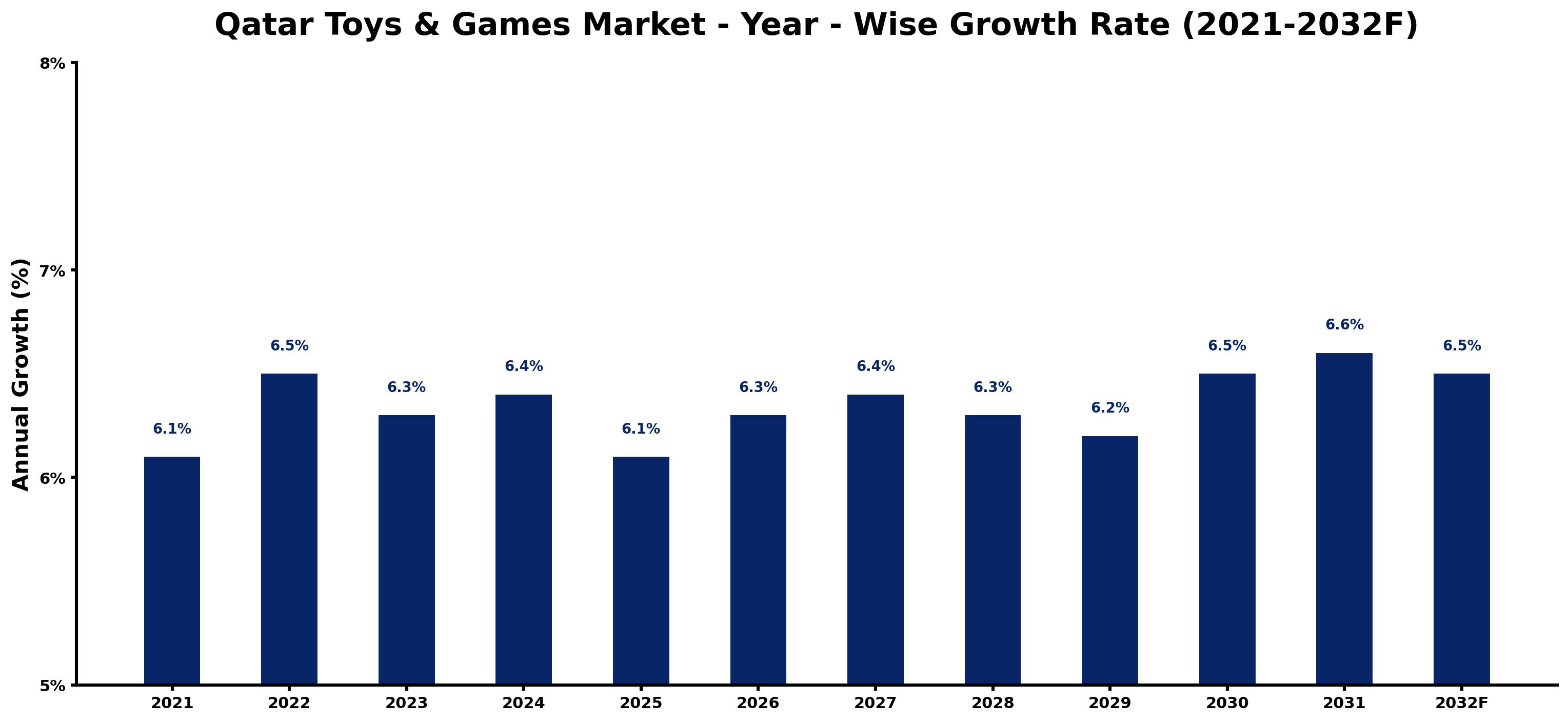
The table below presents the year wise growth rates along with the key drivers influencing the market
| Year | Growth Rate | Major Drivers |
| 2021 | 6.1% | Post-lockdown retail projects revitalized consumer interest in innovative toys and games. |
| 2022 | 6.5% | Local manufacturers collaborated with international brands to enhance market competitiveness and variety. |
| 2023 | 6.3% | Increased urbanization and a younger demographic expanded the target audience for toys. |
| 2024 | 6.4% | E-commerce platforms evolved swiftly, offering extensive options for online toy shopping. |
| 2025 | 6.1% | Cultural events promoted family-oriented activities, boosting toy purchases during festive seasons. |
| 2026 | 6.3% | Sustainability trends gained traction, influencing the development of eco-friendly toy materials. |
| 2027 | 6.4% | Gaming technology saw considerable improvements, enticing consumers toward interactive play experiences. |
| 2028 | 6.3% | Localization efforts intensified, adapting global toy products to appeal to Qatari cultural preferences. |
| 2029 | 6.2% | Educational toys gained popularity, aligning with parents' growing emphasis on developmental benefits. |
| 2030 | 6.5% | Partnerships with schools expanded opportunities for educational toys in the curriculum. |
| 2031 | 6.6% | Social media marketing strategies engaged parents, driving awareness and increasing sales conversions. |
| 2032 | 6.5% | Investment in leisure and entertainment sectors propelled demand for diverse toy offerings. |
Note - Market size estimations and growth projections presented in this report are based on 6Wresearch's advanced forecasting approach, validated with industry datasets as of June 2026.
Qatar Toys & Games Market Synopsis
The Qatar Toys Games Market is projected to reach 6.3% and witness significant growth during the forecast period (2026-2032). This market encompasses a diverse array of products, including traditional toys, electronic toys, board games, puzzles, and video games. The rapid growth is largely attributed to the demographic profile of Qatar, characterized by a young population that stimulates robust demand for various toys and games.
Qatar Toys & Games Market Growth Drivers
The growth trajectory of the Qatar Toys & Games Market is influenced by several factors:
- The high per capita income in Qatar enables consumers to enjoy greater disposable incomes, which contributes to increased spending on entertainment such as toys and games.
- The development of retail infrastructure, particularly the rise of shopping malls and dedicated entertainment centers, has created an advantageous environment for the shopping of toys and games.
- Qatar's vibrant media landscape, featuring popular television shows, movies, and iconic characters, stimulates demand for related merchandise, opening up lucrative licensing opportunities for producers.
- Family-oriented cultural norms promote the gifting of toys during holidays and special occasions, sustaining continuous demand for traditional and innovative toy offerings.
- The ongoing efforts to enhance educational resources in Qatar, particularly through stimulating learning tools, have led to heightened interest in educational toys that are designed to foster cognitive development.
Qatar Toys & Games Market Challenges and Restraints
While the Qatar Toys & Games Market presents numerous opportunities, it faces specific challenges that could hinder growth:
- Traditional cultural values may dictate the types of toys and games that are acceptable, possibly limiting market options for manufacturers and retailers.
- The heavy reliance on imports for toy supplies makes the market vulnerable to fluctuations in international trade conditions, impacting pricing and availability.
- Currency exchange rate variations can affect the cost structure for imported goods, creating uncertainty for pricing strategies in the local market.
- The rise of digital entertainment options, such as mobile games and online streaming services, poses direct competition to traditional physical toys and games.
- Health concerns stemming from potential safety risks associated with imported toys may lead to increased scrutiny from regulatory bodies, necessitating strict compliance and quality assurance measures.
Qatar Toys & Games Market Covid-19 Impact
The Covid-19 pandemic significantly influenced the operations of the toys and games market in Qatar, similar to global trends. During peak lockdowns, physical toy stores experienced temporary closures, prompting a rapid transition towards online sales. Families, under the constraints of restricted mobility, sought entertainment and educational engagement for children, thereby leading to a spike in demand for board games, puzzles, and educational toys designed for home use.
Qatar Toys & Games Market Government Investment and Initiatives
The Qatari government remains proactive in fostering the growth of the toys and games sector through various initiatives. This includes substantial investments in improving retail environments and public facilities where families can engage in leisure and educational activities. Government policies are increasingly focused on enhancing local manufacturing capabilities to reduce dependency on imports, which may lead to the establishment of toy production facilities. Additionally, initiatives aimed at promoting creative and educational industries support the development of innovative toys that align with national educational frameworks. Incentives for businesses within the sector are also part of the broader economic diversification strategy, encouraging local entrepreneurship and innovation in the toys and games market.
Qatar Toys & Games Market Latest Developments (May 2025 - June 2026)
Recent developments in the Qatar Toys & Games Market have indicated a shift towards integrating technology with traditional toys, reflecting global trends. As the market heads towards 2026, there has been a noticeable increase in the availability of interactive and smart toys, catering to tech-savvy consumers. Retailers have also been adapting to changing market dynamics by enhancing online platforms to facilitate e-commerce. Furthermore, collaborations between educational institutions and toy manufacturers have emerged to create products that support STEAM (Science, Technology, Engineering, Arts, and Mathematics) learning. The focus on sustainability is also gaining traction, with companies exploring eco-friendly materials for toy production, aligning with global consumer preferences for environmentally responsible products.
Qatar Toys & Games Market - Key Attractiveness of the Report
- 10 Years of Market Numbers
- Historical Data Starting from 2022 to 2025
- Base Year: 2025
- Forecast Data until 2032
- Key Performance Indicators Impacting the Market
- Major Upcoming Developments and Projects
Key Highlights of the Report:
- Qatar Toys & Games Market Outlook
- Market Size of Qatar Toys & Games Market, 2025
- Forecast of Qatar Toys & Games Market, 2032
- Historical Data and Forecast of Qatar Toys & Games Revenues & Volume for the Period 2022-2032F
- Qatar Toys & Games Market Trend Evolution
- Qatar Toys & Games Market Drivers and Challenges
- Qatar Toys & Games Price Trends
- Qatar Toys & Games Porter's Five Forces
- Qatar Toys & Games Industry Life Cycle
- Historical Data and Forecast of Qatar Toys & Games Market Revenues & Volume By Product Type for the Period 2022-2032F
- Historical Data and Forecast of Qatar Toys & Games Market Revenues & Volume By Puzzles for the Period 2022-2032F
- Historical Data and Forecast of Qatar Toys & Games Market Revenues & Volume By Preschool Toys for the Period 2022-2032F
- Historical Data and Forecast of Qatar Toys & Games Market Revenues & Volume By Outdoor/Sports for the Period 2022-2032F
- Historical Data and Forecast of Qatar Toys & Games Market Revenues & Volume By Dolls for the Period 2022-2032F
- Historical Data and Forecast of Qatar Toys & Games Market Revenues & Volume By Video Games for the Period 2022-2032F
- Historical Data and Forecast of Qatar Toys & Games Market Revenues & Volume By Others for the Period 2022-2032F
- Historical Data and Forecast of Qatar Toys & Games Market Revenues & Volume By Applications for the Period 2022-2032F
- Historical Data and Forecast of Qatar Toys & Games Market Revenues & Volume By 0 - 8 Years for the Period 2022-2032F
- Historical Data and Forecast of Qatar Toys & Games Market Revenues & Volume By 8 - 15 Years for the Period 2022-2032F
- Historical Data and Forecast of Qatar Toys & Games Market Revenues & Volume By 15 Years & Above for the Period 2022-2032F
- Historical Data and Forecast of Qatar Toys & Games Market Revenues & Volume By Distribution Channel for the Period 2022-2032F
- Historical Data and Forecast of Qatar Toys & Games Market Revenues & Volume By Offline for the Period 2022-2032F
- Historical Data and Forecast of Qatar Toys & Games Market Revenues & Volume By Online for the Period 2022-2032F
- Qatar Toys & Games Import Export Trade Statistics
- Market Opportunity Assessment By Product Type
- Market Opportunity Assessment By Applications
- Market Opportunity Assessment By Distribution Channel
- Qatar Toys & Games Top Companies Market Share
- Qatar Toys & Games Competitive Benchmarking By Technical and Operational Parameters
- Qatar Toys & Games Company Profiles
- Qatar Toys & Games Key Strategic Recommendations






































