Qatar Vending machines Market Summary
The qatar vending machines market was estimated at USD 312 Million in 2025 and is projected to reach USD 428 Million by 2032, growing at a CAGR of 5.3% from 2026 to 2032.
Qatar Vending machines Market Year-wise Growth Rate and Key Drivers
This graph highlights how the Qatar Vending machines Market has steadily grown over the past five years, supported by major growth factors.
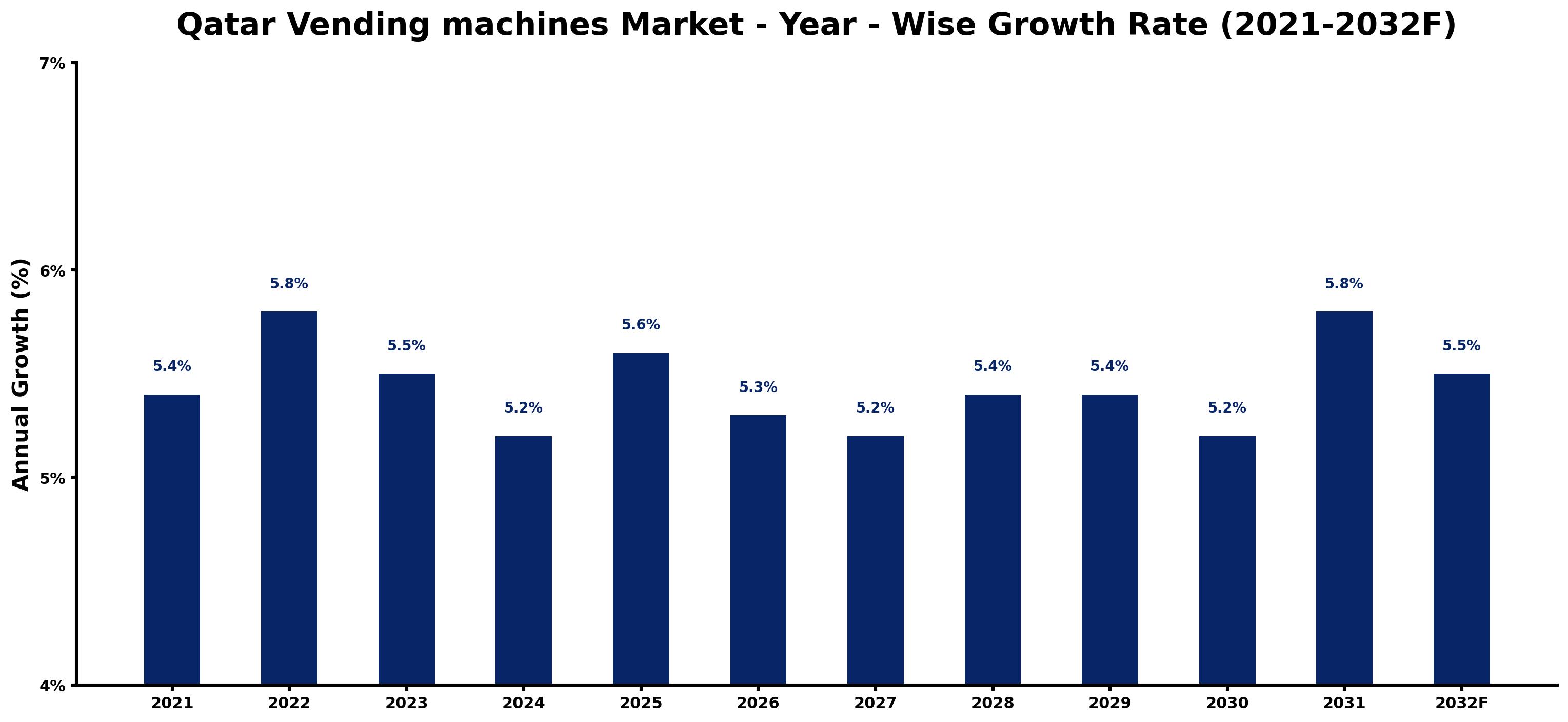
The table below presents the year wise growth rates along with the key drivers influencing the market
| Year | Growth Rate | Major Drivers |
| 2021 | 5.4% | The pandemic prompted increased demand for contactless services across various sectors. |
| 2022 | 5.8% | Tourism revival led to higher foot traffic in key locations throughout Qatar. |
| 2023 | 5.5% | Local businesses began exploring vending machines for their cost-effective retail solutions. |
| 2024 | 5.2% | Smart technology integration in vending machines enhances user experience and operational efficiency. |
| 2025 | 5.6% | Urbanization trends boost the installation of machines in high-density residential areas. |
| 2026 | 5.3% | Corporate wellness initiatives promote healthy vending options in workplaces and gyms. |
| 2027 | 5.2% | Sustainability practices shift market focus towards eco-friendly vending machine designs. |
| 2028 | 5.4% | Collaborations with local suppliers foster a vibrant ecosystem for product offerings. |
| 2029 | 5.4% | Catering to dietary preferences opens avenues for specialized vending machines. |
| 2030 | 5.2% | Technological advancements enhance vending machine locations through mobile app integrations. |
| 2031 | 5.8% | Expansion of international events necessitates diverse vending solutions for global audiences. |
| 2032 | 5.5% | Increased competition leads to innovative product offerings and improved customer service. |
Note - Market size estimations and growth projections presented in this report are based on 6Wresearch's advanced forecasting approach, validated with industry datasets as of June 2026.
Qatar Vending machines Market Synopsis
The Qatar Vending machines Market is projected to reach 5.3% and witness significant growth during the forecast period (2026-2032). This growth trajectory is primarily influenced by the rising demand for accessible food and beverage options, driven by urbanization and a lifestyle increasingly characterized by fast-paced routines.
Qatar Vending machines Market Growth Drivers
The development of the Qatar vending machines market is propelled by multiple factors:
- The burgeoning urban population is driving the need for convenient food options. Vending machines provide a solution by offering diverse snack and beverage choices readily available to consumers.
- Technological advancements in vending machines, including the implementation of digital payment systems and user-friendly interfaces, have greatly enhanced the overall user experience.
- Smart vending machines have emerged, offering real-time inventory tracking and analytics. This innovation helps operators improve efficiency and respond swiftly to consumer demands.
- Increased health consciousness among consumers is leading to a demand for healthier food and beverage options, prompting vending machine operators to diversify their offerings.
- The rise of contactless transactions, particularly in light of the Covid-19 pandemic, has made vending machines an attractive option for consumers seeking safe and hygienic purchases.
Qatar Vending machines Market Challenges and Restraints
Despite the positive growth outlook, several challenges have emerged in the Qatar vending machines market:
- The initial investment costs associated with establishing a network of vending machines can be significant, posing a barrier to entry for new operators.
- Maintenance and operational costs can also be substantial, particularly for machines that require regular restocking and servicing.
- Some locations in Qatar lack adequate infrastructure and electricity supply, limiting the deployment of vending machines in certain high-potential areas.
- Consumer preferences are evolving rapidly, making it essential for operators to regularly update their product offerings to maintain relevancy.
- Regulatory challenges and compliance with health and safety standards can add complexity to the operations of vending machine businesses.
Qatar Vending machines Market Regional Analysis
The Qatar vending machines market exhibits distinct characteristics depending on the region:
- Urban areas such as Doha show a higher concentration of vending machines due to the dense population and increased foot traffic in commercial spaces.
- The proliferation of commercial establishments, including shopping malls and offices, provides a robust platform for vending machine operators to reach consumers effectively.
- Tourist hotspots are often equipped with vending machines to cater to the needs of international visitors seeking quick and convenient refreshments.
- In contrast, rural and less populated regions may present challenges due to lower demand and insufficient infrastructure.
- Future expansions into underserved areas may present growth opportunities, provided operational challenges can be addressed sufficiently.
Qatar Vending machines Market Government Investment and Initiatives
The Qatari government has recognized the significance of the vending machines market within its broader economic framework. Initiatives aimed at enhancing public infrastructure and promoting entrepreneurship are influencing the market landscape:
- Investment in public spaces, including parks and transportation hubs, is expected to enhance the operational viability of vending machines, creating more opportunities for operators.
- Government policies encouraging technological advancement support the integration of smart vending machines throughout urban areas.
- Public health initiatives have spurred a move toward more nutritious offerings in vending machines, aligning products with national health objectives.
- Incentives for local businesses, including tax breaks and funding opportunities, encourage more entrants into the vending machines sector.
- The government's focus on sustainability and environmental stewardship may influence the market towards eco-friendly vending solutions and packaging.
Qatar Vending machines Market Latest Developments (May 2025 - June 2026)
Recent developments within the Qatar vending machines market reflect evolving consumer expectations and technological advancements:
- Operators are integrating more health-conscious options in response to increasing consumer preferences for healthier snacks and beverages.
- Investment in touchless and cashless payment systems has surged, fostering consumer confidence in safety and hygiene during purchases.
- Market participants have begun leveraging data analytics to tailor product offerings based on consumer purchasing trends, thereby enhancing operational efficiency.
- Innovative marketing strategies are being employed to promote vending machines as not only convenient purchase points but also as platforms for local brand promotions.
- Efforts are underway to expand vending machine presence in more remote areas, driven by technological solutions that mitigate traditional challenges faced in those regions.
Qatar Vending machines Market - Key Attractiveness of the Report
- 10 Years of Market Numbers
- Historical Data Starting from 2022 to 2025
- Base Year: 2025
- Forecast Data until 2032
- Key Performance Indicators Impacting the Market
- Major Upcoming Developments and Projects
Key Highlights of the Report:
- Qatar Vending machines Market Outlook
- Market Size of Qatar Vending machines Market, 2025
- Forecast of Qatar Vending machines Market, 2032
- Historical Data and Forecast of Qatar Vending machines Revenues & Volume for the Period 2022-2032F
- Qatar Vending machines Market Trend Evolution
- Qatar Vending machines Market Drivers and Challenges
- Qatar Vending machines Price Trends
- Qatar Vending machines Porter's Five Forces
- Qatar Vending machines Industry Life Cycle
- Historical Data and Forecast of Qatar Vending machines Market Revenues & Volume By Applications for the Period 2022-2032F
- Historical Data and Forecast of Qatar Vending machines Market Revenues & Volume By Commercial Places for the Period 2022-2032F
- Historical Data and Forecast of Qatar Vending machines Market Revenues & Volume By Offices for the Period 2022-2032F
- Historical Data and Forecast of Qatar Vending machines Market Revenues & Volume By Public Places for the Period 2022-2032F
- Historical Data and Forecast of Qatar Vending machines Market Revenues & Volume By Others for the Period 2022-2032F
- Historical Data and Forecast of Qatar Vending machines Market Revenues & Volume By Payment Mode for the Period 2022-2032F
- Historical Data and Forecast of Qatar Vending machines Market Revenues & Volume By Cash for the Period 2022-2032F
- Historical Data and Forecast of Qatar Vending machines Market Revenues & Volume By Cashless for the Period 2022-2032F
- Qatar Vending machines Import Export Trade Statistics
- Market Opportunity Assessment By Applications
- Market Opportunity Assessment By Payment Mode
- Qatar Vending machines Top Companies Market Share
- Qatar Vending machines Competitive Benchmarking By Technical and Operational Parameters
- Qatar Vending machines Company Profiles
- Qatar Vending machines Key Strategic Recommendations






































