Qatar Warm Air Heating Equipment Market Size, Share & Growth Rate
The Qatar Warm Air Heating Equipment Market was estimated at USD 1425 Million in 2025 and is projected to reach USD 2497 Million by 2032, growing at a CAGR of 8.3% from 2026 to 2032. This upward trajectory is driven by the rapid expansion of the construction and infrastructure sectors in Qatar, spurred by ambitious national development projects. The increasing focus on energy efficiency and modern heating solutions further propels demand for advanced warm air heating systems across both residential and commercial applications.
Qatar Warm Air Heating Equipment Market Year-wise Growth Rate and Key Drivers
This graph highlights how the Qatar Warm Air Heating Equipment Market has steadily grown over the years, supported by major growth factors.
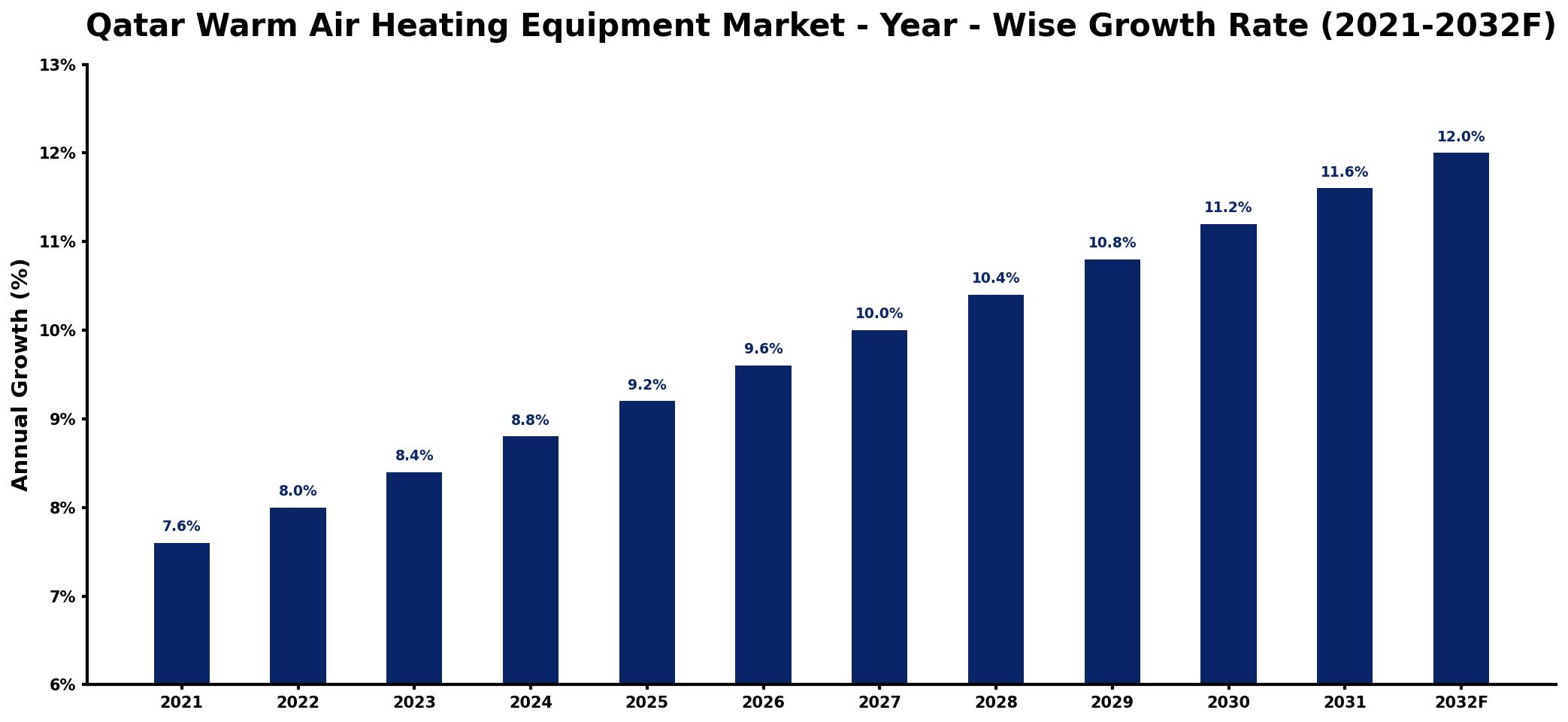
The table below presents the year‑wise growth rates along with the key drivers influencing the market
| Year | Growth Rate | Major Drivers |
| 2021 | 7.6% | Rising demand for residential comfort |
| 2022 | 8.0% | Increased construction activity nationwide |
| 2023 | 8.4% | Growing focus on energy efficiency |
| 2024 | 8.8% | Expansion of commercial infrastructure projects |
| 2025 | 9.2% | Higher investments in sustainability initiatives |
| 2026 | 9.6% | Surge in luxury property developments |
| 2027 | 10.0% | Increased government infrastructure spending |
| 2028 | 10.4% | Growing awareness of climate control |
| 2029 | 10.8% | Rising disposable income levels |
| 2030 | 11.2% | Enhanced focus on smart technologies |
| 2031 | 11.6% | Growing population driving demand |
| 2032 | 12.0% | Increased urbanization and modernization |
Note: Market size estimations and growth projections presented in this report are based on 6Wresearch's proprietary forecasting methodology, utilizing the latest available industry data, government publications, and primary research inputs.
Qatar Warm Air Heating Equipment Market Synopsis
The Qatar Warm Air Heating Equipment Market is poised for robust growth, reflecting the nations strategic investments in infrastructure and urban development. Recent advancements in heating technology have made warm air systems not only more efficient but also adaptable to the unique climate and energy requirements of the region.
As energy conservation becomes a top priority, both the public and private sectors are adopting warm air heating solutions that promise lower operational costs and enhanced performance. The markets evolution is also influenced by growing consumer awareness regarding environmental sustainability and the push for greener technologies.
Qatar Warm Air Heating Equipment Market Key Takeaways
- Qatar's construction boom is a primary driver for warm air heating equipment demand.
- Technological innovations are enhancing the efficiency and adaptability of heating solutions.
- Increased consumer awareness regarding energy efficiency is shaping purchasing decisions.
- The market is supported by both residential and commercial sectors focusing on modernization.
- Government initiatives aimed at sustainable energy use are further propelling market growth.
Evaluation of Restraints in Qatar Warm Air Heating Equipment Market
Despite its promising outlook, the Qatar Warm Air Heating Equipment Market faces certain challenges. A critical limitation is the reliance on skilled labor for installation and maintenance, particularly as systems become more complex and technologically advanced. Additionally, fluctuations in raw material prices can impact equipment costs, creating volatility in market pricing. Regulatory requirements related to energy efficiency can also serve as both a barrier and a catalyst for market growth, pushing manufacturers to innovate but potentially slowing the introduction of new products.
Qatar Warm Air Heating Equipment Market Trends
Current trends indicate a shift towards energy-efficient heating technologies, including the integration of smart controls and IoT capabilities in warm air systems. There is also an increasing preference for environmentally friendly products, as consumers demand heating solutions that minimize carbon footprints. Moreover, the rise of prefabricated and modular construction techniques is influencing the design and deployment of warm air heating systems, allowing for quicker installation and enhanced scalability.
Qatar Warm Air Heating Equipment Market Opportunities
The market presents significant opportunities for growth, particularly in urban areas undergoing rapid development. Investment in green building initiatives creates a conducive environment for warm air heating technologies that meet stringent energy efficiency standards. Additionally, government-backed incentives for renewable energy adoption are paving the way for innovative solutions that align with national sustainability goals, potentially increasing the market size further.
Government Initiatives in the Qatar Warm Air Heating Equipment Market
The Qatari government has been proactive in shaping the market landscape through various policies and public spending initiatives aimed at improving energy efficiency. Programs focused on building sustainability and smart city developments are encouraging the adoption of advanced heating solutions. Incentives for energy-efficient technologies and renovations in existing structures are also promoting broader use of warm air heating equipment throughout the country.
Future Insights of the Qatar Warm Air Heating Equipment Market
Looking ahead to 2026-2032, the Qatar Warm Air Heating Equipment Market is expected to evolve significantly as demand for sustainable solutions intensifies. Advances in technology will likely lead to even more efficient systems, pushing boundaries in performance and cost-effectiveness. As Qatar continues to diversify its economy and invest in energy efficiency, the market's growth is anticipated to be robust, solidifying its position as a key player in the regions heating solutions landscape.
Qatar Warm Air Heating Equipment Market Latest Developments (2025 - 2026)
In recent months, the Qatar Warm Air Heating Equipment Market has witnessed a surge in product innovations focused on energy efficiency and smart technology integration. The growing interest from both residential and commercial sectors has prompted manufacturers to enhance their product lines to meet emerging consumer demands. Additionally, public-private partnerships aimed at sustainable urban development are increasingly influencing the strategic direction of the market, driving collaboration between stakeholders to bring advanced heating solutions to the forefront.
Qatar Warm Air Heating Equipment Market - Key Attractiveness of the Report
- 10 Years of Market Numbers
- Historical Data Starting from 2022 to 2025
- Base Year: 2025
- Forecast Data until 2032
- Key Performance Indicators Impacting the Market
- Major Upcoming Developments and Projects
Key Highlights of the Report:
- Qatar Warm Air Heating Equipment Market Outlook
- Market Size of Qatar Warm Air Heating Equipment Market, 2025
- Forecast of Qatar Warm Air Heating Equipment Market, 2032
- Historical Data and Forecast of Qatar Warm Air Heating Equipment Revenues & Volume for the Period 2022-2032F
- Qatar Warm Air Heating Equipment Market Trend Evolution
- Qatar Warm Air Heating Equipment Market Drivers and Challenges
- Qatar Warm Air Heating Equipment Price Trends
- Qatar Warm Air Heating Equipment Porter's Five Forces
- Qatar Warm Air Heating Equipment Industry Life Cycle
- Historical Data and Forecast of Qatar Warm Air Heating Equipment Market Revenues & Volume By Product Type for the Period 2022-2032F
- Historical Data and Forecast of Qatar Warm Air Heating Equipment Market Revenues & Volume By Heat Pumps for the Period 2022-2032F
- Historical Data and Forecast of Qatar Warm Air Heating Equipment Market Revenues & Volume By Humidifying Equipment for the Period 2022-2032F
- Historical Data and Forecast of Qatar Warm Air Heating Equipment Market Revenues & Volume By Fuel Type for the Period 2022-2032F
- Historical Data and Forecast of Qatar Warm Air Heating Equipment Market Revenues & Volume By Electric Powered for the Period 2022-2032F
- Historical Data and Forecast of Qatar Warm Air Heating Equipment Market Revenues & Volume By Gas-Powered for the Period 2022-2032F
- Historical Data and Forecast of Qatar Warm Air Heating Equipment Market Revenues & Volume By Hybrid for the Period 2022-2032F
- Historical Data and Forecast of Qatar Warm Air Heating Equipment Market Revenues & Volume By Solar Powered for the Period 2022-2032F
- Historical Data and Forecast of Qatar Warm Air Heating Equipment Market Revenues & Volume By Application for the Period 2022-2032F
- Historical Data and Forecast of Qatar Warm Air Heating Equipment Market Revenues & Volume By Air to Air for the Period 2022-2032F
- Historical Data and Forecast of Qatar Warm Air Heating Equipment Market Revenues & Volume By Air to Water for the Period 2022-2032F
- Historical Data and Forecast of Qatar Warm Air Heating Equipment Market Revenues & Volume By Implementation for the Period 2022-2032F
- Historical Data and Forecast of Qatar Warm Air Heating Equipment Market Revenues & Volume By New Construction for the Period 2022-2032F
- Historical Data and Forecast of Qatar Warm Air Heating Equipment Market Revenues & Volume By Maintenance for the Period 2022-2032F
- Historical Data and Forecast of Qatar Warm Air Heating Equipment Market Revenues & Volume By End User Industry for the Period 2022-2032F
- Historical Data and Forecast of Qatar Warm Air Heating Equipment Market Revenues & Volume By Residential for the Period 2022-2032F
- Historical Data and Forecast of Qatar Warm Air Heating Equipment Market Revenues & Volume By Commercial for the Period 2022-2032F
- Historical Data and Forecast of Qatar Warm Air Heating Equipment Market Revenues & Volume By Industrial for the Period 2022-2032F
- Historical Data and Forecast of Qatar Warm Air Heating Equipment Market Revenues & Volume By Business Type for the Period 2022-2032F
- Historical Data and Forecast of Qatar Warm Air Heating Equipment Market Revenues & Volume By Original Equipment Manufacturer (OEM) for the Period 2022-2032F
- Historical Data and Forecast of Qatar Warm Air Heating Equipment Market Revenues & Volume By Aftermarket for the Period 2022-2032F
- Qatar Warm Air Heating Equipment Import Export Trade Statistics
- Market Opportunity Assessment By Product Type
- Market Opportunity Assessment By Fuel Type
- Market Opportunity Assessment By Application
- Market Opportunity Assessment By Implementation
- Market Opportunity Assessment By End User Industry
- Market Opportunity Assessment By Business Type
- Qatar Warm Air Heating Equipment Top Companies Market Share
- Qatar Warm Air Heating Equipment Competitive Benchmarking By Technical and Operational Parameters
- Qatar Warm Air Heating Equipment Company Profiles
- Qatar Warm Air Heating Equipment Key Strategic Recommendations






































