Qatar Web Application Firewall Market Size & Growth Rate (2026-2032)
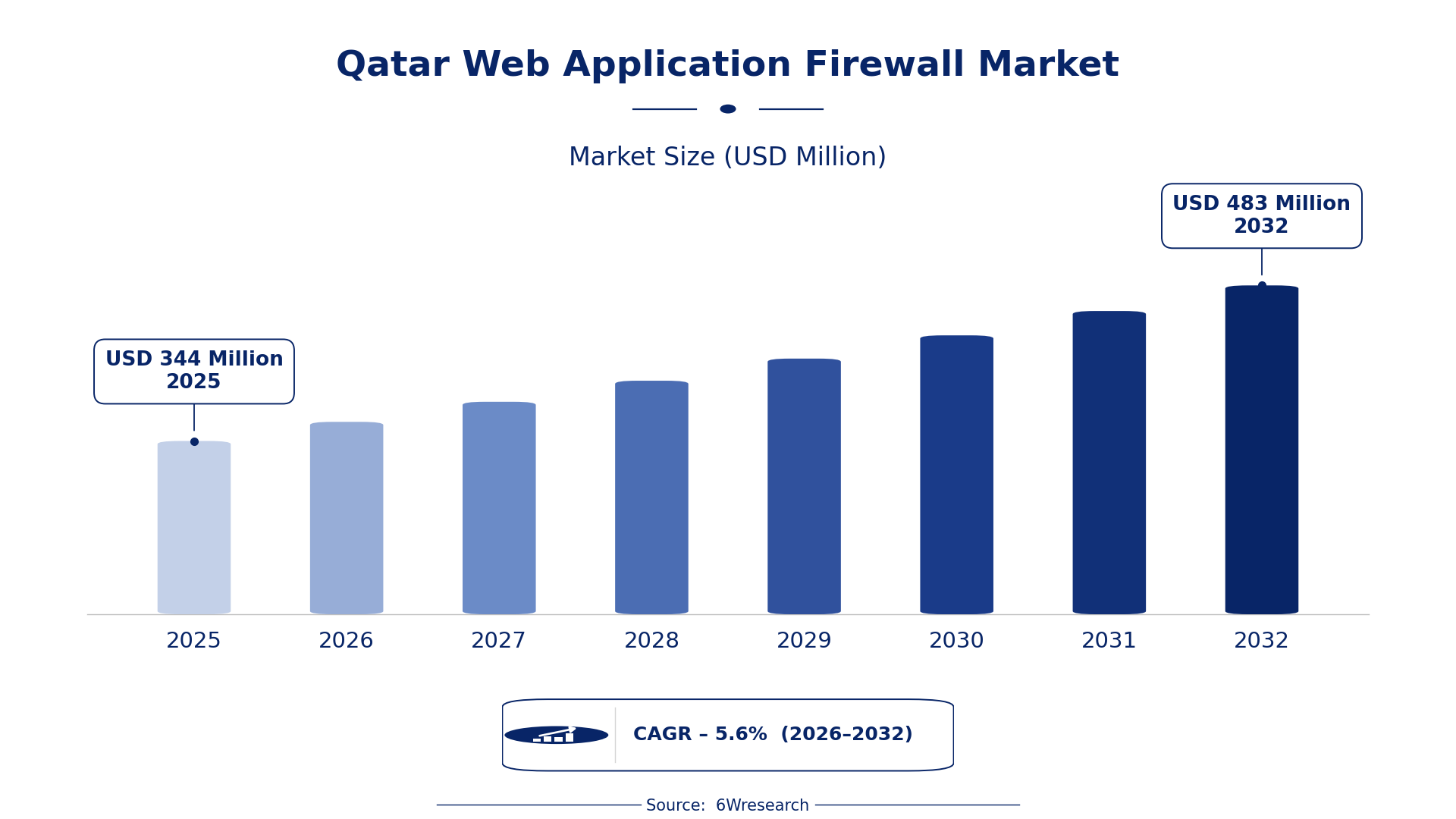
The Qatar Web Application Firewall Market was estimated at USD 344 Million in 2025 and is projected to reach USD 483 Million by 2032, growing at a CAGR of 5.6% from 2026 to 2032.
Qatar Web Application Firewall Market Synopsis
In Qatar, the surge in cyber threats targeting web applications has propelled the demand for Web Application Firewalls (WAFs). Organizations across various sectors recognize that safeguarding their digital assets is not just a precaution but a necessity in an increasingly online world.
The rapid digital transformation initiatives undertaken by both the government and private sectors are intensifying the focus on cybersecurity. As e-commerce and online services expand, the urgency to implement advanced WAF solutions becomes evident, ensuring protection against data breaches and application vulnerabilities.
Qatar Web Application Firewall Market Year-wise Growth Rate and Key Drivers
This graph illustrates the annual growth rates of the Qatar Web Application Firewall Market from 2021 to 2032, highlighting a steady upward trajectory and projected expansion over the forecast period.
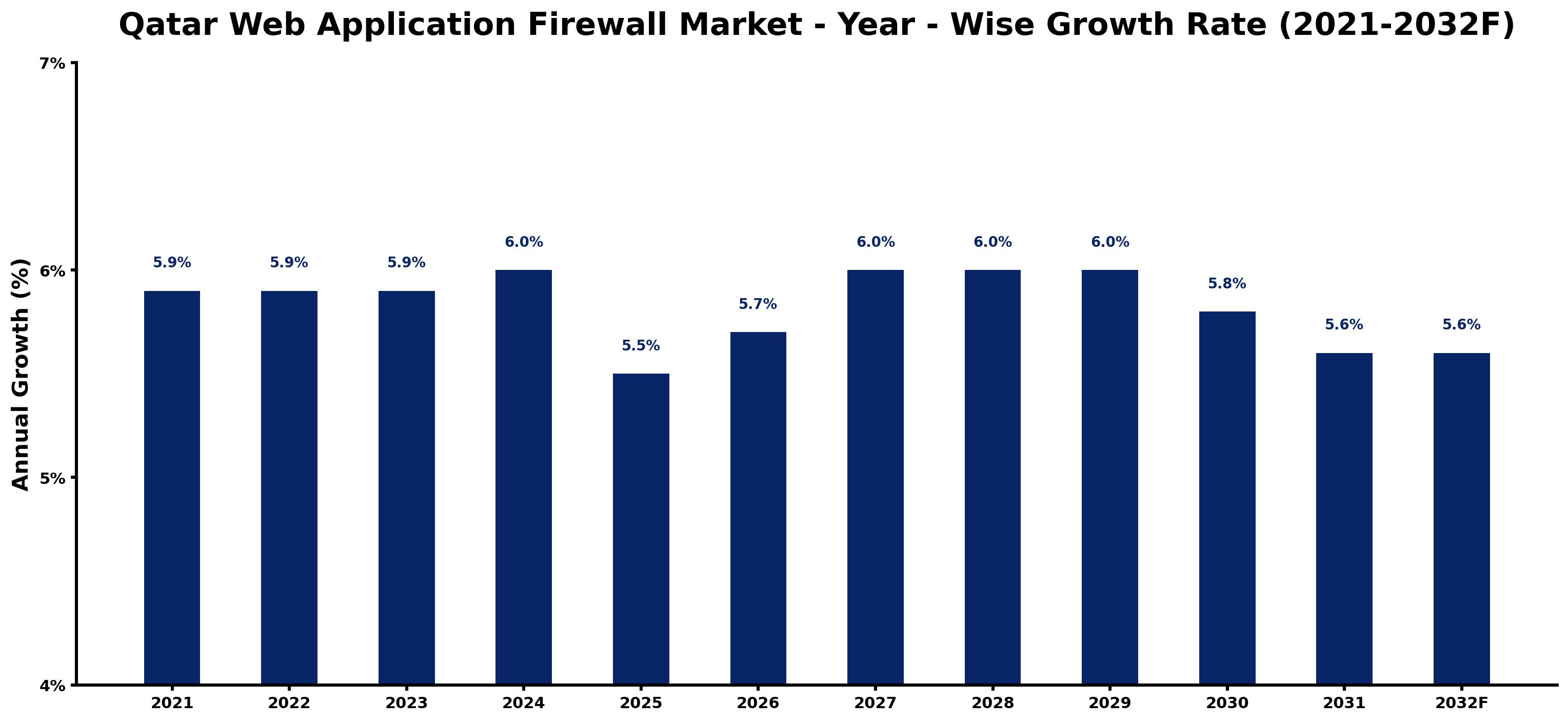
The table below presents the year‑wise growth rates along with the key drivers influencing the market
| Year | Growth Rate | Major Drivers |
| 2021 | 5.9% | Qatar Cybersecurity Framework implementation boosting web protection services. |
| 2022 | 5.9% | Increased digital service adoption by Qatar government initiatives. |
| 2023 | 5.9% | Rising local demand for data privacy regulations compliance. |
| 2024 | 6.0% | Growing investment in smart city digital infrastructure projects. |
| 2025 | 5.5% | Expanding e-commerce market driving web security service needs. |
| 2026 | 5.7% | Surge in digital banking usage requiring enhanced web security. |
| 2027 | 6.0% | Government's National Cyber Security Strategy spurring web firewall demand. |
| 2028 | 6.0% | Increased sophistication of cyber threats prompting stronger defenses. |
| 2029 | 6.0% | Qatar hosting global events necessitating robust web security measures. |
| 2030 | 5.8% | Sector-specific regulations driving demand for compliance solutions. |
| 2031 | 5.6% | Rising adoption of remote working increasing web security focus. |
| 2032 | 5.6% | Increased awareness of cyber threats boosting firewall investment. |
Note: Market size estimations and growth projections presented in this report are based on 6Wresearch's proprietary forecasting methodology, utilizing the latest available industry data, government publications, and primary research inputs.
Qatar Web Application Firewall Market Key Takeaways
Below are some of the specific key takeaways from the market, including:
- The Qatar WAF market is primarily driven by the increasing number of web-based applications.
- Cloud-based WAF solutions are gaining traction due to their scalability and real-time capabilities.
- Stringent data protection regulations are compelling businesses to adopt advanced security measures.
- The COVID-19 pandemic accelerated the adoption of web security solutions as businesses shifted online.
- Integrating WAF solutions with diverse application architectures remains a critical challenge.
Evaluation of Restraints in Qatar Web Application Firewall Market
Despite the booming demand for WAF solutions in Qatar, several restraints hinder market growth. The increasing complexity of cyber threats requires constant updates and innovations in WAF technologies. Companies often struggle to adapt their WAFs to protect against evolving vulnerabilities like zero-day exploits. This is further complicated by the diverse range of web application frameworks in use, making integration a challenge for many organizations. Balancing stringent security measures while ensuring seamless user experiences adds to the existing pressure on businesses trying to maintain their online services.
Qatar Web Application Firewall Market Trends
The Qatar Web Application Firewall Market is witnessing several trends shaping its trajectory. A notable trend is the shift towards cloud-based solutions, offering organizations flexibility and scalability. Furthermore, the incorporation of AI and machine learning in WAF solutions enhances real-time threat detection and response capabilities, making them more effective against sophisticated cyber threats.
Additionally, businesses are increasingly focusing on compliance with international data protection standards, further driving the adoption of WAF technologies. The rise of e-commerce and digital services has heightened the awareness of web security, reinforcing the necessity for comprehensive WAF solutions.
Qatar Web Application Firewall Market Opportunities
Opportunities in the Qatar Web Application Firewall Market are abundant, particularly as organizations seek to bolster their cybersecurity posture. Investment in cloud-based WAF solutions presents a significant growth avenue, especially for small and medium-sized enterprises looking for cost-effective security measures.
The government’s digital initiatives aimed at enhancing public services online also create a fertile ground for WAF providers. As businesses increasingly integrate digital solutions into their operations, the demand for tailored WAF solutions that address specific industry needs will likely continue to rise.
Government Initiatives in the Qatar Web Application Firewall Market
The Qatari government is actively fostering a secure digital environment, influencing the Web Application Firewall Market positively. Public policy initiatives aimed at enhancing cybersecurity are now crucial, given the rapid digitalization of services and the corresponding rise in cyber threats. These efforts demonstrate the government’s commitment to protecting sensitive data and ensuring the security of online transactions.
- A regulatory framework established in 2025 mandates higher security standards for online services, pushing organizations towards implementing WAF solutions.
- The National Cybersecurity Strategy, currently underway, focuses on enhancing the resilience of critical infrastructure against cyberattacks.
- A planned initiative for 2027 aims to bolster public sector cybersecurity, requiring government agencies to adopt advanced web application protection measures.
- Ongoing public-private partnerships are facilitating the development of cybersecurity education programs to elevate awareness and best practices among businesses.
- The establishment of a dedicated cybersecurity agency in early 2026 is set to oversee compliance with WAF implementation across sectors.
Future Insights of the Qatar Web Application Firewall Market
Looking ahead to 2026-2032, the Qatar Web Application Firewall Market is expected to experience dynamic growth driven by the continuous digitalization of services and increased awareness of cyber risks. Companies will increasingly prioritize cybersecurity as integral to their operations, leading to heightened investments in advanced WAF solutions.
The anticipated growth in e-commerce and online services will serve as a catalyst for innovation in WAF technologies. As threats become more sophisticated, organizations will seek adaptive solutions that can evolve to meet the challenges posed by new cyber threats. The future will also see a stronger emphasis on integrating WAF solutions with existing IT infrastructures, enabling enhanced security without hindering performance.
Qatar Web Application Firewall Market Latest Developments
In the last 12-14 months, the Qatar Web Application Firewall Market has seen several noteworthy developments. As organizations embrace digital transformation, there’s been a marked increase in the deployment of WAF solutions, particularly in sectors experiencing rapid online growth. This trend underscores the heightened awareness of cybersecurity across industries in Qatar.
- A new cloud-based WAF service was launched in early 2025, allowing businesses to scale their security measures quickly in response to evolving threats.
- In late 2025, a collaboration between tech firms focused on integrating AI-driven threat detection capabilities into existing WAF solutions commenced, aimed at enhancing response times.
- A major national campaign to promote cybersecurity awareness kicked off in mid-2025, emphasizing the importance of WAFs in protecting online businesses.
- An expansion project for local cybersecurity firms is currently underway, enhancing their capacity to provide tailored WAF solutions to SMEs.
- Upcoming in early 2027 is a national WAF certification program designed to establish standards and best practices within the industry.
Qatar Web Application Firewall Market - Key Attractiveness of the Report
- 10 Years of Market Numbers
- Historical Data Starting from 2022 to 2025
- Base Year: 2025
- Forecast Data until 2032
- Key Performance Indicators Impacting the Market
- Major Upcoming Developments and Projects
Key Highlights of the Report:
- Qatar Web Application Firewall Market Outlook
- Market Size of Qatar Web Application Firewall Market, 2025
- Forecast of Qatar Web Application Firewall Market, 2032
- Historical Data and Forecast of Qatar Web Application Firewall Revenues & Volume for the Period 2022-2032F
- Qatar Web Application Firewall Market Trend Evolution
- Qatar Web Application Firewall Market Drivers and Challenges
- Qatar Web Application Firewall Price Trends
- Qatar Web Application Firewall Porter's Five Forces
- Qatar Web Application Firewall Industry Life Cycle
- Historical Data and Forecast of Qatar Web Application Firewall Market Revenues & Volume By Component for the Period 2022-2032F
- Historical Data and Forecast of Qatar Web Application Firewall Market Revenues & Volume By Solutions (Hardware Appliances, Virtual Appliances, Cloud-Based) for the Period 2022-2032F
- Historical Data and Forecast of Qatar Web Application Firewall Market Revenues & Volume By Services (Professional and Managed) for the Period 2022-2032F
- Historical Data and Forecast of Qatar Web Application Firewall Market Revenues & Volume By Organization Size for the Period 2022-2032F
- Historical Data and Forecast of Qatar Web Application Firewall Market Revenues & Volume By SMEs for the Period 2022-2032F
- Historical Data and Forecast of Qatar Web Application Firewall Market Revenues & Volume By Large Enterprises for the Period 2022-2032F
- Historical Data and Forecast of Qatar Web Application Firewall Market Revenues & Volume By Vertical for the Period 2022-2032F
- Historical Data and Forecast of Qatar Web Application Firewall Market Revenues & Volume By Banking, Financial Services & Insurance for the Period 2022-2032F
- Historical Data and Forecast of Qatar Web Application Firewall Market Revenues & Volume By Retail for the Period 2022-2032F
- Historical Data and Forecast of Qatar Web Application Firewall Market Revenues & Volume By IT & Telecommunications for the Period 2022-2032F
- Historical Data and Forecast of Qatar Web Application Firewall Market Revenues & Volume By Government & Defense for the Period 2022-2032F
- Historical Data and Forecast of Qatar Web Application Firewall Market Revenues & Volume By Healthcare for the Period 2022-2032F
- Historical Data and Forecast of Qatar Web Application Firewall Market Revenues & Volume By Energy & Utilities for the Period 2022-2032F
- Historical Data and Forecast of Qatar Web Application Firewall Market Revenues & Volume By Education for the Period 2022-2032F
- Historical Data and Forecast of Qatar Web Application Firewall Market Revenues & Volume By Other Verticals for the Period 2022-2032F
- Qatar Web Application Firewall Import Export Trade Statistics
- Market Opportunity Assessment By Component
- Market Opportunity Assessment By Organization Size
- Market Opportunity Assessment By Vertical
- Qatar Web Application Firewall Top Companies Market Share
- Qatar Web Application Firewall Competitive Benchmarking By Technical and Operational Parameters
- Qatar Web Application Firewall Company Profiles
- Qatar Web Application Firewall Key Strategic Recommendations






































