Qatar Wooden Toys Market Size, Share & Growth Rate
The Qatar Wooden Toys Market was estimated at USD 1373 Million in 2025 and is projected to reach USD 1964 Million by 2032, growing at a CAGR of 5.2% from 2026 to 2032. This promising trajectory is largely driven by a pronounced shift in consumer preferences towards sustainable and eco-friendly products, reflecting a growing awareness among parents about the benefits of non-toxic play options. Furthermore, the rising understanding of traditional toys developmental advantages over digital alternatives is fostering a robust demand for wooden toys, indicating a significant cultural revival in playtime practices.
Qatar Wooden Toys Market Year-wise Growth Rate and Key Drivers
This graph highlights how the Qatar Wooden Toys Market has steadily grown over the years, supported by major growth factors.
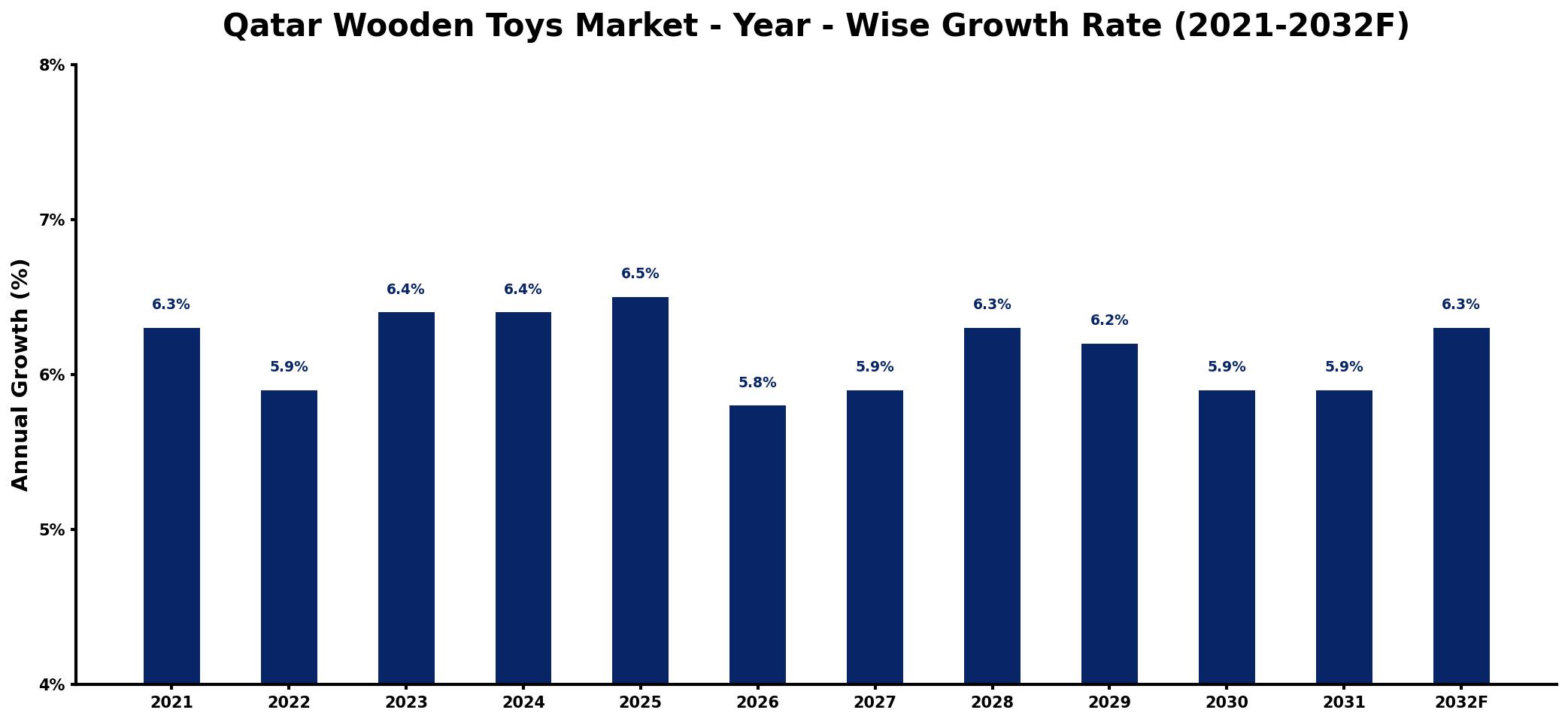
The table below presents the year‑wise growth rates along with the key drivers influencing the market
| Year | Growth Rate | Major Drivers |
| 2021 | 6.3% | Increased consumer interest in sustainability |
| 2022 | 5.9% | Growing demand for eco-friendly products |
| 2023 | 6.4% | Expansion of local manufacturing capabilities |
| 2024 | 6.4% | Rise in disposable income levels |
| 2025 | 6.5% | Increased investment in educational products |
| 2026 | 5.8% | Shift towards natural materials preference |
| 2027 | 5.9% | Emergence of new retail channels |
| 2028 | 6.3% | Strengthened online shopping platforms |
| 2029 | 6.2% | Higher awareness of child development |
| 2030 | 5.9% | Growth in family-oriented recreational activities |
| 2031 | 5.9% | Increased focus on quality craftsmanship |
| 2032 | 6.3% | Expansion into regional markets |
Note: Market size estimations and growth projections presented in this report are based on 6Wresearch's proprietary forecasting methodology, utilizing the latest available industry data, government publications, and primary research inputs.
Qatar Wooden Toys Market Synopsis
The primary force shaping the Qatar wooden toys market today is the increasing awareness of the environmental impact of toy production. Parents are actively seeking out non-toxic, durable alternatives to plastic toys, which not only align with their values but also offer greater safety for their children. This desire for sustainability is complemented by a growing appreciation for traditional craftsmanship, leading to heightened demand for locally-made wooden toys.
Additionally, the market is witnessing a wave of innovation, as companies develop products that incorporate educational aspects alongside classic play. This trend is empowering parents to make informed choices that benefit their children's development, further solidifying the place of wooden toys in the modern toy landscape. With a diverse range of products available for various age groups, the Qatar wooden toys market is well-positioned for sustained growth.
Qatar Wooden Toys Market Key Takeaways
- The market is on a robust growth trajectory, with a projected value of USD 1964 Million by 2032.
- Increased consumer focus on eco-friendly products is a major driver of market expansion.
- There is a notable resurgence in the preference for traditional toys that offer educational value.
- Local craftsmanship is becoming increasingly significant as consumers support homegrown brands.
- The market is adapting to modern safety standards while preserving cultural heritage.
Evaluation of Restraints in Qatar Wooden Toys Market
Despite the favorable growth environment, the Qatar wooden toys market is encountering some restraints that could hinder its overall potential. One significant challenge is the competition posed by digital toys and electronic gadgets, which dominate the children's toy market. Addressing this challenge requires wooden toy manufacturers to innovate continually, ensuring their products align with modern safety standards and educational needs while also resonating with parents' desire for traditional play experiences. Additionally, concerns surrounding the sourcing of sustainable wood materials may impact production costs and availability, necessitating a strategic focus on sustainable practices that comply with global environmental standards.
Qatar Wooden Toys Market Trends
Current trends in the Qatar wooden toys market are characterized by a strong inclination towards personalization and educational play. Companies are increasingly offering customizable toys that allow children to express their creativity while learning important skills. Moreover, an emphasis on storytelling and thematic playsets is gaining traction, encouraging interactive and imaginative play experiences. Another emerging trend is the integration of technology within traditional wooden toys, such as incorporating augmented reality features to create a hybrid play environment. This blend of tradition and innovation is shaping a vibrant market landscape.
Qatar Wooden Toys Market Opportunities
The Qatar wooden toys market presents several avenues for growth and investment. There is a notable opportunity to develop educational toys that promote STEM learning, aligning with global trends in early childhood education. Additionally, expanding online sales channels can help capture a wider audience, particularly among tech-savvy parents who prefer the convenience of e-commerce. Furthermore, partnerships with local artisans and craftsmen could enhance product authenticity and promote cultural heritage, thereby attracting consumers interested in supporting local economies and traditional craftsmanship.
Government Initiatives in the Qatar Wooden Toys Market
Qatar's government has implemented various initiatives aimed at promoting sustainable practices and supporting local businesses in the wooden toys sector. There is a growing commitment to preserving traditional craftsmanship, with programs designed to encourage artisans and small manufacturers in the toy industry. Additionally, public spending on educational programs that emphasize the importance of play in childhood development further bolsters demand for wooden toys. By fostering a favorable business environment and investing in community-based craftsmanship, the government is actively promoting the wooden toys market as a vital component of Qatar's economic landscape.
Future Insights of the Qatar Wooden Toys Market
Looking ahead to the period from 2026 to 2032, the Qatar wooden toys market is poised for significant advancements, driven by a combination of sustainable manufacturing practices and innovative product development. As the preference for eco-friendly toys continues to grow, companies will likely invest in new materials and techniques that enhance durability and safety without compromising environmental integrity. Additionally, the integration of educational themes and interactive elements is expected to further redefine the role of wooden toys in child development, ensuring their relevance in an increasingly digital world.
Qatar Wooden Toys Market Latest Developments (2025 - 2026)
In recent months, the Qatar wooden toys market has seen a surge in new product launches that emphasize sustainability and educational value. Innovative designs that promote creativity and learning are gaining traction among parents seeking high-quality play options. Concurrently, there is an increasing emphasis on ethical sourcing and transparent supply chains, as consumers demand greater accountability from manufacturers. The online retail landscape is evolving rapidly, with many companies enhancing their e-commerce platforms to meet the needs of a more digital-savvy consumer base.
Qatar Wooden Toys Market - Key Attractiveness of the Report
- 10 Years of Market Numbers
- Historical Data Starting from 2022 to 2025
- Base Year: 2025
- Forecast Data until 2032
- Key Performance Indicators Impacting the Market
- Major Upcoming Developments and Projects
Key Highlights of the Report:
- Qatar Wooden Toys Market Outlook
- Market Size of Qatar Wooden Toys Market, 2025
- Forecast of Qatar Wooden Toys Market, 2032
- Historical Data and Forecast of Qatar Wooden Toys Revenues & Volume for the Period 2022-2032F
- Qatar Wooden Toys Market Trend Evolution
- Qatar Wooden Toys Market Drivers and Challenges
- Qatar Wooden Toys Price Trends
- Qatar Wooden Toys Porter's Five Forces
- Qatar Wooden Toys Industry Life Cycle
- Historical Data and Forecast of Qatar Wooden Toys Market Revenues & Volume By Product Type for the Period 2022-2032F
- Historical Data and Forecast of Qatar Wooden Toys Market Revenues & Volume By Educational Toys for the Period 2022-2032F
- Historical Data and Forecast of Qatar Wooden Toys Market Revenues & Volume By Construction Toys for the Period 2022-2032F
- Historical Data and Forecast of Qatar Wooden Toys Market Revenues & Volume By Musical Toys for the Period 2022-2032F
- Historical Data and Forecast of Qatar Wooden Toys Market Revenues & Volume By Game Toys for the Period 2022-2032F
- Historical Data and Forecast of Qatar Wooden Toys Market Revenues & Volume By Dolls & Miniatures for the Period 2022-2032F
- Historical Data and Forecast of Qatar Wooden Toys Market Revenues & Volume By Automotive Toys for the Period 2022-2032F
- Historical Data and Forecast of Qatar Wooden Toys Market Revenues & Volume By Pretend Play Toys for the Period 2022-2032F
- Historical Data and Forecast of Qatar Wooden Toys Market Revenues & Volume By Wood Type for the Period 2022-2032F
- Historical Data and Forecast of Qatar Wooden Toys Market Revenues & Volume By Softwood for the Period 2022-2032F
- Historical Data and Forecast of Qatar Wooden Toys Market Revenues & Volume By Hardwood for the Period 2022-2032F
- Historical Data and Forecast of Qatar Wooden Toys Market Revenues & Volume By Age Group for the Period 2022-2032F
- Historical Data and Forecast of Qatar Wooden Toys Market Revenues & Volume By Below 1 Year for the Period 2022-2032F
- Historical Data and Forecast of Qatar Wooden Toys Market Revenues & Volume By Age 1-3 for the Period 2022-2032F
- Historical Data and Forecast of Qatar Wooden Toys Market Revenues & Volume By Age 3-5 for the Period 2022-2032F
- Historical Data and Forecast of Qatar Wooden Toys Market Revenues & Volume By Age 5-12 for the Period 2022-2032F
- Historical Data and Forecast of Qatar Wooden Toys Market Revenues & Volume By Age 12+ for the Period 2022-2032F
- Historical Data and Forecast of Qatar Wooden Toys Market Revenues & Volume By Distribution Channel for the Period 2022-2032F
- Historical Data and Forecast of Qatar Wooden Toys Market Revenues & Volume By Online for the Period 2022-2032F
- Historical Data and Forecast of Qatar Wooden Toys Market Revenues & Volume By Offline for the Period 2022-2032F
- Qatar Wooden Toys Import Export Trade Statistics
- Market Opportunity Assessment By Product Type
- Market Opportunity Assessment By Wood Type
- Market Opportunity Assessment By Age Group
- Market Opportunity Assessment By Distribution Channel
- Qatar Wooden Toys Top Companies Market Share
- Qatar Wooden Toys Competitive Benchmarking By Technical and Operational Parameters
- Qatar Wooden Toys Company Profiles
- Qatar Wooden Toys Key Strategic Recommendations






































