Romania Agricultural Film Market Size & Growth Rate
According to 6Wresearch internal database and industry insights, the Romania Agricultural Film Market was valued at USD 52.5 Million in 2025 and is projected to reach USD 79.46 Million by 2032, growing at a CAGR of approximately 6.1% during 2026–2032.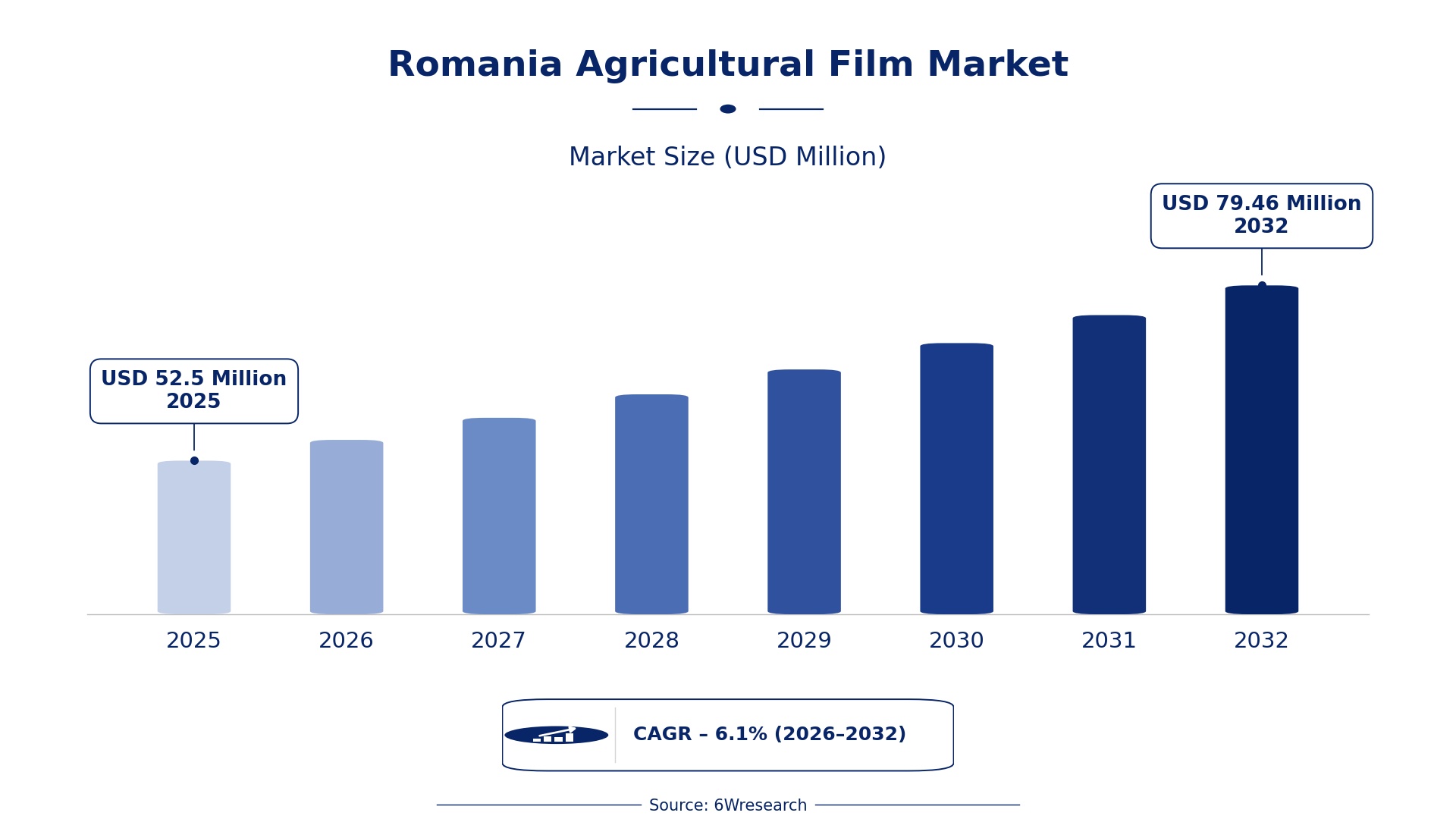
Romania Agricultural Film Market Highlights
| Report Metric | Details |
| Report Name | Romania Agricultural Film Market (2026-2032) |
| Market Size 2025 | USD 52.5 Million |
| Market Size 2032 | USD 79.46 Million |
| Absolute Growth 2025–2032 | USD 26.96 Million |
| CAGR 2026–2032 | 6.1% |
| Peak Annual Growth | 6.9% in 2027 |
| Forecast Period | 2026–2032 |
| Historical Data | 2022–2025 |
| Base Year | 2025 |
| Leading Product Type, 2025 | Polyethylene Films (68% share) |
| Fastest-Growing Product Type | Biodegradable Films (9.4% CAGR) |
| Leading Application, 2025 | Greenhouse Films (36% share) |
| Fastest-Growing Application | Mulch Films (7.4% CAGR) |
| Leading End User, 2025 | Farmers (72% share) |
| Fastest-Growing End User | Horticulturalists (7.8% CAGR) |
| Growing Sector | Biodegradable mulch and protected vegetable cultivation |
| Key End Users | Commercial crop and livestock farms, vegetable and fruit growers, agricultural contractors, farm cooperatives and greenhouse builders |
Romania Agricultural Film Market Year-wise Growth Rate and Key Drivers (2022–2032)
This graph illustrates the annual growth rates of the market from 2022 to 2032, highlighting a steady upward trajectory and projected market expansion over the forecast period.
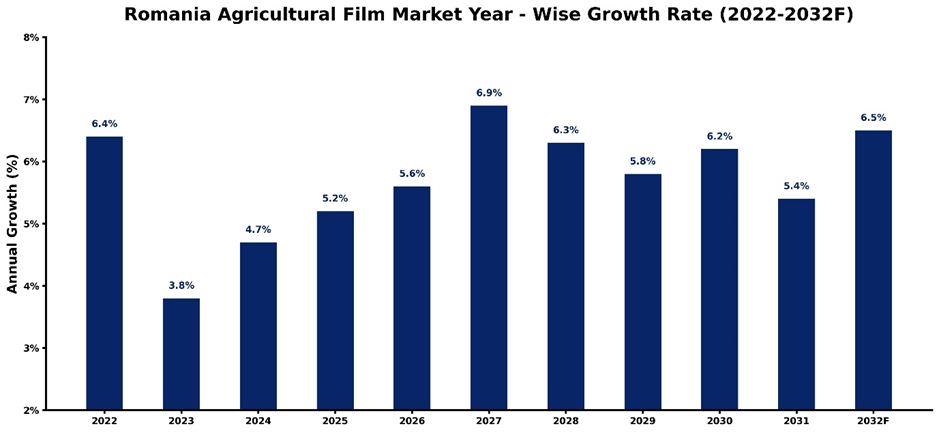
The following table presents the estimated annual growth rate for each year together with the principal factor influencing market performance.
| Year | Estimated Annual Growth (%) | Market Rationale |
| 2022 | 6.4% | Reopening of horticulture supply chains supported growth, although polymer price spikes after the Ukraine war raised film costs. |
| 2023 | 3.8% | Lower polymer prices led distributors to destock and drought-hit farm incomes limited film purchases, slowing growth sharply. |
| 2024 | 4.7% | Rollout of 2023–2027 CAP Strategic Plan investment calls revived greenhouse and storage investment among commercial growers. |
| 2025 | 5.2% | Wider planting of vegetables under protected structures and higher silage making on dairy farms lifted film volumes. |
| 2026 | 5.6% | Greater use of mulch among horticulture growers is expected to lift demand as water-saving practices spread. |
| 2027 | 6.9% | Peak disbursement of EU-funded farm investment is expected to drive replacement of greenhouse covers and new silage capacity. |
| 2028 | 6.3% | Completion of the current funding cycle is expected to moderate investment and defer large film replacement. |
| 2029 | 5.8% | Tighter agricultural plastic waste rules are expected to raise collection costs and temper purchases of conventional films. |
| 2030 | 6.2% | Expansion of certified biodegradable mulch supply is expected to widen adoption and restore growth momentum. |
| 2031 | 5.4% | Maturing demand in established protected-cultivation areas is expected to slow new film installations temporarily. |
| 2032 | 6.5% | Adoption of multi-layer, longer-life films with better light and thermal properties is expected to lift growth again. |
Note: Market size estimations and growth projections presented in this report are based on 6Wresearch’s proprietary forecasting methodology, utilizing the latest available industry data, government publications, and primary research inputs.
Romania Agricultural Film Market Synopsis
The Romania Agricultural Film Market is projected to experience sustained growth, driven by increasing adoption of protected cultivation, rising demand for silage preservation and growing emphasis on water-efficient farming practices. Polyethylene and biodegradable films are increasingly used in greenhouse coverings, soil mulching, livestock feed storage and agricultural structure protection. Investments in modern farming infrastructure across the Danube Plain and Transylvania are creating additional opportunities for market participants. However, dependence on imported resins, fluctuations in polymer prices and inadequate infrastructure for collecting and recycling agricultural films continue to challenge market development.
Market Dynamics Impact Analysis (2026–2032)
| Factor | Type | Impact | Primary Segment Affected |
| Expansion of protected vegetable cultivation | Driver | High | Greenhouse Films |
| Growth in livestock feed conservation | Driver | High | Silage Films |
| Shift to certified biodegradable mulch | Opportunity | High | Biodegradable Films |
| Professionalisation of horticulture | Opportunity | Medium | Horticulturalists |
| Resin price volatility | Restraint | High | Polyethylene Films |
| Fragmented small holdings | Restraint | Medium | Farmers |
| Limited collection and recycling of used film | Challenge | Medium | Mulch Films |
| Low-cost thin film imports | Challenge | Medium | Polypropylene Films |
Evaluation of Drivers in Romania Agricultural Film Market (2026–2032)
Below mentioned are some major drivers and their influence on market dynamics:
| Drivers | Primary Segment Affected | Why It Matters (Evidence) |
| Expansion of protected vegetable cultivation | Greenhouse Films | Solarium and greenhouse growers replace film covers every few seasons, creating recurring demand. The state-supported tomato programme for protected spaces has underpinned investment in covered structures. |
| Growth in livestock feed conservation | Silage Films | Dairy and beef farms wrap and cover forage to preserve feed value, so film use rises with forage output. Romania cultivates about 8 million hectares of arable land, with maize as the main silage crop. |
| Water-saving soil management | Mulch Films | Mulch cuts evaporation and weed growth, which raises its value after drought years. Severe droughts in 2022 and 2024 reduced yields across southern Romania. |
| Demand for biodegradable alternatives | Biodegradable Films | Films that can be ploughed in after harvest remove recovery labour and disposal fees. EN 17033 gives buyers a recognised reference for biodegradable mulch quality. |
| Modernisation of farm structures | Shed Covers | Covers protect machinery, feed and produce, so higher mechanisation raises cover use. AFIR investment measures reimburse eligible farm building and equipment projects. |
Market growth is supported by steady retail demand for fresh vegetables and fruit from a domestic population of roughly 19 million, which encourages production under protective covers. Expansion of modern retail chains is raising quality and consistency requirements, pushing producers towards controlled-environment cultivation. Private and foreign investment in agri-food value chains, including cold storage and packing facilities, is increasing the volume of produce handled with protective film. Local converters are adding extrusion capacity to serve regional demand, while improving distribution networks are shortening delivery times to rural buyers.
Evaluation of Restraints in Romania Agricultural Film Market
Below mentioned are some major restraints and their influence on market dynamics:
| Market Restraint | Primary Segment Affected | Why It Matters (Evidence) |
| Resin price volatility | Polyethylene Films | Film is priced off polymer, so oil and feedstock swings reach buyers quickly and delay purchases. Polymer prices spiked after the war in Ukraine began in 2022. |
| Fragmented small holdings | Farmers | Small holdings buy film in small lots, which raises distribution cost per kilogram and limits premium film uptake. The 2020 agricultural census recorded nearly 2.9 million holdings. |
| Import dependence for specialty grades | EVA (Ethylene-Vinyl Acetate) Films | Multi-layer and EVA grades are mainly supplied from Western Europe, Turkey and Israel, which adds freight cost and lead time for local buyers. |
| Price-led purchasing | Polypropylene Films | Buyers choose on price per roll rather than service life, so higher-grade films struggle to win share. Multi-year greenhouse films last three to four seasons against one for thin films. |
| Seasonal demand concentration | Mulch Films | Purchases cluster before spring planting, which strains working capital for distributors and creates stock risk. Most mulch is laid between March and May. |
Romania Agricultural Film Market Challenges
Although the Romania Agricultural Film Market is projected to witness growth, several challenges could influence its development trajectory. Collection and recycling of used film remain limited, since contaminated mulch and silage wrap are hard to recover and few farms have access to treatment sites, which raises disposal costs under Law 211 of 2011. Biodegradable products face certification uncertainty, as buyers rely on EN 17033 claims that they cannot easily verify in the field. Thin, low-cost imports of greenhouse covers below 150 microns undercut local converters and tear early, damaging buyer confidence. A shortage of agronomic advisers trained in film selection and installation also leaves many growers reusing unsuitable films.
Romania Agricultural Film Market Trends
Significant trends driving the Romania Agricultural Film Industry are presented below:
- Shift from Single-Season Thin Films to Multi-Layer Long-Life Covers: Commercial vegetable producers in southern Romania are replacing thin single-layer covers with three- and five-layer films that offer UV stabilisation and anti-drip properties, extending service life to several seasons. Larger solarium operators value stable yields and lower replacement labour. The trend favours converters with co-extrusion lines and additive know-how over suppliers of basic film.
- Transition from Conventional Polyethylene Mulch to Certified Biodegradable Mulch: Vegetable and strawberry growers are testing certified biodegradable mulch that can be ploughed in after harvest, avoiding retrieval labour and disposal fees. Supply from European producers of Mater-Bi and ecovio grades is widening through agricultural input distributors. The shift benefits suppliers with certified, field-proven grades, while conventional film producers face pressure on mulch volumes.
- Switch from Traditional Stretch Film to Oxygen Barrier Silage Film: Farmers who increase livestock herds in Transylvania and western Romania have switched from the use of traditional stretch wrap to oxygen barrier films which reduce spoilage in baled and bunker silages. Increased prices for milk and feed make the quality of preserved feeds is important. Oxygen barrier films with good tack and UV protection provide an edge over traditional films.
Investment Opportunities in the Romania Agricultural Film Market
Key investment prospects in the Romania Agricultural Film Market are outlined below:
- Co-Extruded Greenhouse Film Production: Replacement of ageing covers in southern vegetable clusters and new structures built with farm investment grants are creating demand for UV-stabilised, anti-drip multi-layer film. Investors can add wide-width co-extrusion lines in Dolj, Teleorman or Bucharest-Ilfov. Entry is through a joint venture with a European film producer or resin supplier and supply agreements with greenhouse builders.
- Certified Biodegradable Mulch Film Conversion: Growers face rising disposal costs for used mulch, and certified films remove retrieval work. Investment can target conversion of starch-based or PBAT-based resins into mulch rolls for vegetables and strawberries. Entry requires third-party biodegradability certification and a licensing or toll-conversion partnership with a resin developer.
- Used Agricultural Film Collection and Recycling Capacity: Growing film volumes and waste obligations under national law leave a gap in collection and washing capacity. Investors can build collection hubs and wash-and-pelletise lines in major farming counties such as Constanța, Timiș and Brăila to supply recycled resin for non-food films. Entry is through contracts with farm cooperatives, input distributors and producer responsibility organisations.
Leading Players in Romania Agricultural Film Market
Below is an overview of key companies operating in the Romania Agricultural Film Market:
1. Romcarbon S.A.
|
Company Name |
Romcarbon S.A. |
|---|---|
|
Established Year |
1957 |
|
Headquarters |
Buzău, Romania |
|
Official Website |
Romcarbon S.A. is a prominent domestic polymer processor manufacturing multi-layer coextruded agricultural and solar films reaching widths between 2 and 12 meters.
2. Farmpack S.R.L.
|
Company Name |
Farmpack S.R.L. |
|---|---|
|
Established Year |
2025 |
|
Headquarters |
Romania |
|
Official Website |
Farmpack S.R.L. operates in partnership with Karatzis S.A., producing specialized agricultural netting, baling accessories, and protective crop packaging films for local growers.
3. POLIFILM Romania S.R.L.
|
Company Name |
POLIFILM Romania S.R.L. |
|---|---|
|
Established Year |
1988 |
|
Headquarters |
Weißandt-Gölzau, Germany |
|
Official Website |
POLIFILM Romania supplies high-performance silage stretch films, protective agricultural wraps, and specialized greenhouse cover films tailored to modern crop protection standards.
4. RKW Group
|
Company Name |
RKW Group |
|---|---|
|
Established Year |
1957 |
|
Headquarters |
Mannheim, Germany |
|
Official Website |
RKW Group manufactures advanced polyolefin agricultural films, high-durability silage sheeting, mulch films, and horticultural net systems serving crop growers across European markets.
5. Berry Global Inc.
|
Company Name |
Berry Global Inc. |
|---|---|
|
Established Year |
1967 |
|
Headquarters |
Evansville, Indiana, USA |
|
Official Website |
Berry Global engineers high-efficiency agricultural films, balewrap stretch membranes, and sustainable flexible packaging technologies optimized for silage preservation and horticultural crop management.
Government Initiatives in the Romania Agricultural Film Market
Romania’s framework rests on the CAP Strategic Plan 2023–2027, which co-finances farm investment, and on the National Recovery and Resilience Plan approved in 2021 with about EUR 29.2 billion. Waste Law No. 211 of 2011 transposes the EU Waste Framework Directive and sets recovery obligations for plastic waste.
Implementation involves five institutions. The Ministry of Agriculture and Rural Development designs support schemes, the Agency for Rural Investment Financing (AFIR) reimburses eligible farm structure investments during 2023–2027, and the Agency for Payments and Intervention in Agriculture (APIA) manages area-based payments. The Ministry of Environment, Waters and Forests and the National Environmental Guard oversee waste compliance.
Future Insights of the Romania Agricultural Film Market
The Romania Agricultural Film Market is anticipated to develop as continued innovation in polymer additives and multi-layer co-extrusion improves film durability, light management and crop yields. Development of regional collection and recycling infrastructure will support circular film supply, with the EU target of recycling 55% of plastic packaging waste by 2030 guiding investment. Wider use of precision irrigation and fertigation systems will increase the need for compatible protective films. Increasing adoption of digital farm monitoring will help growers match film specifications to local climate conditions.
Market Segmentation Analysis
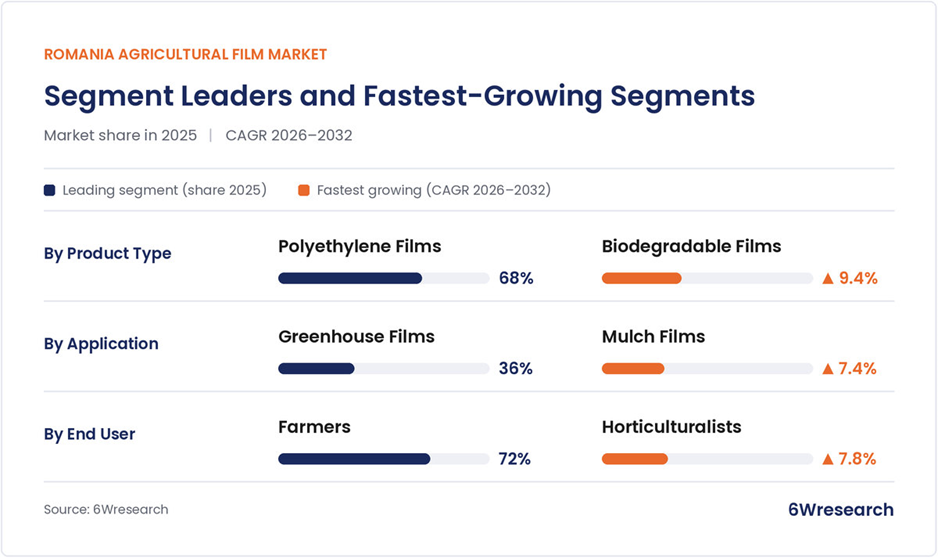
The report offers a comprehensive study of the market across its key segments. The chart below highlights the leading segment by market share in 2025 and the fastest-growing segment by CAGR over 2026–2032, followed by a detailed analysis of each segment.
By Product Type – Polyethylene Films Leads, Biodegradable Films Expected to Grow Fastest
According to Sachin Kumar Rai, Senior Research Analyst at 6Wresearch, Polyethylene Films accounted for 68% market share in 2025, supported by low cost, wide availability of resin from regional suppliers and suitability for large covers and wraps. On the other hand, Biodegradable Films are expected to record the fastest CAGR of 9.4% during 2026–2032, driven by rising disposal costs for used film, availability of certified European grades and interest among vegetable and strawberry growers.
By Application – Greenhouse Films Leads, Mulch Films Expected to Grow Fastest
Greenhouse Films captured about 36% share in 2025, supported by large base of vegetable solariums, recurring replacement of covers every few seasons and state-supported production of protected tomatoes. However, Mulch Films are projected to record the highest CAGR of 7.4% through 2032 as droughts raise the value of soil moisture retention, strawberry and vegetable plantations expand and weed control reduces herbicide use.
By End User – Farmers Lead, Horticulturalists Expected to Grow Fastest
Farmers represented 72% share in 2025 due to large area of arable land, widespread livestock keeping that requires feed conservation and the large number of holdings that buy film through input distributors. Meanwhile, Horticulturalists are expected to grow fastest at a CAGR of 7.8% during 2026–2032, supported by orchard and vegetable expansion, rising retail quality standards and greater adoption of protected structures.
Key Attractiveness of the Report
- 10 Years of Market Numbers
- Historical Data Starting from 2022 to 2025
- Base Year 2025
- Forecast Data until 2032
- Key Performance Indicators Impacting the Market
- Major Upcoming Developments and Projects
Key Highlights of the Report:
- Romania Agricultural Film Market Outlook
- Market Size of Romania Agricultural Film Market, 2025
- Forecast of Romania Agricultural Film Market, 2032
- Historical Data and Forecast of Romania Agricultural Film Revenues & Volume for the Period 2022-2032F
- Romania Agricultural Film Market Trend Evolution
- Romania Agricultural Film Market Drivers and Challenges
- Romania Agricultural Film Price Trends
- Romania Agricultural Film Porter's Five Forces
- Romania Agricultural Film Industry Life Cycle
- Historical Data and Forecast of Romania Agricultural Film Market Revenues & Volume By Product Type for the Period 2022-2032F
- Historical Data and Forecast of Romania Agricultural Film Market Revenues & Volume By Polyethylene Films for the Period 2022-2032F
- Historical Data and Forecast of Romania Agricultural Film Market Revenues & Volume By Polypropylene Films for the Period 2022-2032F
- Historical Data and Forecast of Romania Agricultural Film Market Revenues & Volume By EVA (Ethylene-Vinyl Acetate) Films for the Period 2022-2032F
- Historical Data and Forecast of Romania Agricultural Film Market Revenues & Volume By Biodegradable Films for the Period 2022-2032F
- Historical Data and Forecast of Romania Agricultural Film Market Revenues & Volume By Application for the Period 2022-2032F
- Historical Data and Forecast of Romania Agricultural Film Market Revenues & Volume By Greenhouse Films for the Period 2022-2032F
- Historical Data and Forecast of Romania Agricultural Film Market Revenues & Volume By Mulch Films for the Period 2022-2032F
- Historical Data and Forecast of Romania Agricultural Film Market Revenues & Volume By Silage Films for the Period 2022-2032F
- Historical Data and Forecast of Romania Agricultural Film Market Revenues & Volume By Shed Covers for the Period 2022-2032F
- Historical Data and Forecast of Romania Agricultural Film Market Revenues & Volume By End User for the Period 2022-2032F
- Historical Data and Forecast of Romania Agricultural Film Market Revenues & Volume By Farmers for the Period 2022-2032F
- Historical Data and Forecast of Romania Agricultural Film Market Revenues & Volume By Agricultural Contractors for the Period 2022-2032F
- Historical Data and Forecast of Romania Agricultural Film Market Revenues & Volume By Horticulturalists for the Period 2022-2032F
- Romania Agricultural Film Import Export Trade Statistics
- Market Opportunity Assessment By Product Type
- Market Opportunity Assessment By Application
- Market Opportunity Assessment By End User
- Romania Agricultural Film Top Companies Market Share
- Romania Agricultural Film Competitive Benchmarking By Technical and Operational Parameters
- Romania Agricultural Film Company Profiles
- Romania Agricultural Film Key Strategic Recommendations
Market Covered
The report offers an extensive study of the following market segments.
By Product Type
- Polyethylene Films
- Polypropylene Films
- EVA (Ethylene-Vinyl Acetate) Films
- Biodegradable Films
By Application
- Greenhouse Films
- Mulch Films
- Silage Films
- Shed Covers
By End User
- Farmers
- Agricultural Contractors
- Horticulturalists






































