Romania Cybersecurity Market Growth Rate
According to 6Wresearch internal database and industry insights, the Romania Cybersecurity Market is projected to grow at a compound annual growth rate (CAGR) of 10.8% during the forecast period (2026-2032).
Romania Cybersecurity Market Year-wise Growth Rate and Key Drivers (2022-2032)
This graph illustrates the annual growth rates of the Romania Cybersecurity Market from 2022 to 2032, highlighting a steady upward trajectory and projected market expansion over the forecast period.
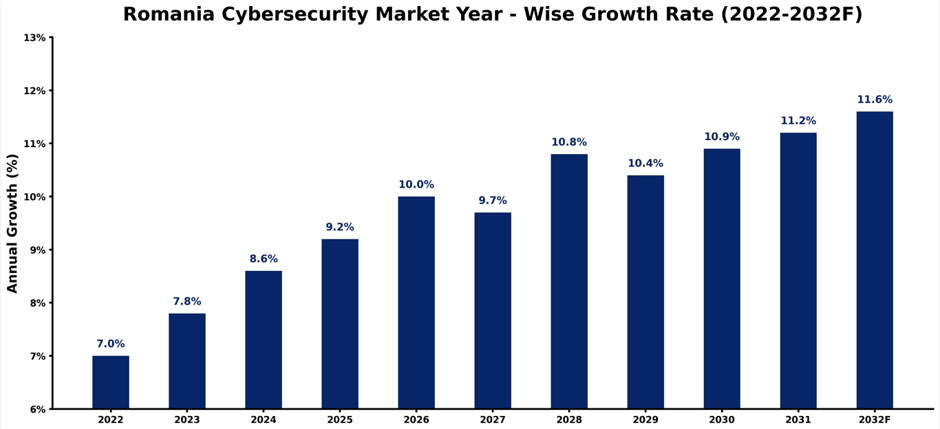
The following table summarizes the historical and forecasted growth rates of the Romania Cybersecurity Market, along with the rationale behind each year’s performance.
| Year | Estimated Growth (%) | Market Rationale |
| 2022 | 7% | Increasing cyber threats, ransomware incidents, and growing awareness of data protection requirements drive early adoption of cybersecurity solutions among Romanian organizations. |
| 2023 | 7.8% | Rising digital transformation initiatives and increased adoption of cloud-based applications encourage enterprises to strengthen network security and endpoint protection capabilities. |
| 2024 | 8.6% | Growing compliance requirements under European cybersecurity regulations and increasing enterprise focus on risk management support market expansion. |
| 2025 | 9.2% | Higher investments in managed security services, identity management solutions, and security monitoring platforms accelerate cybersecurity adoption across industries. |
| 2026 | 10% | Growing implementation of zero-trust architectures, cloud security platforms, and advanced threat detection solutions strengthens market demand during the forecast transition phase. |
| 2027 | 9.7% | Slight moderation due to cybersecurity maturity among large enterprises and optimization of existing security infrastructure; however, SME adoption and cloud security demand continue supporting growth. |
| 2028 | 10.8% | Increasing adoption of AI-driven threat intelligence, security automation, and modernization of public and private sector IT infrastructure drives market recovery. |
| 2029 | 10.4% | Growth remains stable as organizations optimize cybersecurity budgets while continuing investments in data protection, network security, and regulatory compliance solutions. |
| 2030 | 10.9% | Rising demand for advanced endpoint security, extended detection and response (XDR), and critical infrastructure protection solutions supports market expansion. |
| 2031 | 11.2% | Stronger cybersecurity regulations, digital resilience programs, and increasing adoption of integrated security platforms accelerate market growth. |
| 2032 | 11.6% | Mature growth phase supported by widespread adoption of cloud security, AI-powered cybersecurity solutions, and increasing enterprise focus on proactive cyber defense. |
Topics Covered in the Romania Cybersecurity Market Report
The Romania Cybersecurity Market report thoroughly covers the market by security type, deployment, and end-user. The market report provides an unbiased and detailed analysis of ongoing market trends, opportunities/high growth areas, and market drivers, which help stakeholders devise and align their market strategies according to the current and future market dynamics.
Romania Cybersecurity Market Highlights
| Report Name | Romania Cybersecurity Market |
| Forecast period | 2026–2032 |
| CAGR | 10.8% |
| Growing Sector | Cloud Security |
Romania Cybersecurity Market Synopsis
Romania Cybersecurity Market is anticipated to record substantial growth due to the increasing digitization trend, fast proliferation of cloud computing, and growing incidences of cyberattacks on corporations and government organizations. Cybersecurity offerings include products and services that help safeguard networks, systems, applications, and data from any cyber threats, attacks, and breaches. The sector is further being bolstered by stringent regulations on data protection and growing investments in threat intelligence platforms. Furthermore, the use of managed security services and artificial intelligence in cybersecurity offerings is increasing within the firms operating in the country.
Evaluation of Growth Drivers in the Romania Cybersecurity Market (2026-2032)
Below mentioned are some prominent drivers and their influence on the market dynamics:
| Drivers | Primary Segments Affected | Why it Matters (Evidence) |
| Rising Cybercrime Incidents | Network Security; BFSI | Growing ransomware and phishing attacks increase demand for advanced security solutions. |
| Digital Transformation Initiatives | Cloud Security; IT & Telecom | Businesses adopting digital technologies require enhanced cybersecurity frameworks. |
| EU Cybersecurity Regulations | Data Security; Government | Compliance requirements drive investment in security infrastructure and monitoring tools. |
| Expansion of Cloud Computing | Cloud Security; All End Users | Increasing cloud adoption fuels demand for cloud-native protection solutions. |
| Growing Awareness of Data Privacy | Identity Access Management; Healthcare | Organizations are investing in identity protection and data governance solutions. |
Romania Cybersecurity Market is expected to grow at the CAGR of 10.8% during the forecast period of 2026-2032. The market is witnessing strong momentum due to increasing cyber threats, rising investments in cloud technologies, and greater emphasis on digital resilience. Firms from BFSI, healthcare, and manufacturing industries are substantially raising their cybersecurity spending to protect their confidential data. In addition, various government programs to improve cybersecurity skills in the country and European cybersecurity standards have resulted in positive market dynamics. Growing demand for managed security services and AI-based threat detection technologies is also expected to accelerate market expansion throughout the forecast period.
Evaluation of Restraints in the Romania Cybersecurity Market
Below mentioned are some major restraints and their influence on the market dynamics:
| Restraints | Primary Segments Affected | What This Means (Evidence) |
| Shortage of Skilled Professionals | All Segments | Limited cybersecurity talent delays implementation and management of security systems. |
| High Deployment Costs | SMEs; On-Premise | Smaller enterprises struggle to invest in advanced security infrastructure. |
| Complex Regulatory Compliance | Government; BFSI | Frequent regulatory changes increase operational and compliance costs. |
| Legacy IT Infrastructure | Manufacturing; Government | Older systems are difficult to secure against sophisticated cyber threats. |
| Growing Sophistication of Cyberattacks | All Segments | Advanced threats require continuous investments in security upgrades. |
Romania Cybersecurity Industry Challenges
Despite of significant opportunities, the Romania Cybersecurity Market Growth faces several challenges that could hinder its long-term expansion. For instance, one of the biggest problems facing this market is that of lack of expertise on the part of cybersecurity professionals, thus posing significant challenges in implementation and management of cybersecurity measures. Furthermore, many small and medium sized firms continue to be constrained by inadequate budget allocations to address their cybersecurity needs, not to mention their aging systems. This has been made even worse by the rise in sophistication in ransomware attacks, phishing, and data breach attempts.
Romania Cybersecurity Market Trends
Key trends shaping the Romania Cybersecurity Industry include:
- Artificial Intelligence-Based Threat Detection Systems: Businesses are using more artificial intelligence and machine learning systems to help identify and deal with threats in real time.
- More Zero Trust Security Models: Enterprises are using zero trust models that help authenticate identities and minimize risks of unauthorized access.
- Increasing Use of Managed Security Services: Businesses are leveraging managed security services to perform their cybersecurity activities.
- Cloud Security: Increase in cloud computing has resulted in the rise of security models dedicated to the cloud environment.
- Security Orchestration: Automated security systems are becoming common across organizations.
Investment Opportunities in the Romania Cybersecurity Market
Prominent investment opportunities in the Romania Cybersecurity Market include:
- Increase in Cloud Security Services: With an increase in the adoption of cloud services, opportunities for cloud security vendors will increase.
- Cybersecurity Education Initiatives: Investment in developing the skills of workers can be useful to fill the cyber skills gap.
- AI-Based Security Products: New technologies that improve threat intelligence capabilities have a high potential for growth.
- Critical Infrastructure Security Investments: As more funds are allocated by governments for securing critical infrastructure, there are great business opportunities.
Top 5 Leading Players in the Romania Cybersecurity Market
Some leading players operating in the Romania Cybersecurity Market include:
1. Bitdefender
| Company Name | Bitdefender |
|---|---|
| Established Year | 2001 |
| Headquarters | Bucharest, Romania |
| Official Website | Click Here |
Bitdefender develops advanced endpoint protection, threat intelligence, and managed detection solutions used by enterprises and governments worldwide to safeguard digital infrastructure against evolving cyber threats.
2. Palo Alto Networks
| Company Name | Palo Alto Networks |
|---|---|
| Established Year | 2005 |
| Headquarters | California, USA |
| Official Website | Click Here |
Palo Alto Networks offers cloud security, network protection, and AI-powered cybersecurity platforms that help organizations prevent and manage sophisticated cyberattacks.
3. Fortinet
| Company Name | Fortinet |
|---|---|
| Established Year | 2000 |
| Headquarters | California, USA |
| Official Website | Click Here |
Fortinet provides integrated cybersecurity solutions including firewalls, secure networking, and threat management technologies for enterprises and public sector organizations.
4. Cisco Systems
| Company Name | Cisco Systems |
|---|---|
| Established Year | 1984 |
| Headquarters | California, USA |
| Official Website | Click Here |
Cisco delivers network security, cloud protection, and identity management solutions that support secure digital transformation across multiple industries.
5. Check Point Software Technologies
| Company Name | Check Point Software Technologies |
|---|---|
| Established Year | 1993 |
| Headquarters | Tel Aviv, Israel |
| Official Website | Click Here |
Check Point develops comprehensive cybersecurity platforms that protect networks, cloud environments, and endpoints through advanced threat prevention capabilities.
Government Regulations Introduced in the Romania Cybersecurity Market
According to Romania's Government Data, several initiatives have been put in place to boost national cybersecurity resilience and protect against any digital attacks. The Romanian government has adopted the Network and Information Systems Directive by the European Union as well as setting up the National Cyber Security Directorate for coordination of any cyber defense and incident response activities. Further, there are digital transformation efforts that call for advanced cybersecurity. This, together with other initiatives promoting cybersecurity awareness and provision of safe digital services, is fueling the market growth. Finally, Romania is still working with European organizations in boosting its cyber readiness.
Future Insights of the Romania Cybersecurity Market
Romania Cybersecurity Market will register significant growth in the years ahead owing to an increasing number of digital transformation activities and reliance on cloud technology. The market is expected to gain traction on account of growing adoption of artificial intelligence, threat intelligence, and automation within security operations. Initiatives taken by the government aimed at increasing the resilience of the country against cyber threats as well as compliance with EU cyber security standards will offer new avenues for security solution providers. In addition, growing awareness about the cost implications of cyber-attacks amongst businesses will further propel investments in cybersecurity solutions. The increasing need to secure critical infrastructure and protect digital assets is expected to support long-term market expansion.
Market Segmentation Analysis
The report offers a comprehensive study of the following market segments and their leading categories:
By Security Type – Cloud Security Dominates Market, Identity Access Management Witnesses Fastest Growth
Cloud Security secured a dominant 31.8% of the market share in 2025, driven by increasing migration of enterprise workloads to public and hybrid cloud environments. Organizations are increasingly prioritizing cloud-native security platforms to safeguard sensitive business data and ensure regulatory compliance. Meanwhile, Identity Access Management solutions are projected to grow at a CAGR of 12.9% during 2026-2032, owing to rising adoption of zero-trust frameworks and increasing requirements for secure authentication and privileged access management across enterprises and government institutions.
By Deployment – Cloud Deployment Leads Market, On-Premise Solutions Continue Steady Expansion
According to Vasudha, Senior Research Analyst, 6Wresearch, cloud deployment accounted for 58.6% of the Romania Cybersecurity Market Share in 2025, supported by the rapid digital transformation of businesses and growing preference for scalable and cost-efficient security platforms. Organizations are increasingly adopting cloud-based security services to improve threat visibility and operational flexibility. On-premise deployment is projected to expand at a CAGR of 8.6% through 2032 as highly regulated industries such as government, defense, and banking continue to invest in dedicated security infrastructure to maintain control over critical data and compliance requirements.
By End-User – BFSI Sector Dominates Market, Healthcare Emerges as a High-Growth Segment
The BFSI sector held a dominant 27.9% share of the Romania Cybersecurity Market in 2025 due to increasing cyberattacks targeting financial institutions and stringent data protection requirements. Banks and financial organizations continue to invest heavily in fraud detection, identity management, and advanced threat prevention technologies. The healthcare sector is expected to register a CAGR of 12.1% during the forecast period, driven by rapid digitization of healthcare records, increasing telemedicine adoption, and rising concerns regarding patient data security and ransomware attacks on healthcare providers.
Note: Market size estimations and growth projections presented in this report are based on 6Wresearch’s advanced forecasting approach, validated with industry datasets as of June 2026.
Key Attractiveness of the Report
- 10 Years of Market Numbers
- Historical Data Starting from 2022 to 2025
- Base Year: 2025
- Forecast Data until 2032
- Key Performance Indicators Impacting the Market
- Major Upcoming Developments and Projects
Key Highlights of the Report:
- Romania Cybersecurity Market Outlook
- Market Size of Romania Cybersecurity Market, 2025
- Forecast of Romania Cybersecurity Market, 2032
- Historical Data and Forecast of Romania Cybersecurity Revenues & Volume for the Period 2022-2032
- Romania Cybersecurity Market Trend Evolution
- Romania Cybersecurity Market Drivers and Challenges
- Romania Cybersecurity Price Trends
- Romania Cybersecurity Porter's Five Forces
- Romania Cybersecurity Industry Life Cycle
- Historical Data and Forecast of Romania Cybersecurity Market Revenues & Volume By Security Type for the Period 2022-2032
- Historical Data and Forecast of Romania Cybersecurity Market Revenues & Volume By Cloud Security for the Period 2022-2032
- Historical Data and Forecast of Romania Cybersecurity Market Revenues & Volume By Data Security for the Period 2022-2032
- Historical Data and Forecast of Romania Cybersecurity Market Revenues & Volume By Identity Access Management for the Period 2022-2032
- Historical Data and Forecast of Romania Cybersecurity Market Revenues & Volume By Network Security for the Period 2022-2032
- Historical Data and Forecast of Romania Cybersecurity Market Revenues & Volume By Consumer Security for the Period 2022-2032
- Historical Data and Forecast of Romania Cybersecurity Market Revenues & Volume By Infrastructure Protection for the Period 2022-2032
- Historical Data and Forecast of Romania Cybersecurity Market Revenues & Volume By Others for the Period 2022-2032
- Historical Data and Forecast of Romania Cybersecurity Market Revenues & Volume By Deployment for the Period 2022-2032
- Historical Data and Forecast of Romania Cybersecurity Market Revenues & Volume By Cloud for the Period 2022-2032
- Historical Data and Forecast of Romania Cybersecurity Market Revenues & Volume By On-Premise for the Period 2022-2032
- Historical Data and Forecast of Romania Cybersecurity Market Revenues & Volume By End-User for the Period 2022-2032
- Historical Data and Forecast of Romania Cybersecurity Market Revenues & Volume By BFSI for the Period 2022-2032
- Historical Data and Forecast of Romania Cybersecurity Market Revenues & Volume By Healthcare for the Period 2022-2032
- Historical Data and Forecast of Romania Cybersecurity Market Revenues & Volume By Manufacturing for the Period 2022-2032
- Historical Data and Forecast of Romania Cybersecurity Market Revenues & Volume By Government and Defense for the Period 2022-2032
- Historical Data and Forecast of Romania Cybersecurity Market Revenues & Volume By IT and Telecommunication for the Period 2022-2032
- Historical Data and Forecast of Romania Cybersecurity Market Revenues & Volume By Others for the Period 2022-2032
- Romania Cybersecurity Import Export Trade Statistics
- Market Opportunity Assessment By Security Type
- Market Opportunity Assessment By Deployment
- Market Opportunity Assessment By End-User
- Romania Cybersecurity Top Companies Market Share
- Romania Cybersecurity Competitive Benchmarking By Technical and Operational Parameters
- Romania Cybersecurity Company Profiles
- Romania Cybersecurity Key Strategic Recommendations
Market Covered
The report offers a comprehensive study of the subsequent market segments:
By Security Type
- Cloud Security
- Data Security
- Identity Access Management
- Network Security
- Consumer Security
- Infrastructure Protection
- Others
By Deployment
- Cloud
- On-Premise
By End-User
- BFSI
- Healthcare
- Manufacturing
- Government and Defense
- IT and Telecommunication
- Others






































