Meat Market: Romania vs Top 5 Major Economies in 2027 (Europe)
By 2027, Romania's Meat market is forecasted to achieve a stable growth rate of 0.01%, with Germany leading the Europe region, followed by United Kingdom, France, Italy and Russia.
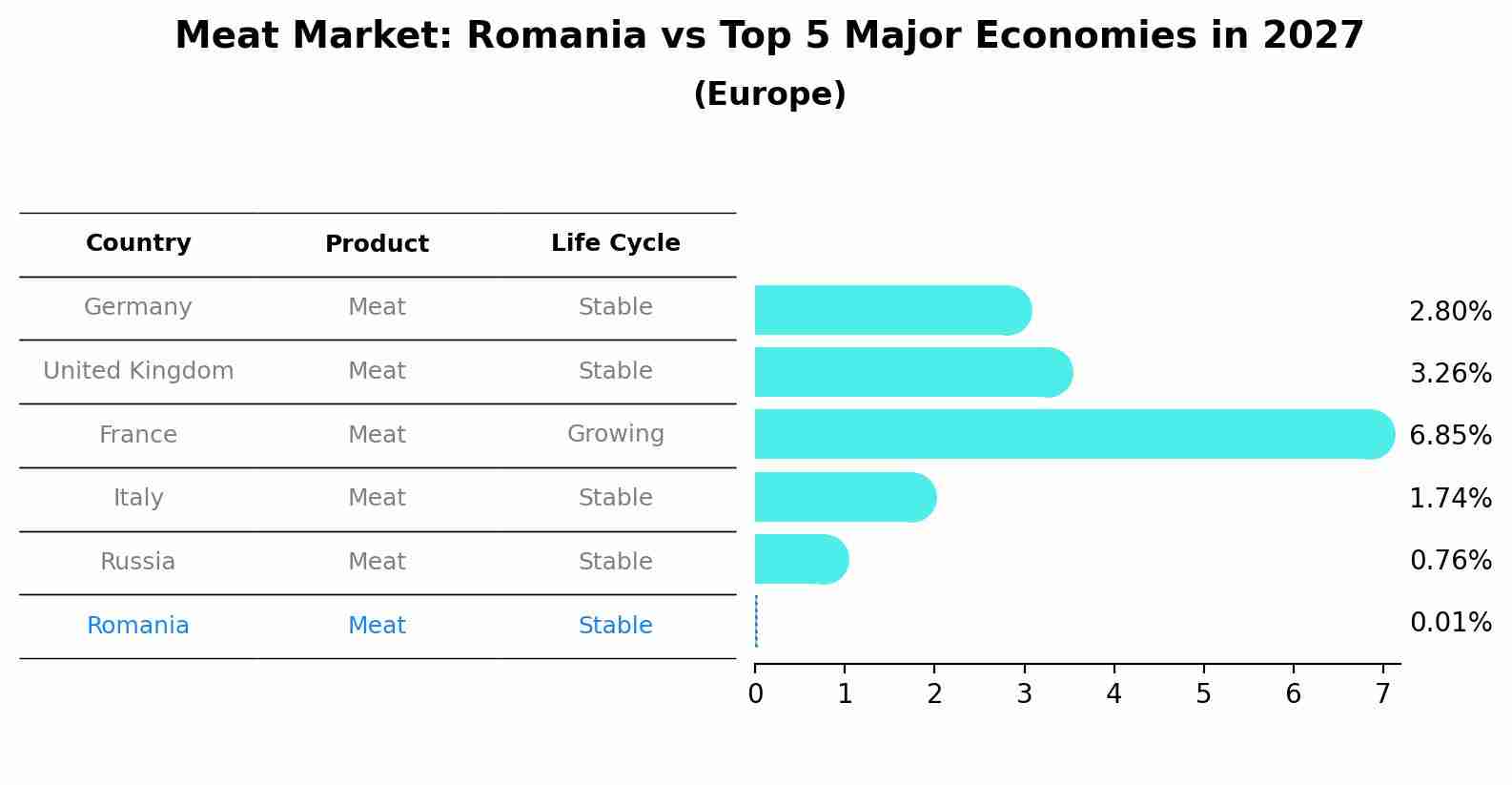
Romania Meat Market Growth Rate
According to 6Wresearch internal database and industry insights, the Romania Meat Market is projected to grow at a compound annual growth rate (CAGR) of 5.9% during the forecast period (2026-2032).
Five-Year Growth Trajectory of the Romania Meat Market with Core Drivers
Below mentioned is the evaluation of year-wise growth rate along with key growth drivers:
| Year | Est. Annual Growth (%) | Growth Drivers |
| 2021 | 2.9% | Rising domestic meat consumption and recovery in retail food sales |
| 2022 | 3.5% | Expansion of supermarket chains and improved cold storage infrastructure |
| 2023 | 4.2% | Growing demand for processed and packaged meat products |
| 2024 | 4.8% | Increasing investments in livestock farming and meat processing facilities |
| 2025 | 5.3% | Higher exports of poultry and pork products across European markets |
Topics Covered in the Romania Meat Market Report
The Romania Meat Market report thoroughly covers the market by end users and distribution channel. The market report provides an unbiased and detailed analysis of ongoing market trends, opportunities/high growth areas, and market drivers, which help stakeholders devise and align their market strategies according to the current and future market dynamics.
Romania Meat Market Highlights
| Report Name | Romania Meat Market |
| Forecast period | 2026-2032 |
| CAGR | 5.9% |
| Growing Sector | Household/ Retail |
Romania Meat Market Synopsis
Romania Meat Market is expected to witness considerable growth due to increased demand from consumers for high-protein foods, increasing distribution channels, and increased investment in local livestock farming. Some of the factors contributing to the growth of this market include changes in dietary habits, increasing urbanization, and increased consumption of processed meat products. Other developments such as advancements in technology regarding meat processing and cold storage have been improving the shelf life of meat. Initiatives from the Romanian government in agriculture and increased exportation of poultry and pork products are also responsible for the growth of the industry.
Evaluation of Growth Drivers in the Romania Meat Market
Below mentioned are some prominent drivers and their influence on the market dynamics:
| Drivers | Primary Segments Affected | Why it Matters (Evidence) |
| Rising Demand for Protein-Based Food | Household/Retail; Hypermarkets/Supermarkets | Consumers are increasing meat consumption due to changing dietary preferences and nutrition awareness. |
| Expansion of Modern Retail Chains | Household/Retail; Convenience Stores | Supermarket and retail chain growth improves product accessibility across urban regions. |
| Increasing Meat Processing Investments | Food Processing Industry; B2B Direct | Advanced processing facilities improve production efficiency and packaged meat availability. |
| Growth in Poultry and Pork Exports | Food Service Providers; Specialty Stores | Export activities encourage domestic production expansion and supply chain development. |
| Government Support for Livestock Farming | Food Processing Industry; Butcher Shop/Wets | Agricultural subsidies and livestock development programs strengthen meat production capacity. |
Romania Meat Market is expected to grow at the CAGR of 5.9% during the forecast period of 2026-2032. The growth is mainly influenced by the escalating demand from consumers for processed meat products, the increase in disposable incomes, and the development of the retail infrastructure in Romania. The rising preference of urban consumers for convenient foods and precooked meat products is adding to the momentum in market demand. Moreover, the upgrading in livestock farming, meat processing facilities, and refrigerated logistics is enhancing the quality and efficiency of operations. The government’s assistance in the modernization of agriculture and export-oriented meat production is playing a critical role in market development.
Evaluation of Restraints in the Romania Meat Market
Below mentioned are some major restraints and their influence on the market dynamics:
| Restraints | Primary Segments Affected | What This Means (Evidence) |
| Rising Feed and Production Costs | Food Processing Industry; B2B Direct | Higher livestock feed prices increase operational expenses for producers. |
| Strict Food Safety Regulations | Food Service Providers; Specialty Stores | Compliance requirements raise processing and packaging costs for meat suppliers. |
| Volatility in Livestock Supply | Household/Retail; Butcher Shop/Wets | Fluctuations in animal availability affect stable meat production volumes. |
| Growing Preference for Plant-Based Alternatives | Household/Retail; Online Retailing | Increasing health-conscious consumers may reduce traditional meat consumption. |
| Cold Chain Infrastructure Gaps in Rural Areas | Convenience Stores; Others | Limited refrigerated logistics impact fresh meat distribution efficiency. |
Romania Meat Industry Challenges
Despite significant market expansion, the Romania Meat Industry continues to encounter several operational and supply chain challenges. The other problem is the rising cost of livestock feed and energy that directly impacts the cost of producing meat products and their price. Also, stringent adherence to European standards of food safety and quality has economic implications for small meat manufacturers and suppliers. Other difficulties associated with the meat industry include the problem of the irregular supply of livestock and insufficient capacity for storing meat in refrigerators in the countryside. Furthermore, changes in consumer tastes in favor of healthy and alternative sources of protein are putting pressure on the meat manufacturing industry.
Romania Meat Market Trends
Key trends shaping the Romania Meat Market Growth include:
- Increasing Preference for Packaged Meat Products: Hygienically packaged and branded meat products are gaining popularity due to consumer demand.
- Increased Online Selling of Meat Products: Internet grocery shopping sites have helped in offering services like delivery of fresh meat products at home.
- Popularity of Quality Poultry Products Increasing: Consumers are displaying an increasing liking towards quality poultry meat due to economic advantages.
- Utilization of Modern Cold Chain Logistics: The use of cold chains logistics in meat industries is resulting in improved freshness and increased shelf life of products.
Investment Opportunities in the Romania Meat Market
Some major investment opportunities in the Romania Meat Market include:
- Expansion of Meat Processing Plant – The establishment of automated meat processing plant will lead to improvement in production efficiency.
- Development of Cold Warehousing Facility – The expansion of cold warehousing facility will boost meat production.
- Modernization of Poultry Farming – Upgrading poultry farming using sophisticated feeding and monitoring systems will help boost meat production.
- Digital Meat Delivery Services – Digital services can be developed for selling meat products online to customers.
Top 5 Leading Players in the Romania Meat Market
Some leading players operating in the Romania Meat Market include:
1. Smithfield România
| Company Name | Smithfield România |
|---|---|
| Established Year | 2004 |
| Headquarters | Timiș County, Romania |
| Website | Click Here |
Smithfield România is one of the leading pork producers in Romania, operating integrated livestock farming and meat processing facilities. The company focuses on high-quality pork production, modern farming technologies, and efficient supply chain operations to meet domestic and export market demand.
2. Cris-Tim Group
| Company Name | Cris-Tim Group |
|---|---|
| Established Year | 1992 |
| Headquarters | Bucharest, Romania |
| Website | Click Here |
Cris-Tim Group is a prominent Romanian meat processing company known for its diversified portfolio of processed meat and ready-to-eat food products. The company emphasizes food safety standards, product innovation, and nationwide retail distribution across supermarkets and specialty stores.
3. Transavia S.A.
| Company Name | Transavia S.A. |
|---|---|
| Established Year | 1991 |
| Headquarters | Alba County, Romania |
| Website | Click Here |
Transavia S.A. is a major poultry producer in Romania, supplying fresh and processed chicken products to retail and food service sectors. The company focuses on sustainable farming, advanced poultry processing technologies, and maintaining high-quality production standards throughout operations.
4. Caroli Foods Group
| Company Name | Caroli Foods Group |
|---|---|
| Established Year | 1994 |
| Headquarters | Bucharest, Romania |
| Website | Click Here |
Caroli Foods Group manufactures a wide range of meat and sausage products for Romanian consumers and food service providers. The company invests in modern production facilities, product diversification, and cold chain logistics to strengthen its market position and operational capabilities.
5. Elit Cugir
| Company Name | Elit Cugir |
|---|---|
| Established Year | 1991 |
| Headquarters | Alba County, Romania |
| Website | Click Here |
Elit Cugir specializes in processed meat products, including sausages, smoked meats, and ready-to-cook items distributed across Romania. The company focuses on maintaining product quality, expanding retail presence, and improving manufacturing efficiency through advanced food processing technologies.
Government Regulations Introduced in the Romania Meat Market
According to Romania’s Government Data, Several efforts have been made to bolster the meat production and food safety infrastructure in Romania. For example, the Ministry of Agriculture and Rural Development has launched programs for supporting livestock and providing subsidies in order to increase the efficiency of poultry and pork production. At the same time, stringent food safety rules, in compliance with those established in Europe, have been enforced in the meat industry in Romania. Moreover, modernizing efforts in slaughterhouses and meat refrigerators have been facilitated by Romanian agricultural funding programs. Lastly, Romanian exporters have been encouraged to increase transparency and improve their products' quality due to export and traceability policies that favor meat producers in Romania in the European meat export market.
Future Insights of the Romania Meat Market
Romania Meat Market Share is expected to experience stable growth over the coming years due to increasing demand for protein-rich food products, rising urbanization, and ongoing investments in livestock farming and meat processing technologies. The development of cold storage facilities and the growth of organized retail chains will help improve product availability and efficient distribution throughout the nation. Furthermore, consumers' growing demand for high-quality, hygienic, and processed meat products will prompt manufacturers to use advanced technologies in processing and packaging. Government initiatives for agriculture modernization and meat production for export purposes will boost the competitive edge of the industry. Finally, the growth of e-retailing and sustainable livestock farming will favor the market's future development.
Market Segmentation Analysis
The report offers a comprehensive study of the subsequent market segments and their leading categories.
Household/ Retail to Dominate the Market – By End Users
According to Rahul, Senior Research Analyst, 6Wresearch, the Household/ Retail category dominates the Romania Meat Market due to increasing consumer demand for fresh, processed, and packaged meat products across urban and semi-urban households. The increase in disposable income, shift in eating patterns, and development of organized retail channels have become major drivers behind the segment’s growth. Hygienic and ready-to-cook meat products offered through supermarkets and convenience stores have gained consumer preference. Moreover, the growth in e-commerce food retailing and home delivery services has enhanced convenience for domestic consumers.
Hypermarkets/ Supermarkets to Dominate the Market – By Distribution Channel
Hypermarkets/Supermarkets is the market segment that commands the biggest market share in the market due to the wide variety of goods available in these stores, their good cold chain facilities, and an overall comfortable shopping experience provided by these stores to consumers. Chain stores are rapidly incorporating various types of meat products, including packaged, frozen, and fresh meat products. The choice of supermarket meat products is influenced by the availability of product quality, attractive offers on promotions, and product diversity.
Key Attractiveness of the Report
- 10 Years of Market Numbers.
- Historical Data Starting from 2022 to 2025.
- Base Year: 2025.
- Forecast Data until 2032.
- Key Performance Indicators Impacting the Market.
- Major Upcoming Developments and Projects.
Key Highlights of the Report:
- Romania Meat Market Outlook
- Market Size of Romania Meat Market, 2025
- Forecast of Romania Meat Market, 2032
- Historical Data and Forecast of Romania Meat Revenues & Volume for the Period 2022 - 2032F
- Romania Meat Market Trend Evolution
- Romania Meat Market Drivers and Challenges
- Romania Meat Price Trends
- Romania Meat Porter's Five Forces
- Romania Meat Industry Life Cycle
- Historical Data and Forecast of Romania Meat Market Revenues & Volume By Product for the Period 2022 - 2032F
- Historical Data and Forecast of Romania Meat Market Revenues & Volume By Chicken for the Period 2022 - 2032F
- Historical Data and Forecast of Romania Meat Market Revenues & Volume By Beef for the Period 2022 - 2032F
- Historical Data and Forecast of Romania Meat Market Revenues & Volume By Pork for the Period 2022 - 2032F
- Historical Data and Forecast of Romania Meat Market Revenues & Volume By Mutton for the Period 2022 - 2032F
- Historical Data and Forecast of Romania Meat Market Revenues & Volume By Others for the Period 2022 - 2032F
- Historical Data and Forecast of Romania Meat Market Revenues & Volume By Type for the Period 2022 - 2032F
- Historical Data and Forecast of Romania Meat Market Revenues & Volume By Raw for the Period 2022 - 2032F
- Historical Data and Forecast of Romania Meat Market Revenues & Volume By Processed for the Period 2022 - 2032F
- Historical Data and Forecast of Romania Meat Market Revenues & Volume By Distribution Channel for the Period 2022 - 2032F
- Historical Data and Forecast of Romania Meat Market Revenues & Volume By Departmental Stores for the Period 2022 - 2032F
- Historical Data and Forecast of Romania Meat Market Revenues & Volume By Specialty Stores for the Period 2022 - 2032F
- Historical Data and Forecast of Romania Meat Market Revenues & Volume By Hypermarket/ Supermarket for the Period 2022 - 2032F
- Historical Data and Forecast of Romania Meat Market Revenues & Volume By Online Sales Channel for the Period 2022 - 2032F
- Historical Data and Forecast of Romania Meat Market Revenues & Volume By Others for the Period 2022 - 2032F
- Romania Meat Import Export Trade Statistics
- Market Opportunity Assessment By Product
- Market Opportunity Assessment By Type
- Market Opportunity Assessment By Distribution Channel
- Romania Meat Top Companies Market Share
- Romania Meat Competitive Benchmarking By Technical and Operational Parameters
- Romania Meat Company Profiles
- Romania Meat Key Strategic Recommendations
Market Covered
The report offers a comprehensive study of the subsequent market segments:
By Application
- Home Purchase
- Refinance
- Home Improvement
- Others
By Providers
- Banks
- Housing Finance Companies
- Real Estate Agents
By Interest Rate
- Fixed Rate Mortgage Loan
- Adjustable Rate Mortgage Loan






































