Japan Meat, Poultry, Seafood Packaging Market Size & Growth Rate
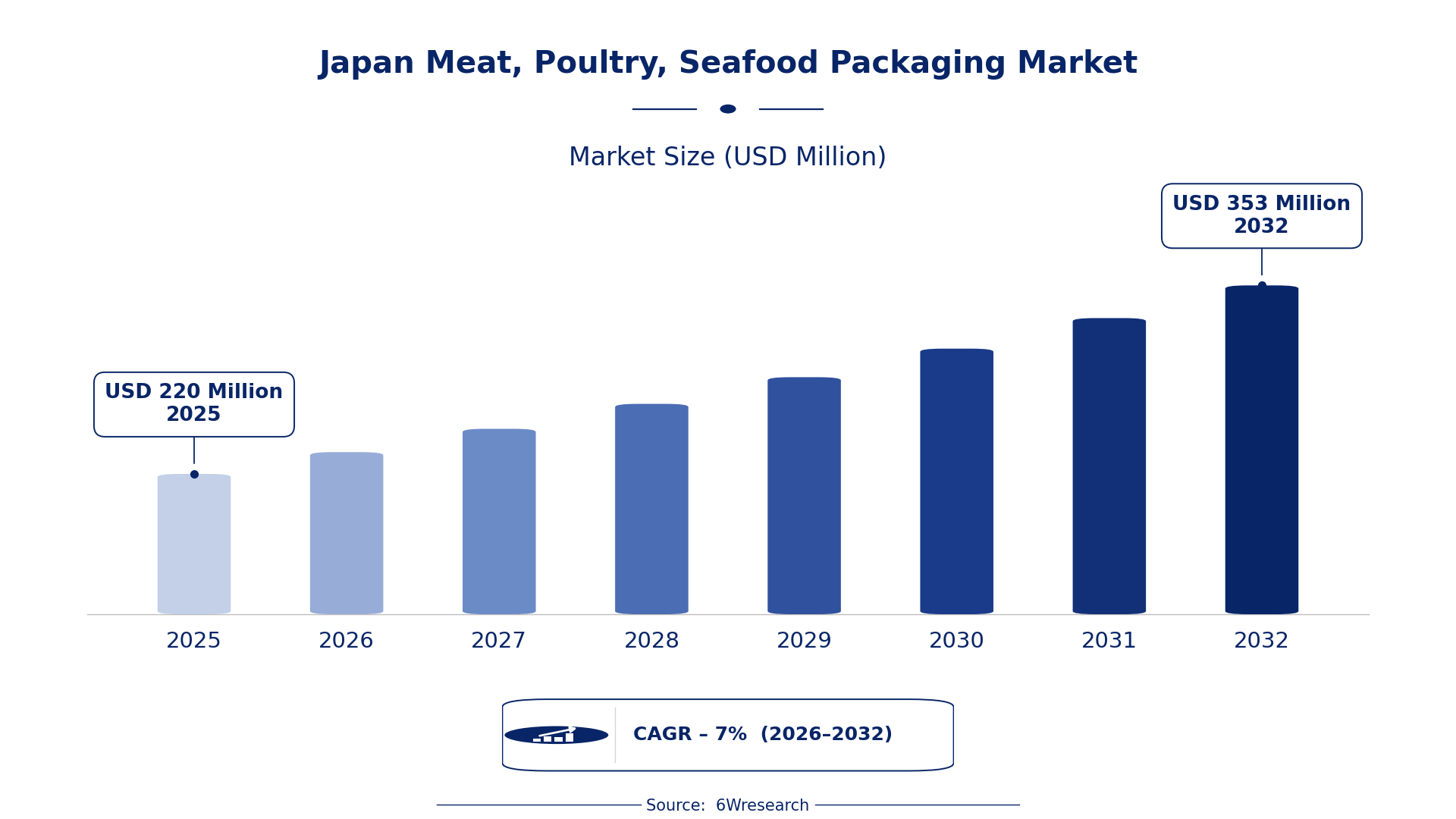
According to 6Wresearch internal database and industry insights, the Japan Meat, Poultry, Seafood Packaging Market was valued at USD 220 Million in 2025 and is projected to reach USD 353 Million by 2032, growing at a CAGR of approximately 7% during 2026–2032.
Japan Meat, Poultry, Seafood Packaging Market Highlights
| Report Metric | Details |
| Report Name | Japan Meat, Poultry, Seafood Packaging Market (2026-2032) |
| Market Size 2025 | USD 220 Million |
| Market Size 2032 | USD 353 Million |
| Absolute Growth 2025–2032 | USD 133 Million |
| CAGR 2026–2032 | 7% |
| Peak Annual Growth | 7.5% in 2032 |
| Forecast Period | 2026–2032 |
| Historical Data | 2022–2025 |
| Base Year | 2025 |
| Leading Packaging Type, 2025 | Flexible Packaging (57% share) |
| Leading Product Type, 2025 | Pre-made Bags (42% share) |
| Leading Material Type, 2025 | Polypropylene (PP) (48% share) |
| Fastest-Growing Product Type | Containers (9.8% CAGR) |
| Fastest-Growing Material Type | Polyester (PET) (10.0% CAGR) |
| Growing Sector | Polyester (PET) |
| Key End Users | Polypropylene (PP), Polyester (PET), Aluminium, Polystrene (PS) |
Japan Meat, Poultry, Seafood Packaging Market Year-wise Growth Rate and Key Drivers (2022–2032)
This graph illustrates the annual growth rates of the market from 2022 to 2032, highlighting a steady upward trajectory and projected market expansion over the forecast period.
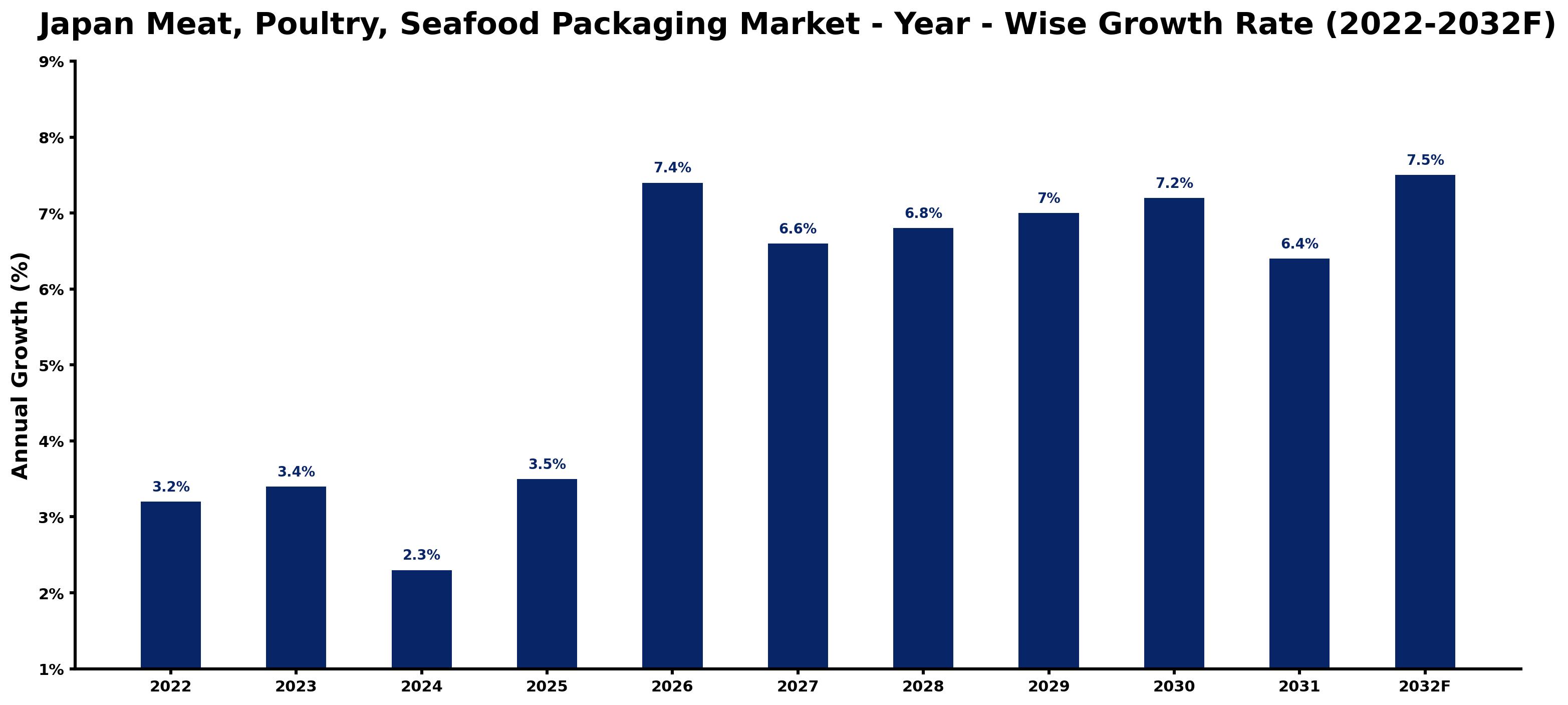
The following figures match every annual growth estimate with the main market development of that year, giving the reasoning behind each rise or slowdown.
| Year | Estimated Annual Growth (%) | Market Rationale |
| 2022 | 3.2 | The market showed steady growth, reflecting consistent consumer demand for meat products. |
| 2023 | 3.4 | Growth accelerated as consumers increased their spending on meat products amid rising disposable incomes. |
| 2024 | 2.3 | Growth slowed due to market saturation and increased competition among packaging suppliers. |
| 2025 | 3.5 | The market rebounded with faster growth driven by rising meat consumption and packaging innovations. |
| 2026 | 7.4 | Surging demand for flexible packaging is expected as food manufacturers seek efficient solutions. |
| 2027 | 6.6 | Growth is projected to slow slightly as the market adjusts to previous high demand levels and competition intensifies. |
| 2028 | 6.8 | Growth is expected to pick up again as sustainable packaging solutions attract more buyers in the food sector. |
| 2029 | 7.0 | The market will continue to expand as consumer preferences shift towards convenience and freshness. |
| 2030 | 7.2 | Growth is projected to remain strong as technological advancements in packaging improve product shelf life. |
| 2031 | 6.4 | Growth is expected to slow as the market matures and competition among suppliers becomes more pronounced. |
| 2032 | 7.5 | The market will peak with heightened demand for advanced packaging solutions that improve food safety. |
Note: Market size estimations and growth projections presented in this report are based on 6Wresearch's proprietary forecasting methodology, utilizing the latest available industry data, government publications, and primary research inputs.
Japan Meat, Poultry, Seafood Packaging Market Synopsis
Packaging for meat, poultry, and seafood involves materials designed to preserve freshness and prevent spoilage. In Japan, flexible packaging is widely adopted in the food service sector, accounting for 55% of the total packaging market. The food processing industry, valued at ¥20 trillion, drives demand, supported by a growing population and increasing consumer spending on meat products, averaging ¥30,000 annually per person. The Japan Meat, Poultry, Seafood Packaging Market is expanding as consumer preferences shift towards convenience and sustainability, prompting investments in new packaging solutions.
Market Dynamics Impact Analysis (2026–2032)
| Factor | Type | Impact | Primary Segment Affected |
| Rising meat consumption drives demand for effective packaging solutions. | Driver | High | Flexible Packaging |
| Sustainable packaging practices are becoming essential for compliance and consumer preference. | Driver | High | Rigid Packaging |
| The demand for innovative packaging solutions presents opportunities for new entrants. | Opportunity | High | Containers |
| Growing interest in eco-friendly materials opens new markets for packaging suppliers. | Opportunity | Medium | Pre-made Bags |
| Competition among packaging suppliers can lead to price wars, affecting margins. | Restraint | High | Flexible Packaging |
| Regulatory compliance can increase operational costs for packaging producers. | Restraint | Medium | Rigid Packaging |
| Supply chain disruptions can delay product availability for buyers. | Challenge | High | Containers |
| Technological advancements require continuous investment from suppliers to remain competitive. | Challenge | Medium | Pre-made Bags |
Evaluation of Drivers in Japan Meat, Poultry, Seafood Packaging Market (2026–2032)
Demand rests on the following drivers, each shown with the segment it touches most.
| Drivers | Primary Segment Affected | Why It Matters (Evidence) |
| Increased meat consumption leads to higher demand for packaging solutions. | Flexible Packaging | Japan's meat consumption reached 8.4 million tons in 2022, driving the need for effective packaging solutions. |
| Consumer preference for convenience boosts demand for ready-to-eat meat products. | Pre-made Bags | The average Japanese consumer spends approximately ¥30,000 annually on meat products, increasing demand for convenient packaging options. |
| Sustainability trends encourage the adoption of eco-friendly packaging materials. | Rigid Packaging | The Ministry of Agriculture, Forestry and Fisheries promotes sustainable practices, influencing packaging choices and driving demand. |
| Technological advancements in packaging materials improve product shelf life. | Containers | Innovations in packaging technology are critical as the food processing industry is valued at ¥20 trillion, necessitating effective solutions. |
| Urbanisation is driving demand for packaging that meets the needs of city consumers. | Flexible Packaging | The Tokyo metropolitan area accounts for 30% of Japan's meat packaging demand, highlighting the need for tailored solutions. |
Japan's meat consumption reached 8.4 million tons in 2022, leading to higher demand for packaging solutions that ensure freshness. The average consumer spends approximately ¥30,000 annually on meat products, driving the need for pre-made bags that offer convenience. As the food processing industry is valued at ¥20 trillion, innovations in packaging technology are essential for maintaining product quality and meeting consumer expectations. Compliance with safety standards compels producers to adopt effective packaging solutions that align with market trends. Urbanisation in regions like Tokyo is increasing the demand for packaging that caters to the needs of city consumers.
Evaluation of Restraints in Japan Meat, Poultry, Seafood Packaging Market
These are the pressures that could keep growth below its potential.
| Market Restraint | Primary Segment Affected | Why It Matters (Evidence) |
| Intense competition among packaging suppliers can lead to price wars, affecting profitability. | Flexible Packaging | With numerous suppliers in the market, maintaining competitive pricing becomes challenging, resulting in price erosion. |
| Regulatory compliance increases operational costs for packaging producers, impacting pricing strategies. | Rigid Packaging | Adhering to the Food Sanitation Act requires investments in quality assurance and testing, raising operational costs. |
| Supply chain disruptions can delay product availability, affecting customer satisfaction. | Containers | Global supply chain issues have resulted in delays in sourcing materials for packaging, impacting delivery timelines. |
| Technological advancements require continuous investment to stay competitive in the market. | Pre-made Bags | Suppliers must invest in new technologies to meet evolving consumer preferences, which can strain budgets. |
| Market saturation can limit growth opportunities for new entrants in the packaging sector. | Flexible Packaging | The established presence of major players creates barriers for new competitors, making market entry difficult. |
Japan Meat, Poultry, Seafood Packaging Market Challenges
Producers in Japan face fierce competition, as the crowded meat packaging market drives down prices and squeezes profit margins. Supply chain issues arise from the declining workforce, with Japan's population aged 65 or older reaching 29.3% in September 2024, leading to production delays and increased costs for manufacturers. A lack of skilled workers hampers the food processing industry, making it difficult for producers to maintain efficiency and meet demand. Technology adoption lags behind global standards, forcing buyers to incur higher operational costs and limiting their ability to innovate.
Trends in the Japan Meat, Poultry, Seafood Packaging Market
Below are the shifts with the largest effect on the Japan Meat, Poultry, Seafood Packaging Market.
- Shift towards Sustainable Packaging Solutions: Since 2021, there has been a notable shift towards sustainable packaging materials in Japan. The Plastic Resource Circulation Act encourages the use of biodegradable plastics, with 30% of packaging now adopting eco-friendly options, appealing to environmentally conscious consumers.
- Increased Adoption of Flexible Packaging: In 2023, flexible packaging became the preferred choice for meat products, accounting for 55% of the market. This trend reflects the growing demand for convenience and longer shelf life, particularly in urban areas like Tokyo.
- Emergence of Advanced Packaging Technologies: Beginning in 2026, advanced packaging technologies are being integrated into meat packaging processes. Innovations such as vacuum sealing and modified atmosphere packaging are improving product freshness, with a projected 20% increase in adoption rates.
- Growth of E-commerce Influencing Packaging Design: Starting in 2022, the rise of e-commerce has influenced packaging design for meat products. The need for protective and visually appealing packaging has led to a 15% increase in demand for specialized containers.
Investment Opportunities in the Japan Meat, Poultry, Seafood Packaging Market
Several openings in the Japan Meat, Poultry, Seafood Packaging Market merit attention from investors.
- Gap in Eco-friendly Packaging: With 30% of packaging now adopting sustainable materials, there is an opportunity for suppliers to provide biodegradable options. Food manufacturers in urban areas are increasingly seeking these solutions, allowing for partnerships with local producers.
- Demand for Convenience Packaging: As consumer spending on meat products continues to rise, the demand for pre-made bags is expected to grow. Retailers in metropolitan areas are looking to invest in packaging that offers convenience and freshness, presenting a clear entry point for suppliers.
- Technological Innovations in Packaging: The projected annual growth rate of 3% in the meat packaging market highlights the need for investment in advanced technologies. Suppliers can target food processing facilities looking to enhance product quality through innovative packaging solutions.
- Expansion of the Food Processing Sector: With the food processing industry valued at ¥20 trillion, there is a growing need for effective packaging solutions. Suppliers can explore partnerships with processing plants to meet the increasing demand for high-quality packaging.
Government Initiatives in the Japan Meat, Poultry, Seafood Packaging Market
The Food Sanitation Act amendment (2018) introduced a positive list system for synthetic resins in food packaging. This measure requires producers to ensure compliance with safety standards, impacting the materials used in meat packaging. The amendment aims to enhance food safety and protect consumer health, influencing the choice of materials in the industry.
The Ministry of Health, Labour and Welfare oversees the implementation of the Food Recycling Law (2000), which mandates food businesses to reduce waste and recycle materials. This law encourages packaging producers to adopt sustainable practices, influencing their operational strategies. The ministry also funds initiatives aimed at improving recycling rates and reducing environmental impact.
Future Insight of the Japan Meat, Poultry, Seafood Packaging Market
A policy-driven shift towards sustainable practices will reshape the market, encouraging suppliers to embrace eco-friendly materials and technologies. Stricter regulations from the Ministry of Agriculture, Forestry and Fisheries will enforce compliance with JIS Z 1700 standards, enhancing food safety. As Japan's seafood consumption reached 2.2 million tons in 2023, buyers will benefit from improved packaging solutions that extend shelf life and reduce waste. Investments in advanced technologies will create a more efficient supply chain, responding to the expected annual growth rate of 3% in the meat packaging market.
Market Segmentation Analysis
Japan Meat, Poultry, Seafood Packaging Market report covers a detailed analysis of the following market segments:
By Packaging Type – Flexible Packaging Leads and Records the Fastest Growth
According to Ravi Bhandari, Research Head at 6Wresearch, Flexible Packaging held 57% of the Japan Meat, Poultry, Seafood Packaging Market by packaging type in 2025. Flexible packaging leads the market due to its versatility in preserving freshness and preventing spoilage, making it ideal for various meat products. The Tokyo metropolitan area, accounting for 30% of Japan's meat packaging demand, predominantly employs flexible packaging solutions. Flexible Packaging is also forecast to expand faster than any other category, at a CAGR of 8.3% over 2026–2032. The swift growth of flexible packaging stems from its increasing adoption in the food service sector, driven by consumer preferences for convenience and longer shelf life. As ready-to-eat meals gain popularity, the demand for flexible packaging is expected to rise further. This indicates that suppliers should focus on enhancing flexible packaging offerings to meet the growing requirements of both retail and food service sectors.
By Product Type – Pre-made Bags Lead, Containers Expected to Grow Fastest
With 42% of product type revenue in 2025, Pre-made Bags was the largest category. Pre-made bags dominate the market due to their widespread use in vacuum-sealing meat and poultry products, which ensures freshness and extends shelf life. This method is particularly popular among consumers who prioritise convenience in their meat purchases. Over 2026–2032, Containers are expected to post the fastest growth, at a CAGR of 9.8%. The containers segment is experiencing rapid growth as they are essential for packaging various meat products in retail settings. The shift towards more sustainable packaging options is also driving the demand for containers, which are often perceived as more environmentally friendly. Buyers may benefit from exploring diverse packaging options, especially containers, to align with sustainability trends and consumer preferences.
By Material Type – Polypropylene (PP) Leads, Polyester (PET) Expected to Grow Fastest
Polypropylene (PP) accounted for 48% of the market by material type in 2025. Polypropylene (PP) leads the material type segment due to its excellent barrier properties and cost-effectiveness, making it a preferred choice for meat packaging. Its widespread use in the food processing industry, valued at ¥20 trillion, underscores its importance in maintaining food safety. Polyester (PET) is projected to grow fastest, at a CAGR of 10.0% during 2026–2032. Polyester (PET) is rapidly gaining traction, primarily due to its recyclability and strength, appealing to environmentally conscious consumers. As regulations around sustainable packaging tighten, PET's growth is expected to accelerate as manufacturers seek compliant solutions. Suppliers should consider investing in PET materials to cater to the increasing demand for sustainable packaging solutions.
Key Attractiveness of the Report
- 10 Years of Market Numbers
- Historical Data Starting from 2022 to 2025
- Base Year 2025
- Forecast Data until 2032
- Key Performance Indicators Impacting the Market
- Major Upcoming Developments and Projects
Key Highlights of the Report:
- Japan Meat, Poultry, Seafood Packaging Market Outlook
- Market Size of Japan Meat, Poultry, Seafood Packaging Market, 2025
- Forecast of Japan Meat, Poultry, Seafood Packaging Market, 2032
- Historical Data and Forecast of Japan Meat, Poultry, Seafood Packaging Revenues & Volume for the Period 2022-2032
- Japan Meat, Poultry, Seafood Packaging Market Trend Evolution
- Japan Meat, Poultry, Seafood Packaging Market Drivers and Challenges
- Japan Meat, Poultry, Seafood Packaging Price Trends
- Japan Meat, Poultry, Seafood Packaging Porter's Five Forces
- Japan Meat, Poultry, Seafood Packaging Industry Life Cycle
- Historical Data and Forecast of Japan Meat, Poultry, Seafood Packaging Market Revenues & Volume By Packaging Type for the Period 2022-2032
- Historical Data and Forecast of Japan Meat, Poultry, Seafood Packaging Market Revenues & Volume By Rigid Packaging for the Period 2022-2032
- Historical Data and Forecast of Japan Meat, Poultry, Seafood Packaging Market Revenues & Volume By Flexible Packaging for the Period 2022-2032
- Historical Data and Forecast of Japan Meat, Poultry, Seafood Packaging Market Revenues & Volume By Product Type for the Period 2022-2032
- Historical Data and Forecast of Japan Meat, Poultry, Seafood Packaging Market Revenues & Volume By Containers for the Period 2022-2032
- Historical Data and Forecast of Japan Meat, Poultry, Seafood Packaging Market Revenues & Volume By Pre-made Bags for the Period 2022-2032
- Historical Data and Forecast of Japan Meat, Poultry, Seafood Packaging Market Revenues & Volume By Food Cans for the Period 2022-2032
- Historical Data and Forecast of Japan Meat, Poultry, Seafood Packaging Market Revenues & Volume By Coated Films for the Period 2022-2032
- Historical Data and Forecast of Japan Meat, Poultry, Seafood Packaging Market Revenues & Volume By Others for the Period 2022-2032
- Historical Data and Forecast of Japan Meat, Poultry, Seafood Packaging Market Revenues & Volume By Material Type for the Period 2022-2032
- Historical Data and Forecast of Japan Meat, Poultry, Seafood Packaging Market Revenues & Volume By Polypropylene (PP) for the Period 2022-2032
- Historical Data and Forecast of Japan Meat, Poultry, Seafood Packaging Market Revenues & Volume By Polystrene (PS) for the Period 2022-2032
- Historical Data and Forecast of Japan Meat, Poultry, Seafood Packaging Market Revenues & Volume By Polyester (PET) for the Period 2022-2032
- Historical Data and Forecast of Japan Meat, Poultry, Seafood Packaging Market Revenues & Volume By Thermoform for the Period 2022-2032
- Historical Data and Forecast of Japan Meat, Poultry, Seafood Packaging Market Revenues & Volume By Aluminium for the Period 2022-2032
- Historical Data and Forecast of Japan Meat, Poultry, Seafood Packaging Market Revenues & Volume By Others for the Period 2022-2032
- Japan Meat, Poultry, Seafood Packaging Import Export Trade Statistics
- Market Opportunity Assessment By Packaging Type
- Market Opportunity Assessment By Product Type
- Market Opportunity Assessment By Material Type
- Japan Meat, Poultry, Seafood Packaging Top Companies Market Share
- Japan Meat, Poultry, Seafood Packaging Competitive Benchmarking By Technical and Operational Parameters
- Japan Meat, Poultry, Seafood Packaging Company Profiles
- Japan Meat, Poultry, Seafood Packaging Key Strategic Recommendations
Market Covered
This report examines the market across the segments below.
By Packaging Type
- Rigid Packaging
- Flexible Packaging
By Product Type
- Containers
- Pre-made Bags
- Food Cans
- Coated Films
- Others
By Material Type
- Polypropylene (PP)
- Polystrene (PS)
- Polyester (PET)
- Thermoform
- Aluminium
- Others































