Romania Oxidized Bitumen Market: Import Trend Analysis
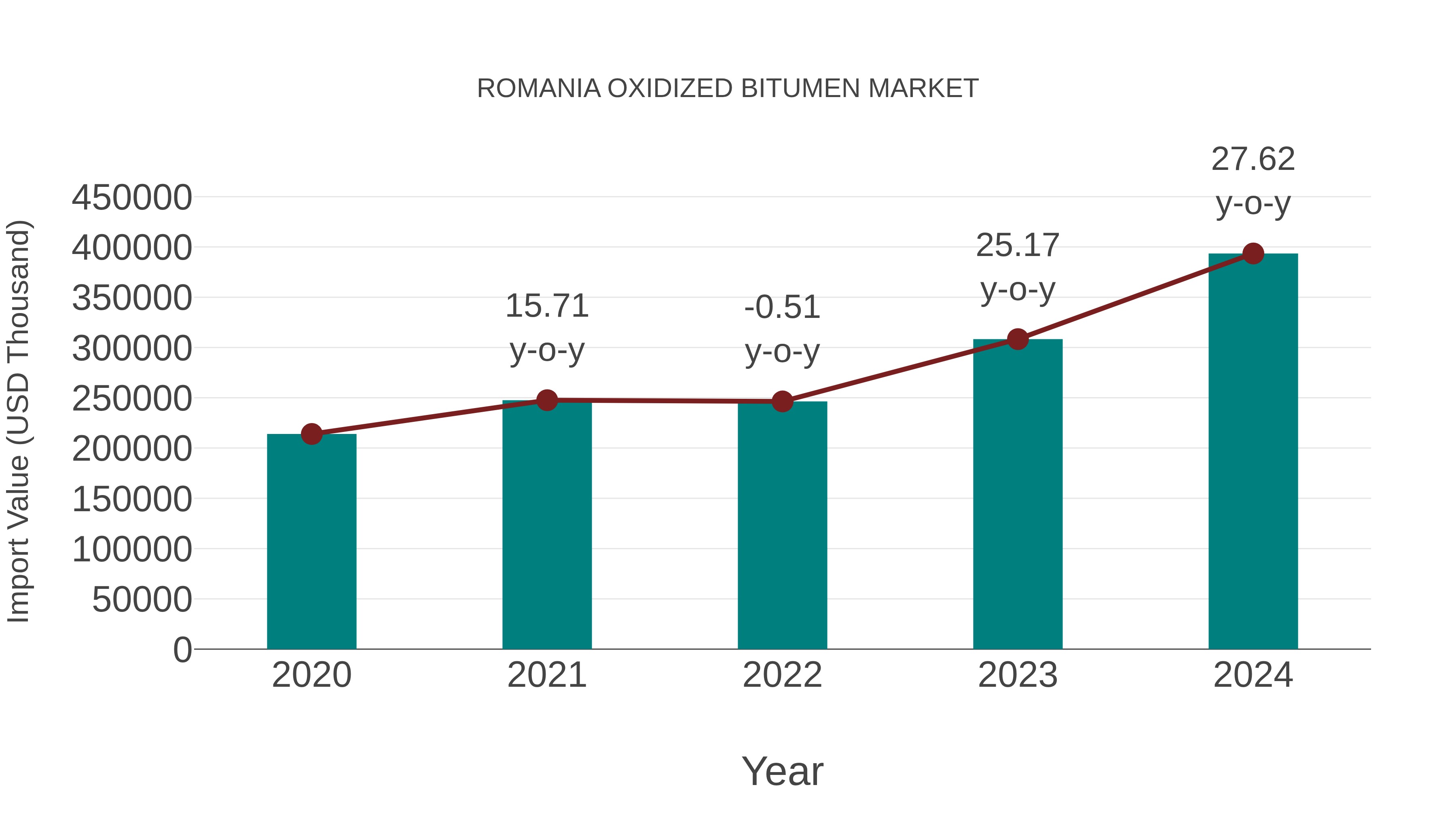
In the Romania oxidized bitumen market, imports showed a notable upward momentum from 2023 to 2024, with a growth rate of 27.62%. The compound annual growth rate (CAGR) for the period 2020-2024 stood at 16.45%. This surge in imports could be attributed to a shift in demand patterns or increased infrastructure projects, indicating a potential market recovery.
Topics Covered in Romania Oxidized Bitumen Market Report
Romania Oxidized Bitumen Market Report thoroughly covers the market by product and by application. Romania Oxidized Bitumen Market Outlook report provides an unbiased and detailed analysis of the ongoing Romania Oxidized Bitumen Market trends, opportunities/high growth areas, and market drivers. This would help stakeholders devise and align their market strategies according to the current and future market dynamics.
Romania Oxidized Bitumen Market Synopsis
Romania’s oxidized bitumen market recorded moderate growth between 2021 and 2024, fueled primarily by strong infrastructure investment and the rollout of EU-funded programs such as the Recovery and Resilience Plan (PNRR). Key national infrastructure upgrades—most notably the Sibiu–Pitești Motorway, A0 Bucharest Ring Motorway, and rural development through PNDL—played a central role in boosting demand, particularly in road paving, roofing, and waterproofing applications. While 2021 marked a relatively stable year, 2022 saw a sharp rise in international bitumen prices, including higher-grade products, leading to a drop in import volume and a resulting slowdown in revenue growth.
However, in 2023 and 2024, the market rebounded as price growth stabilized and import volumes increased again to meet the needs of Romania’s resurging construction sector, which benefited from both public and private investments. Simultaneously, Romania’s alignment with Trans-European Transport Network (TEN-T) goals and stricter construction regulations enhanced the focus on quality, sustainability, and performance. This supported the use of specialized oxidized bitumen for insulation, corrosion protection, and energy-efficient infrastructure. Despite this progress, the country remained heavily dependent on imports, particularly from Turkey and the Middle East, due to limited local refining and oxidation capacity.
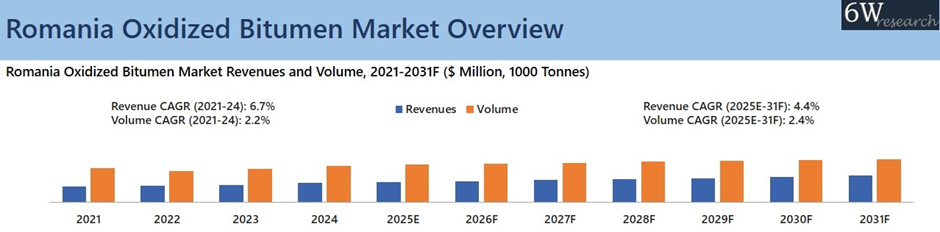
According to 6Wresearch, Romania oxidized bitumen market size is projected to grow at a CAGR of 4.4% and 2.8% in terms of revenues and volume respectively during 2025-2031, supported by long-term public and private infrastructure initiatives. One of the key drivers would be Romania's commitment to the EU Green Deal, which encourages low-emission, energy-efficient building materials. This would lead to an increase in demand for environmentally-friendly oxidized bitumen, particularly those with reduced sulfur and VOC emissions. The climate-neutral mandates tied to EU infrastructure funding would also foster the use of modified and recycled bitumen blends, opening the door for innovation and product diversification. Moreover, Romania’s focus on renewable energy infrastructure, including the construction of solar and wind farms, biomass plants, and energy-efficient industrial zones, would create new application areas for bitumen products in insulation, sealing, and cable protection.
The government's continued support for projects such as urban mobility hubs, smart cities, and waterproofing of rail and utility tunnels under national urban resilience plans would further drive demand. With improvements in domestic refining capabilities, especially through capacity expansion at facilities such as those owned by Petrom, the country is expected to gradually reduce its reliance on imported oxidized bitumen. This would help enhance supply stability, reduce logistics costs, and foster a more competitive domestic market.
Public-private partnerships (PPPs), increased participation of foreign construction firms, and regional integration of supply chains are also expected to play a major role in shaping the market. In addition, rising awareness about the life-cycle performance and cost-effectiveness of oxidized bitumen in applications such as damp-proofing, industrial corrosion protection, and membrane roofing would contribute to expanding its usage across industrial and commercial real estate projects. As new product grades emerge that meet both sustainability and performance standards, major producers and importers would need to innovate and differentiate to retain market share in a rapidly evolving environment.
Market Segmentation By Product
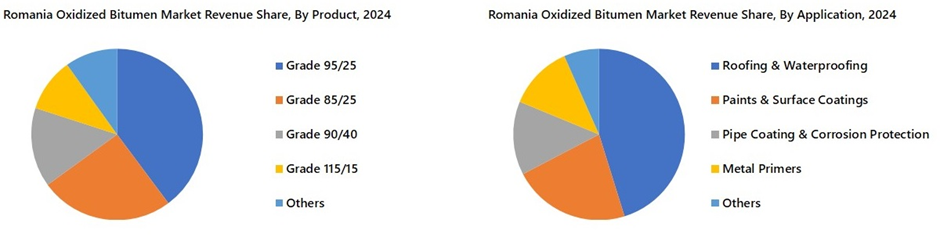
By product, grade 95/25 segment would dominate both revenue and volume size in 2031, driven by its key role in infrastructure projects and road networks. Ongoing government and EU-backed initiatives would sustain demand for durable, high-quality bitumen. The rising demand for eco-friendly construction would further solidify its position in high-performance applications. However, grade 115/15 would see the fastest growth in both revenue and volume terms from 2025-2031, driven by its increasing use in specialized applications such as waterproofing, roofing, and energy-efficient construction. Romania's focus on green building and sustainable infrastructure would boost demand for high-grade bitumen. Its durability and resistance to harsh conditions would make it ideal for emerging sectors such as energy and sustainable construction.
Market Segmentation By Application
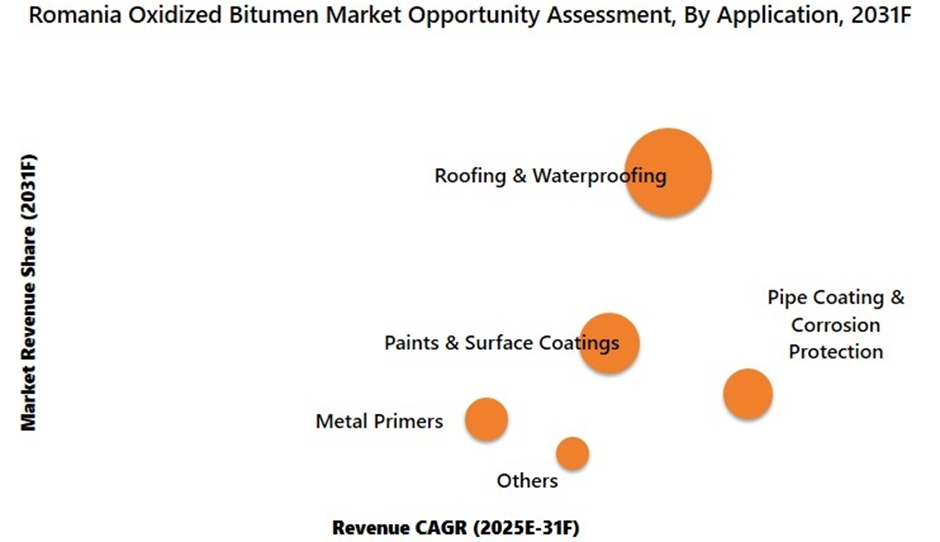
Roofing & waterproofing segment would dominate Romania’s oxidized bitumen market size in 2031 driven by retrofitting of aging buildings and stricter EU energy efficiency standards encouraging advanced waterproofing systems. Growth in green roofs and integrated solar panel roofing would also increase demand for high-performance bitumen-based layers.
However, pipe coating & corrosion protection would witness the fastest growth during 2025-2031 due to expanding oil & gas, utilities, and renewable energy networks. As Romania upgrades underground and cross-country pipelines, demand for corrosion-resistant materials such as oxidized bitumen would rise sharply, especially in harsh soil or coastal zones.
Key Attractiveness of the Report
- 10 Years Market Numbers.
- Historical Data Starting from 2021 to 2024
- Base Year: 2024
- Forecast Data until 2031
- Key Performance Indicators Impacting the Market.
- Major Upcoming Developments and Projects.
Key Highlights of the Report:
- Romania Oxidized Bitumen Market Overview
- Romania Oxidized Bitumen Market Outlook
- Romania Oxidized Bitumen Market Forecast
- Historical Data and Forecast of Romania Oxidized Bitumen Market Revenues for the Period 2022-2032F
- Historical Data and Forecast of Market Revenues and Volume, By Product, for the Period 2022-2032F
- Historical Data and Forecast of Market Revenues, By Application, for the Period 2022-2032F
- Romania Oxidized Bitumen Market Drivers and Restraints
- Industry Life Cycle
- Porter’s Five Force Analysis
- Romania Oxidized Bitumen Market Trends & Evolution
- Market Opportunity Assessment
- Romania Oxidized Bitumen Market Revenue Ranking, By Top 3 Companies
- Competitive Benchmarking
- Company Profiles
- Key Strategic Recommendations
Market Scope and Segmentation
Thereportprovides a detailed analysis of the following market segments:
By Product
- Grade 95/25
- Grade 85/25
- Grade 90/40
- Grade 115/15
- Other
By Application
- Roofing & Waterproofing
- Paints & Surface Coatings
- Pipe Coating & Corrosion Protection
- Metal Primers
- Others






































