Romania Railway Maintenance Machinery Market Size, Share & Growth Rate
The Romania Railway Maintenance Machinery Market was estimated at USD 1305 Million in 2025 and is projected to reach USD 2237 Million by 2032, growing at a CAGR of 8.0% from 2026 to 2032. This robust growth trajectory is primarily propelled by ongoing infrastructure development projects and modernization initiatives aimed at enhancing the efficiency and safety of Romania's railway network. Furthermore, the increasing emphasis on cost reduction in maintenance operations and the adoption of advanced technologies are expected to further drive demand for railway maintenance machinery in the country.
Romania Railway Maintenance Machinery Market Year-wise Growth Rate and Key Drivers
This graph highlights how the Romania Railway Maintenance Machinery Market has steadily grown over the years, supported by major growth factors.
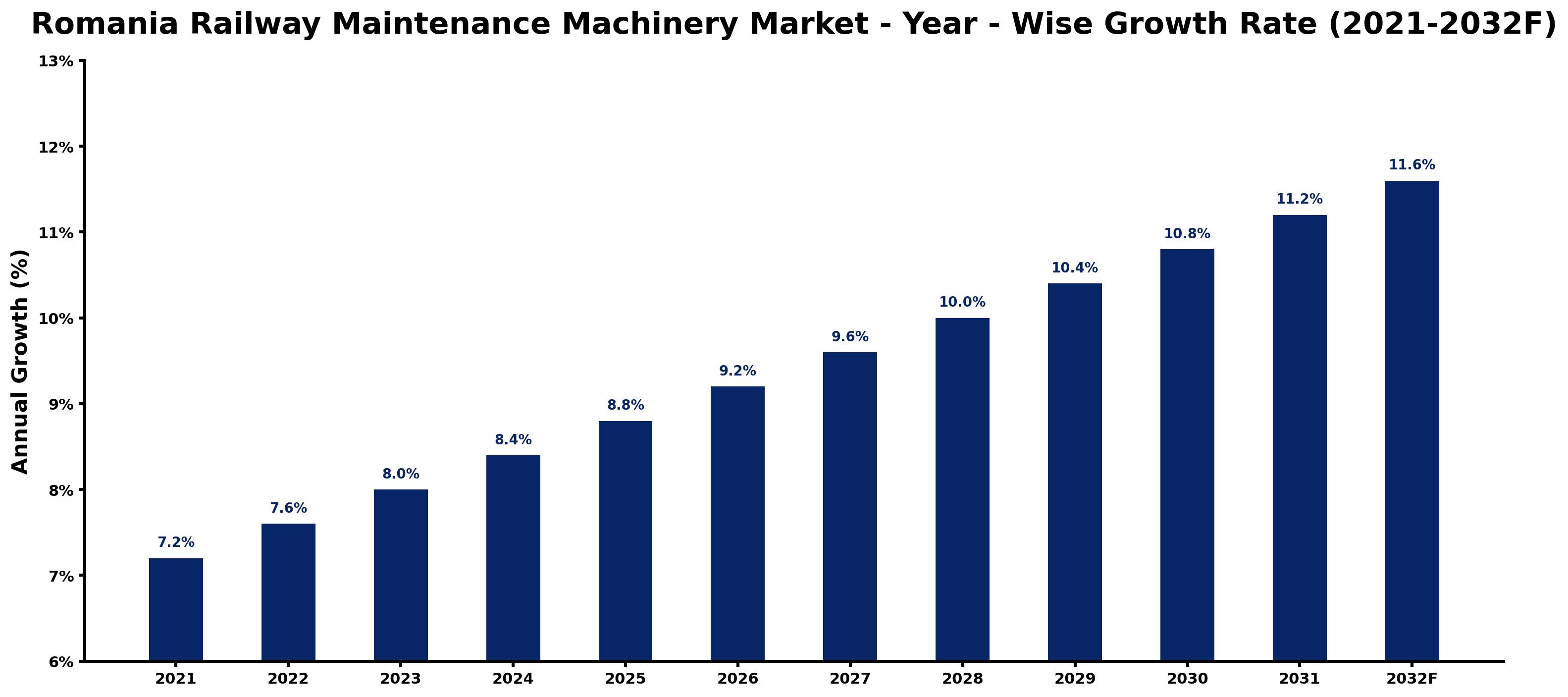
The table below presents the year‑wise growth rates along with the key drivers influencing the market
| Year | Growth Rate | Major Drivers |
| 2021 | 7.2% | Government infrastructure modernization initiatives |
| 2022 | 7.6% | Increasing industrial automation investments |
| 2023 | 8.0% | Expansion of transportation and logistics networks |
| 2024 | 8.4% | Expansion of commercial construction activities |
| 2025 | 8.8% | Growing renewable energy integration projects |
| 2026 | 9.2% | Government infrastructure modernization initiatives |
| 2027 | 9.6% | Rapid growth in telecom and data center sectors |
| 2028 | 10.0% | Expansion of manufacturing activities |
| 2029 | 10.4% | Growing urbanization and commercial development |
| 2030 | 10.8% | Growing renewable energy integration projects |
| 2031 | 11.2% | Rapid growth in telecom and data center sectors |
| 2032 | 11.6% | Growing urbanization and commercial development |
Note - Market size estimations and growth projections presented in this report are based on 6Wresearch’s advanced forecasting approach, validated with industry datasets as of June 2026.
Romania Railway Maintenance Machinery Market Synopsis
The strongest force currently shaping the Romania Railway Maintenance Machinery Market is the government's commitment to modernizing rail infrastructure. This commitment has sparked a surge in investments aimed at enhancing the operational capabilities of the rail network, resulting in increased demand for advanced maintenance machinery.
Additionally, the market is witnessing a transformative shift towards incorporating innovative technologies in maintenance processes. This trend not only aims to improve the overall efficiency of operations but also to align with global sustainability goals, reflecting a growing consciousness regarding environmental impact within the rail sector.
Romania Railway Maintenance Machinery Market Key Takeaways
- The market is projected to grow significantly, reflecting strong government backing and infrastructure investments.
- Innovative technologies are increasingly being integrated into maintenance processes for enhanced operational efficiency.
- Environmental considerations are driving demand for energy-efficient and sustainable maintenance solutions.
- Collaboration between manufacturers and railway authorities is fostering the development of modern maintenance practices.
- Investment opportunities are on the rise for both domestic and international players in the evolving market landscape.
Evaluation of Restraints in Romania Railway Maintenance Machinery Market
Despite its promising outlook, the Romania Railway Maintenance Machinery Market faces notable constraints. Aging infrastructure necessitates frequent maintenance, which is often hindered by limited budget allocations. Financial constraints frequently delay critical modernization projects, while the scarcity of skilled labor in railway maintenance further complicates operational effectiveness. To navigate these challenges, industry players will need to innovate and adapt their strategies, prioritizing investments that enhance the capabilities of their workforce and the efficiency of their processes.
Romania Railway Maintenance Machinery Market Trends
A distinct trend emerging in the Romania Railway Maintenance Machinery Market is the increasing adoption of predictive maintenance systems and automated inspection tools. These advancements are essential for minimizing downtime and ensuring the operational reliability of railway infrastructure. Additionally, the industry is witnessing a growing demand for environmentally friendly maintenance solutions that align with sustainability objectives, shaping the types of equipment manufacturers are developing and offering.
Romania Railway Maintenance Machinery Market Opportunities
The Romania Railway Maintenance Machinery Market is ripe with investment opportunities, particularly for those targeting innovative technologies that enhance efficiency and safety. As the government continues to push for infrastructure upgrades, investors can benefit from partnering with local railway companies and tapping into forthcoming projects and tenders. The focus on advanced maintenance machinery, such as rail grinding machines and ballast regulators, presents avenues for sustainable growth and profitability.
Government Initiatives in the Romania Railway Maintenance Machinery Market
The Romanian government has been instrumental in fostering growth within the Railway Maintenance Machinery Market through a variety of policies aimed at infrastructure enhancement. Recent initiatives focus on increasing operational efficiency and safety standards, encouraging public-private partnerships to attract additional investment. These collaborations are crucial for driving innovation in the sector and ensuring compliance with safety and environmental regulations, ultimately enhancing the quality and reliability of railway maintenance services.
Future Insights of the Romania Railway Maintenance Machinery Market
Looking ahead to 2026-2032, the Romania Railway Maintenance Machinery Market is expected to maintain its upward trajectory, bolstered by a combination of continued government support and increased investments in railway infrastructure. The demand for advanced maintenance machinery will be influenced by ongoing modernization efforts and heightened safety standards. As market players prioritize innovation and the development of tailored solutions, the sector is set to evolve significantly, paving the way for sustainable growth and expanded operational capabilities.
Romania Railway Maintenance Machinery Market Latest Developments (May 2025 - June 2026)
Recent developments in the Romania Railway Maintenance Machinery Market indicate a strong shift towards automation and digitalization. Manufacturers are increasingly introducing advanced maintenance technologies that facilitate remote monitoring and predictive analytics. Additionally, collaborations between governmental entities and private companies are on the rise, focusing on the establishment of modern maintenance practices to enhance operational efficiency across the railway sector.
Romania Railway Maintenance Machinery Market - Key Attractiveness of the Report
- 10 Years of Market Numbers
- Historical Data Starting from 2022 to 2025
- Base Year: 2025
- Forecast Data until 2032
- Key Performance Indicators Impacting the Market
- Major Upcoming Developments and Projects
Key Highlights of the Report:
- Romania Railway Maintenance Machinery Market Outlook
- Market Size of Romania Railway Maintenance Machinery Market, 2025
- Forecast of Romania Railway Maintenance Machinery Market, 2032
- Historical Data and Forecast of Romania Railway Maintenance Machinery Revenues & Volume for the Period 2022-2032F
- Romania Railway Maintenance Machinery Market Trend Evolution
- Romania Railway Maintenance Machinery Market Drivers and Challenges
- Romania Railway Maintenance Machinery Price Trends
- Romania Railway Maintenance Machinery Porter's Five Forces
- Romania Railway Maintenance Machinery Industry Life Cycle
- Historical Data and Forecast of Romania Railway Maintenance Machinery Market Revenues & Volume By Type for the Period 2022-2032F
- Historical Data and Forecast of Romania Railway Maintenance Machinery Market Revenues & Volume By Tamping Machine for the Period 2022-2032F
- Historical Data and Forecast of Romania Railway Maintenance Machinery Market Revenues & Volume By Stabilizing Machinery for the Period 2022-2032F
- Historical Data and Forecast of Romania Railway Maintenance Machinery Market Revenues & Volume By Rail Handling Machinery for the Period 2022-2032F
- Historical Data and Forecast of Romania Railway Maintenance Machinery Market Revenues & Volume By Ballast Cleaning Machine for the Period 2022-2032F
- Historical Data and Forecast of Romania Railway Maintenance Machinery Market Revenues & Volume By Other for the Period 2022-2032F
- Historical Data and Forecast of Romania Railway Maintenance Machinery Market Revenues & Volume By Applications for the Period 2022-2032F
- Historical Data and Forecast of Romania Railway Maintenance Machinery Market Revenues & Volume By Ballast Track for the Period 2022-2032F
- Historical Data and Forecast of Romania Railway Maintenance Machinery Market Revenues & Volume By Ballastless Track for the Period 2022-2032F
- Romania Railway Maintenance Machinery Import Export Trade Statistics
- Market Opportunity Assessment By Type
- Market Opportunity Assessment By Applications
- Romania Railway Maintenance Machinery Top Companies Market Share
- Romania Railway Maintenance Machinery Competitive Benchmarking By Technical and Operational Parameters
- Romania Railway Maintenance Machinery Company Profiles
- Romania Railway Maintenance Machinery Key Strategic Recommendations






































