Russia 3D Animation Market Size & Growth Rate (2026-2032)
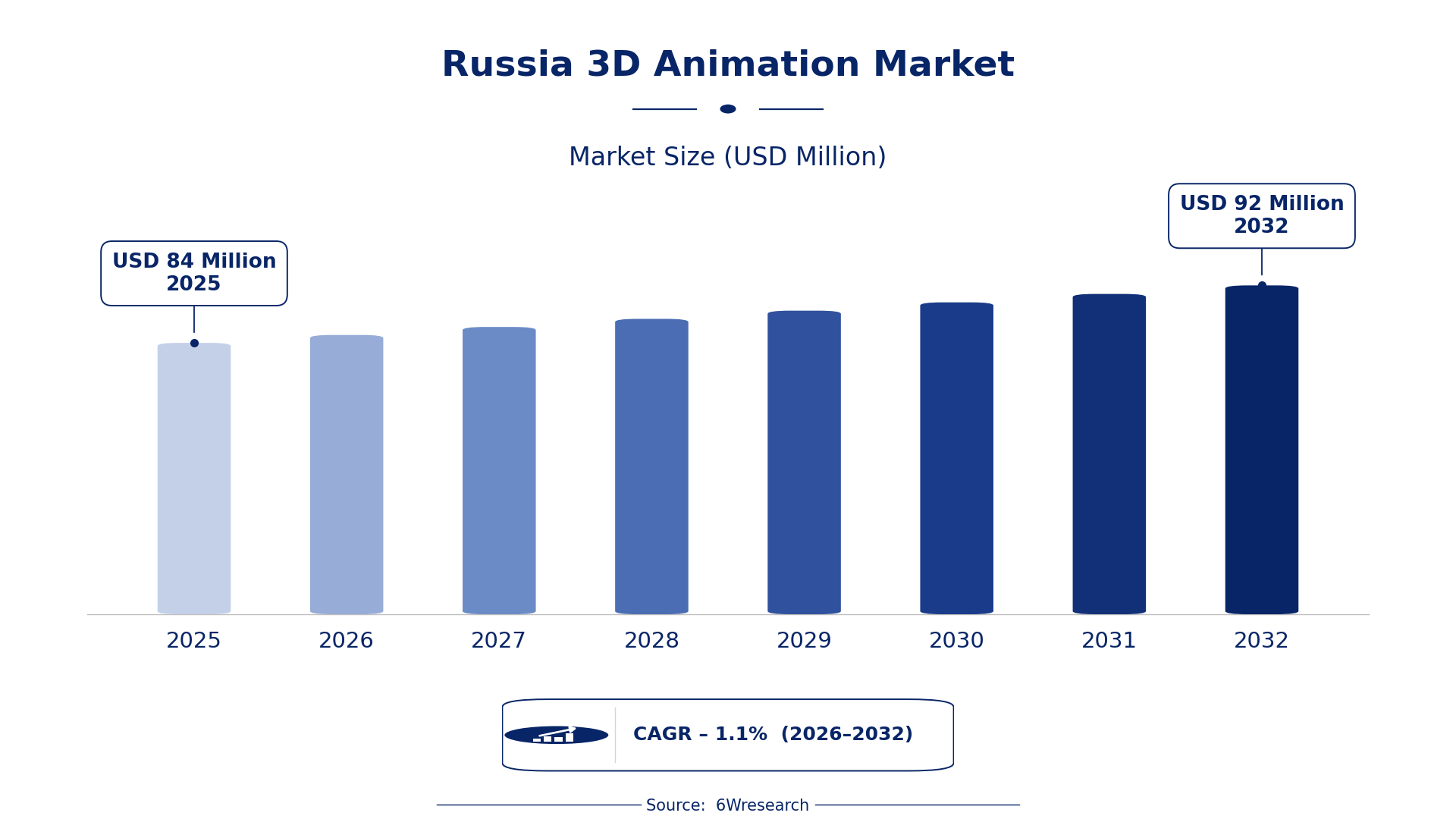
The Russia 3D Animation Market was estimated at USD 84 Million in 2025 and is projected to reach USD 92 Million by 2032, growing at a CAGR of 1.1% from 2026 to 2032.
Russia 3D Animation Market Synopsis
The Russia 3D Animation Market is on a steady upward trajectory, driven by the escalating demand for high-quality animated content across multiple sectors. From entertainment and advertising to gaming, the appetite for engaging visuals is stronger than ever, creating a fertile environment for growth.
As the industry matures, local talent is emerging, leading to a greater diversity of creative offerings. Government support, including incentives and funding, is further bolstering the industry's potential, positioning Russia as an increasingly relevant player on the global animation stage.
Russia 3D Animation Market Year-wise Growth Rate and Key Drivers
This graph illustrates the annual growth rates of the Russia 3D Animation Market from 2021 to 2032, highlighting a steady upward trajectory and projected expansion over the forecast period.
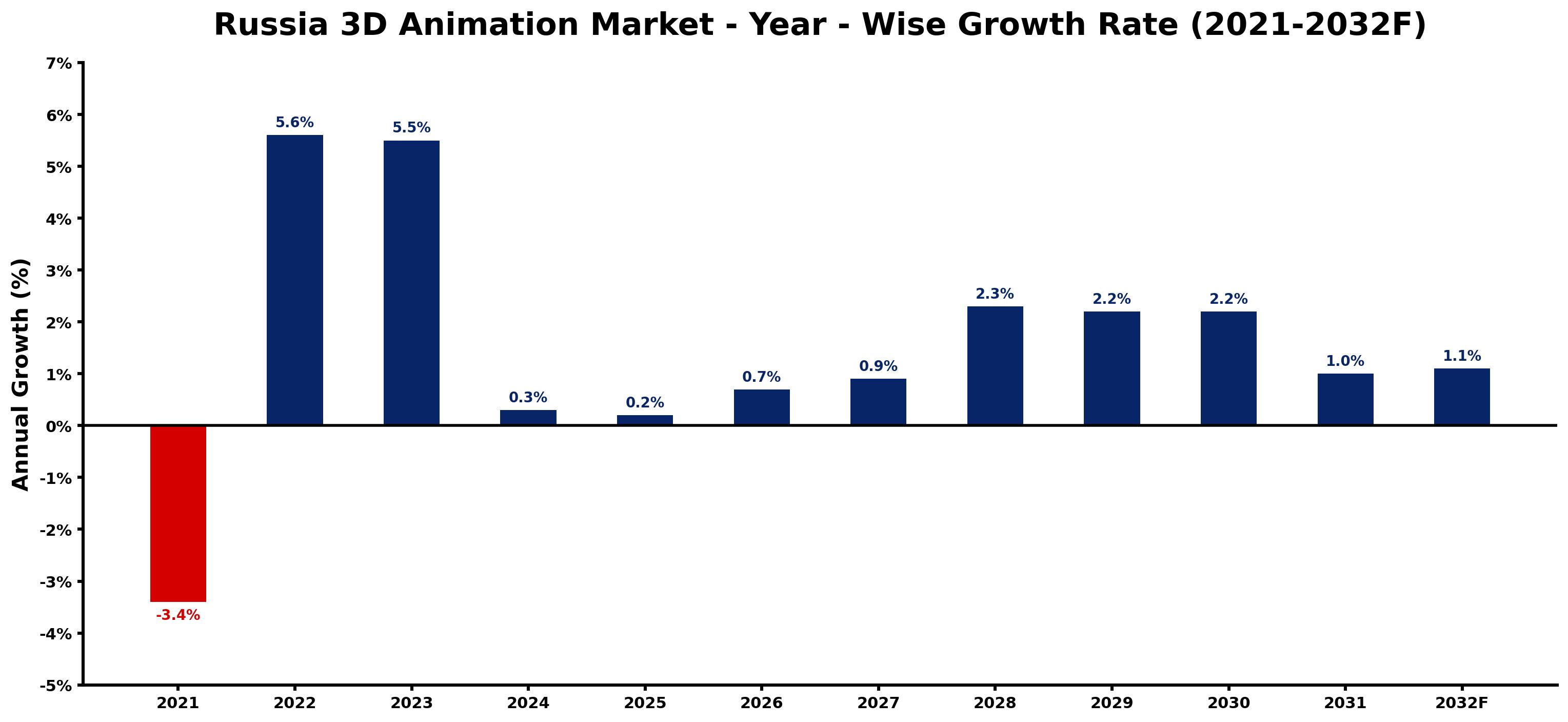
The table below presents the year‑wise growth rates along with the key drivers influencing the market
| Year | Growth Rate | Major Drivers |
| 2021 | -3.4% | Sanctions hindered foreign investment in 3D technology. |
| 2022 | 5.6% | Increased funding for domestic animated feature films. |
| 2023 | 5.5% | Growing popularity of Russian animated series on streaming platforms. |
| 2024 | 0.3% | Government grants for educational animation projects in schools. |
| 2025 | 0.2% | Rise in demand for 3D graphics in gaming industry. |
| 2026 | 0.7% | Boost in local talent through animation training programs. |
| 2027 | 0.9% | Collaborations between studios and international streaming services. |
| 2028 | 2.3% | Supportive policies for cultural export of animations. |
| 2029 | 2.2% | Increased investment from VFX studios in animation technology. |
| 2030 | 2.2% | Emergence of local startups in animated content creation. |
| 2031 | 1.0% | Rising interest in immersive experiences using animation. |
| 2032 | 1.1% | Enhancements in software tools developed by Russian firms. |
Note: Market size estimations and growth projections presented in this report are based on 6Wresearch's proprietary forecasting methodology, utilizing the latest available industry data, government publications, and primary research inputs.
Russia 3D Animation Market Key Takeaways
Below are some of the specific key takeaways from the market, including:
- The increasing integration of 3D animation across various industries is reshaping content creation.
- Technological advancements, particularly in virtual and augmented reality, are enhancing animation quality and interactivity.
- Government initiatives are providing necessary support to stimulate market growth and innovation.
- Emerging local studios are meeting the rising demand for high-quality animated content.
- Investment opportunities are expanding, especially in education and training for animation professionals.
Evaluation of Restraints in Russia 3D Animation Market
The growth of the Russia 3D Animation Market is hampered by several factors. Notably, access to advanced technologies remains limited due to sanctions that restrict the import of essential software and hardware. This creates a barrier to innovation and competitiveness. on top of that, there is a significant skills gap in the workforce, as the demand for skilled animators outpaces supply. This talent shortage can stifle the growth potential of animation studios and projects. Lastly, issues related to piracy and copyright infringement continue to undermine profitability, posing a serious challenge to sustainable growth in the sector.
Russia 3D Animation Market Trends
Several trends are shaping the future of the 3D animation market in Russia. A notable increase in the demand for high-quality visual effects is evident, particularly within the film and gaming sectors. Additionally, industries such as architecture and healthcare are increasingly leveraging 3D animation for presentations and simulations, driving further adoption.
The rise of online streaming platforms and mobile content consumption has created a surge in demand for animated series and films, pushing studios to innovate continually. on top of that, the integration of technologies like virtual and augmented reality is enhancing user engagement, offering immersive experiences that traditional animation cannot match.
Russia 3D Animation Market Opportunities
The market presents diverse investment opportunities, particularly in sectors where animated content is in high demand. Animation studios focusing on entertainment, advertising, and education stand to benefit from increased funding and consumer interest. There is also significant potential in developing training programs to cultivate a skilled workforce, addressing the talent gap that currently exists. Collaborations between local studios and international partners can further enhance creative output and market reach, creating pathways for sustained growth.
Government Initiatives in the Russia 3D Animation Market
The Russian government has implemented targeted policies to foster the growth of the 3D animation market. These initiatives reflect a commitment to enhancing the industry’s competitiveness and nurturing local talent. Supportive regulations and funding opportunities are crucial for the ongoing development of this sector.
- A recent funding initiative launched in early 2025 provides grants to promising 3D animation studios, aimed at accelerating project development.
- Currently, educational partnerships are being strengthened between animation studios and universities to improve training and skill development.
- Upcoming tax incentives are set to be introduced by mid-2026, designed to attract foreign investment into the animation sector.
- The government is currently working on a regulatory framework to enhance intellectual property protections for animators.
- A national animation festival, planned for late 2026, aims to showcase local talent and promote collaboration among industry players.
Future Insights of the Russia 3D Animation Market
Looking ahead to 2026-2032, the Russia 3D Animation Market is expected to see notable advancements, driven by technological innovations and an expanding talent pool. The continuous rise in demand for animated content across various platforms will necessitate further investment in both technology and human resources. As the local industry matures, collaborative efforts with international players will likely increase, enhancing the quality and reach of Russian animated productions. This evolving dynamic positions the market for significant growth and innovation.
Russia 3D Animation Market Latest Developments
Over the past year, the Russia 3D Animation Market has witnessed a flurry of activity, indicating a vibrant and competitive environment. The push for high-quality content is resulting in both local and international partnerships, expanding the horizons for creativity in this sector.
- A major collaboration was announced in early 2025 between local animation studios and a European production house, focusing on co-developing animated series.
- A new software tool designed to streamline the animation process was launched in Q2 2025, gaining traction among local studios.
- Currently, an initiative aimed at increasing public awareness and appreciation for animated films is underway, involving schools and community centers.
- Planned for late 2026, a national program will support the establishment of animation incubators to foster innovation and entrepreneurship.
- Ongoing training workshops for aspiring animators began in early 2025, aimed at bridging the skills gap within the industry.
Russia 3D Animation Market - Key Attractiveness of the Report
- 10 Years of Market Numbers
- Historical Data Starting from 2022 to 2025
- Base Year: 2025
- Forecast Data until 2032
- Key Performance Indicators Impacting the Market
- Major Upcoming Developments and Projects
Key Highlights of the Report:
- Russia 3D Animation Market Outlook
- Market Size of Russia 3D Animation Market, 2025
- Forecast of Russia 3D Animation Market, 2032
- Historical Data and Forecast of Russia 3D Animation Revenues & Volume for the Period 2022-2032F
- Russia 3D Animation Market Trend Evolution
- Russia 3D Animation Market Drivers and Challenges
- Russia 3D Animation Price Trends
- Russia 3D Animation Porter's Five Forces
- Russia 3D Animation Industry Life Cycle
- Historical Data and Forecast of Russia 3D Animation Market Revenues & Volume By Technology for the Period 2022-2032F
- Historical Data and Forecast of Russia 3D Animation Market Revenues & Volume By 3D Modeling for the Period 2022-2032F
- Historical Data and Forecast of Russia 3D Animation Market Revenues & Volume By Motion Graphics for the Period 2022-2032F
- Historical Data and Forecast of Russia 3D Animation Market Revenues & Volume By 3D Rendering for the Period 2022-2032F
- Historical Data and Forecast of Russia 3D Animation Market Revenues & Volume By Visual Effects for the Period 2022-2032F
- Historical Data and Forecast of Russia 3D Animation Market Revenues & Volume By Service for the Period 2022-2032F
- Historical Data and Forecast of Russia 3D Animation Market Revenues & Volume By Consulting for the Period 2022-2032F
- Historical Data and Forecast of Russia 3D Animation Market Revenues & Volume By Support and Maintenance for the Period 2022-2032F
- Historical Data and Forecast of Russia 3D Animation Market Revenues & Volume By Integration and Deployment for the Period 2022-2032F
- Historical Data and Forecast of Russia 3D Animation Market Revenues & Volume By Education and Training for the Period 2022-2032F
- Historical Data and Forecast of Russia 3D Animation Market Revenues & Volume By Vertical for the Period 2022-2032F
- Historical Data and Forecast of Russia 3D Animation Market Revenues & Volume By Media and Entertainment for the Period 2022-2032F
- Historical Data and Forecast of Russia 3D Animation Market Revenues & Volume By Construction and Architecture for the Period 2022-2032F
- Historical Data and Forecast of Russia 3D Animation Market Revenues & Volume By Healthcare and Lifesciences for the Period 2022-2032F
- Historical Data and Forecast of Russia 3D Animation Market Revenues & Volume By Manufacturing for the Period 2022-2032F
- Historical Data and Forecast of Russia 3D Animation Market Revenues & Volume By Education and Academia for the Period 2022-2032F
- Historical Data and Forecast of Russia 3D Animation Market Revenues & Volume By Others for the Period 2022-2032F
- Historical Data and Forecast of Russia 3D Animation Market Revenues & Volume By Deployment for the Period 2022-2032F
- Historical Data and Forecast of Russia 3D Animation Market Revenues & Volume By On-Premises for the Period 2022-2032F
- Historical Data and Forecast of Russia 3D Animation Market Revenues & Volume By On-Demand for the Period 2022-2032F
- Russia 3D Animation Import Export Trade Statistics
- Market Opportunity Assessment By Technology
- Market Opportunity Assessment By Service
- Market Opportunity Assessment By Vertical
- Market Opportunity Assessment By Deployment
- Russia 3D Animation Top Companies Market Share
- Russia 3D Animation Competitive Benchmarking By Technical and Operational Parameters
- Russia 3D Animation Company Profiles
- Russia 3D Animation Key Strategic Recommendations






































