Russia Algorithmic Trading Market Size & Growth Rate (2026-2032)
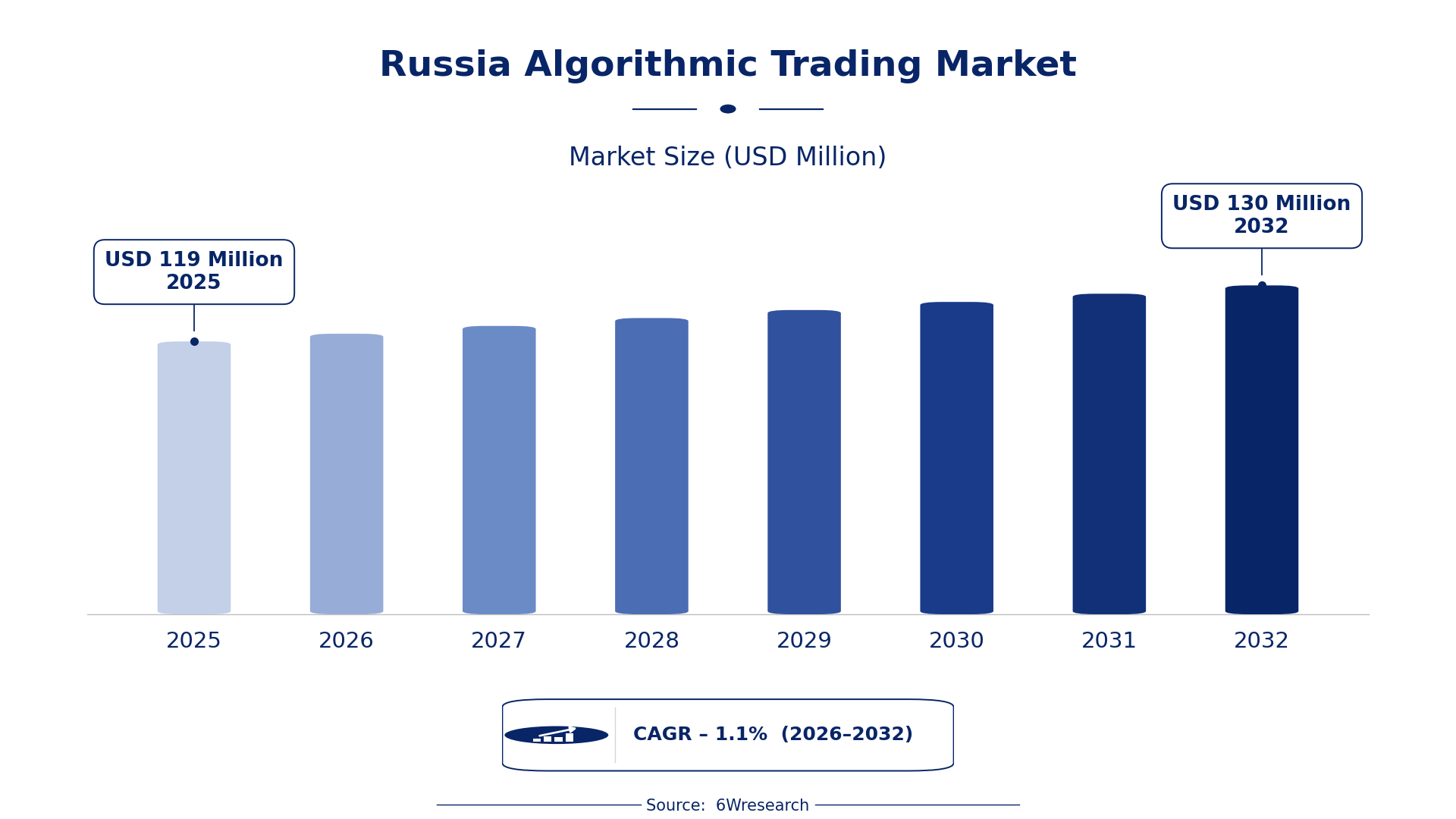
The Russia Algorithmic Trading Market was estimated at USD 119 Million in 2025 and is projected to reach USD 130 Million by 2032, growing at a CAGR of 1.1% from 2026 to 2032.
Russia Algorithmic Trading Market Synopsis
The demand for algorithmic trading in Russia is primarily driven by the increasing sophistication of trading strategies and the necessity for speed in executing trades. As financial institutions adopt these advanced systems, the pressure to innovate and improve efficiency has never been greater.
Technological advancements, particularly in artificial intelligence and machine learning, are enabling market participants to create and implement more complex algorithms. This trend is reshaping the trading environment, allowing firms to capitalize on market inefficiencies and respond more effectively to volatility.
Russia Algorithmic Trading Market Year-wise Growth Rate and Key Drivers
This graph illustrates the annual growth rates of the Russia Algorithmic Trading Market from 2021 to 2032, highlighting a steady upward trajectory and projected expansion over the forecast period.
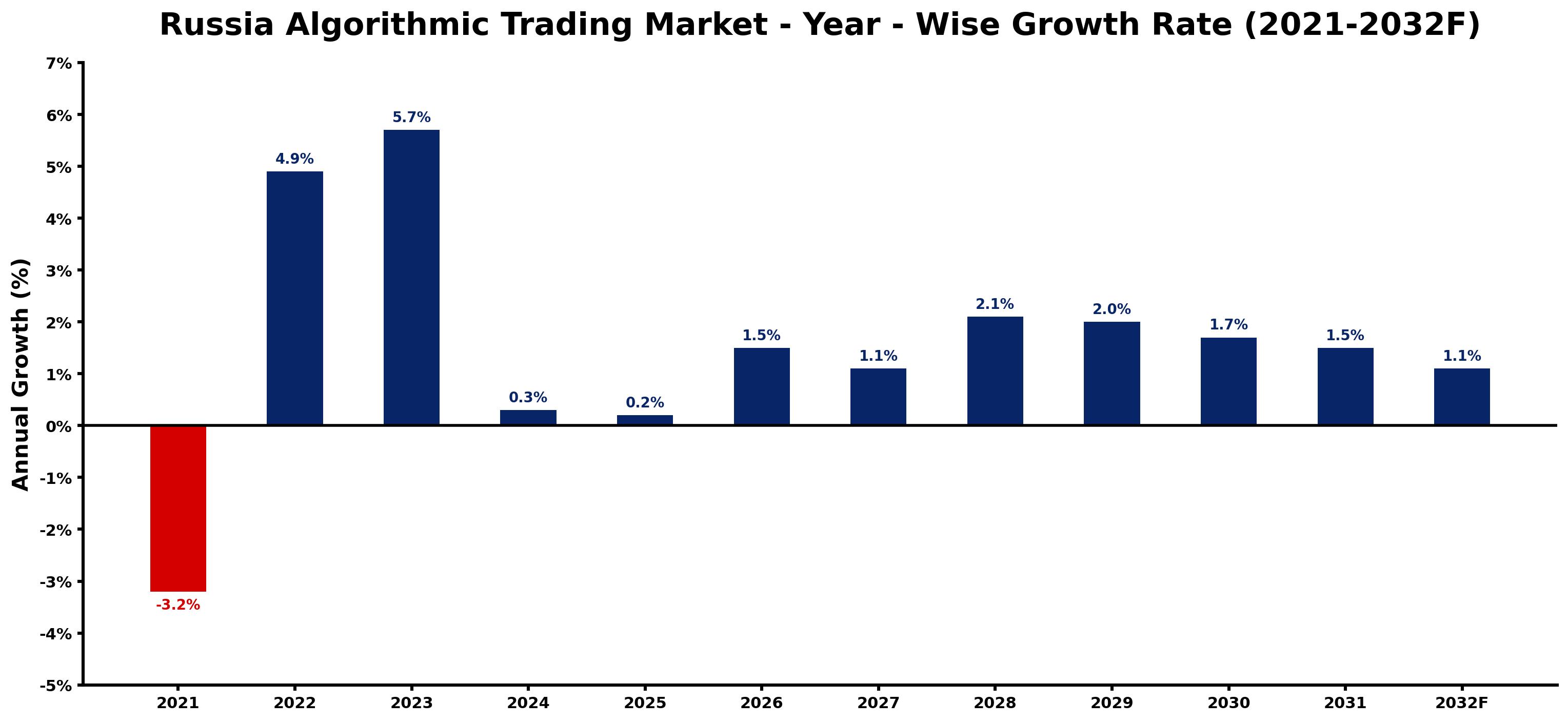
The table below presents the year‑wise growth rates along with the key drivers influencing the market
| Year | Growth Rate | Major Drivers |
| 2021 | -3.2% | Sanctions limiting foreign investment in financial technologies. |
| 2022 | 4.9% | Increased retail investor participation in stock markets |
| 2023 | 5.7% | Regulatory support from the Central Bank of Russia |
| 2024 | 0.3% | Growth in fintech solutions for algorithmic trading |
| 2025 | 0.2% | Enhanced data analytics capabilities among traders |
| 2026 | 1.5% | Rise in high-frequency trading activities in Moscow |
| 2027 | 1.1% | Emergence of local algorithmic trading startups |
| 2028 | 2.1% | Adoption of advanced trading software by brokerages |
| 2029 | 2.0% | Increased demand for trading efficiency and speed |
| 2030 | 1.7% | Regulatory innovations encouraging algorithmic trading strategies |
| 2031 | 1.5% | Greater access to real-time market data platforms |
| 2032 | 1.1% | Advancements in AI for predictive trading models |
Note: Market size estimations and growth projections presented in this report are based on 6Wresearch's proprietary forecasting methodology, utilizing the latest available industry data, government publications, and primary research inputs.
Russia Algorithmic Trading Market Key Takeaways
Below are some of the specific key takeaways from the market, including:
- The growing integration of AI technologies is enhancing trading accuracy and strategy development.
- Institutional investors are increasingly adopting algorithmic trading to improve trading efficiency.
- Regulatory frameworks are evolving to ensure compliance and market integrity.
- High-frequency trading is on the rise due to improved technological infrastructure.
- The market is expanding beyond equities into various asset classes, including derivatives and commodities.
Evaluation of Restraints in Russia Algorithmic Trading Market
The Russia algorithmic trading market faces several constraints that hinder its potential. Regulatory complexities create an unpredictable environment, as firms must adapt to frequent changes in compliance requirements. on top of that, the technology infrastructure in Russia is lagging compared to Western markets, resulting in challenges related to speed and efficiency in trade execution. Geopolitical factors also add uncertainty, making it difficult for firms to operate without risk. These elements collectively dampen the overall market growth and complicate operational strategies for algorithmic trading firms.
Russia Algorithmic Trading Market Trends
Several trends are currently shaping the Russia algorithmic trading market. The adoption of machine learning algorithms is gaining traction, enabling traders to make data-driven decisions that enhance their trading outcomes. High-frequency trading continues to expand as infrastructure improves, allowing firms to execute trades with unprecedented speed. on top of that, as market volatility increases, there is a greater emphasis on risk management and compliance, prompting firms to refine their strategies and tools.
Russia Algorithmic Trading Market Opportunities
Investment opportunities abound in the Russia algorithmic trading market, particularly for those focused on developing advanced trading algorithms and software solutions. There is significant demand for educational services that train professionals in algorithmic trading, which presents a lucrative avenue for growth. Additionally, investing in firms that specialize in quantitative analysis and high-frequency trading can yield substantial returns, given the market's ongoing evolution.
Government Initiatives in the Russia Algorithmic Trading Market
Government policy in Russia plays a crucial role in shaping the algorithmic trading market. The regulatory framework is designed to ensure market stability and protect investors, which is particularly significant in the face of recent market volatility. Policies aimed at enhancing cybersecurity and managing trading risks are currently in focus, as the government aims to create a transparent trading environment.
- A regulatory framework introduced in 2016 mandates licensing for algorithmic traders, requiring compliance with risk management protocols.
- Ongoing initiatives include enhanced cybersecurity measures to safeguard against potential cyber threats within the trading sphere.
- Recent efforts involve the implementation of new reporting requirements for high-frequency trading to ensure greater market transparency.
- Planned infrastructure upgrades are expected to improve technological capabilities for algorithmic trading firms by 2028.
- Future policies will likely focus on adapting regulations to better accommodate the rapid changes in trading technologies.
Future Insights of the Russia Algorithmic Trading Market
Looking ahead to 2026-2032, the Russia algorithmic trading market is set to undergo notable transformation. As technological advancements continue to emerge, the demand for more sophisticated trading solutions is expected to rise. The regulatory landscape will evolve, fostering a more transparent and efficient trading environment. Institutional adoption will likely increase, driven by the need for speed and efficiency in trading processes. Consequently, firms that can innovate and adapt to these changes will find ample opportunities for growth in the coming years.
Russia Algorithmic Trading Market Latest Developments
In the past year, the Russia algorithmic trading market has seen a series of notable developments. Firms are increasingly focused on enhancing their trading algorithms to better navigate market volatility. As the demand for automation grows, several technology vendors are launching new platforms aimed at improving execution speeds and trading accuracy.
- A major technology vendor launched a new algorithmic trading platform in early 2025, designed to improve trade execution speed for institutional clients.
- An initiative that began in mid-2025 focuses on integrating machine learning algorithms into existing trading systems, enhancing decision-making capabilities.
- In Q2 2025, a leading financial institution announced a partnership with a cybersecurity firm to bolster protections against potential trading-related cyber threats.
- Upcoming in late 2026, a rollout is expected for a comprehensive training program aimed at educating traders on advanced algorithmic strategies.
- A recent collaboration was established between regulatory bodies and financial institutions to streamline compliance processes, initiated in early 2025 and currently underway.
Russia Algorithmic Trading Market - Key Attractiveness of the Report
- 10 Years of Market Numbers
- Historical Data Starting from 2022 to 2025
- Base Year: 2025
- Forecast Data until 2032
- Key Performance Indicators Impacting the Market
- Major Upcoming Developments and Projects
Key Highlights of the Report:
- Russia Algorithmic Trading Market Outlook
- Market Size of Russia Algorithmic Trading Market, 2025
- Forecast of Russia Algorithmic Trading Market, 2032
- Historical Data and Forecast of Russia Algorithmic Trading Revenues & Volume for the Period 2022-2032F
- Russia Algorithmic Trading Market Trend Evolution
- Russia Algorithmic Trading Market Drivers and Challenges
- Russia Algorithmic Trading Price Trends
- Russia Algorithmic Trading Porter's Five Forces
- Russia Algorithmic Trading Industry Life Cycle
- Historical Data and Forecast of Russia Algorithmic Trading Market Revenues & Volume By Trading Type for the Period 2022-2032F
- Historical Data and Forecast of Russia Algorithmic Trading Market Revenues & Volume By Foreign Exchange (FOREX) for the Period 2022-2032F
- Historical Data and Forecast of Russia Algorithmic Trading Market Revenues & Volume By Stock Markets for the Period 2022-2032F
- Historical Data and Forecast of Russia Algorithmic Trading Market Revenues & Volume By Exchange-Traded Fund (ETF) for the Period 2022-2032F
- Historical Data and Forecast of Russia Algorithmic Trading Market Revenues & Volume By Bonds for the Period 2022-2032F
- Historical Data and Forecast of Russia Algorithmic Trading Market Revenues & Volume By Cryptocurrencies for the Period 2022-2032F
- Historical Data and Forecast of Russia Algorithmic Trading Market Revenues & Volume By Others for the Period 2022-2032F
- Historical Data and Forecast of Russia Algorithmic Trading Market Revenues & Volume By Deployment Mode for the Period 2022-2032F
- Historical Data and Forecast of Russia Algorithmic Trading Market Revenues & Volume By Cloud for the Period 2022-2032F
- Historical Data and Forecast of Russia Algorithmic Trading Market Revenues & Volume By On-premises for the Period 2022-2032F
- Historical Data and Forecast of Russia Algorithmic Trading Market Revenues & Volume By Component for the Period 2022-2032F
- Historical Data and Forecast of Russia Algorithmic Trading Market Revenues & Volume By Solutions for the Period 2022-2032F
- Historical Data and Forecast of Russia Algorithmic Trading Market Revenues & Volume By Services for the Period 2022-2032F
- Historical Data and Forecast of Russia Algorithmic Trading Market Revenues & Volume By Enterprise Size for the Period 2022-2032F
- Historical Data and Forecast of Russia Algorithmic Trading Market Revenues & Volume By Small and Medium-sized Enterprises (SMEs) for the Period 2022-2032F
- Historical Data and Forecast of Russia Algorithmic Trading Market Revenues & Volume By Large Enterprises for the Period 2022-2032F
- Russia Algorithmic Trading Import Export Trade Statistics
- Market Opportunity Assessment By Trading Type
- Market Opportunity Assessment By Deployment Mode
- Market Opportunity Assessment By Component
- Market Opportunity Assessment By Enterprise Size
- Russia Algorithmic Trading Top Companies Market Share
- Russia Algorithmic Trading Competitive Benchmarking By Technical and Operational Parameters
- Russia Algorithmic Trading Company Profiles
- Russia Algorithmic Trading Key Strategic Recommendations






































