Russia Automotive Market Growth Rate
According to 6Wresearch internal database and industry insights, the Russia Automotive Market is projected to grow at a compound annual growth rate (CAGR) of 6.2% during the forecast period (2026–2032).
Russia Automotive Market Year-wise Growth Rate and Key Drivers
This graph highlights how the Russia Automotive Market has steadily grown over the past five years, supported by major growth factors.
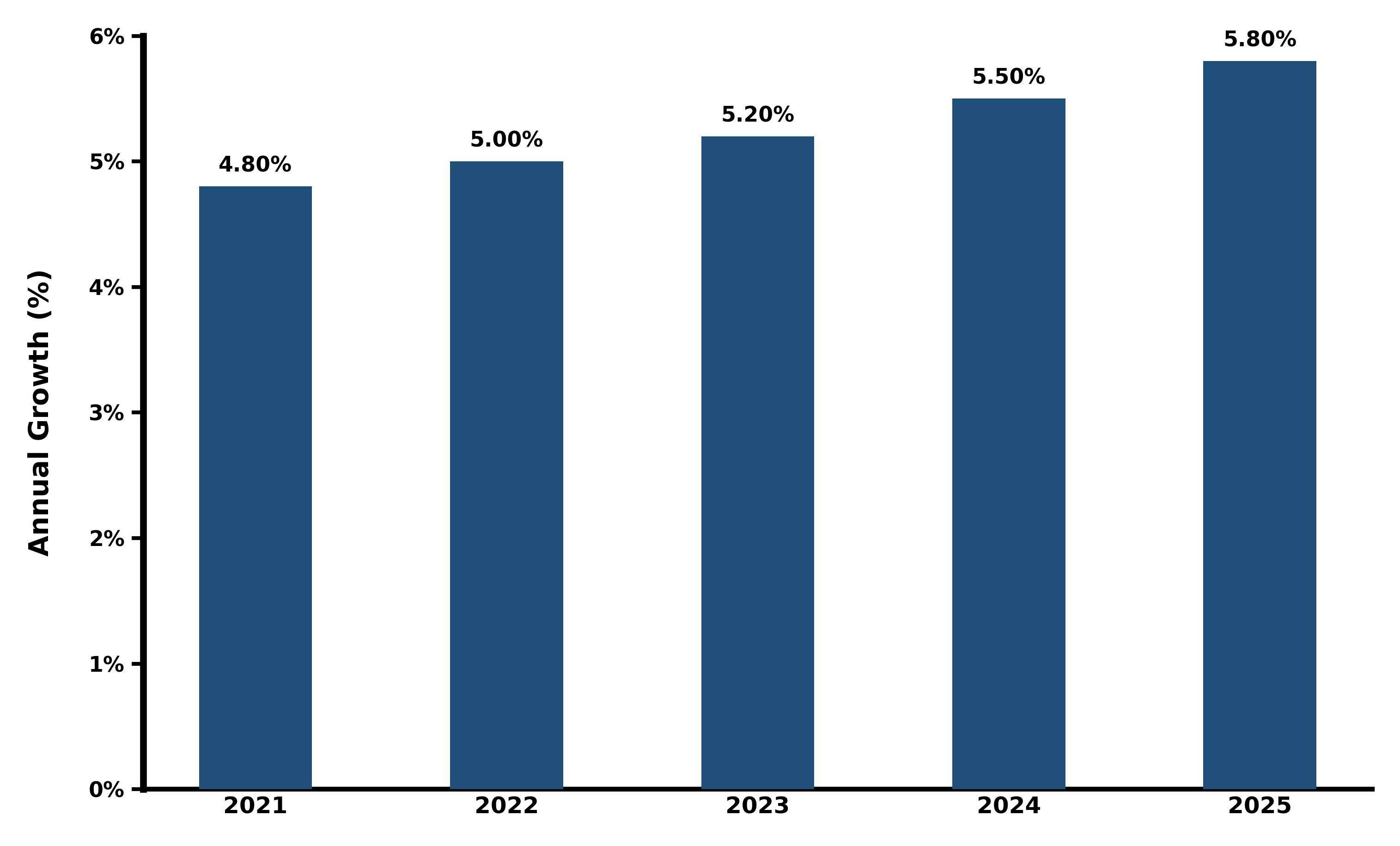
The table below presents the year‑wise growth rates along with the key drivers influencing the market
| Years | Estimated Annual Growth (%) | Growth Drivers |
| 2021 | 4.8% | Rising demand for personal mobility and passenger vehicles. |
| 2022 | 5% | Expansion of domestic production combined with the introduction of technologically advanced imported vehicles. |
| 2023 | 5.2% | Government incentives for electric and hybrid vehicle adoption. |
| 2024 | 5.5% | Growth in infrastructure dedicated to electric vehicle charging and hybrid mobility. |
| 2025 | 5.8% | Increasing consumer preference for fuel-efficient and low-emission vehicles. |
Topics Covered in the Russia Automotive Market Report
The Russia Automotive Market report thoroughly covers the market by Product Type. The report provides a detailed analysis of ongoing market trends, opportunities/high-growth areas, and market drivers that will help stakeholders devise and align strategies according to current and future market dynamics.
Russia Automotive Market Highlights
| Report Name | Russia Automotive Market |
| Forecast Period | 2026–2032 |
| CAGR | 6.20% |
| Growing Sector | Electric & Hybrid Vehicles |
Russia Automotive Market Synopsis
The Russia Automotive Market is expected to witness consistent growth, driven primarily by the rising demand for several types of vehicles, including passenger and commercial models that are fuel-efficient, electric, and hybrid. The market for electric and hybrid vehicles is attracting substantial investment from the government and private players, in areas like manufacturing and infrastructure development. The government, in particular, is taking steps to create a favorable environment for clean energy mobility and local production which will speed up the market adoption.
Evaluation of Growth Drivers in the Russia Automotive Market
Below are some prominent drivers and their influence on the Russia Automotive Market dynamics:
| Drivers | Primary Segments Affected | Why it Matters |
| Government Incentives for EVs | By Product Type | Subsidies, tax benefits, and import duty reductions increase EV adoption. |
| Rising Demand for Fuel-Efficient Vehicles | By Product Type | Increasing consumer awareness and cost-consciousness drive demand for hybrid and petrol vehicles. |
| Expansion of Manufacturing | By Product Type | New plants and assembly lines improve local production and reduce vehicle costs. |
| Infrastructure Development | By Application | Charging stations and urban mobility initiatives support the adoption of electric and hybrid vehicles. |
The Russia Automotive Market size is projected to grow at a CAGR of 6.2% during the forecast period (2026–2032). The Russia Automotive Market is growing due to government support for manufacturers and consumers; increased interest in purchasing fuel-efficient vehicles; localised manufacturing; and the expansion of charging infrastructure for electric and hybrid vehicles. The continued development of battery technologies, environmental control technologies and connected vehicle technologies is leading to a greater level of vehicle reliability and performance. The worldwide transition to low-emission transportation, along with increasing consumer preference for eco-friendly vehicles, will sustain long-term market growth.
Evaluation of Restraints in the Russia Automotive Market
Below are some prominent restraints and their influence on the Russia Automotive Market dynamics:
| Restraints | Primary Segments Affected | What this Means |
| High Vehicle Costs | By Product Type | Expensive EVs and hybrid vehicles limit affordability for average consumers. |
| Supply Chain Challenges | By Application | Disruptions in battery and component availability may slow manufacturing and product distribution. |
| Economic Volatility | By Product Type | Currency volatility and inflation influence vehicle pricing and purchasing demand. |
| Limited Charging Infrastructure | By Application | A lack of public charging stations may slow electric vehicle uptake in rural and distant areas. |
Russia Automotive Market Challenges
Several aspects of the Russia Automotive Industry are challenging and currently limit its potential for future growth. Significant production costs and importing costs make vehicles more expensive, while also limiting the amount of profit that manufacturers can generate. Furthermore, the dependency on purchased electronic components for electric vehicles also drives the price of them higher and limits growth opportunities. Moreover, due to the inconsistent availability of charging stations in rural and isolated locations, the purchase of electric vehicles is dramatically limited.
Russia Automotive Market Trends
Several key trends are shaping the Russia Automotive Market Growth:
- Advancements in Technology: Modern functionality for battery technology, electric motors, and self-driving vehicles is making these products more affordable and improving their operation.
- Shift to Electric & Hybrid Vehicles: As people are aware about the environment and governments offer tax rebates, it has encouraged people to buy low-emission vehicles.
- Connected & Smart Vehicles: There is increased usage of telematics (Internet of Things) that provides a better experience and enhances safety when using the vehicle.
- Luxury Vehicle Demands: Increased available income allows consumers to purchase more premium and technologically superior vehicles.
- Government Support for Electric Vehicles: Government policies and financial support for buying electric hybrid vehicles, as well as incentives to manufacture locally, are supporting growth for this segment.
Investment Opportunities in the Russia Automotive Market
Some notable investment opportunities include:
- Local Manufacturing Expansion: Setting up new assembly units or enlarging existing ones reduces import dependency and cost.
- Electric Vehicle Production: The production of battery-electric and hybrid vehicles aligns with the increasing demand for eco-friendly transport.
- Battery & Charging Infrastructure: The installation of charging stations and battery manufacturing are considered as the major steps to the acceptance of electric vehicles.
- Smart Vehicle Technology: Establishing connected vehicle platforms and telematics systems enables further market expansion.
Top 5 Leading Players in the Russia Automotive Market
Some leading players operating in the Russia Automotive Market Share include:
1. AvtoVAZ
| Company Name | AvtoVAZ |
| Established | 1966 |
| Headquarters | Tolyatti, Russia |
| Website | - |
AvtoVAZ is the largest automotive manufacturer in Russia, producing a range of passenger cars, including petrol, hybrid, and electric models, with a focus on affordable mobility.
2. GAZ Group
| Company Name | GAZ Group |
| Established | 1932 |
| Headquarters | Nizhny Novgorod, Russia |
| Website | - |
GAZ Group is a leading manufacturer of commercial and passenger vehicles in Russia, investing in hybrid and fuel-efficient technologies for sustainable transportation.
3. KamAZ
| Company Name | KamAZ |
| Established | 1969 |
| Headquarters | Naberezhnye Chelny, Russia |
| Website | Click Here |
KamAZ is a prominent heavy-duty vehicle manufacturer in Russia, producing trucks and buses while exploring electric and hybrid commercial vehicle technologies.
4. Sollers JSC
| Company Name | Sollers JSC |
| Established | 2002 |
| Headquarters | Moscow, Russia |
| Website | Click Here |
Sollers JSC produces a wide range of passenger and commercial vehicles in partnership with global automotive brands, emphasizing hybrid and electric mobility solutions.
5. Hyundai Motor Russia
| Company Name | Hyundai Motor Russia |
| Established | 2001 |
| Headquarters | Moscow, Russia |
| Website | Click Here |
Hyundai Motor Russia operates locally to manufacture and sell passenger vehicles, including hybrid and electric variants, catering to growing demand for low-emission vehicles.
Government Regulations Introduced in the Russia Automotive Market
The Russian government has introduced several initiatives to strengthen the automotive sector. The “Eco-Drive Incentives” project has been introduced to provide supports like subsidies and tax exemptions for electric and hybrid cars as a way to eco-friendly transport. The government local manufacturing rules are in line with the plans to grow assembly capabilities at home and at the same time, restrict imports. On top of that, there are roads for electric vehicle charging and urban transport that are being built as well as emission regulations that are set to attract low-emission vehicles and promote the invention of clean mobility technologies.
Future Insights of the Russia Automotive Market
The Russia Automotive Market is expected to grow steadily, driven by increasing demand for electric, hybrid, and fuel-efficient vehicles, coupled with rising local production and growing consumer awareness of sustainable transportation solutions. The market is being further driven by the supportive government policies that encourage the adoption of electric vehicles, along with the global trend for low-emission mobility and technological improvements in vehicle design. Moreover, the increasing investments in smart mobility solutions, battery technology, connected vehicles, and charging infrastructure are opening up new avenues and also reinforcing the long-term growth potential of the automotive industry in Russia.
Market Segmentation Analysis
The report offers a comprehensive study of the following market segments and their leading categories:
Electric Vehicles to Lead the Market -By Product Type
According to Ritika Kalra, Senior Research Analyst, 6Wresearch, Electric vehicles (EVs) are expected to dominate the Russia Automotive Market due to rising government incentives, growing charging infrastructure, and increasing consumer demand for sustainable, low-emission mobility solutions.
Key Attractiveness of the Report
- 10 Years of Market Numbers
- Historical Data Starting from 2022 to 2025
- Base Year: 2025
- Forecast Data until 2032
- Key Performance Indicators Impacting the Market
- Major Upcoming Developments and Projects
Key Highlights of the Report:
- Russia Automotive Market Outlook
- Market Size of Russia Automotive Market, 2022
- Forecast of Russia Automotive Market, 2032
- Historical Data and Forecast of Russia Automotive Revenues & Volume for the Period 2022 - 2032F
- Russia Automotive Market Trend Evolution
- Russia Automotive Market Drivers and Challenges
- Russia Automotive Price Trends
- Russia Automotive Porter's Five Forces
- Russia Automotive Industry Life Cycle
- Historical Data and Forecast of Russia Automotive Market Revenues & Volume By Product Type for the Period 2022 - 2032F
- Historical Data and Forecast of Russia Automotive Market Revenues & Volume By Electric for the Period 2022 - 2032F
- Historical Data and Forecast of Russia Automotive Market Revenues & Volume By Hybrid Electric for the Period 2022 - 2032F
- Historical Data and Forecast of Russia Automotive Market Revenues & Volume By Plug-In Hybrid Electric for the Period 2022 - 2032F
- Historical Data and Forecast of Russia Automotive Market Revenues & Volume By Mild Hybrid for the Period 2022 - 2032F
- Historical Data and Forecast of Russia Automotive Market Revenues & Volume By Natural Gas for the Period 2022 - 2032F
- Historical Data and Forecast of Russia Automotive Market Revenues & Volume By Fuel Cell Electric for the Period 2022 - 2032F
- Historical Data and Forecast of Russia Automotive Market Revenues & Volume By Diesel for the Period 2022 - 2032F
- Historical Data and Forecast of Russia Electric Automotive Market Revenues & Volume By Petrol for the Period 2022 - 2032F
- Russia Automotive Import Export Trade Statistics
- Market Opportunity Assessment By Product Type
- Russia Automotive Top Companies Market Share
- Russia Automotive Competitive Benchmarking By Technical and Operational Parameters
- Russia Automotive Company Profiles
- Russia Automotive Key Strategic Recommendations
Markets Covered
The report offers a comprehensive study of the following market segments:
By Product Type
- Electric
- Hybrid Electric
- Plug-In Hybrid Electric
- Mild Hybrid
- Natural Gas
- Fuel Cell Electric
- Diesel
- Petrol






































