Russia Content Services Platforms Market Size & Growth Rate (2026-2032)
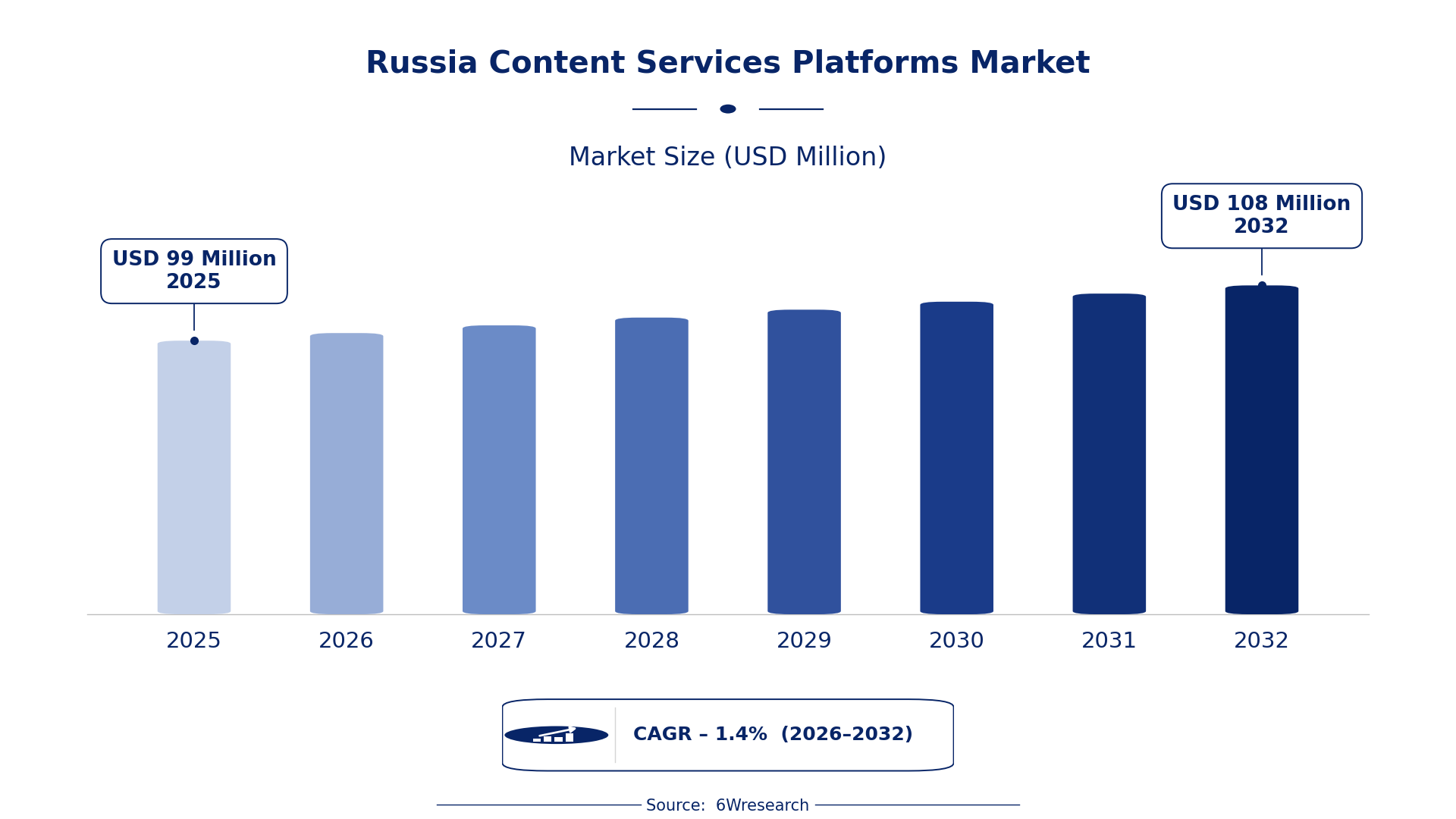
The Russia Content Services Platforms Market was estimated at USD 99 Million in 2025 and is projected to reach USD 108 Million by 2032, growing at a CAGR of 1.4% from 2026 to 2032.
Russia Content Services Platforms Market Synopsis
In recent years, the Russia Content Services Platforms Market has gained traction as digitalization becomes more ingrained in consumer behavior. Organizations are increasingly recognizing the need for efficient content management solutions that cater to the evolving demands of their audiences.
Looking ahead, the market is expected to evolve further as businesses prioritize enhanced customer engagement and personalized experiences. This shift will likely spur innovation, necessitating advanced technologies like AI and analytics to meet consumer expectations.
Russia Content Services Platforms Market Year-wise Growth Rate and Key Drivers
This graph illustrates the annual growth rates of the Russia Content Services Platforms Market from 2021 to 2032, highlighting a steady upward trajectory and projected expansion over the forecast period.
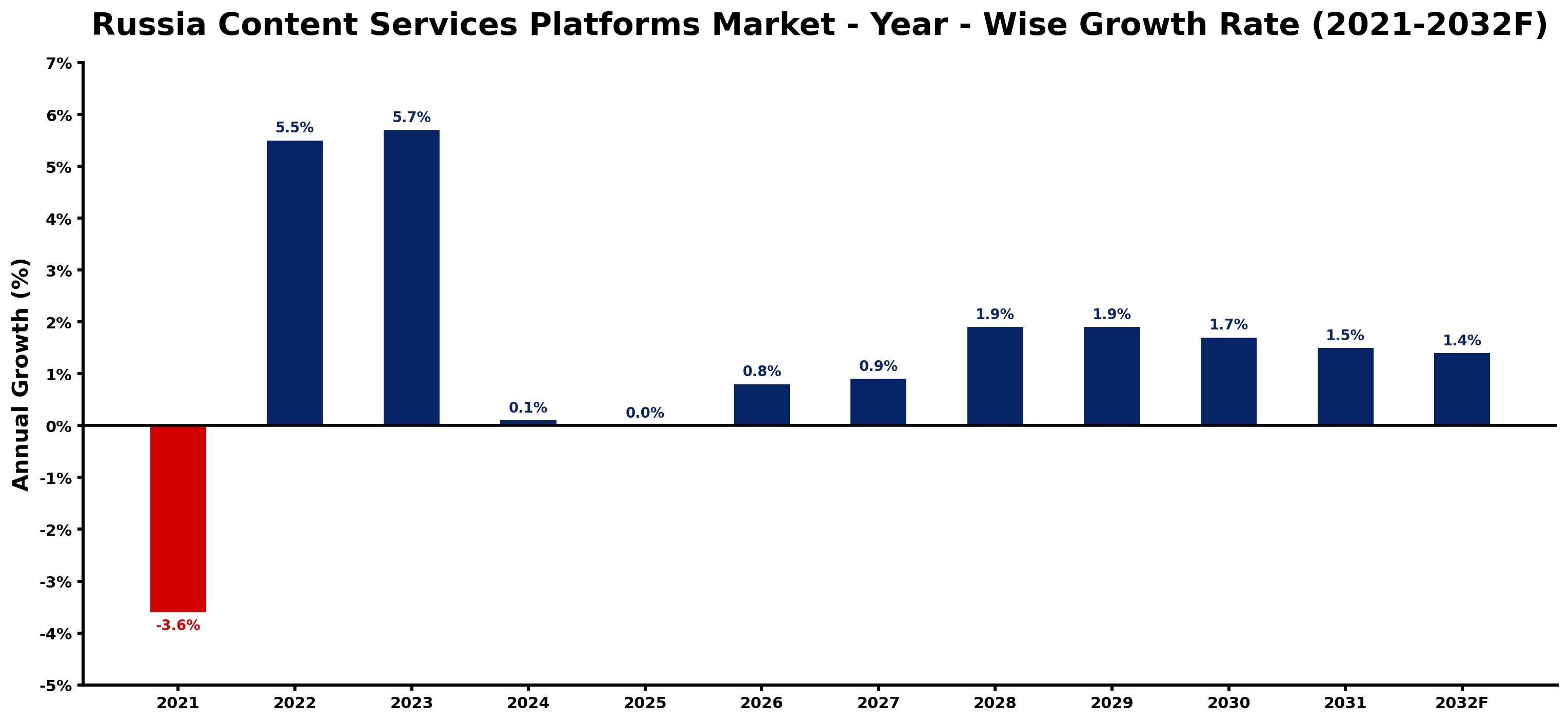
The table below presents the year‑wise growth rates along with the key drivers influencing the market
| Year | Growth Rate | Major Drivers |
| 2021 | -3.6% | Increasing censorship laws by the Russian government |
| 2022 | 5.5% | Increased investment in localized content production strategies |
| 2023 | 5.7% | Growing audience for independent Russian film and series |
| 2024 | 0.1% | Government endorsement of domestic digital rights management |
| 2025 | 0.0% | Increasing adoption of advanced technologies |
| 2026 | 0.8% | Emergence of niche platforms targeting Russian youth |
| 2027 | 0.9% | Surge in Russian-language content from local creators |
| 2028 | 1.9% | Strengthened consumer preference for anti-foreign platform options |
| 2029 | 1.9% | Popularity of user-generated content among younger demographics |
| 2030 | 1.7% | Adoption of homegrown social media influencing content trends |
| 2031 | 1.5% | Local partnerships enhancing content distribution networks |
| 2032 | 1.4% | Evolving consumer behavior favoring subscription-based models |
Note: Market size estimations and growth projections presented in this report are based on 6Wresearch's proprietary forecasting methodology, utilizing the latest available industry data, government publications, and primary research inputs.
Russia Content Services Platforms Market Key Takeaways
Below are some of the specific key takeaways from the market, including:
- Steady growth fueled by rising digitalization and consumer demand for personalized content.
- Technological advancements such as AI and machine learning are enhancing content delivery and management.
- Emerging trends include a shift toward interactive content and localized offerings for diverse audiences.
- Investment opportunities exist in content management systems and analytics tools tailored to local needs.
- Government regulations are shaping operational practices, influencing both compliance and content strategy.
Evaluation of Restraints in Russia Content Services Platforms Market
Several factors are currently holding back the Russia Content Services Platforms Market. The complex regulatory environment complicates compliance for content providers, while ongoing data privacy concerns create significant hurdles. on top of that, the challenge of limited internet penetration in certain regions restricts access to digital content, hindering market expansion. Companies must also address the diverse preferences of Russian consumers, requiring tailored content strategies that resonate culturally and linguistically. These factors collectively underscore the need for a nuanced approach to market entry and growth.
Russia Content Services Platforms Market Trends
Current trends indicate a clear movement toward personalized and interactive content experiences. With the surge in demand for streaming services, platforms are increasingly implementing AI-driven recommendations to enhance user engagement. There’s also a growing focus on content localization, with many providers investing in original productions that cater specifically to Russian consumers. Partnerships between content creators and technology firms are on the rise, aimed at utilizing data analytics for more effective content delivery.
Russia Content Services Platforms Market Opportunities
The market presents a wealth of opportunities for growth and investment. As digital content consumption continues to rise, there’s an urgent need for sophisticated content services platforms that prioritize user engagement. Investors should look into companies specializing in content management systems and video streaming services tailored for the Russian audience. Collaborating with local media companies can offer a strategic edge, while focusing on technology that improves content discovery and user experience stands to capitalize on changing consumer habits.
Government Initiatives in the Russia Content Services Platforms Market
Government policies are playing a critical role in shaping the Russia Content Services Platforms Market. Current regulations focus on enhancing data security and ensuring content compliance, reflecting broader national interests in digital sovereignty. As the regulatory landscape evolves, businesses must remain agile to adapt to new requirements.
- A recently implemented regulation mandates that all online platforms store user data within Russian borders to bolster data protection.
- Current initiatives include ongoing discussions around content restrictions aimed at curbing illegal material, affecting how platforms curate their offerings.
- A planned public-private partnership is expected to enhance digital infrastructure by 2028, improving access to content services across the country.
- Upcoming policies are anticipated to address foreign ownership limits in media, potentially reshaping competitive dynamics in the market.
Future Insights of the Russia Content Services Platforms Market
Looking towards 2026-2032, the Russia Content Services Platforms Market is set for promising developments. The growing reliance on digital content suggests an increase in demand for platforms that streamline content creation and distribution. With mobile devices becoming ubiquitous, content services will need to adapt rapidly. The integration of advanced technologies like AI will facilitate more personalized and efficient content delivery, making this an exciting period for stakeholders in the industry.
Russia Content Services Platforms Market Latest Developments
In the past year, the Russia Content Services Platforms Market has witnessed notable developments that signal its dynamic nature. Companies are increasingly focused on innovation, leading to advancements in content delivery and user engagement strategies.
- A major technology vendor launched a new content management system in Q1 2025, designed to enhance user experience and analytics capabilities.
- In mid-2025, a leading regional operator initiated a partnership with local media firms to expand its content library, aiming for a broader audience reach.
- An ongoing project started in early 2025 focuses on developing AI-driven recommendation systems to improve content discovery.
- Upcoming enhancements are expected in the second half of 2026, aimed at integrating cross-device functionalities for seamless user experiences.
Russia Content Services Platforms Market - Key Attractiveness of the Report
- 10 Years of Market Numbers
- Historical Data Starting from 2022 to 2025
- Base Year: 2025
- Forecast Data until 2032
- Key Performance Indicators Impacting the Market
- Major Upcoming Developments and Projects
Key Highlights of the Report:
- Russia Content Services Platforms Market Outlook
- Market Size of Russia Content Services Platforms Market, 2025
- Forecast of Russia Content Services Platforms Market, 2032
- Historical Data and Forecast of Russia Content Services Platforms Revenues & Volume for the Period 2022-2032F
- Russia Content Services Platforms Market Trend Evolution
- Russia Content Services Platforms Market Drivers and Challenges
- Russia Content Services Platforms Price Trends
- Russia Content Services Platforms Porter's Five Forces
- Russia Content Services Platforms Industry Life Cycle
- Historical Data and Forecast of Russia Content Services Platforms Market Revenues & Volume By Business Function for the Period 2022-2032F
- Historical Data and Forecast of Russia Content Services Platforms Market Revenues & Volume By Human Resource for the Period 2022-2032F
- Historical Data and Forecast of Russia Content Services Platforms Market Revenues & Volume By Sales and Marketing for the Period 2022-2032F
- Historical Data and Forecast of Russia Content Services Platforms Market Revenues & Volume By Accounting and Legal for the Period 2022-2032F
- Historical Data and Forecast of Russia Content Services Platforms Market Revenues & Volume By Procurement and Supply Chain Management for the Period 2022-2032F
- Historical Data and Forecast of Russia Content Services Platforms Market Revenues & Volume By Deployment Mode for the Period 2022-2032F
- Historical Data and Forecast of Russia Content Services Platforms Market Revenues & Volume By Cloud for the Period 2022-2032F
- Historical Data and Forecast of Russia Content Services Platforms Market Revenues & Volume By On-premises for the Period 2022-2032F
- Historical Data and Forecast of Russia Content Services Platforms Market Revenues & Volume By Enterprise Size for the Period 2022-2032F
- Historical Data and Forecast of Russia Content Services Platforms Market Revenues & Volume By Large Enterprises for the Period 2022-2032F
- Historical Data and Forecast of Russia Content Services Platforms Market Revenues & Volume By SMEs for the Period 2022-2032F
- Historical Data and Forecast of Russia Content Services Platforms Market Revenues & Volume By Vertical for the Period 2022-2032F
- Historical Data and Forecast of Russia Content Services Platforms Market Revenues & Volume By Banking, Financial Services, and Insurance for the Period 2022-2032F
- Historical Data and Forecast of Russia Content Services Platforms Market Revenues & Volume By Retail and Consumer Goods for the Period 2022-2032F
- Historical Data and Forecast of Russia Content Services Platforms Market Revenues & Volume By Energy and Utilities for the Period 2022-2032F
- Historical Data and Forecast of Russia Content Services Platforms Market Revenues & Volume By Government and Public Sector for the Period 2022-2032F
- Historical Data and Forecast of Russia Content Services Platforms Market Revenues & Volume By Healthcare and Life Sciences for the Period 2022-2032F
- Historical Data and Forecast of Russia Content Services Platforms Market Revenues & Volume By IT and ITeS for the Period 2022-2032F
- Historical Data and Forecast of Russia Content Services Platforms Market Revenues & Volume By Manufacturing for the Period 2022-2032F
- Russia Content Services Platforms Import Export Trade Statistics
- Market Opportunity Assessment By Business Function
- Market Opportunity Assessment By Deployment Mode
- Market Opportunity Assessment By Enterprise Size
- Market Opportunity Assessment By Vertical
- Russia Content Services Platforms Top Companies Market Share
- Russia Content Services Platforms Competitive Benchmarking By Technical and Operational Parameters
- Russia Content Services Platforms Company Profiles
- Russia Content Services Platforms Key Strategic Recommendations






































