Russia Data Protection Market Size & Growth Rate (2026-2032)
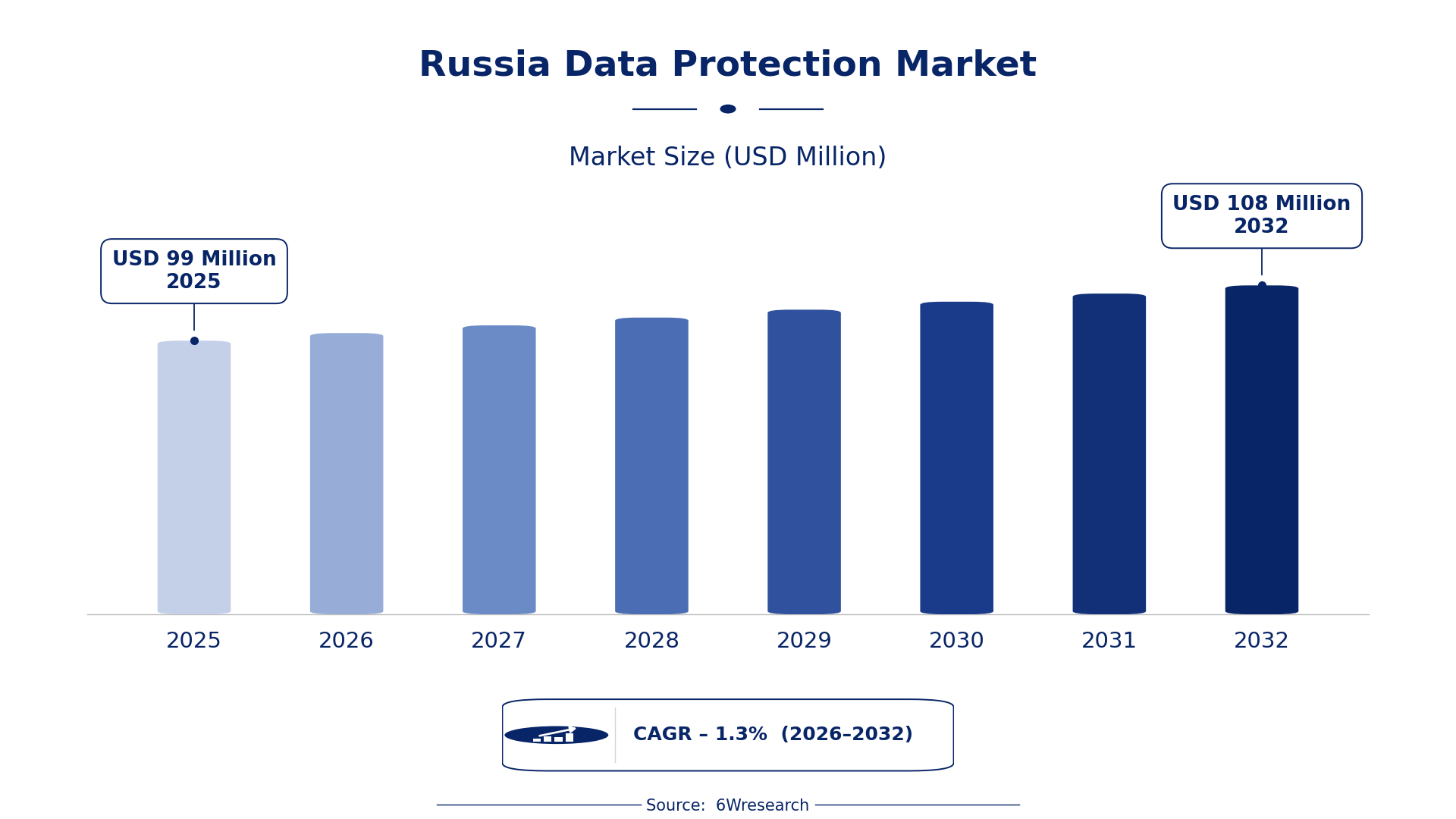
The Russia Data Protection Market was estimated at USD 99 Million in 2025 and is projected to reach USD 108 Million by 2032, growing at a CAGR of 1.3% from 2026 to 2032.
Russia Data Protection Market Synopsis
In recent years, the Russia Data Protection Market has gained notable traction, fueled by rising data privacy concerns and the implementation of stringent regulations. Organizations are increasingly recognizing the necessity of robust data protection measures to safeguard sensitive information amidst escalating cybersecurity threats.
Looking forward, the market is expected to evolve further as compliance requirements tighten and awareness of data security risks grows. Businesses of all sizes are shifting their focus toward innovative data protection solutions to not only protect their assets but also to meet regulatory mandates effectively.
Russia Data Protection Market Year-wise Growth Rate and Key Drivers
This graph illustrates the annual growth rates of the Russia Data Protection Market from 2021 to 2032, highlighting a steady upward trajectory and projected expansion over the forecast period.
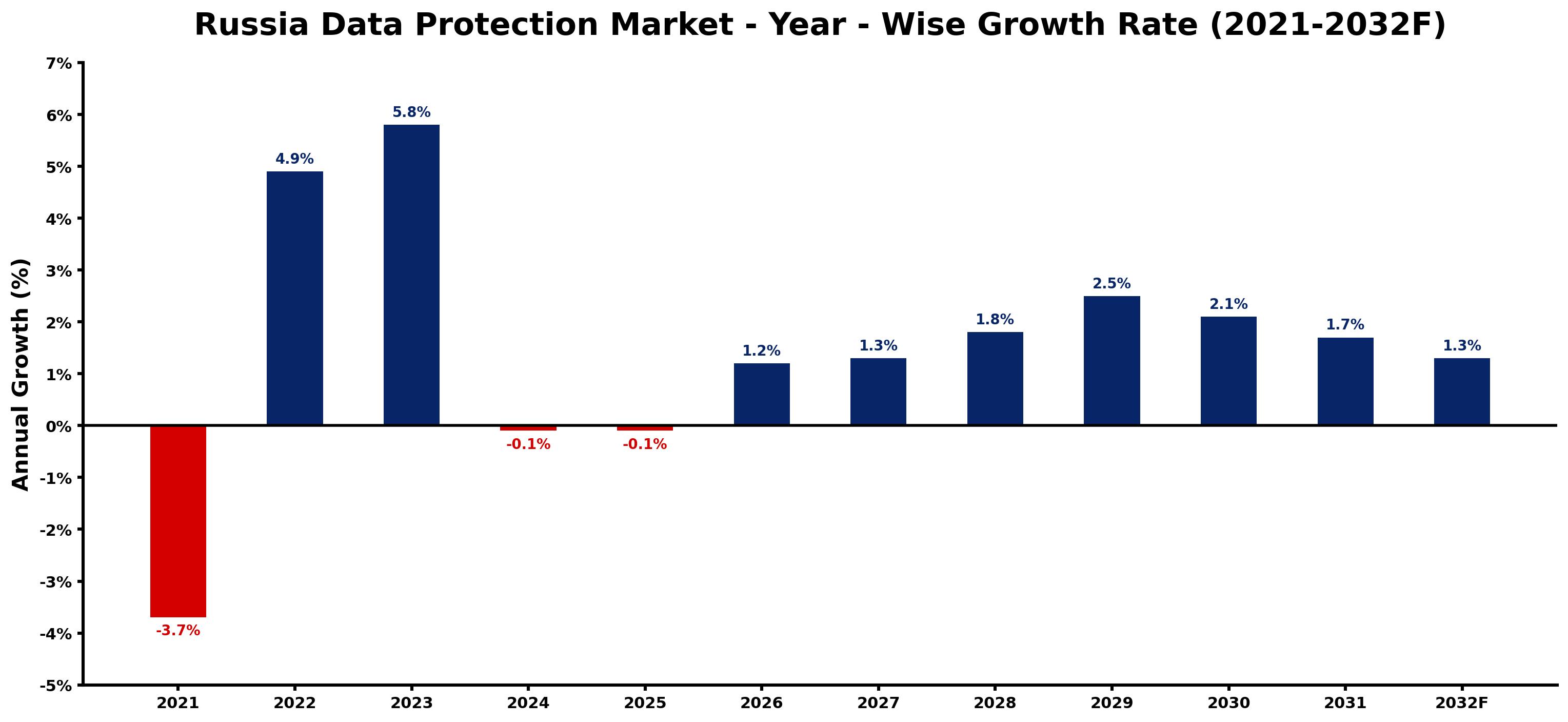
The table below presents the year‑wise growth rates along with the key drivers influencing the market
| Year | Growth Rate | Major Drivers |
| 2021 | -3.7% | Tightened regulations by Roskomnadzor on data storage. |
| 2022 | 4.9% | Implementation of data localization laws by Roskomnadzor |
| 2023 | 5.8% | Increased demand for compliance with personal data regulations |
| 2024 | -0.1% | Economic sanctions hinder investment in cybersecurity technologies. |
| 2025 | -0.1% | Declining trust in local data protection services. |
| 2026 | 1.2% | Growth in cyber insurance policies boosting data security demands |
| 2027 | 1.3% | Rising awareness of data privacy among Russian consumers |
| 2028 | 1.8% | Adoption of AI technologies for enhanced data protection mechanisms |
| 2029 | 2.5% | Strengthening of legal frameworks around digital rights protection |
| 2030 | 2.1% | Emergence of local content regulation enhancing data safeguarding |
| 2031 | 1.7% | Initiatives promoting cybersecurity education and training programs |
| 2032 | 1.3% | Boost in investments for protecting sensitive user data |
Note: Market size estimations and growth projections presented in this report are based on 6Wresearch's proprietary forecasting methodology, utilizing the latest available industry data, government publications, and primary research inputs.
Russia Data Protection Market Key Takeaways
Below are some of the specific key takeaways from the market, including:
- Robust growth driven by regulatory compliance and heightened data privacy awareness.
- Increased demand for encryption technologies and cybersecurity solutions across various sectors.
- Cloud-based data protection solutions are becoming essential for many organizations.
- Investment opportunities abound, particularly in compliance software and consulting services.
- Regulatory landscape continues to evolve, necessitating continuous adaptation by businesses.
Evaluation of Restraints in Russia Data Protection Market
The complexity of Russia's regulatory environment poses significant challenges for businesses in the data protection sector. The stringent requirements under laws such as the Federal Law on Personal Data can be daunting to interpret and implement. Additionally, concerns regarding rising cyber threats and data breaches add layers of difficulty to compliance efforts. Many organizations struggle with a lack of awareness about the critical importance of data protection, further hindering effective implementation.
Russia Data Protection Market Trends
A marked trend toward greater emphasis on data localization is unfolding in the market, largely driven by governmental regulations requiring personal data of Russian citizens to be stored domestically. Organizations are increasingly prioritizing encryption technologies and data loss prevention tools as essential components of their security strategies. The rise of remote work has also catalyzed the need for securing data across distributed networks, further amplifying interest in cloud security solutions.
Russia Data Protection Market Opportunities
Investors and service providers can find numerous opportunities within the Russia Data Protection Market. The ongoing need for compliance with strict data protection laws creates demand for advanced technologies tailored to the region. There is a notable rise in demand for cybersecurity consulting services as organizations seek expert guidance on navigating regulatory complexities. Additionally, as businesses increasingly adopt cloud computing, the market for cloud-based data protection solutions is set to expand significantly.
Government Initiatives in the Russia Data Protection Market
The regulatory environment significantly influences the dynamics of the Russia Data Protection Market. Recent government initiatives have focused on strengthening data protection frameworks, ensuring compliance and enhancing security measures. These efforts are crucial as organizations adapt to both domestic and international data protection requirements.
- A recently completed initiative mandated that all personal data of Russian citizens must be stored on local servers, emphasizing data localization.
- Currently underway is the development of a national cybersecurity strategy aimed at addressing emerging threats and enhancing data protection capabilities.
- Planned initiatives include expanded educational programs to raise awareness about the importance of data protection across various industries.
- Ongoing efforts to refine regulatory guidelines to support businesses in achieving compliance with the Federal Law on Personal Data.
- A proposed public-private partnership aimed at upgrading national data infrastructure to bolster cybersecurity defenses.
Future Insights of the Russia Data Protection Market
In the next several years, the Russia Data Protection Market is anticipated to grow steadily as both businesses and consumers become more aware of data security issues. Companies will increasingly invest in cutting-edge technologies to protect sensitive information while also ensuring compliance with evolving regulations. This forward momentum is likely to attract investment into cybersecurity solutions, paving the way for innovative developments tailored specifically for the Russian market.
Russia Data Protection Market Latest Developments
Over the past year, the Russia Data Protection Market has witnessed several noteworthy developments. Organizations are actively enhancing their data protection strategies in response to regulatory pressures and escalating cyber threats. This trend is shaping the competitive dynamics within the market.
- A leading technology provider launched a new encryption software solution in Q3 2025, aimed at improving data security for businesses across sectors.
- A regional cybersecurity firm initiated a comprehensive training program for organizations in early 2025 to bolster understanding of data protection regulations.
- An industry consortium formed in mid-2025 is focused on developing standardized data protection practices to facilitate compliance for small businesses.
- Upcoming initiatives include a rollout planned for early 2026 that aims to expand access to localized cloud services for enhanced data protection.
- A pilot program launched in late 2025 focuses on integrating AI-driven analytics into data security frameworks for real-time threat detection.
Russia Data Protection Market - Key Attractiveness of the Report
- 10 Years of Market Numbers
- Historical Data Starting from 2022 to 2025
- Base Year: 2025
- Forecast Data until 2032
- Key Performance Indicators Impacting the Market
- Major Upcoming Developments and Projects
Key Highlights of the Report:
- Russia Data Protection Market Outlook
- Market Size of Russia Data Protection Market, 2025
- Forecast of Russia Data Protection Market, 2032
- Historical Data and Forecast of Russia Data Protection Revenues & Volume for the Period 2022-2032F
- Russia Data Protection Market Trend Evolution
- Russia Data Protection Market Drivers and Challenges
- Russia Data Protection Price Trends
- Russia Data Protection Porter's Five Forces
- Russia Data Protection Industry Life Cycle
- Historical Data and Forecast of Russia Data Protection Market Revenues & Volume By Component for the Period 2022-2032F
- Historical Data and Forecast of Russia Data Protection Market Revenues & Volume By Solutions for the Period 2022-2032F
- Historical Data and Forecast of Russia Data Protection Market Revenues & Volume By Services (Professional Services and Managed Services) for the Period 2022-2032F
- Historical Data and Forecast of Russia Data Protection Market Revenues & Volume By Deployment Mode for the Period 2022-2032F
- Historical Data and Forecast of Russia Data Protection Market Revenues & Volume By On-premises for the Period 2022-2032F
- Historical Data and Forecast of Russia Data Protection Market Revenues & Volume By Cloud for the Period 2022-2032F
- Historical Data and Forecast of Russia Data Protection Market Revenues & Volume By Industry Vertical for the Period 2022-2032F
- Historical Data and Forecast of Russia Data Protection Market Revenues & Volume By Government and defense for the Period 2022-2032F
- Historical Data and Forecast of Russia Data Protection Market Revenues & Volume By Banking, Financial Services, and Insurance (BFSI) for the Period 2022-2032F
- Historical Data and Forecast of Russia Data Protection Market Revenues & Volume By Healthcare for the Period 2022-2032F
- Historical Data and Forecast of Russia Data Protection Market Revenues & Volume By IT and telecom for the Period 2022-2032F
- Historical Data and Forecast of Russia Data Protection Market Revenues & Volume By Consumer goods and retail for the Period 2022-2032F
- Historical Data and Forecast of Russia Data Protection Market Revenues & Volume By Education for the Period 2022-2032F
- Historical Data and Forecast of Russia Data Protection Market Revenues & Volume By Media and entertainment for the Period 2022-2032F
- Historical Data and Forecast of Russia Data Protection Market Revenues & Volume By Organization Size Large Enterprises for the Period 2022-2032F
- Historical Data and Forecast of Russia Data Protection Market Revenues & Volume By SMEs for the Period 2022-2032F
- Historical Data and Forecast of Russia Data Protection Market Revenues & Volume By Large Enterprises for the Period 2022-2032F
- Russia Data Protection Import Export Trade Statistics
- Market Opportunity Assessment By Component
- Market Opportunity Assessment By Deployment Mode
- Market Opportunity Assessment By Industry Vertical
- Market Opportunity Assessment By Organization Size Large Enterprises
- Russia Data Protection Top Companies Market Share
- Russia Data Protection Competitive Benchmarking By Technical and Operational Parameters
- Russia Data Protection Company Profiles
- Russia Data Protection Key Strategic Recommendations






































