Topics Covered in Russia Food Coating Market Report
Russia Food Coating Market Report thoroughly covers the market by ingredient type, form and application. Russia Food Coating Market Outlook report provides an unbiased and detailed analysis of the ongoing Russia Food Coating Market trends, opportunities/high growth areas, and market drivers. This would help stakeholders devise and align their market strategies according to the current and future market dynamics.
Russia Food Coating Market Synopsis
The Russia Food Coating market saw steady growth from 2020 to early 2022, driven by increasing demand for processed foods and supportive government initiatives. In response to geopolitical challenges and sanctions, the government increased key strategies such as the National Food Security Policy (2018-2027), which aimed to reduce import dependence and promote domestic production of essential food products, including grains, meat, dairy, and sugar. This approach has strengthened the Russian food sector amidst ongoing conflict. As a result, sugar production rose from 624.7 thousand tonnes to 659.7 thousand tonnes in 2023, while chocolate production increased by 6.6%, reaching 273.7 thousand tonnes in the same period. In 2023, the agro-industrial complex in Russia supported 325 export-focused projects with $11 billion in investments, significantly enhancing food production capacity. This growth, particularly in processed food products such as cheese and cream, which experienced growth rates of 16% and 21%, respectively, in 2023, is driving higher demand for food coatings to extend product shelf life. These gains drove the demand for food coatings across Russia in the previous years.
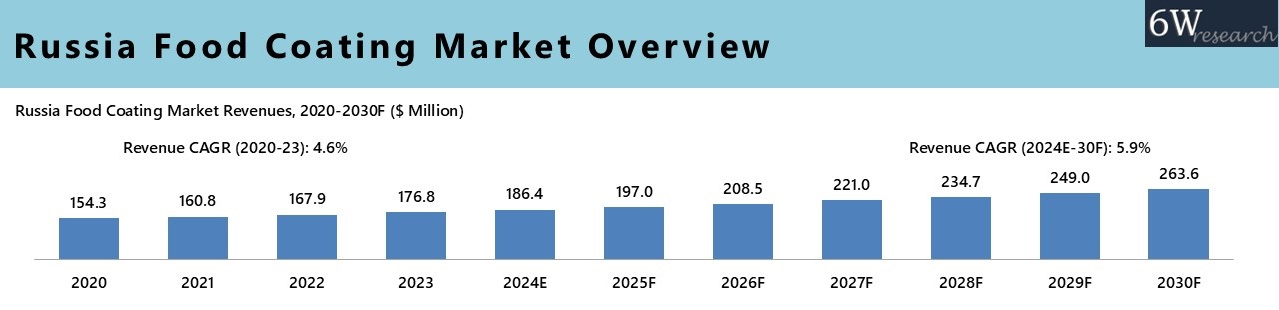
According to 6Wresearch, Russia Food Coating Market size is projected to grow at a CAGR of 5.9% during 2024-2030F. The Russian government's ongoing initiatives under the State Program for the Development of Agriculture and Regulation of Agricultural Markets (2021-2030) aims to boost domestic agricultural production by 25% by 2030, compared to 2021, while increasing exports by 50%. Additionally, the bakery and confectionery sectors are on an upward trajectory, with bakery sales expected to reach $12 billion by the end of 2024. Furthermore, annual meat consumption is projected to rise to 83 kg per person by 2024, up from 80 kg in 2023, which would increase the need for extended preservation during storage and transportation, driving the use of food coatings to prevent spoilage, reduce moisture loss, and maintain meat freshness. This growth trend is expected to continue due to urbanization, changing consumer preferences, and increased investments in quick-service restaurants (QSRs) and ready-to-eat snacks. With ready-to-eat food sales anticipated to reach 800,000 tons by 2025, the demand for food coatings across Russia is set to rise significantly in coming years.
Market Segmentation By Ingredient Type
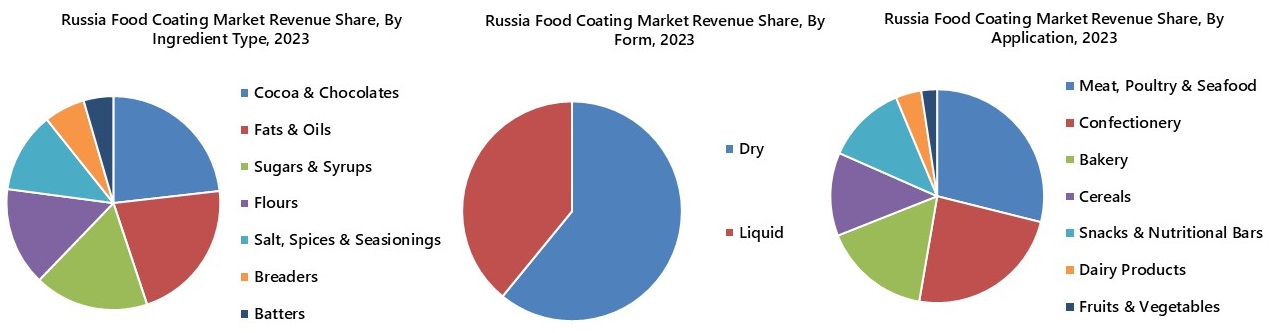
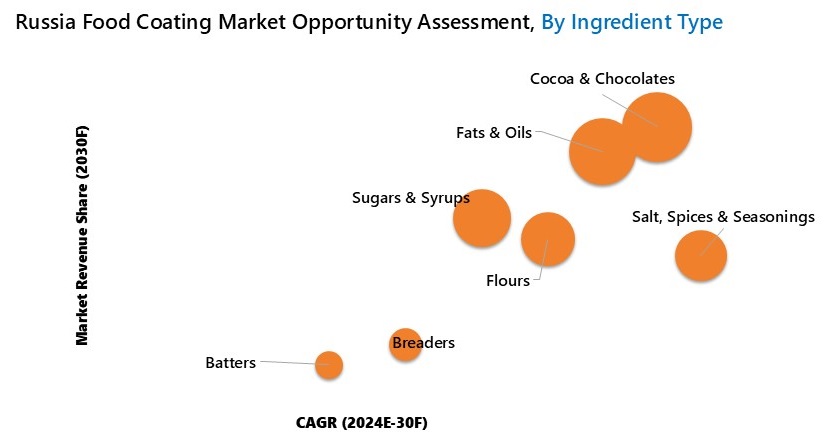
In the forthcoming years, salt, spices & seasonings are expected to experience significant growth driven by rising snack consumption and the expansion of restaurants and cafes across Russia. Meanwhile, cocoa & chocolates would have maximum revenue size due to growing demand for chocolate-coated products, reflecting consumer trends toward comfort foods and innovative snack By balancing focus on both salt, spices & seasonings and cocoa & chocolates, businesses could tap into diverse markets and maximize their sales.
Market Segmentation By Form
Dry food coating is expected to see the highest growth in the Russia food coating market due to their versatility and appeal for crunchy snacks. Additionally, the rise in health-conscious eating is driving demand for dry coatings made from whole grains and natural ingredients, as consumers seek nutritious options.
Market Segmentation By Application
The meat, poultry & seafood segment is anticipated to have maximum revenue size due to rising meat consumption and an emphasis on product quality. However, in the coming years, snacks & nutritional bars are expected to see notable growth, driven by urbanization and evolving lifestyles, which are expected to generate the demand for convenient and on-the-go options options that appeal to health-conscious consumers. By balancing focus on both snacks and nutritional bars and meat, poultry, and seafood businesses could tap into diverse markets and maximize their sales.
Key Attractiveness of the Report
- 10 Years Market Numbers.
- Historical Data Starting from 2020 to 2023.
- Base Year: 2023
- Forecast Data until 2030.
- Key Performance Indicators Impacting the Market.
- Major Upcoming Developments and Projects.
Key Highlights of the Report:
- Russia Food Coating Market Overview
- Russia Food Coating Market Outlook 2020-2030F
- Historical Data of Russia Food Coating Market Revenues, for the Period 2020-2023
- Russia Food Coating Market Forecast of Revenues, Until 2030
- Historical Data of Russia Food Coating Market Revenues, by Ingredient Types, Form and Application, for the Period 2020-2023
- Forecasted market size of Russia Food Coating Market Revenues, by Ingredient Types, Form and Application, until 2030
- Russia Food Coating Market Revenue share, by Ingredient Types, Form and Application, 2023 & 2030F.
- Industry Life Cycle
- Russia Food Coating Market Porter 5 Forces
- Market Drivers and Restraints
- Market Trends and Evolution
- Russia Food Coating Market Opportunity Assessment
- Market Company Share.
- Market Competitive Benchmarking
- Company Profiles
- Key Strategic Recommendations
Market Scope and Segmentation
Thereportprovides a detailed analysis of the following market segments:
By Ingredient Type
- Cocoa & Chocolates
- Fats & Oils
- Flours
- Sugars & Syrups
- Salt, Spices & Seasonings
- Breaders
- Batters
By Form
- Dry (includes Powder and Crumbs)
- Liquid
By Application
- Meat, Poultry & Seafood
- Confectionery
- Bakery
- Cereals
- Snacks & Nutritional Bars
- Dairy Products
- Fruits & Vegetables






































