Russia Government Cloud Market Size & Growth Rate (2026-2032)
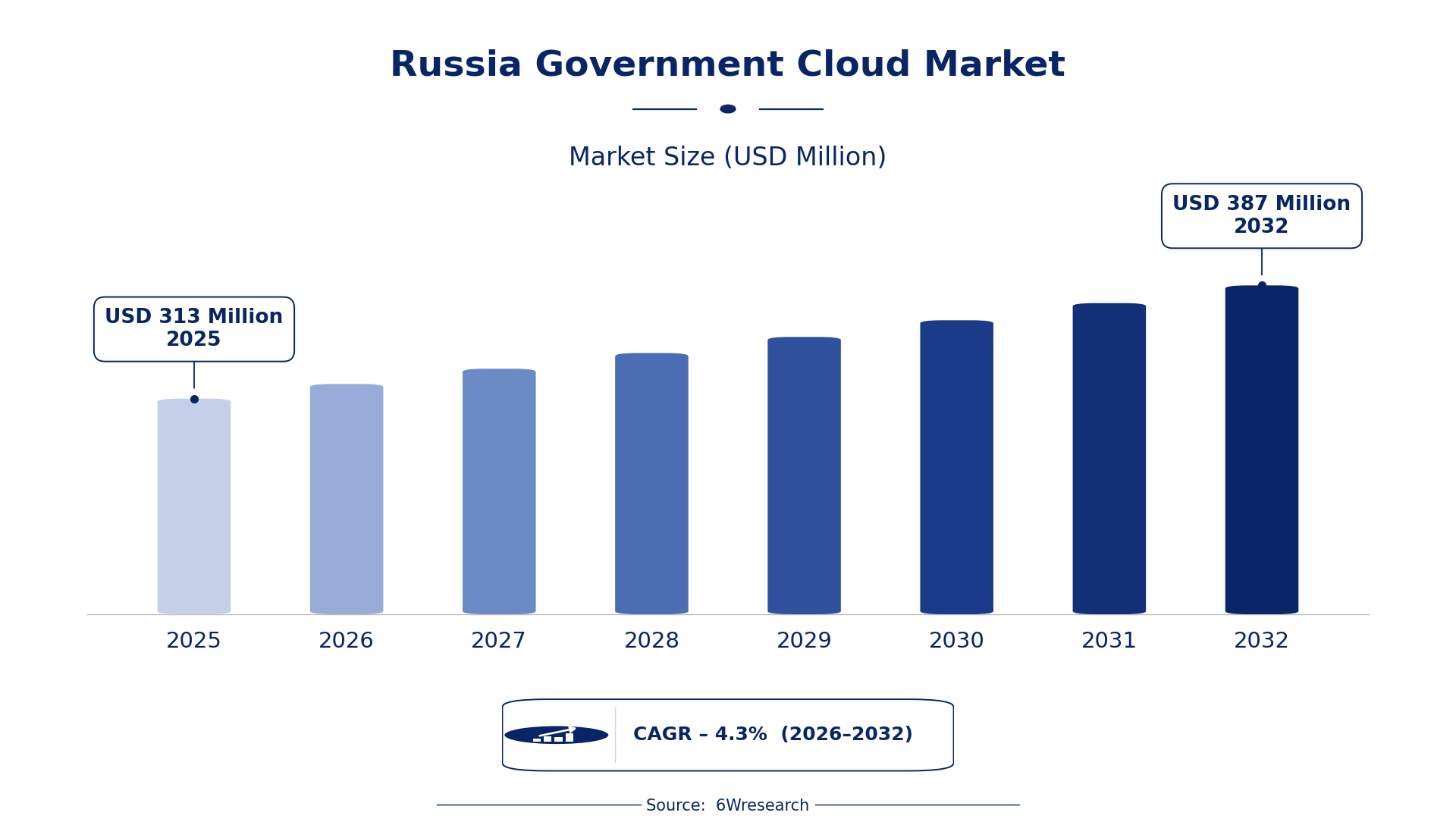
The Russia Government Cloud Market was estimated at USD 313 Million in 2025 and is projected to reach USD 387 Million by 2032, growing at a CAGR of 4.3% from 2026 to 2032.
Russia Government Cloud Market Synopsis
The demand for cloud services within Russian government agencies is intensifying as they seek to modernize their operations and improve efficiency. Local cloud providers are stepping up to cater to this demand by offering tailored services that align with government regulations and specific needs.
As the government continues to emphasize digital transformation, there is a noticeable shift towards hybrid cloud solutions. This approach allows agencies to achieve a balance between security and accessibility while fostering innovation through advanced technologies such as AI and data analytics.
Russia Government Cloud Market Year-wise Growth Rate and Key Drivers
This graph illustrates the annual growth rates of the Russia Government Cloud Market from 2021 to 2032, highlighting a steady upward trajectory and projected expansion over the forecast period.
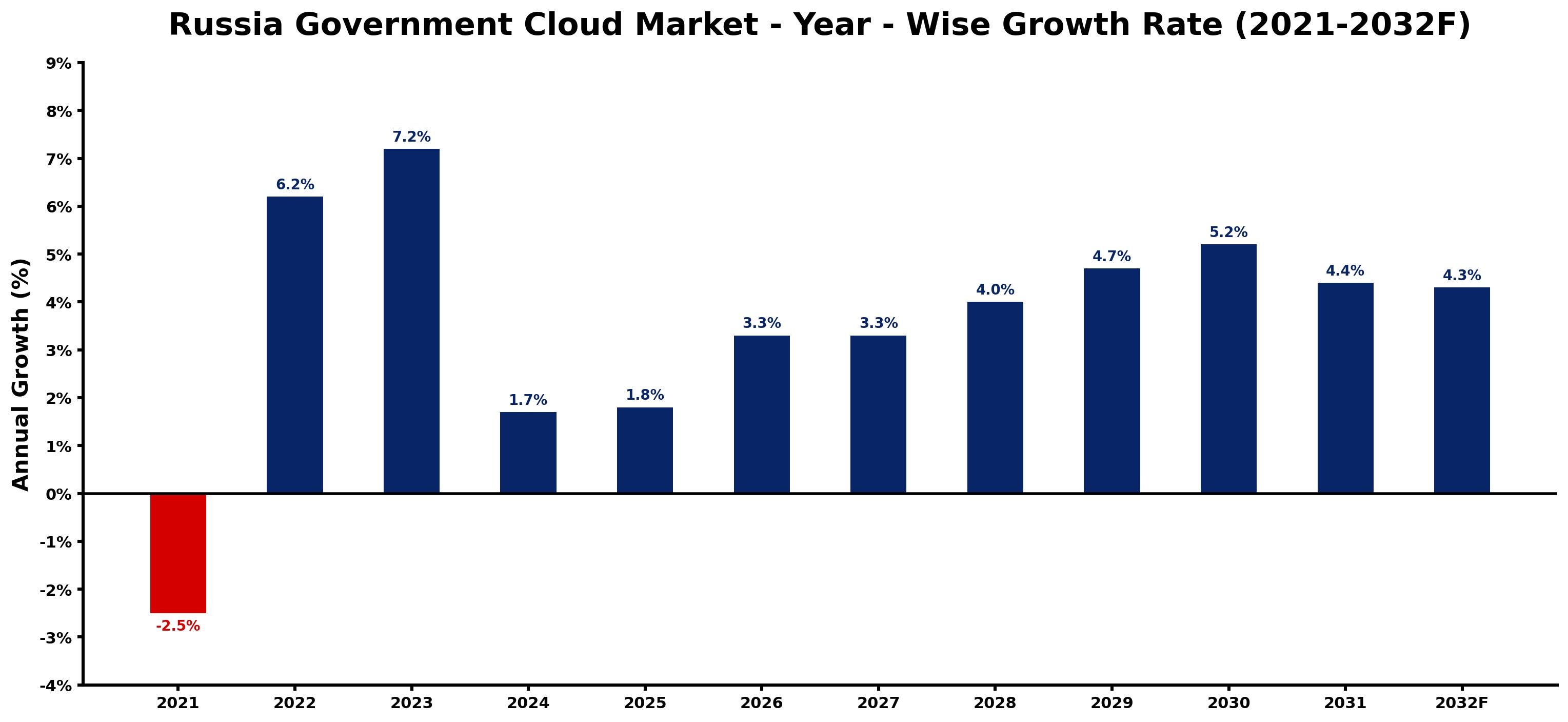
The table below presents the year‑wise growth rates along with the key drivers influencing the market
| Year | Growth Rate | Major Drivers |
| 2021 | -2.5% | Increased sanctions limited foreign technology access. |
| 2022 | 6.2% | Government cybersecurity initiatives boost cloud service adoption. |
| 2023 | 7.2% | Increased digitalization in public sector drives cloud investments. |
| 2024 | 1.7% | Public sector modernization necessitates advanced cloud solutions. |
| 2025 | 1.8% | Legislative changes encourage public data storage in clouds. |
| 2026 | 3.3% | Growing emphasis on data sovereignty pushing cloud usage. |
| 2027 | 3.3% | Strategic alliances with local cloud providers enhance services. |
| 2028 | 4.0% | Enhanced data analytics capabilities stimulate cloud service demand. |
| 2029 | 4.7% | Investment in digital identity services fosters secure cloud access. |
| 2030 | 5.2% | State-funded cloud projects support digital transformation efforts. |
| 2031 | 4.4% | Market consolidation improves availability of local cloud solutions. |
| 2032 | 4.3% | Public procurement policies favor cloud service adoption. |
Note: Market size estimations and growth projections presented in this report are based on 6Wresearch's proprietary forecasting methodology, utilizing the latest available industry data, government publications, and primary research inputs.
Russia Government Cloud Market Key Takeaways
Below are some of the specific key takeaways from the market, including:
- The market is driven by a strong governmental push for digital transformation and modernization.
- Cloud solutions are increasingly being adopted to enhance service delivery and operational efficiency in public agencies.
- Hybrid cloud models are gaining traction as they offer a balance between data security and accessibility.
- Data localization laws are compelling providers to invest in local infrastructure to meet regulatory requirements.
- There are substantial opportunities for tailored cloud solutions to address the specific needs of government entities.
Evaluation of Restraints in Russia Government Cloud Market
The growth of the Russia Government Cloud Market is hindered by several constraints. Data localization requirements pose a significant challenge, as they necessitate that all government data be stored domestically. This forces cloud providers to invest heavily in local data centers, impacting overall operational costs.
Cybersecurity threats remain a persistent concern, particularly given the sensitivity of government data. The risk of data breaches is heightened when sensitive information is stored in cloud environments. on top of that, ensuring interoperability with existing legacy systems can complicate the adoption of cloud solutions, as many government agencies still rely on outdated infrastructure.
Russia Government Cloud Market Trends
A clear trend in the Russia Government Cloud Market is the increasing adoption of hybrid cloud solutions. This shift reflects a growing recognition of the need for both security and flexibility in data management. Additionally, the integration of AI and data analytics into government operations is becoming more prevalent, enhancing decision-making and operational efficiency.
Another key trend is the heightened focus on data localization, with government regulations mandating that sensitive information be stored within the country. This has driven local cloud providers to expand their services, ensuring compliance while also catering to the unique needs of public-sector clients.
Russia Government Cloud Market Opportunities
The Russia Government Cloud Market presents numerous growth opportunities for cloud service providers. As government agencies seek to modernize their IT infrastructure, there is a demand for secure data storage, disaster recovery solutions, and scalable cloud services tailored to public sector needs. on top of that, the ongoing digital transformation initiatives create a fertile ground for innovation and collaboration among technology vendors.
Investments in local data centers and compliance solutions will be crucial as the government continues to enforce data localization requirements. Providers that can navigate these regulatory landscapes while delivering effective solutions will find substantial opportunities for expansion.
Government Initiatives in the Russia Government Cloud Market
The Russian government is actively shaping the direction of the Government Cloud Market through various initiatives aimed at enhancing data security and promoting domestic cloud services. Regulatory frameworks are being established to ensure compliance with data protection laws while fostering the growth of local cloud infrastructure. These policies prioritize data sovereignty and are essential for addressing the unique challenges faced by the public sector.
- A regulatory framework mandating the storage of government data within Russia has been recently implemented, increasing demand for local cloud providers.
- Current initiatives focus on upgrading digital infrastructure, with several public agencies transitioning to cloud-based services to enhance efficiency.
- Ongoing programs aim to foster collaboration between government and private sector technology firms, promoting innovation in cloud service delivery.
- Plans are underway to expand training and support programs for government employees to improve their proficiency in cloud technologies by 2026.
- Future legislation is expected to introduce clearer guidelines for cloud service procurement, streamlining the process for government agencies.
Future Insights of the Russia Government Cloud Market
Looking ahead to 2026-2032, the Russia Government Cloud Market is set for sustained growth. The ongoing emphasis on digital transformation will drive the adoption of cloud technologies across government agencies. Increased demand for data storage and processing capabilities will further propel the market as agencies seek to enhance their operational capabilities.
The focus on cost savings and the need for scalable IT resources will remain critical factors influencing cloud adoption. As more government organizations shift towards cloud-based solutions, the market will likely witness innovative service offerings tailored to meet the evolving needs of the public sector.
Russia Government Cloud Market Latest Developments
Recent activity in the Russia Government Cloud Market reflects a strong commitment to enhancing digital capabilities across public agencies. The past year has seen various developments aimed at improving cloud infrastructure and services, aligning with government priorities for modernization and efficiency.
- A major technology vendor announced a partnership with a regional government to deploy cloud solutions that enhance data security, with the project launched in Q1 2025 and expected to conclude in Q3 2025.
- A public initiative focusing on upgrading legacy systems to cloud-based architectures is currently underway, with pilot programs being tested in several government departments.
- A cloud service provider is planning to expand its data center capacity in Russia, with the rollout expected to begin in early 2026 to meet increasing demand.
- In mid-2025, a pilot program was launched to integrate AI capabilities into public sector cloud services, aimed at improving operational efficiency.
- A national conference on cloud computing for government services is scheduled for late 2025, aiming to foster collaboration and share best practices among public agencies and technology providers.
Russia Government Cloud Market - Key Attractiveness of the Report
- 10 Years of Market Numbers
- Historical Data Starting from 2022 to 2025
- Base Year: 2025
- Forecast Data until 2032
- Key Performance Indicators Impacting the Market
- Major Upcoming Developments and Projects
Key Highlights of the Report:
- Russia Government Cloud Market Outlook
- Market Size of Russia Government Cloud Market, 2025
- Forecast of Russia Government Cloud Market, 2032
- Historical Data and Forecast of Russia Government Cloud Revenues & Volume for the Period 2022-2032F
- Russia Government Cloud Market Trend Evolution
- Russia Government Cloud Market Drivers and Challenges
- Russia Government Cloud Price Trends
- Russia Government Cloud Porter's Five Forces
- Russia Government Cloud Industry Life Cycle
- Historical Data and Forecast of Russia Government Cloud Market Revenues & Volume By Solutions for the Period 2022-2032F
- Historical Data and Forecast of Russia Government Cloud Market Revenues & Volume By Cloud Storage for the Period 2022-2032F
- Historical Data and Forecast of Russia Government Cloud Market Revenues & Volume By Disaster Recovery for the Period 2022-2032F
- Historical Data and Forecast of Russia Government Cloud Market Revenues & Volume By Identity and Access Management (IAM) for the Period 2022-2032F
- Historical Data and Forecast of Russia Government Cloud Market Revenues & Volume By Risk and compliance management for the Period 2022-2032F
- Historical Data and Forecast of Russia Government Cloud Market Revenues & Volume By Others (reporting and analytics, and security and vulnerability) for the Period 2022-2032F
- Historical Data and Forecast of Russia Government Cloud Market Revenues & Volume By Services for the Period 2022-2032F
- Historical Data and Forecast of Russia Government Cloud Market Revenues & Volume By Training, consulting, and education for the Period 2022-2032F
- Historical Data and Forecast of Russia Government Cloud Market Revenues & Volume By Support and Maintenance for the Period 2022-2032F
- Historical Data and Forecast of Russia Government Cloud Market Revenues & Volume By Integration and Migration for the Period 2022-2032F
- Historical Data and Forecast of Russia Government Cloud Market Revenues & Volume By Service Model for the Period 2022-2032F
- Historical Data and Forecast of Russia Government Cloud Market Revenues & Volume By Infrastructure as a Service (IaaS) for the Period 2022-2032F
- Historical Data and Forecast of Russia Government Cloud Market Revenues & Volume By Platform as a Service (PaaS) for the Period 2022-2032F
- Historical Data and Forecast of Russia Government Cloud Market Revenues & Volume By Software as a Service (SaaS) for the Period 2022-2032F
- Historical Data and Forecast of Russia Government Cloud Market Revenues & Volume By Deployment Model for the Period 2022-2032F
- Historical Data and Forecast of Russia Government Cloud Market Revenues & Volume By Public Cloud for the Period 2022-2032F
- Historical Data and Forecast of Russia Government Cloud Market Revenues & Volume By Private Cloud for the Period 2022-2032F
- Historical Data and Forecast of Russia Government Cloud Market Revenues & Volume By Hybrid Cloud for the Period 2022-2032F
- Russia Government Cloud Import Export Trade Statistics
- Market Opportunity Assessment By Solutions
- Market Opportunity Assessment By Services
- Market Opportunity Assessment By Service Model
- Market Opportunity Assessment By Deployment Model
- Russia Government Cloud Top Companies Market Share
- Russia Government Cloud Competitive Benchmarking By Technical and Operational Parameters
- Russia Government Cloud Company Profiles
- Russia Government Cloud Key Strategic Recommendations






































