Russia Insecticide Market Size, Share & Growth Rate
The Russia Insecticide Market was estimated at USD 89 Million in 2025 and is projected to reach USD 97 Million by 2032, growing at a CAGR of 1.2% from 2026 to 2032. This growth trajectory is driven by the increasing agricultural activities, a pressing need for effective pest management, and rising urbanization across the nation. As farmers and urban residents alike become more aware of the importance of pest control, the demand for innovative insecticide solutions is expected to rise significantly.
Russia Insecticide Market Year-wise Growth Rate and Key Drivers
This graph highlights how the Russia Insecticide Market has steadily grown over the years, supported by major growth factors.
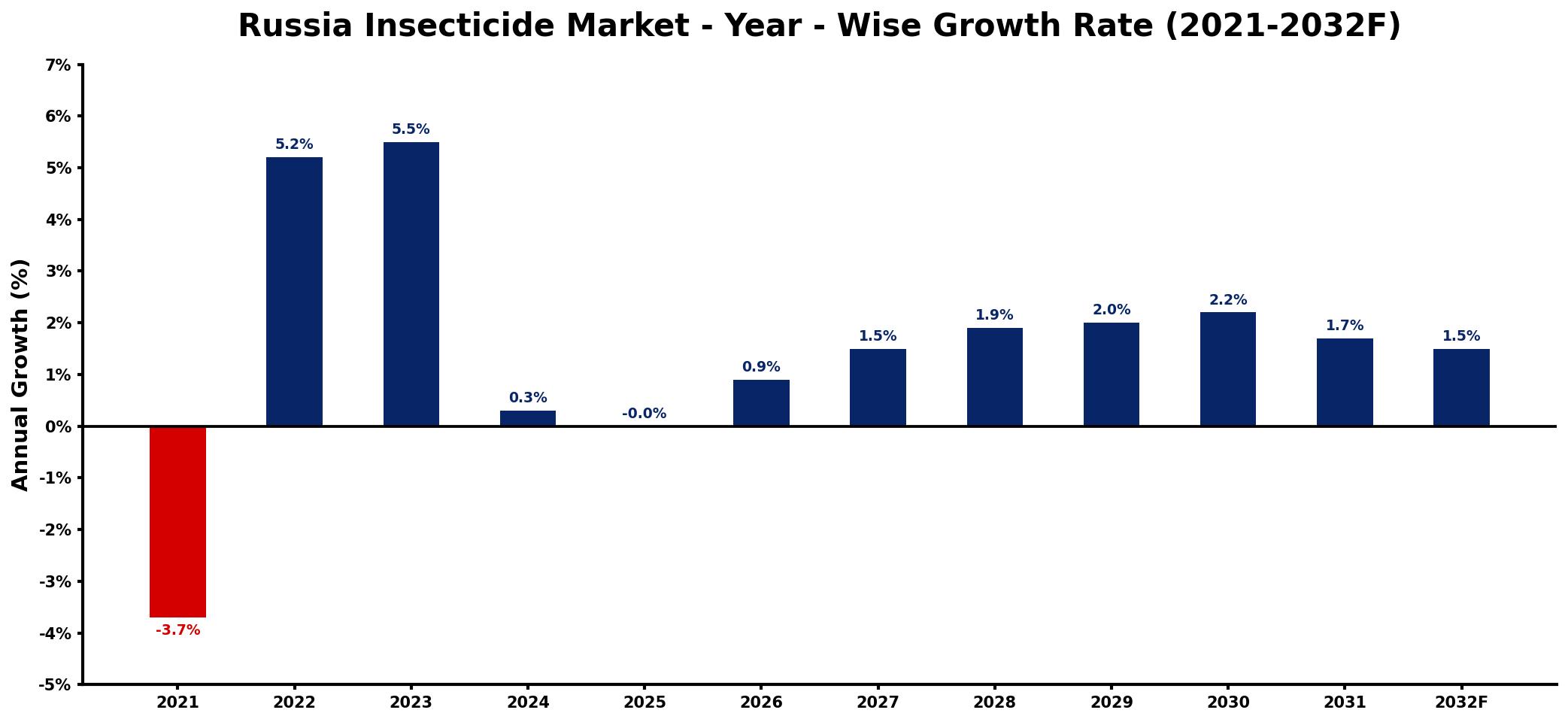
The table below presents the year‑wise growth rates along with the key drivers influencing the market
| Year | Growth Rate | Major Drivers |
| 2021 | -3.7% | Agricultural output experienced reduction |
| 2022 | 5.2% | Rising demand for sustainable practices |
| 2023 | 5.5% | Increased investments in agriculture technology |
| 2024 | 0.3% | Expansion of organic farming initiatives |
| 2025 | -0.0% | Growing awareness of pest management |
| 2026 | 0.9% | Enhanced regulatory support for agriculture |
| 2027 | 1.5% | Surge in urban gardening trends |
| 2028 | 1.9% | Development of eco-friendly alternatives |
| 2029 | 2.0% | Increased collaboration among stakeholders |
| 2030 | 2.2% | Technological advancements in crop protection |
| 2031 | 1.7% | Rising consumer preference for safety |
| 2032 | 1.5% | Strengthened agricultural export opportunities |
Note: Market size estimations and growth projections presented in this report are based on 6Wresearch's proprietary forecasting methodology, utilizing the latest available industry data, government publications, and primary research inputs.
Russia Insecticide Market Synopsis
The Russia insecticide market is witnessing a substantial increase in demand due to escalating agricultural practices that prioritize crop protection. With the population growing and urban areas expanding, there is an urgent need for effective pest management strategies to safeguard food security and public health.
In recent years, the market has experienced a notable shift toward sustainable and eco-friendly insecticides. This transition is largely fueled by environmental concerns, regulatory changes, and a growing consumer preference for organic solutions, positioning companies to innovate in product development and formulation technologies.
Russia Insecticide Market Key Takeaways
- The market is evolving towards environmentally friendly insecticide solutions, particularly biopesticides.
- Integrated pest management practices are increasingly adopted by farmers aiming to reduce reliance on chemical insecticides.
- Regulatory frameworks play a critical role in shaping market dynamics and influencing product offerings.
- There is significant potential for investment in innovative formulations tailored to local agricultural needs.
- Education and awareness initiatives are essential for promoting responsible insecticide usage among farmers.
Evaluation of Restraints in Russia Insecticide Market
Despite its growth potential, the Russia insecticide market faces several real constraints. Stringent regulations concerning pesticide registration and usage often slow down the introduction of new products. Concerns regarding environmental impact and human health also limit the appeal of traditional chemical insecticides. Additionally, fluctuating climate conditions can create unpredictability in agricultural outputs, further complicating the demand landscape. Finally, the prevalence of counterfeit products hampers the market, undermining trust in legitimate offerings and complicating regulatory compliance.
Russia Insecticide Market Trends
A significant trend shaping the Russia insecticide market is the increasing consumer demand for sustainable pest management solutions. This movement towards biopesticides and organic formulations reflects a broader societal awareness of health and environmental issues. Moreover, the continuous investment in research and development indicates that companies are focused on creating targeted and efficient insecticide technologies. The adoption of integrated pest management practices is also on the rise, highlighting a shift towards a more holistic approach to pest control that minimizes chemical use.
Russia Insecticide Market Opportunities
There are considerable opportunities for growth within the Russia insecticide market, particularly in the realm of biopesticides and organic products that resonate with consumer values. The increasing demand for food security in the context of a growing population presents a clear avenue for investment. Furthermore, building strategic partnerships with local agricultural entities can enhance market penetration, allowing for tailored solutions that address unique pest pressures and crop varieties specific to Russia. Companies that innovate while adhering to regulatory standards will likely see sustainable success.
Government Initiatives in the Russia Insecticide Market
The Russian government has enacted strict regulations governing the use of insecticides, primarily enforced by the Federal Service for Supervision of Consumer Rights Protection and Human Well-Being (Rospotrebnadzor). This regulatory oversight ensures that all insecticides undergo rigorous testing and approval processes before market entry. The government has also introduced specific guidelines aimed at minimizing environmental impact and promoting public health, emphasizing compliance and responsible insecticide usage within the agricultural sector.
Future Insights of the Russia Insecticide Market
Looking ahead to the period of 2026-2032, the Russia insecticide market is set to expand steadily, propelled by the increasing recognition of pest control as vital for agricultural success. Advancements in technology are expected to result in more effective and eco-friendly products, while government initiatives to support sustainable agricultural practices will further influence market dynamics. As consumer preferences continue to evolve, the emphasis on sustainability will likely dictate the strategic direction of companies operating in this sector.
Russia Insecticide Market Latest Developments (2025 - 2026)
Recent developments in the Russia insecticide market have highlighted an increased focus on product innovation and sustainability. Many companies are prioritizing the development of biopesticides and organic solutions in response to consumer demands and regulatory pressures. Additionally, the implementation of government guidelines aimed at minimizing the environmental impact of pesticide use has prompted further investment in research and development. The marketplace is becoming increasingly competitive as stakeholders adapt to evolving consumer expectations and compliance requirements.
Russia Insecticide Market - Key Attractiveness of the Report
- 10 Years of Market Numbers
- Historical Data Starting from 2022 to 2025
- Base Year: 2025
- Forecast Data until 2032
- Key Performance Indicators Impacting the Market
- Major Upcoming Developments and Projects
Key Highlights of the Report:
- Russia Insecticide Market Outlook
- Market Size of Russia Insecticide Market, 2025
- Forecast of Russia Insecticide Market, 2032
- Historical Data and Forecast of Russia Insecticide Revenues & Volume for the Period 2022-2032F
- Russia Insecticide Market Trend Evolution
- Russia Insecticide Market Drivers and Challenges
- Russia Insecticide Price Trends
- Russia Insecticide Porter's Five Forces
- Russia Insecticide Industry Life Cycle
- Historical Data and Forecast of Russia Insecticide Market Revenues & Volume By Type for the Period 2022-2032F
- Historical Data and Forecast of Russia Insecticide Market Revenues & Volume By Pyrethroids for the Period 2022-2032F
- Historical Data and Forecast of Russia Insecticide Market Revenues & Volume By Organophosphorus for the Period 2022-2032F
- Historical Data and Forecast of Russia Insecticide Market Revenues & Volume By Carbamates for the Period 2022-2032F
- Historical Data and Forecast of Russia Insecticide Market Revenues & Volume By Organochlorine for the Period 2022-2032F
- Historical Data and Forecast of Russia Insecticide Market Revenues & Volume By Botanicals for the Period 2022-2032F
- Historical Data and Forecast of Russia Insecticide Market Revenues & Volume By Other Types for the Period 2022-2032F
- Historical Data and Forecast of Russia Insecticide Market Revenues & Volume By Crop Type for the Period 2022-2032F
- Historical Data and Forecast of Russia Insecticide Market Revenues & Volume By Cereals & Grains for the Period 2022-2032F
- Historical Data and Forecast of Russia Insecticide Market Revenues & Volume By Oilseeds & Pulses for the Period 2022-2032F
- Historical Data and Forecast of Russia Insecticide Market Revenues & Volume By Fruits & Vegetables for the Period 2022-2032F
- Historical Data and Forecast of Russia Insecticide Market Revenues & Volume By Other Crop Types for the Period 2022-2032F
- Historical Data and Forecast of Russia Insecticide Market Revenues & Volume By Formulation for the Period 2022-2032F
- Historical Data and Forecast of Russia Insecticide Market Revenues & Volume By Wettable Powder for the Period 2022-2032F
- Historical Data and Forecast of Russia Insecticide Market Revenues & Volume By Emulsifiable Concentrate for the Period 2022-2032F
- Historical Data and Forecast of Russia Insecticide Market Revenues & Volume By Suspension Concentrate for the Period 2022-2032F
- Historical Data and Forecast of Russia Insecticide Market Revenues & Volume By Oil Emulsion In Water for the Period 2022-2032F
- Historical Data and Forecast of Russia Insecticide Market Revenues & Volume By Microencapsulated Suspension for the Period 2022-2032F
- Historical Data and Forecast of Russia Insecticide Market Revenues & Volume By Granules for the Period 2022-2032F
- Historical Data and Forecast of Russia Insecticide Market Revenues & Volume By Other Formulations for the Period 2022-2032F
- Historical Data and Forecast of Russia Insecticide Market Revenues & Volume By Form for the Period 2022-2032F
- Historical Data and Forecast of Russia Insecticide Market Revenues & Volume By Sprays for the Period 2022-2032F
- Historical Data and Forecast of Russia Insecticide Market Revenues & Volume By Baits for the Period 2022-2032F
- Historical Data and Forecast of Russia Insecticide Market Revenues & Volume By Strips for the Period 2022-2032F
- Russia Insecticide Import Export Trade Statistics
- Market Opportunity Assessment By Type
- Market Opportunity Assessment By Crop Type
- Market Opportunity Assessment By Formulation
- Market Opportunity Assessment By Form
- Russia Insecticide Top Companies Market Share
- Russia Insecticide Competitive Benchmarking By Technical and Operational Parameters
- Russia Insecticide Company Profiles
- Russia Insecticide Key Strategic Recommendations






































