Russia LED Professional Lighting Market Summary
The russia led professional lighting market was estimated at USD 152 Million in 2025 and is projected to reach USD 166 Million by 2032, growing at a CAGR of 1.3% from 2026 to 2032.
Russia LED Professional Lighting Market Year-wise Growth Rate and Key Drivers
This graph highlights how the Russia LED Professional Lighting Market has steadily grown over the past five years, supported by major growth factors.
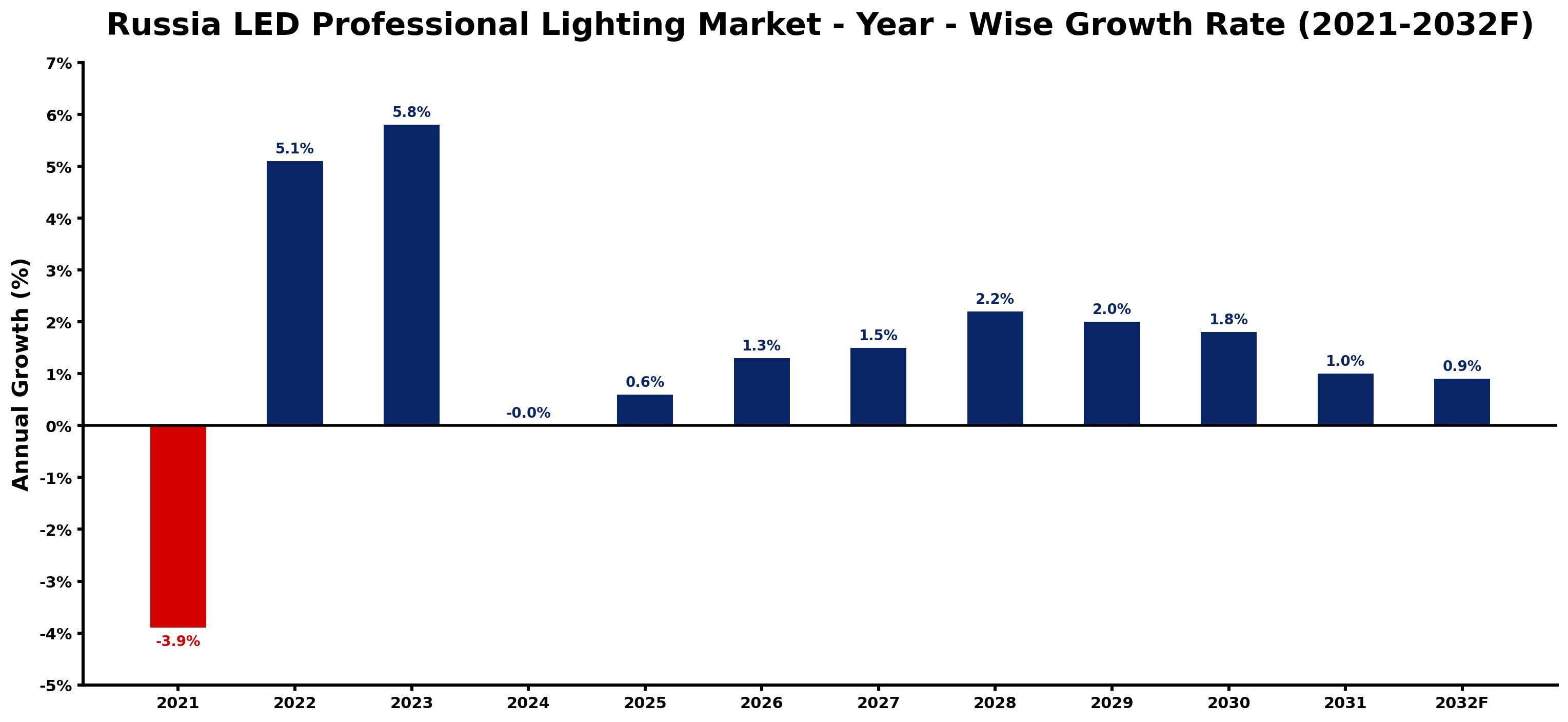
The table below presents the year wise growth rates along with the key drivers influencing the market
| Year | Growth Rate | Major Drivers |
| 2021 | -3.9% | Geopolitical tensions led to sanctions, constraining supply chains and dampening investment in LED lighting projects. |
| 2022 | 5.1% | Energy efficiency mandates prompted businesses to explore LED technology for cost savings. |
| 2023 | 5.8% | Corporate interest in sustainable practices encouraged the shift to LED lighting solutions. |
| 2024 | -0.0% | Urbanization trends fueled demand for advanced lighting solutions in metropolitan areas. |
| 2025 | 0.6% | Technological innovations expanded the capabilities of LED lighting in commercial sectors. |
| 2026 | 1.3% | Competitors in manufacturing began prioritizing LED integration for operational efficiency. |
| 2027 | 1.5% | Consumer preferences shifted towards smart lighting systems that enhance user experience. |
| 2028 | 2.2% | Emerging industries, such as agriculture, sought efficient lighting solutions for productivity. |
| 2029 | 2.0% | Public-private partnerships invested heavily in smart city initiatives across urban centers. |
| 2030 | 1.8% | Legacy infrastructure upgrades necessitated the replacement of outdated lighting systems. |
| 2031 | 1.0% | Integration of IoT in lighting systems created new market opportunities for service providers. |
| 2032 | 0.9% | Green building certifications increasingly required LED installations for compliance and branding. |
Note - Market size estimations and growth projections presented in this report are based on 6Wresearch's advanced forecasting approach, validated with industry datasets as of June 2026.
Russia LED Professional Lighting Market Synopsis
The Russia LED Professional Lighting Market is projected to reach 1.3% and witness significant growth during the forecast period (2026-2032). This growth trajectory is primarily driven by an increasing focus on energy efficiency, modernization efforts within commercial infrastructure, and the ongoing transition towards advanced lighting technologies. The professional lighting sector is particularly benefiting from the rising demand across various applications including commercial, industrial, and residential environments, thereby catalyzing comprehensive market developments.
Russia LED Professional Lighting Market Growth Drivers
The expansion of the Russia LED Professional Lighting Market is fueled by several key growth drivers:
- Investments in commercial infrastructure are on the rise, as businesses seek to enhance their operational environments through energy-efficient solutions. The upgrading of office spaces and retail environments has accelerated demand for LED lighting systems that facilitate better aesthetics and functionality.
- Government initiatives promoting energy efficiency have significantly influenced market growth. The strong focus on sustainability and reducing carbon footprints is driving public and private sectors to invest in advanced lighting technologies.
- Technological advancements, including the integration of smart lighting systems and automation, are enhancing the appeal of LED solutions. These innovations allow for better control, energy management, and customization in lighting applications.
- Growing urbanization and infrastructural development projects across Russia are creating robust demand for professional lighting solutions. Urban development initiatives are incorporating LED lighting to improve safety and enhance the visual appeal of public spaces.
- The increasing disposable incomes among consumers have led to a heightened demand for advanced residential lighting solutions. This trend is encouraging households to adopt LED technology for its long-term cost savings and superior performance.
Russia LED Professional Lighting Market Challenges and Restraints
Despite the promising growth outlook for the Russia LED Professional Lighting Market, several challenges persist:
- Economic fluctuations can impact investment levels in new infrastructure projects, which may lead to slower adoption rates of LED technology.
- The initial capital cost associated with the transition to LED lighting systems may deter smaller businesses from making the switch, affecting overall market growth.
- Competition from low-cost, non-LED lighting alternatives continues to pose a challenge, particularly in regions where cost-sensitive consumers prioritize upfront expenses over long-term savings.
- Lack of awareness regarding the benefits of LED technologies can hinder adoption rates, especially among consumers used to traditional lighting solutions.
- The complexity of integrating advanced lighting systems with existing infrastructure may act as a barrier for some businesses, leading to hesitation in upgrading to LED technology.
Russia LED Professional Lighting Market Government Investment and Initiatives
The Russian government has implemented various initiatives to foster the growth of the LED Professional Lighting Market. As part of its broader energy efficiency objectives, the government is encouraging investments in sustainable lighting solutions. Key initiatives include:
- Public spending on infrastructure and modernization is focused on integrating LED technologies in public facilities, thereby reducing energy consumption and operational costs.
- Subsidies and grants aimed at businesses adopting LED lighting solutions are being rolled out, further incentivizing the shift toward energy-efficient options.
- Regulatory frameworks are being established to promote energy-saving technologies, which includes streamlining the approval processes for LED lighting products.
- Awareness campaigns conducted by the government are aimed at educating both consumers and businesses about the benefits of LED lighting, emphasizing long-term savings and environmental impact.
- Partnerships between public and private sectors are being fostered to stimulate innovation in the lighting sector, focusing on R&D to develop more efficient lighting solutions.
Russia LED Professional Lighting Market Latest Developments (May 2025 - June 2026)
In the period between May 2025 and June 2026, the Russia LED Professional Lighting Market has witnessed several notable developments. There has been an increased emphasis on smart lighting technologies, with several projects piloting advanced automation and control systems to enhance energy management. The acceleration of urbanization initiatives has resulted in substantial investment in professional lighting for public spaces, contributing to improved safety and aesthetics. Industry stakeholders have reported ongoing collaboration with government entities to synchronize efforts in promoting energy-efficient lighting solutions and advancing regulatory standards. Additionally, the market has seen a rise in consumer education initiatives aimed at showcasing the benefits of LED lighting over traditional systems, thereby fostering greater acceptance and adoption.
Russia LED Professional Lighting Market - Key Attractiveness of the Report
- 10 Years of Market Numbers
- Historical Data Starting from 2022 to 2025
- Base Year: 2025
- Forecast Data until 2032
- Key Performance Indicators Impacting the Market
- Major Upcoming Developments and Projects
Key Highlights of the Report:
- Russia LED Professional Lighting Market Outlook
- Market Size of Russia LED Professional Lighting Market, 2025
- Forecast of Russia LED Professional Lighting Market, 2032
- Historical Data and Forecast of Russia LED Professional Lighting Revenues & Volume for the Period 2022-2032
- Russia LED Professional Lighting Market Trend Evolution
- Russia LED Professional Lighting Market Drivers and Challenges
- Russia LED Professional Lighting Price Trends
- Russia LED Professional Lighting Porter's Five Forces
- Russia LED Professional Lighting Industry Life Cycle
- Historical Data and Forecast of Russia LED Professional Lighting Market Revenues & Volume By Product Type for the Period 2022-2032
- Historical Data and Forecast of Russia LED Professional Lighting Market Revenues & Volume By LED Bulbs for the Period 2022-2032
- Historical Data and Forecast of Russia LED Professional Lighting Market Revenues & Volume By LED Fixtures for the Period 2022-2032
- Historical Data and Forecast of Russia LED Professional Lighting Market Revenues & Volume By Bare LED Tubes for the Period 2022-2032
- Historical Data and Forecast of Russia LED Professional Lighting Market Revenues & Volume By LED Down lights for the Period 2022-2032
- Historical Data and Forecast of Russia LED Professional Lighting Market Revenues & Volume By Applications for the Period 2022-2032
- Historical Data and Forecast of Russia LED Professional Lighting Market Revenues & Volume By Indoor for the Period 2022-2032
- Historical Data and Forecast of Russia LED Professional Lighting Market Revenues & Volume By Outdoor for the Period 2022-2032
- Historical Data and Forecast of Russia LED Professional Lighting Market Revenues & Volume By Automotive for the Period 2022-2032
- Historical Data and Forecast of Russia LED Professional Lighting Market Revenues & Volume By Backlighting for the Period 2022-2032
- Russia LED Professional Lighting Import Export Trade Statistics
- Market Opportunity Assessment By Product Type
- Market Opportunity Assessment By Applications
- Russia LED Professional Lighting Top Companies Market Share
- Russia LED Professional Lighting Competitive Benchmarking By Technical and Operational Parameters
- Russia LED Professional Lighting Company Profiles
- Russia LED Professional Lighting Key Strategic Recommendations
Market Covered
This report offers a comprehensive study of the subsequent market segments:
By Product Type
- LED Bulbs
- LED Fixtures
- Bare LED Tubes
- LED Down lights
By Applications
- Indoor, Outdoor
- Automotive
- Backlighting
- Competitive Landscape






































