Russia Metal & Metallurgy Machinery Market Summary
The russia metal & metallurgy machinery market was estimated at USD 240 Million in 2025 and is projected to reach USD 264 Million by 2032, growing at a CAGR of 1.0% from 2026 to 2032.
Russia Metal & Metallurgy Machinery Market Year-wise Growth Rate and Key Drivers
This graph highlights how the Russia Metal & Metallurgy Machinery Market has steadily grown over the past five years, supported by major growth factors.
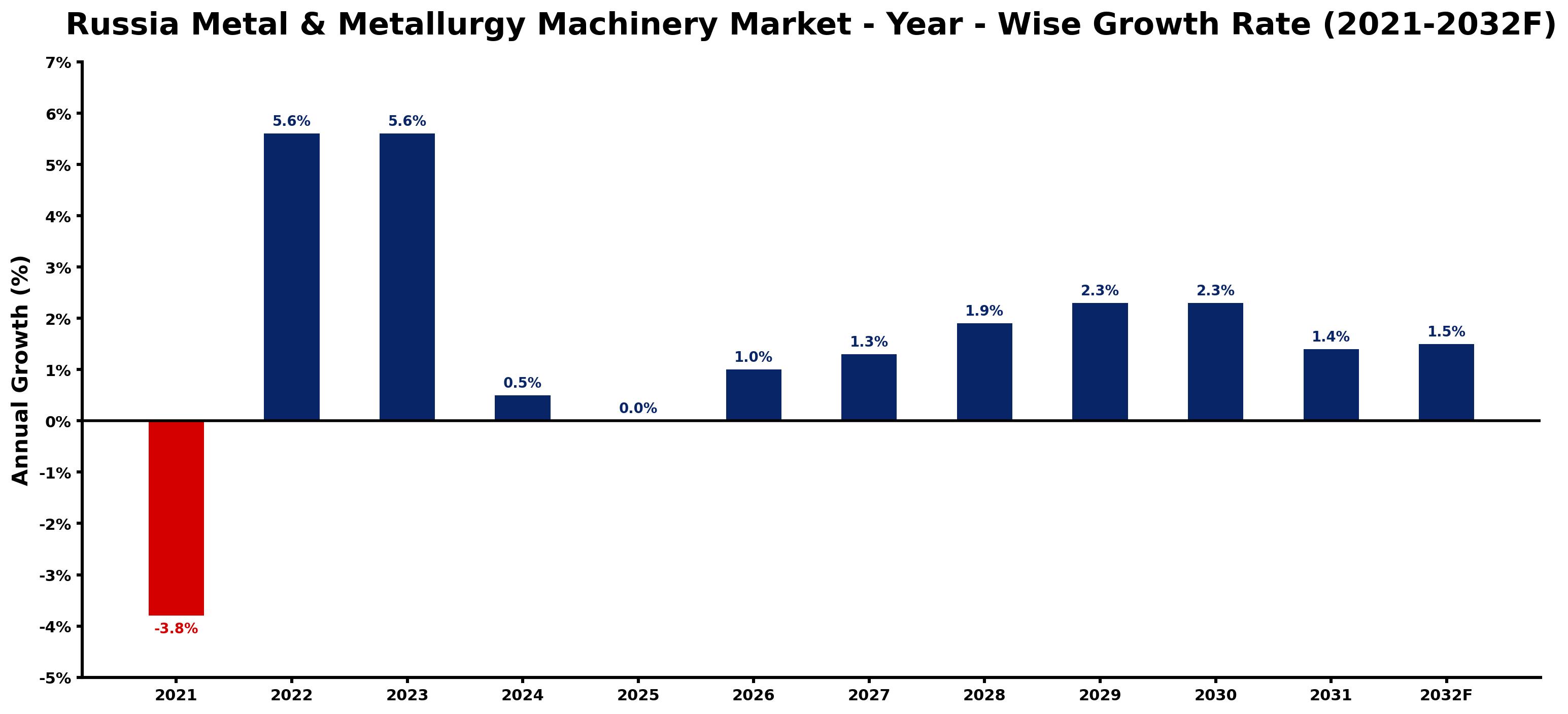
The table below presents the year wise growth rates along with the key drivers influencing the market
| Year | Growth Rate | Major Drivers |
| 2021 | -3.8% | Geopolitical tensions and sanctions significantly hindered investment opportunities, leading to decreased machinery procurement in the sector. |
| 2022 | 5.6% | Local manufacturers increasingly focused on enhancing operational efficiencies to reduce costs. |
| 2023 | 5.6% | Technological collaboration with foreign partners improved production capabilities for metal machinery. |
| 2024 | 0.5% | Shift towards automation addressed labor shortages and increased operational productivity significantly. |
| 2025 | 0.0% | Emerging sectors, like renewable energy, created new demand for specialized metallurgy machinery. |
| 2026 | 1.0% | Export opportunities expanded as global markets recognized Russian metal quality and innovation. |
| 2027 | 1.3% | Increasing urbanization stimulated construction projects, boosting demand for metal processing equipment. |
| 2028 | 1.9% | Sustainability trends prompted investments in eco-friendly machinery and waste reduction technologies. |
| 2029 | 2.3% | Innovative financing models allowed SMEs access to advanced metalworking technologies and machinery. |
| 2030 | 2.3% | Increased focus on local raw materials reduced dependency on imports, enhancing market resilience. |
| 2031 | 1.4% | Consumer preferences shifted toward customized products, requiring adaptable metal production processes. |
| 2032 | 1.5% | A robust skilled labor force emerged, improving productivity in metal machinery manufacturing. |
Note - Market size estimations and growth projections presented in this report are based on 6Wresearch's advanced forecasting approach, validated with industry datasets as of June 2026.
Russia Metal & Metallurgy Machinery Market Synopsis
The Russia Metal Metallurgy Machinery Market is projected to reach 1.0% and witness significant growth during the forecast period (2026-2032). This growth trajectory is anticipated due to a robust demand for primary metals like steel, aluminum, and copper across a spectrum of end-use sectors, including automotive, construction, and electrical & electronics. The confluence of a growing population and accelerating urbanization has catalyzed an increased requirement for these metals, prompting expansions in various industrial domains.
Russia Metal & Metallurgy Machinery Market Growth Drivers
Several factors are propelling the growth of the Russia Metal & Metallurgy Machinery Market. A primary driver is the escalating demand from key industries, which is underpinned by both domestic consumption and export opportunities. Additionally, government efforts aimed at enhancing the manufacturing sector are set to stimulate market advancement. The strategic geographical location of Russia, especially its proximity to Asian countries like China, offers advantages in procuring high-quality raw materials at competitive prices, fostering a favorable economic environment.
- The automotive industry's resurgence is generating a heightened need for metal components, stimulating machinery demand.
- Infrastructural development plans are fostering a surge in construction activities, further driving metal consumption.
- The electrical and electronics sectors are experiencing technological upgrades, necessitating advanced metallurgy machinery for manufacturing processes.
- Increased foreign investments in manufacturing technologies bring innovation, thereby enhancing production efficiency and reducing operational costs.
- Government incentives aimed at modernizing existing facilities are encouraging players to adopt advanced metallurgical techniques, resulting in sustainable growth.
Russia Metal & Metallurgy Machinery Market Technological Advancements
The Russia Metal & Metallurgy Machinery Market is witnessing significant technological advancements that are reshaping production methodologies. New innovations in automation and digitization in machinery are leading to improved efficiency and reduced operational costs. These technological developments are not only enhancing product quality but are also enabling manufacturers to respond more swiftly to market demands. The adoption of Industry 4.0 practices is particularly notable, as companies seek to leverage data analytics and intelligent systems to optimize their operations.
- Automation in processes is minimizing labor costs while maximizing productivity, positioning manufacturers for competitive advantages.
- Advanced data analytics tools are providing insights that drive decision-making and process improvements.
- Integration of IoT devices into machinery is enhancing real-time monitoring and predictive maintenance capabilities.
- Innovations in energy-efficient machinery are not only reducing costs but also aligning with global sustainability objectives.
- Investment in research and development is crucial as firms endeavor to introduce innovative machinery solutions that meet evolving market needs.
Russia Metal & Metallurgy Machinery Market Challenges and Restraints
Despite the promising outlook, the Russia Metal & Metallurgy Machinery Market faces a range of challenges. Fluctuating raw material prices can significantly impact production costs and profit margins. Moreover, geopolitical tensions may lead to uncertainties regarding export capabilities and market access, affecting overall growth. Additionally, the market must contend with stringent environmental regulations, which may necessitate costly compliance measures. The lack of skilled labor in certain regions poses another barrier, as it can impede operational efficiency and innovation.
- Fluctuations in global metal prices can disrupt operational budgeting and financial forecasting.
- Dependence on exports exposes the market to international trade fluctuations and political uncertainties.
- Stricter environmental regulations may increase compliance costs, impacting profit margins.
- Shortages of skilled labor can hinder the adoption of advanced manufacturing techniques.
- Competition from low-cost production regions may challenge local manufacturers' market share and profitability.
Russia Metal & Metallurgy Machinery Market Government Investment and Initiatives
Government investment and initiatives play a critical role in shaping the Russia Metal & Metallurgy Machinery Market. The Russian government has prioritized the modernization of the manufacturing sector, allocating significant funding towards improving infrastructure and promoting technological advancements. Various incentives, including tax breaks and subsidies, are designed to attract investments, particularly in innovation-driven projects. Furthermore, initiatives aimed at fostering public-private partnerships are enhancing the competitiveness of the metallurgy sector.
- Government funding is increasingly directed toward sustainable manufacturing practices, promoting eco-friendly technologies.
- Support for R&D initiatives aims to stimulate innovation and enhance the industry's global competitiveness.
- Investment in infrastructure developments facilitates smoother logistics and supply chain management for metallurgical companies.
- Policies encouraging foreign direct investment are opening opportunities for international cooperation and technological exchange.
- Regulatory frameworks are being streamlined to encourage new entrants, ensuring diverse competition in the market.
Russia Metal & Metallurgy Machinery Market Latest Developments (May 2025 - June 2026)
Recent developments in the Russia Metal & Metallurgy Machinery Market from May 2025 to June 2026 indicate a dynamic shift towards enhanced production capabilities and innovation. Several projects focused on upgrading existing machinery and integrating advanced technologies are underway, demonstrating the industry's commitment to modernization. Furthermore, a noticeable increase in collaboration between local manufacturers and international firms has emerged, aimed at sharing knowledge and developing state-of-the-art machinery solutions. This trend is likely to foster a competitive environment that prioritizes efficiency and product quality.
- New partnerships between domestic and foreign firms are facilitating technology transfer, enhancing local manufacturing capabilities.
- Investment in automation technologies is gaining traction, allowing manufacturers to streamline operations and reduce costs.
- The emergence of 3D printing technologies is providing innovative methods for producing complex metallurgical components.
- Government-sponsored programs focusing on sustainability are encouraging companies to invest in eco-friendly machinery solutions.
- Increased participation in global trade fairs is enhancing the visibility of Russian manufacturers and their technology offerings.
Russia Metal & Metallurgy Machinery Market - Key Attractiveness of the Report
- 10 Years of Market Numbers
- Historical Data Starting from 2022 to 2025
- Base Year: 2025
- Forecast Data until 2032
- Key Performance Indicators Impacting the Market
- Major Upcoming Developments and Projects
Key Highlights of the Report:
- Russia Metal & Metallurgy Machinery Market Outlook
- Market Size of Russia Metal & Metallurgy Machinery Market, 2025
- Forecast of Russia Metal & Metallurgy Machinery Market, 2032F
- Historical Data and Forecast of Russia Metal & Metallurgy Machinery Revenues & Volume for the Period 2022-2032F
- Russia Metal & Metallurgy Machinery Market Trend Evolution
- Russia Metal & Metallurgy Machinery Market Drivers and Challenges
- Russia Metal & Metallurgy Machinery Price Trends
- Russia Metal & Metallurgy Machinery Porter's Five Forces
- Russia Metal & Metallurgy Machinery Industry Life Cycle
- Historical Data and Forecast of Russia Metal & Metallurgy Machinery Market Revenues & Volume By Product Types for the Period 2022-2032F
- Historical Data and Forecast of Russia Metal & Metallurgy Machinery Market Revenues & Volume By Metal Rolling Machinery for the Period 2022-2032F
- Historical Data and Forecast of Russia Metal & Metallurgy Machinery Market Revenues & Volume By Steelmaking Equipment for the Period 2022-2032F
- Historical Data and Forecast of Russia Metal & Metallurgy Machinery Market Revenues & Volume By Ironmaking Equipment for the Period 2022-2032F
- Historical Data and Forecast of Russia Metal & Metallurgy Machinery Market Revenues & Volume By Applications for the Period 2022-2032F
- Historical Data and Forecast of Russia Metal & Metallurgy Machinery Market Revenues & Volume By Cutting for the Period 2022-2032F
- Historical Data and Forecast of Russia Metal & Metallurgy Machinery Market Revenues & Volume By Welding for the Period 2022-2032F
- Historical Data and Forecast of Russia Metal & Metallurgy Machinery Market Revenues & Volume By Non-Metal Processing for the Period 2022-2032F
- Historical Data and Forecast of Russia Metal & Metallurgy Machinery Market Revenues & Volume By Additive Manufacturing for the Period 2022-2032F
- Historical Data and Forecast of Russia Metal & Metallurgy Machinery Market Revenues & Volume By Others for the Period 2022-2032F
- Russia Metal & Metallurgy Machinery Import Export Trade Statistics
- Market Opportunity Assessment By Product Types
- Market Opportunity Assessment By Applications
- Russia Metal & Metallurgy Machinery Top Companies Market Share
- Russia Metal & Metallurgy Machinery Competitive Benchmarking By Technical and Operational Parameters
- Russia Metal & Metallurgy Machinery Company Profiles
- Russia Metal & Metallurgy Machinery Key Strategic Recommendations






































