Russia MVNO Market Size & Growth Rate (2026-2032)
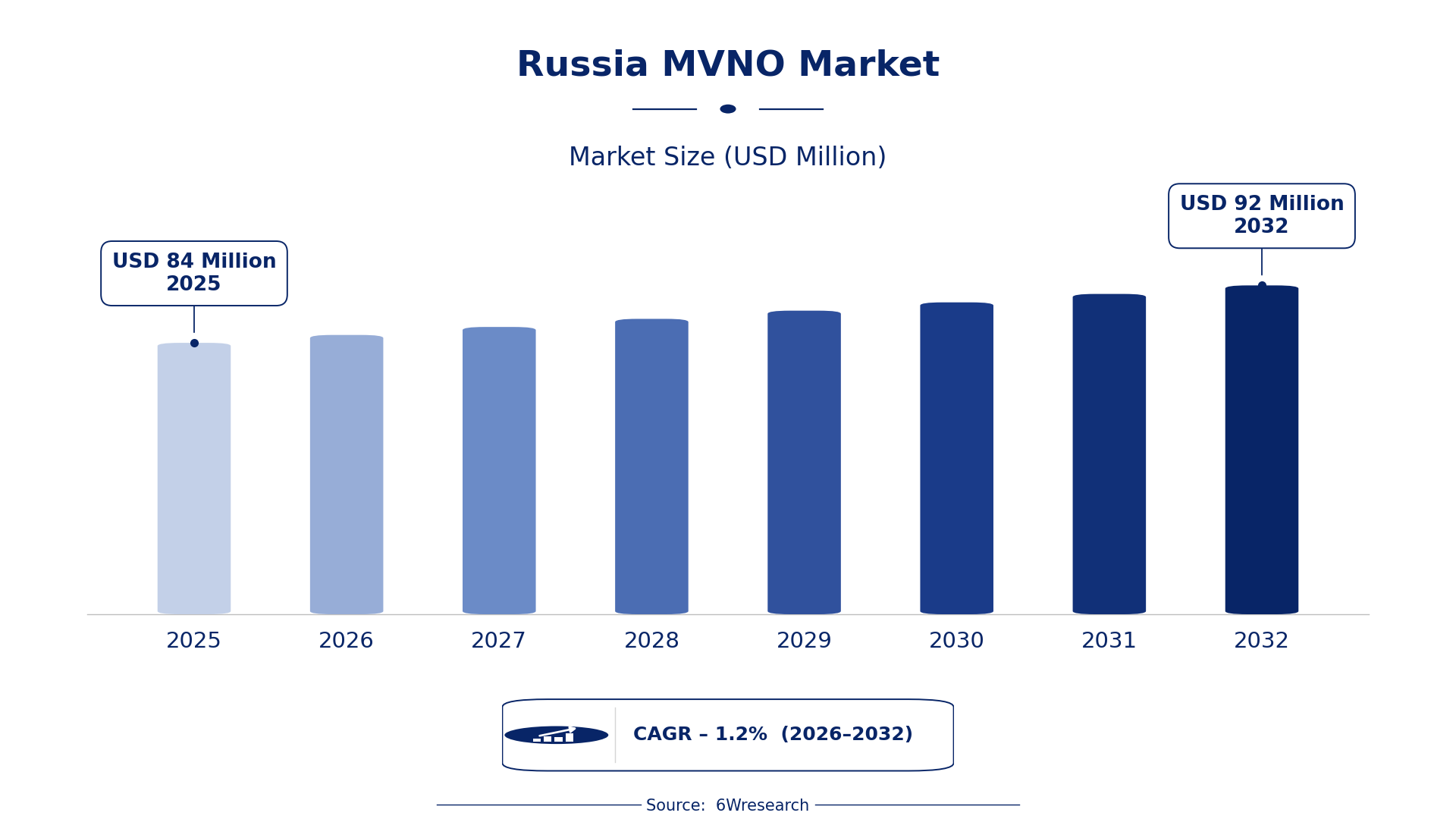
The Russia MVNO Market was estimated at USD 84 Million in 2025 and is projected to reach USD 92 Million by 2032, growing at a CAGR of 1.2% from 2026 to 2032.
Russia MVNO Market Synopsis
The demand for mobile services in Russia is escalating, with MVNOs gaining traction by offering tailored plans that meet the unique needs of various consumer segments. This trend is notably driven by an increasing appetite for data services and affordable pricing, appealing particularly to cost-conscious users and niche markets.
In a market saturated with traditional mobile operators, MVNOs are distinguishing themselves by providing flexible packages and innovative digital content. The regulatory landscape has also evolved, supporting the establishment and growth of MVNOs, which in turn fosters healthy competition among service providers.
Russia MVNO Market Year-wise Growth Rate and Key Drivers
This graph illustrates the annual growth rates of the Russia MVNO Market from 2021 to 2032, highlighting a steady upward trajectory and projected expansion over the forecast period.
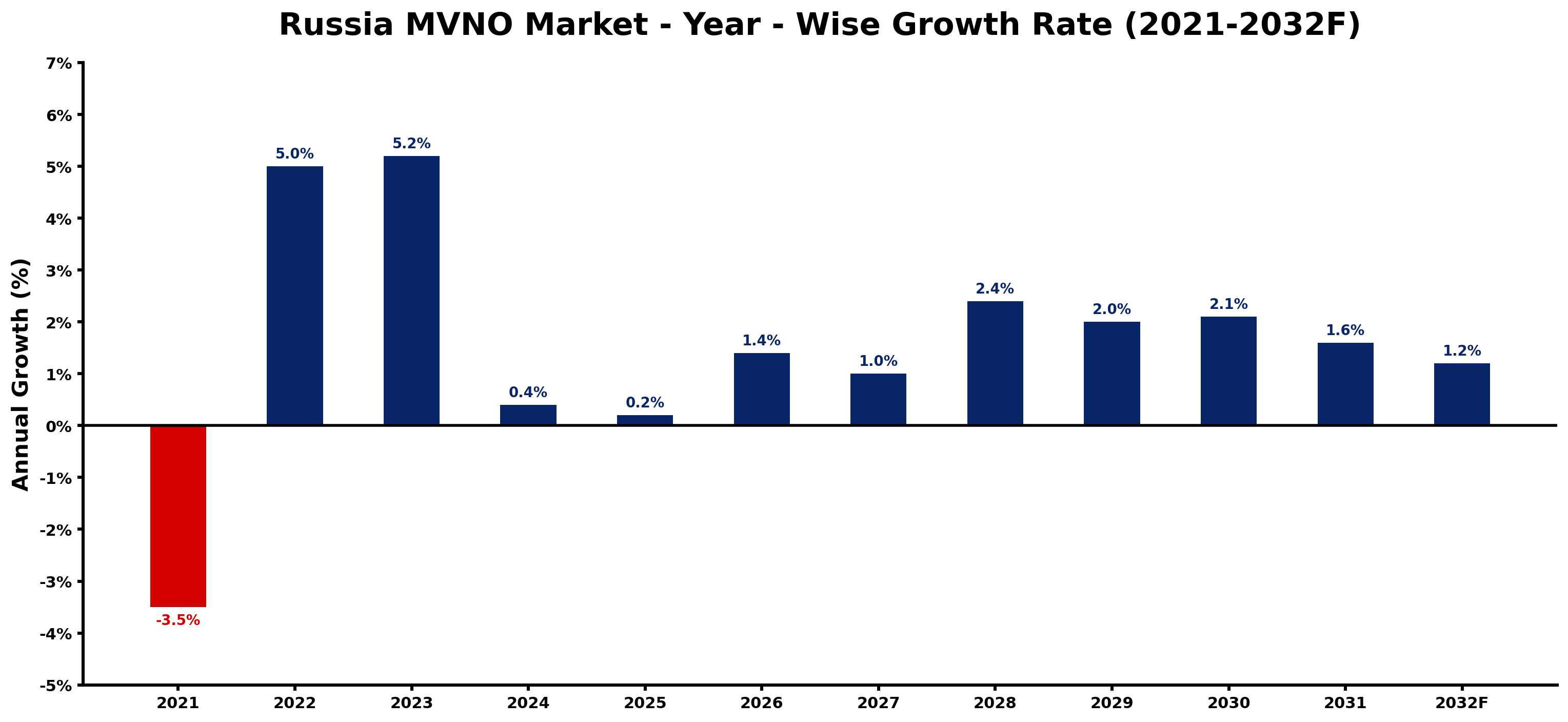
The table below presents the year‑wise growth rates along with the key drivers influencing the market
| Year | Growth Rate | Major Drivers |
| 2021 | -3.5% | Regulatory changes by Rossvyaz limiting new MVNO licenses |
| 2022 | 5.0% | Increased demand for budget-friendly mobile services in Russia. |
| 2023 | 5.2% | New regulatory framework supports MVNO market entry opportunities. |
| 2024 | 0.4% | Emergence of niche MVNOs targeting specific consumer segments. |
| 2025 | 0.2% | Rising smartphone penetration drives mobile virtual services usage. |
| 2026 | 1.4% | Growing interest in innovative data plans among consumers. |
| 2027 | 1.0% | Consolidation of smaller players enhancing competitive dynamics. |
| 2028 | 2.4% | Accessibility of 5G networks fuels MVNO service offerings. |
| 2029 | 2.0% | Rising youth population boosts demand for affordable mobile plans. |
| 2030 | 2.1% | Increased focus on customer service in MVNO operations. |
| 2031 | 1.6% | Local partnerships enhance MVNO capabilities and market reach. |
| 2032 | 1.2% | Youth adoption of e-commerce platforms drives mobile data usage. |
Note: Market size estimations and growth projections presented in this report are based on 6Wresearch's proprietary forecasting methodology, utilizing the latest available industry data, government publications, and primary research inputs.
Russia MVNO Market Key Takeaways
Below are some of the specific key takeaways from the market, including:
- The market is characterized by a diverse range of MVNOs targeting specific segments such as youth, expatriates, and budget consumers.
- Regulatory reforms are reducing barriers to entry, encouraging new MVNOs to enter the market.
- Increasing demand for data services is pushing MVNOs to innovate with affordable data packages.
- Partnerships with major MNOs are becoming a strategic move for MVNOs to enhance their service offerings.
- Competitive pricing strategies are critical for MVNOs to attract and retain subscribers.
Evaluation of Restraints in Russia MVNO Market
Despite the growth opportunities, the Russia MVNO market faces notable challenges. Intense competition from established MNOs creates a difficult environment for smaller MVNOs trying to capture market share. Regulatory hurdles and the need for quality network access also limit new entrants. on top of that, the dominance of a few large players can stifle innovation and make it challenging for smaller MVNOs to differentiate themselves effectively.
Russia MVNO Market Trends
Current trends indicate an increasing number of MVNOs focusing on niche markets, such as students and international travelers. These MVNOs are tailoring their offerings with specialized services that cater to specific customer needs. Additionally, the push for competitive pricing continues, prompting MVNOs to innovate their data packages and services.
Another emerging trend is the collaboration between MVNOs and major MNOs, allowing smaller operators to utilize established network infrastructure. This partnership model is expected to become more prevalent as MVNOs seek to enhance their service delivery and customer experience.
Russia MVNO Market Opportunities
With a growing mobile subscriber base, the Russia MVNO market presents numerous investment opportunities. New entrants can capture market share by targeting underserved segments, such as expatriates or budget-conscious consumers. The government's focus on improving telecom infrastructure further opens doors for innovative service offerings. Partnerships with existing MNOs can also enhance the prospects for MVNOs, making it easier to establish a foothold in this competitive environment.
Government Initiatives in the Russia MVNO Market
Government policies are shaping the Russia MVNO market by fostering a competitive environment and encouraging innovation. The Federal Antimonopoly Service (FAS) plays a crucial role in overseeing MVNO operations, ensuring fair practices and consumer protection. Recent regulatory changes have aimed at lowering entry barriers for new MVNOs, which is vital for stimulating competition in the sector.
- A regulatory framework introduced in 2025 focused on facilitating mobile number portability, enhancing customer choice and competition.
- A national digital infrastructure upgrade program is currently underway, aimed at improving network access for MVNOs and enhancing service quality.
- Ongoing initiatives by the FAS to enforce data protection standards are ensuring consumer rights and fostering trust in MVNO services.
- Planned measures to provide regulated wholesale access to network infrastructure are expected to be implemented by mid-2026, further easing market entry for new players.
Future Insights of the Russia MVNO Market
Looking ahead to 2026-2032, the Russia MVNO market is set for steady growth as demand for affordable mobile services intensifies. MVNOs are likely to expand their offerings with innovative service packages tailored to diverse demographics. The increasing penetration of smartphones and mobile internet will present ample opportunities for MVNOs to enhance customer engagement through value-added services.
Regulatory support is expected to play a crucial role in driving competition, encouraging existing and new MVNOs to innovate. This dynamic will be pivotal in shaping the future trajectory of the market, promising a vibrant environment for both consumers and service providers.
Russia MVNO Market Latest Developments
In the past year, the Russia MVNO market has witnessed several significant developments that illustrate its evolving nature. Companies are actively enhancing their service offerings and forming strategic alliances to stay competitive. This period has seen a marked increase in MVNOs launching new promotional packages and data plans, catering to the needs of their target markets.
- A leading regional MVNO launched an innovative data plan in early 2025, specifically designed for students, which has received positive feedback for its affordability.
- A partnership initiative between several MVNOs and an established MNO began in late 2025, aimed at improving network access and service quality for consumers.
- A new marketing campaign targeting expatriates was rolled out by an MVNO in Q3 2025, which has successfully attracted a significant number of new subscribers.
- Upcoming in 2026, a planned service upgrade by an MVNO will introduce enhanced customer support features, aiming to improve user experience.
Russia MVNO Market - Key Attractiveness of the Report
- 10 Years of Market Numbers
- Historical Data Starting from 2022 to 2025
- Base Year: 2025
- Forecast Data until 2032
- Key Performance Indicators Impacting the Market
- Major Upcoming Developments and Projects
Key Highlights of the Report:
- Russia MVNO Market Outlook
- Market Size of Russia MVNO Market, 2025
- Forecast of Russia MVNO Market, 2032
- Historical Data and Forecast of Russia MVNO Revenues & Volume for the Period 2022-2032F
- Russia MVNO Market Trend Evolution
- Russia MVNO Market Drivers and Challenges
- Russia MVNO Price Trends
- Russia MVNO Porter's Five Forces
- Russia MVNO Industry Life Cycle
- Historical Data and Forecast of Russia MVNO Market Revenues & Volume By Operational Model for the Period 2022-2032F
- Historical Data and Forecast of Russia MVNO Market Revenues & Volume By Reseller for the Period 2022-2032F
- Historical Data and Forecast of Russia MVNO Market Revenues & Volume By Service Operator for the Period 2022-2032F
- Historical Data and Forecast of Russia MVNO Market Revenues & Volume By Full MVNO for the Period 2022-2032F
- Historical Data and Forecast of Russia MVNO Market Revenues & Volume By Organization Size for the Period 2022-2032F
- Historical Data and Forecast of Russia MVNO Market Revenues & Volume By SMES for the Period 2022-2032F
- Historical Data and Forecast of Russia MVNO Market Revenues & Volume By Large Enterprise for the Period 2022-2032F
- Historical Data and Forecast of Russia MVNO Market Revenues & Volume By Subscriber for the Period 2022-2032F
- Historical Data and Forecast of Russia MVNO Market Revenues & Volume By Consumer for the Period 2022-2032F
- Historical Data and Forecast of Russia MVNO Market Revenues & Volume By Enterprise for the Period 2022-2032F
- Russia MVNO Import Export Trade Statistics
- Market Opportunity Assessment By Operational Model
- Market Opportunity Assessment By Organization Size
- Market Opportunity Assessment By Subscriber
- Russia MVNO Top Companies Market Share
- Russia MVNO Competitive Benchmarking By Technical and Operational Parameters
- Russia MVNO Company Profiles
- Russia MVNO Key Strategic Recommendations






































