Russia Network Slicing Market Size, Share & Growth Rate
The Russia Network Slicing Market was estimated at USD 158 Million in 2025 and is projected to reach USD 173 Million by 2032, growing at a CAGR of 1.3% from 2026 to 2032. This growth is being driven primarily by the increased demand for tailored network solutions, particularly as industries embrace advanced technologies like 5G and the Internet of Things (IoT). The ongoing digital transformation across various sectors in Russia further propels the adoption of network slicing as telecom operators seek to improve service quality and operational efficiency.
Russia Network Slicing Market Year-wise Growth Rate and Key Drivers
This graph highlights how the Russia Network Slicing Market has steadily grown over the years, supported by major growth factors.
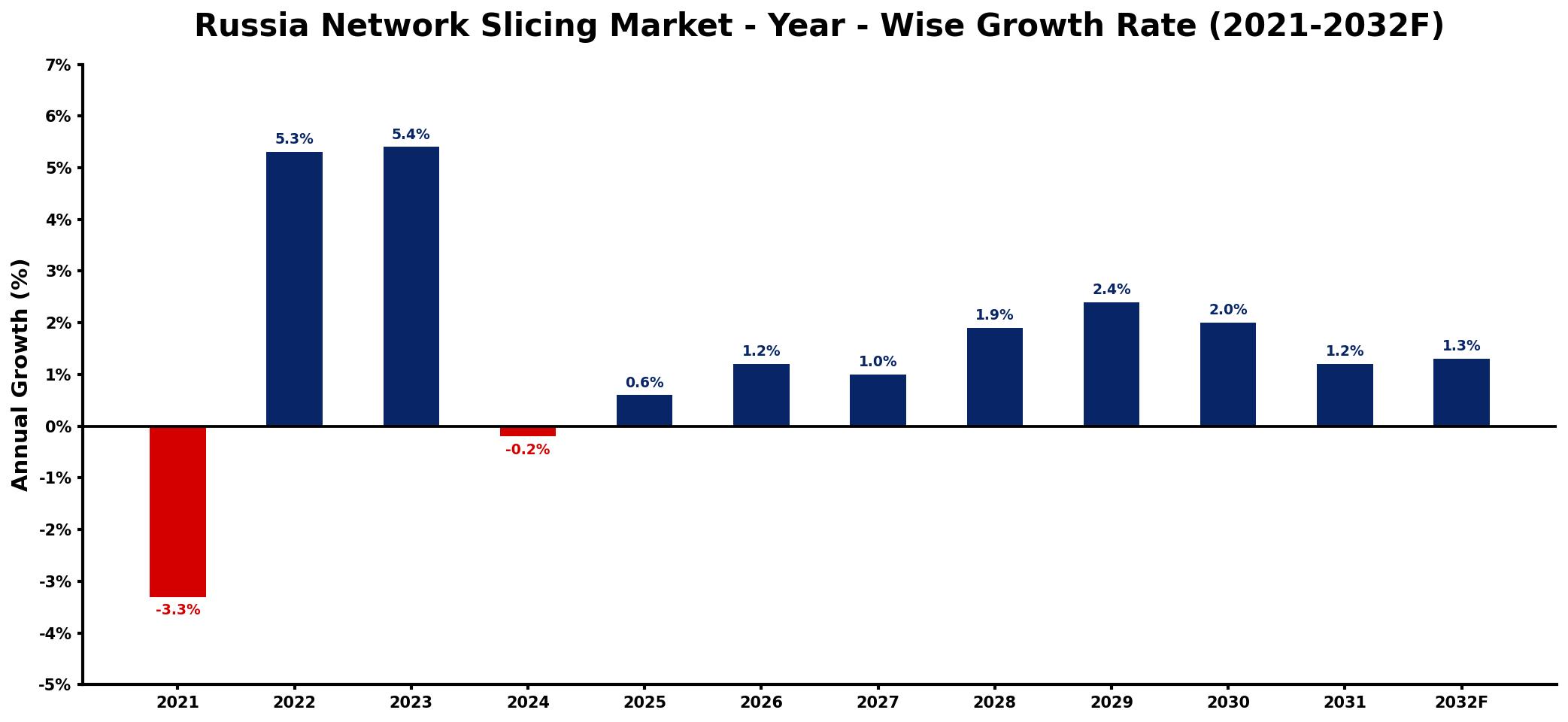
The table below presents the year‑wise growth rates along with the key drivers influencing the market
| Year | Growth Rate | Major Drivers |
| 2021 | -3.3% | decrease in enterprise investments |
| 2022 | 5.3% | rise in digital transformation initiatives |
| 2023 | 5.4% | expansion of 5G infrastructure projects |
| 2024 | -0.2% | falling export shipment volumes |
| 2025 | 0.6% | growing interest in IoT applications |
| 2026 | 1.2% | increased collaboration among telecom providers |
| 2027 | 1.0% | higher demand for customized services |
| 2028 | 1.9% | surge in smart city developments |
| 2029 | 2.4% | enhanced focus on cloud solutions |
| 2030 | 2.0% | growing trends in automation technologies |
| 2031 | 1.2% | growing emerging market penetration |
| 2032 | 1.3% | expanding opportunities in edge computing |
Note: Market size estimations and growth projections presented in this report are based on 6Wresearch's proprietary forecasting methodology, utilizing the latest available industry data, government publications, and primary research inputs.
Russia Network Slicing Market Synopsis
The strongest force shaping the Russia Network Slicing Market currently is the burgeoning adoption of 5G technology. As telecom operators harness the power of network slicing to create customized virtual networks, they gain the ability to cater to specific industry requirements like ultra-reliable low-latency communications and enhanced mobile broadband.
This shift not only enhances user experience but also supports the Russian government's broader initiatives to bolster digital infrastructure across the country. By encouraging investments in innovative telecommunications solutions, the landscape is ripe for the evolution of network slicing capabilities in diverse sectors.
Russia Network Slicing Market Key Takeaways
- Significant growth projected due to increasing demand for advanced network management solutions.
- 5G network deployment is a primary catalyst driving the adoption of network slicing technology.
- Collaboration between telecom operators and technology providers is fostering innovation.
- Government initiatives are actively promoting network slicing as part of digital transformation efforts.
- Customization for specific applications is paramount in meeting diverse user needs.
Evaluation of Restraints in Russia Network Slicing Market
While the Russia Network Slicing Market is poised for growth, several restraints could limit its progress. A primary concern is the complexity of integrating network slicing with existing legacy systems, which may hinder seamless operations. Interoperability issues among different network technologies and vendors pose additional challenges, making it difficult for service providers to deliver cohesive solutions. Furthermore, cybersecurity risks and the need for robust data privacy measures within network slices must be addressed to instill confidence among users. Regulatory compliance is another pressing issue, as the market navigates the development of a unified framework for network slicing deployment and management.
Russia Network Slicing Market Trends
The current trend in the Russia Network Slicing Market is the increasing focus on the differentiation of services through network slicing technology. As telecom operators deploy 5G networks, they are leveraging network slicing to create virtualized segments that meet the unique demands of various applications and end-users. This trend is complemented by partnerships between telecoms and technology firms, driving the innovation of tailored network solutions aimed at enhancing user experience and service efficiency.
Russia Network Slicing Market Opportunities
Investment opportunities abound within the Russia Network Slicing Market, particularly for firms specializing in telecommunications infrastructure and innovative technology. With sectors such as healthcare, manufacturing, and transportation increasingly seeking customized network services, the potential for growth is substantial. Investing in companies that offer advanced network slicing solutions or consulting services could yield significant returns as operators work to optimize their networks and address evolving consumer and business needs.
Government Initiatives in the Russia Network Slicing Market
The Russian government has taken proactive steps to promote the advancement of network slicing technology. In 2020, the Ministry of Digital Development, Communications, and Mass Media outlined a strategic roadmap for developing 5G networks that incorporates network slicing capabilities. This initiative aims to foster a regulatory environment conducive to the deployment of network slicing across multiple industries, including telecommunications, healthcare, and transportation. The Federal Antimonopoly Service is also closely monitoring the market to ensure fair practices and encourage competition.
Future Insights of the Russia Network Slicing Market
Looking forward to the 2026-2032 period, the Russia Network Slicing Market is expected to expand rapidly. With an increasing emphasis on digital transformation, industries are likely to adopt advanced technologies that rely on the flexible and efficient management capabilities offered by network slicing. The integration of IoT and edge computing will further enhance the demand for customized network services, paving the way for telecom operators to innovate continuously. As these trends solidify, the market will provide ample opportunities for stakeholders to capitalize on the evolving telecommunications landscape in Russia.
Russia Network Slicing Market Latest Developments (2025 - 2026)
Recent developments in the Russia Network Slicing Market indicate a robust push towards enhancing network infrastructure to support the growing demand for network slicing. As telecom operators ramp up their 5G deployments, innovative partnerships have emerged between technology providers and service operators to refine slicing capabilities. Industry events are showcasing the latest advancements in network slicing technology, focusing on improving user experiences across various applications.
Russia Network Slicing Market - Key Attractiveness of the Report
- 10 Years of Market Numbers
- Historical Data Starting from 2022 to 2025
- Base Year: 2025
- Forecast Data until 2032
- Key Performance Indicators Impacting the Market
- Major Upcoming Developments and Projects
Key Highlights of the Report:
- Russia Network Slicing Market Outlook
- Market Size of Russia Network Slicing Market, 2025
- Forecast of Russia Network Slicing Market, 2032
- Historical Data and Forecast of Russia Network Slicing Revenues & Volume for the Period 2022-2032F
- Russia Network Slicing Market Trend Evolution
- Russia Network Slicing Market Drivers and Challenges
- Russia Network Slicing Price Trends
- Russia Network Slicing Porter's Five Forces
- Russia Network Slicing Industry Life Cycle
- Historical Data and Forecast of Russia Network Slicing Market Revenues & Volume By Component for the Period 2022-2032F
- Historical Data and Forecast of Russia Network Slicing Market Revenues & Volume By Solution for the Period 2022-2032F
- Historical Data and Forecast of Russia Network Slicing Market Revenues & Volume By Services (Professional & Managed) for the Period 2022-2032F
- Historical Data and Forecast of Russia Network Slicing Market Revenues & Volume By End User for the Period 2022-2032F
- Historical Data and Forecast of Russia Network Slicing Market Revenues & Volume By Telecom Operators for the Period 2022-2032F
- Historical Data and Forecast of Russia Network Slicing Market Revenues & Volume By Enterprises for the Period 2022-2032F
- Historical Data and Forecast of Russia Network Slicing Market Revenues & Volume By Application for the Period 2022-2032F
- Historical Data and Forecast of Russia Network Slicing Market Revenues & Volume By Manufacturing for the Period 2022-2032F
- Historical Data and Forecast of Russia Network Slicing Market Revenues & Volume By Government for the Period 2022-2032F
- Historical Data and Forecast of Russia Network Slicing Market Revenues & Volume By Automotive for the Period 2022-2032F
- Historical Data and Forecast of Russia Network Slicing Market Revenues & Volume By Media and Entertainment for the Period 2022-2032F
- Russia Network Slicing Import Export Trade Statistics
- Market Opportunity Assessment By Component
- Market Opportunity Assessment By End User
- Market Opportunity Assessment By Application
- Russia Network Slicing Top Companies Market Share
- Russia Network Slicing Competitive Benchmarking By Technical and Operational Parameters
- Russia Network Slicing Company Profiles
- Russia Network Slicing Key Strategic Recommendations






































