Russia Over the Top Market Size & Growth Rate (2026-2032)
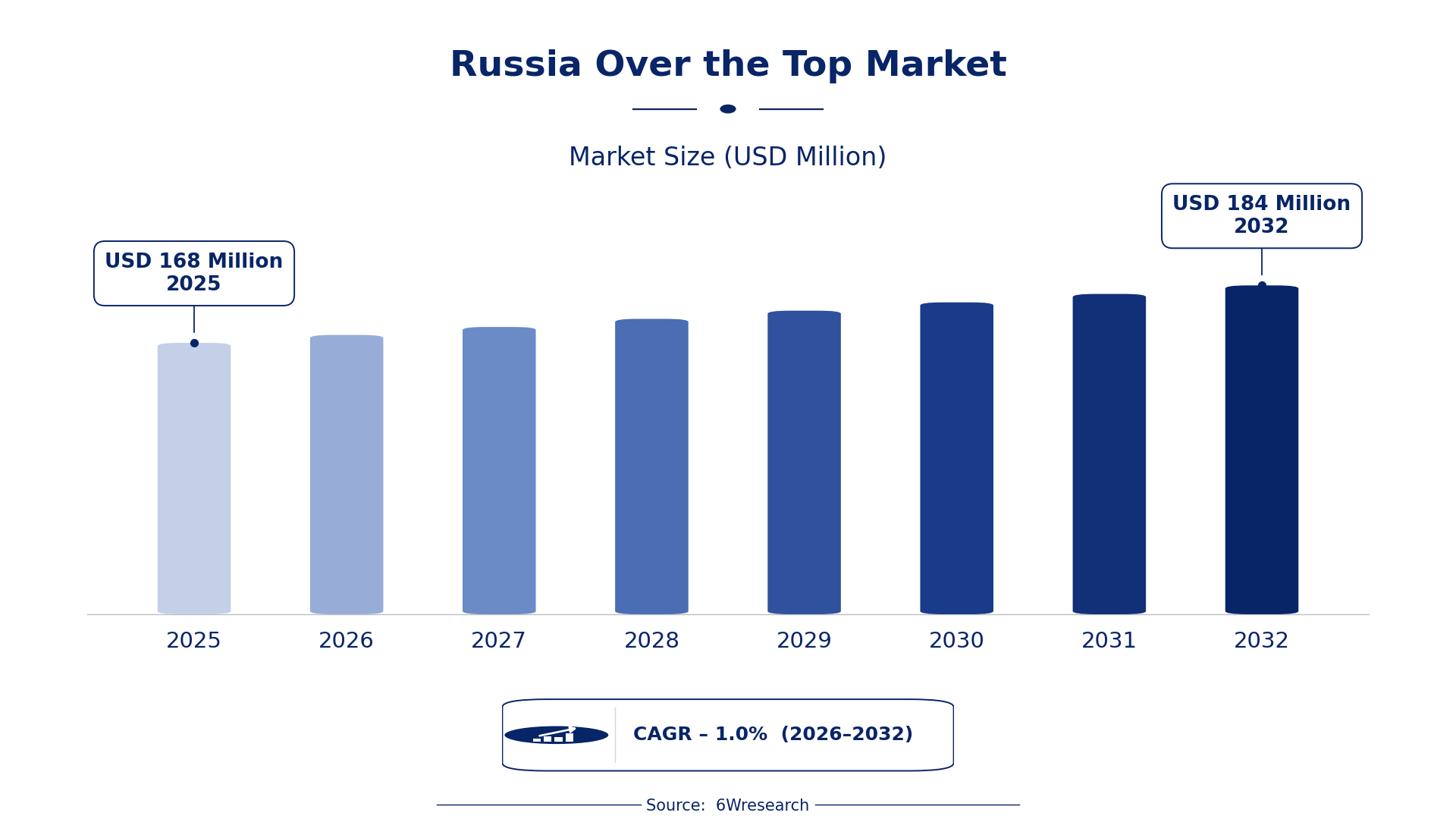
The Russia Over the Top Market was estimated at USD 168 Million in 2025 and is projected to reach USD 184 Million by 2032, growing at a CAGR of 1.0% from 2026 to 2032.
Russia Over the Top Market Synopsis
The Russia Over the Top (OTT) market is on a notable upward trajectory, driven by soaring demand for streaming services and a rapidly expanding internet user base. As consumer preferences continue to shift toward flexible, on-demand content, the landscape is becoming increasingly competitive with both domestic and international players striving for market share.
While the current momentum is impressive, future growth will be influenced by various factors, including regulatory challenges and market saturation. Local providers are currently dominating the scene, yet international services are beginning to carve out a space, intensifying the competition and altering consumer expectations.
Russia Over the Top Market Year-wise Growth Rate and Key Drivers
This graph illustrates the annual growth rates of the Russia Over the Top Market from 2021 to 2032, highlighting a steady upward trajectory and projected expansion over the forecast period.
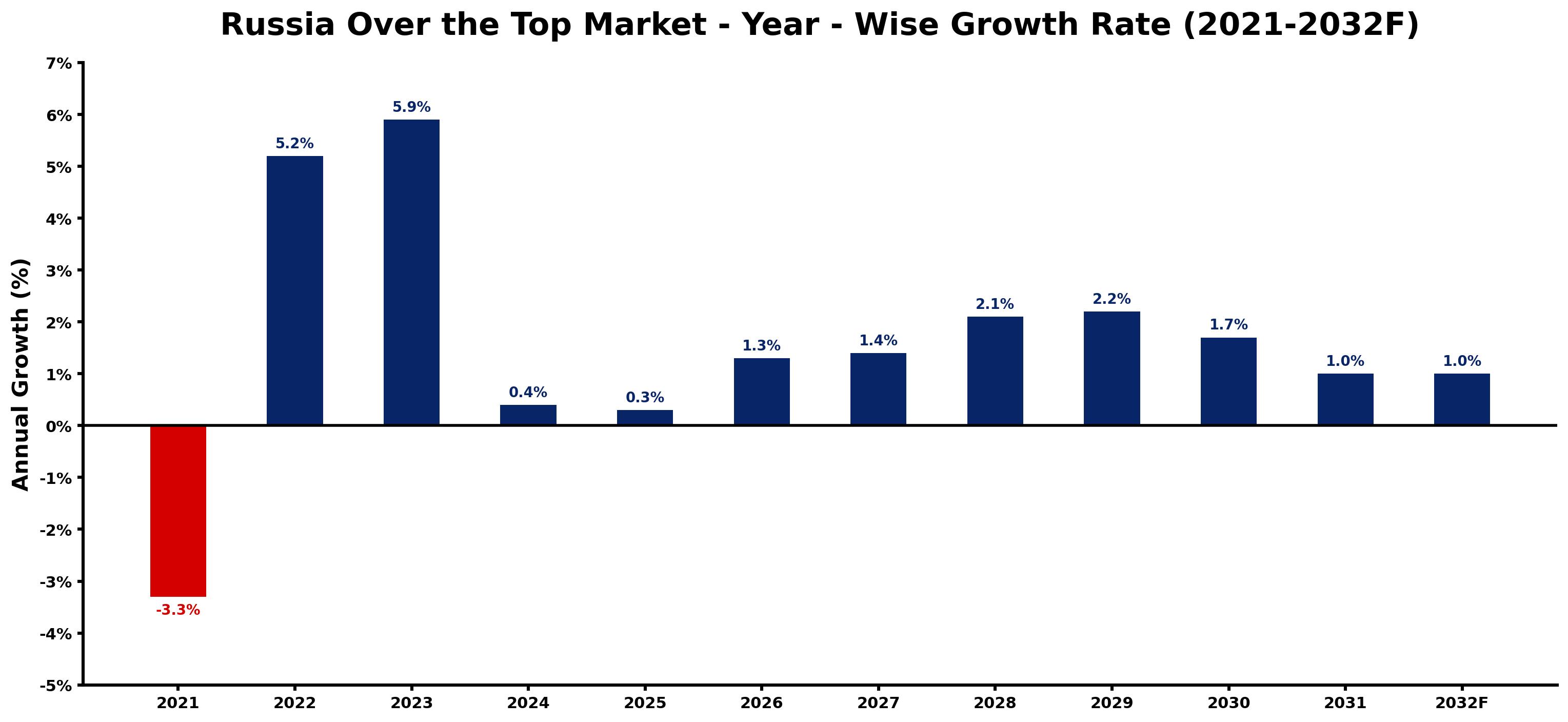
The table below presents the year‑wise growth rates along with the key drivers influencing the market
| Year | Growth Rate | Major Drivers |
| 2021 | -3.3% | Government restrictions on foreign streaming services imposed. |
| 2022 | 5.2% | Increased government support for multimedia innovation funding. |
| 2023 | 5.9% | Surge in adoption of smart TVs in urban areas. |
| 2024 | 0.4% | Growing preference for Russian content over foreign productions. |
| 2025 | 0.3% | Rising investment in domestic streaming platforms. |
| 2026 | 1.3% | Youth engagement in social media video content creation. |
| 2027 | 1.4% | Enhancements in mobile network infrastructure supporting streaming. |
| 2028 | 2.1% | Government initiatives promoting digital entertainment accessibility. |
| 2029 | 2.2% | Expanding popularity of online gaming among teenagers. |
| 2030 | 1.7% | Integration of streaming services with local telecom offerings. |
| 2031 | 1.0% | Increase in subscription services driven by local events. |
| 2032 | 1.0% | Demand for educational content streaming in remote regions. |
Note: Market size estimations and growth projections presented in this report are based on 6Wresearch's proprietary forecasting methodology, utilizing the latest available industry data, government publications, and primary research inputs.
Russia Over the Top Market Key Takeaways
Below are some of the specific key takeaways from the market, including:
- Rapid increase in internet penetration and smartphone adoption drives user engagement.
- Emergence of ad-supported models is changing monetization strategies across platforms.
- The pandemic accelerated OTT service adoption, reshaping viewing habits across demographics.
- Local content production is gaining momentum as providers seek to capture audience loyalty.
- Regulatory challenges persist, impacting content availability and operational strategies.
Evaluation of Restraints in Russia Over the Top Market
The Russia OTT market faces several restraints that could limit its potential. Regulatory uncertainties often create roadblocks for new and existing players; compliance with stringent content regulations demands ongoing attention and resources. Additionally, limited payment options hinder broader user adoption, especially among those less familiar with online transactions. The competitive environment further complicates market entry and sustainability, as both local and international entities battle for viewership in a space that is becoming increasingly crowded.
Russia Over the Top Market Trends
Several trends are shaping the future of the Russia OTT market. The rise of Subscription Video on Demand (SVOD) services is evident, with a marked increase in the popularity of platforms offering exclusive content. Original content creation has surged as providers aim to differentiate themselves from competitors. As ad-supported Video on Demand (AVOD) models grow in acceptance, users are discovering more affordable options. Consumers are also leaning towards mobile platforms, further boosting demand for optimized, on-the-go viewing experiences.
Russia Over the Top Market Opportunities
Investment opportunities abound within the Russia OTT market, particularly given the increasing digital consumption trends. A growing middle class and a population eager for diverse entertainment options create fertile ground for both established and emerging OTT providers. Collaborations with local content creators can effectively tap into regional tastes, enhancing viewer engagement. Moreover, with a shift towards cord-cutting, the potential for new entrants to capture audience share has never been more pronounced.
Government Initiatives in the Russia Over the Top Market
Government policies have a pronounced effect on the Russia OTT market, often balancing regulatory compliance with the need to foster a competitive environment. Current public sector priorities include encouraging local content production while ensuring that platforms adhere to national regulations. This regulatory framework shapes how businesses operate, compelling them to innovate within strict guidelines while also working to safeguard consumer rights.
- A regulatory framework introduced in 2025 mandating content licensing to enhance quality control.
- A public initiative focused on improving internet accessibility is currently underway, aimed at expanding reach across rural areas.
- The government has launched a program in 2024 aimed at promoting domestic content creators, increasing local production funding.
- Plans for stricter data privacy regulations are expected to be introduced in late 2026, further shaping operational requirements.
Future Insights of the Russia Over the Top Market
Looking ahead to 2026-2032, the Russia OTT market is likely to witness continued growth driven by technological advancements and changing consumer habits. Increased internet speed and smartphone penetration will likely facilitate even broader access to streaming services. As competition heats up, we can expect innovation in content delivery methods and pricing strategies, ultimately benefiting consumers. This dynamic environment presents a fertile ground for both new entrants and established players to thrive.
Russia Over the Top Market Latest Developments
Recent activity in the Russia OTT market has been marked by heightened competition and strategic collaborations. Over the past year, stakeholders have focused on bolstering their offerings to attract a more diverse audience. Innovations in technology and content strategy have paved the way for new developments that are reshaping the market.
- New content partnership agreements were signed in early 2025, enhancing the variety of shows available on local platforms.
- A major regional provider is currently rolling out a multi-platform streaming service, aimed for completion by mid-2026.
- A prominent OTT platform announced the launch of a localized original series, expected to premiere in late 2025.
- Investment in augmented reality features has begun, with pilot tests slated for early 2026.
Russia Over the Top Market - Key Attractiveness of the Report
- 10 Years of Market Numbers
- Historical Data Starting from 2022 to 2025
- Base Year: 2025
- Forecast Data until 2032
- Key Performance Indicators Impacting the Market
- Major Upcoming Developments and Projects
Key Highlights of the Report:
- Russia Over the Top Market Outlook
- Market Size of Russia Over the Top Market, 2025
- Forecast of Russia Over the Top Market, 2032
- Historical Data and Forecast of Russia Over the Top Revenues & Volume for the Period 2022-2032F
- Russia Over the Top Market Trend Evolution
- Russia Over the Top Market Drivers and Challenges
- Russia Over the Top Price Trends
- Russia Over the Top Porter's Five Forces
- Russia Over the Top Industry Life Cycle
- Historical Data and Forecast of Russia Over the Top Market Revenues & Volume By Type for the Period 2022-2032F
- Historical Data and Forecast of Russia Over the Top Market Revenues & Volume By Game Streaming for the Period 2022-2032F
- Historical Data and Forecast of Russia Over the Top Market Revenues & Volume By Audio Streaming for the Period 2022-2032F
- Historical Data and Forecast of Russia Over the Top Market Revenues & Volume By Video Streaming for the Period 2022-2032F
- Historical Data and Forecast of Russia Over the Top Market Revenues & Volume By Communication for the Period 2022-2032F
- Historical Data and Forecast of Russia Over the Top Market Revenues & Volume By Monetization Model for the Period 2022-2032F
- Historical Data and Forecast of Russia Over the Top Market Revenues & Volume By Subscription-based for the Period 2022-2032F
- Historical Data and Forecast of Russia Over the Top Market Revenues & Volume By Advertising-based for the Period 2022-2032F
- Historical Data and Forecast of Russia Over the Top Market Revenues & Volume By Transaction-based for the Period 2022-2032F
- Historical Data and Forecast of Russia Over the Top Market Revenues & Volume By Streaming Device for the Period 2022-2032F
- Historical Data and Forecast of Russia Over the Top Market Revenues & Volume By Smartphones and Tablets for the Period 2022-2032F
- Historical Data and Forecast of Russia Over the Top Market Revenues & Volume By Desktops and Laptops for the Period 2022-2032F
- Historical Data and Forecast of Russia Over the Top Market Revenues & Volume By IPTV and Consoles for the Period 2022-2032F
- Historical Data and Forecast of Russia Over the Top Market Revenues & Volume By Vertical for the Period 2022-2032F
- Historical Data and Forecast of Russia Over the Top Market Revenues & Volume By Media and Entertainment for the Period 2022-2032F
- Historical Data and Forecast of Russia Over the Top Market Revenues & Volume By Education and Learning for the Period 2022-2032F
- Historical Data and Forecast of Russia Over the Top Market Revenues & Volume By Gaming for the Period 2022-2032F
- Historical Data and Forecast of Russia Over the Top Market Revenues & Volume By Service Utilities for the Period 2022-2032F
- Russia Over the Top Import Export Trade Statistics
- Market Opportunity Assessment By Type
- Market Opportunity Assessment By Monetization Model
- Market Opportunity Assessment By Streaming Device
- Market Opportunity Assessment By Vertical
- Russia Over the Top Top Companies Market Share
- Russia Over the Top Competitive Benchmarking By Technical and Operational Parameters
- Russia Over the Top Company Profiles
- Russia Over the Top Key Strategic Recommendations






































