Russia Smart Locks Market Size, Share & Growth Rate
The Russia Smart Locks Market was estimated at USD 341 Million in 2025 and is projected to reach USD 412 Million by 2032, growing at a CAGR of 2.7% from 2026 to 2032. This growth trajectory is significantly driven by the surge in smart home technology adoption among Russian consumers, who are increasingly prioritizing convenience and enhanced security in their residential solutions. Factors such as urbanization, increasing disposable incomes, and advancements in IoT technologies further contribute to this positive outlook for the market.
Russia Smart Locks Market Year-wise Growth Rate and Key Drivers
This graph highlights how the Russia Smart Locks Market has steadily grown over the years, supported by major growth factors.
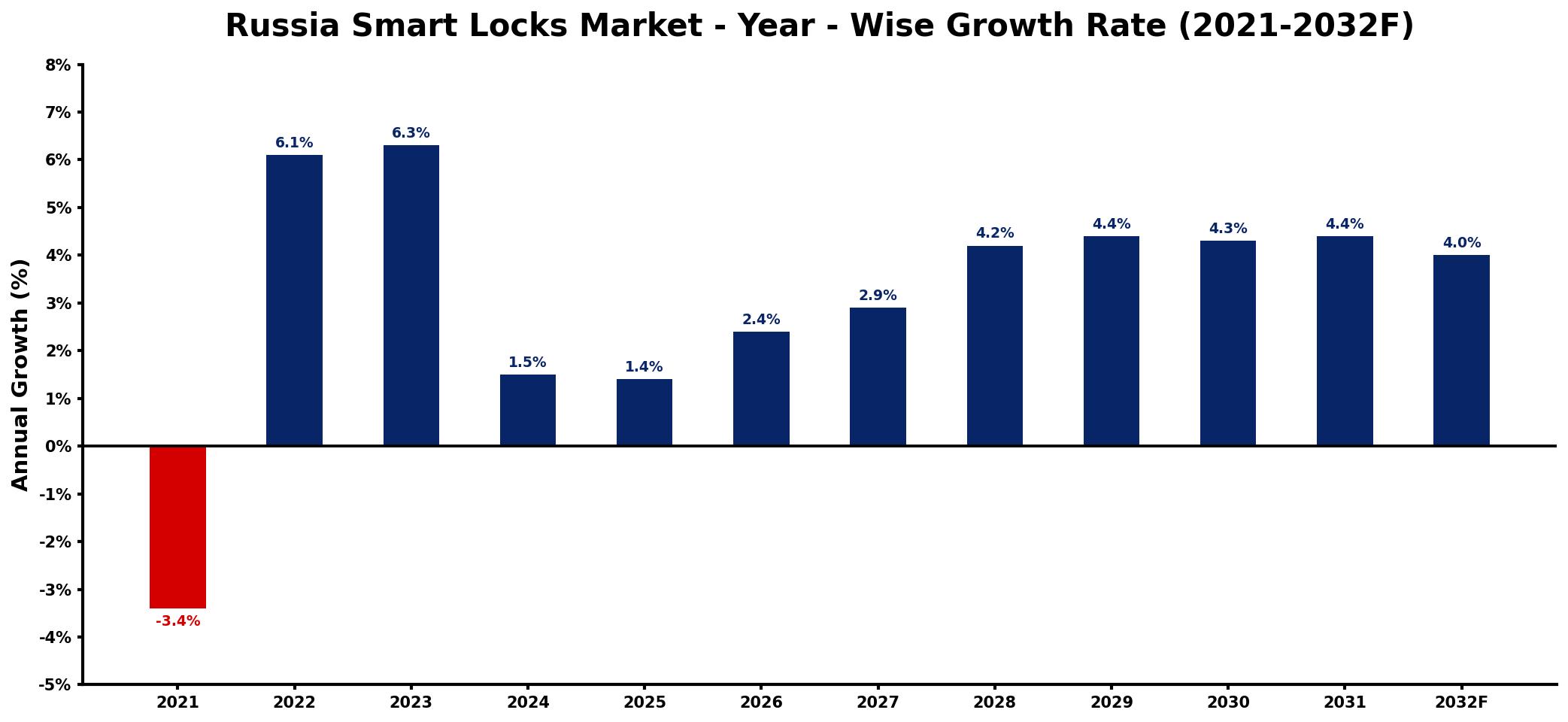
The table below presents the year‑wise growth rates along with the key drivers influencing the market
| Year | Growth Rate | Major Drivers |
| 2021 | -3.4% | Economic uncertainty affecting consumer spending |
| 2022 | 6.1% | Increased focus on home security |
| 2023 | 6.3% | Technological advancements driving adoption |
| 2024 | 1.5% | Growing demand for automation solutions |
| 2025 | 1.4% | Rise in home renovation projects |
| 2026 | 2.4% | Enhanced digital security awareness |
| 2027 | 2.9% | Expansion of e-commerce platforms |
| 2028 | 4.2% | increased capital investment inflows |
| 2029 | 4.4% | Investment in residential security technology |
| 2030 | 4.3% | Shift towards sustainable living practices |
| 2031 | 4.4% | Emergence of new market players |
| 2032 | 4.0% | Strengthening urbanization trends influencing demand |
Note: Market size estimations and growth projections presented in this report are based on 6Wresearch's proprietary forecasting methodology, utilizing the latest available industry data, government publications, and primary research inputs.
Russia Smart Locks Market Synopsis
The strongest force shaping the Russia Smart Locks Market right now is the escalating consumer demand for advanced security solutions. As the awareness of smart home technologies rises, homeowners are keen on integrating these innovations into their daily lives.
Moreover, the burgeoning real estate sector in urban areas has catalyzed interest in smart locks, positioning them as a desirable feature in both new and renovated properties. As security concerns intensify among consumers, the market is anticipated to continue expanding steadily.
Russia Smart Locks Market Key Takeaways
- Growing urbanization is boosting the demand for smart locks in residential sectors.
- Integration with home automation systems is becoming increasingly popular among consumers.
- Rising disposable incomes are facilitating greater investment in advanced security technologies.
- Biometric authentication and Wi-Fi connectivity are emerging as key features sought by buyers.
- Local manufacturers are increasingly entering the market to cater to diverse consumer preferences.
Evaluation of Restraints in Russia Smart Locks Market
Despite the growth potential, the Russia Smart Locks Market faces significant challenges that could limit its expansion. Concerns regarding data security and privacy remain paramount, as the integration of smart locks with the Internet of Things raises the risk of hacking and unauthorized access. Furthermore, some consumers show a reluctance to embrace new technologies, favoring traditional lock-and-key systems due to perceived complexities or vulnerabilities. Regulatory hurdles, alongside compatibility issues with existing infrastructure, further pose hurdles for manufacturers striving to penetrate this market effectively. Additionally, the high upfront costs of smart locks compared to conventional locking mechanisms may deter price-sensitive consumers.
Russia Smart Locks Market Trends
The market is currently witnessing several trends that are shaping both demand and technology. A notable trend is the increasing integration of smart locks with home automation systems, allowing users to control access through mobile apps and voice assistants. Additionally, the popularity of advanced features such as biometric authentication and keyless entry methods is on the rise, enhancing user convenience while addressing security concerns. The demand for smart locks with Wi-Fi connectivity is also growing, enabling homeowners to remotely manage access from anywhere in the world.
Russia Smart Locks Market Opportunities
The Russia Smart Locks Market offers a plethora of investment opportunities, particularly as smart home technologies gain traction. Investors can find growth potential by focusing on smart lock manufacturers or technology providers. Opportunities also exist in forging partnerships with real estate developers and home security firms, enhancing product offerings and expanding market reach. Additionally, as consumer awareness of home security continues to rise, there is considerable room for innovative solutions that meet evolving consumer needs.
Government Initiatives in the Russia Smart Locks Market
The Russian government is actively promoting innovation within the technology sector, including initiatives aimed at advancing smart locking solutions. Policies such as the Digital Economy National Program are designed to foster the development of digital technologies, creating an environment conducive to technological progress. In addition, regulatory measures related to cybersecurity are being enacted to protect smart lock systems and user data. Such government actions are poised to stimulate growth within the smart locks market and enhance its competitive stance on a global scale.
Future Insights of the Russia Smart Locks Market
Looking ahead to 2026-2032, the Russia Smart Locks Market is set to experience significant transformations influenced by continuous advancements in technology and consumer demand. With the proliferation of smart home devices, the integration of enhanced security features will likely become a standard expectation among homeowners. Furthermore, the ongoing urbanization and rising living standards will provide fertile ground for market expansion. Overall, the outlook is robust, indicating a steady growth trajectory fueled by innovation and evolving consumer preferences.
Russia Smart Locks Market Latest Developments (2025 - 2026)
The smart locks sector in Russia has seen a flurry of activity lately, with several companies announcing new product lines that emphasize user-friendly interfaces and heightened security measures. Developments have included enhancements to existing models, integrating more sophisticated biometric technologies and advanced encryption protocols. Furthermore, collaborations between smart lock manufacturers and home automation platforms have become increasingly common, aimed at offering comprehensive security solutions to consumers. As the market evolves, these trends are anticipated to shape the future landscape of smart locking technologies.
Russia Smart Locks Market - Key Attractiveness of the Report
- 10 Years of Market Numbers
- Historical Data Starting from 2022 to 2025
- Base Year: 2025
- Forecast Data until 2032
- Key Performance Indicators Impacting the Market
- Major Upcoming Developments and Projects
Key Highlights of the Report:
- Russia Smart Locks Market Outlook
- Market Size of Russia Smart Locks Market, 2025
- Forecast of Russia Smart Locks Market, 2032
- Historical Data and Forecast of Russia Smart Locks Revenues & Volume for the Period 2022-2032F
- Russia Smart Locks Market Trend Evolution
- Russia Smart Locks Market Drivers and Challenges
- Russia Smart Locks Price Trends
- Russia Smart Locks Porter's Five Forces
- Russia Smart Locks Industry Life Cycle
- Historical Data and Forecast of Russia Smart Locks Market Revenues & Volume By Product for the Period 2022-2032F
- Historical Data and Forecast of Russia Smart Locks Market Revenues & Volume By Deadbolts for the Period 2022-2032F
- Historical Data and Forecast of Russia Smart Locks Market Revenues & Volume By Lever Handles for the Period 2022-2032F
- Historical Data and Forecast of Russia Smart Locks Market Revenues & Volume By Padlocks for the Period 2022-2032F
- Historical Data and Forecast of Russia Smart Locks Market Revenues & Volume By Others for the Period 2022-2032F
- Historical Data and Forecast of Russia Smart Locks Market Revenues & Volume By Technology for the Period 2022-2032F
- Historical Data and Forecast of Russia Smart Locks Market Revenues & Volume By Bluetooth for the Period 2022-2032F
- Historical Data and Forecast of Russia Smart Locks Market Revenues & Volume By Wi-Fi for the Period 2022-2032F
- Historical Data and Forecast of Russia Smart Locks Market Revenues & Volume By End User for the Period 2022-2032F
- Historical Data and Forecast of Russia Smart Locks Market Revenues & Volume By Residential for the Period 2022-2032F
- Historical Data and Forecast of Russia Smart Locks Market Revenues & Volume By Commercial for the Period 2022-2032F
- Russia Smart Locks Import Export Trade Statistics
- Market Opportunity Assessment By Product
- Market Opportunity Assessment By Technology
- Market Opportunity Assessment By End User
- Russia Smart Locks Top Companies Market Share
- Russia Smart Locks Competitive Benchmarking By Technical and Operational Parameters
- Russia Smart Locks Company Profiles
- Russia Smart Locks Key Strategic Recommendations






































