Russia Virtualization Security Market Size & Growth Rate (2026-2032)
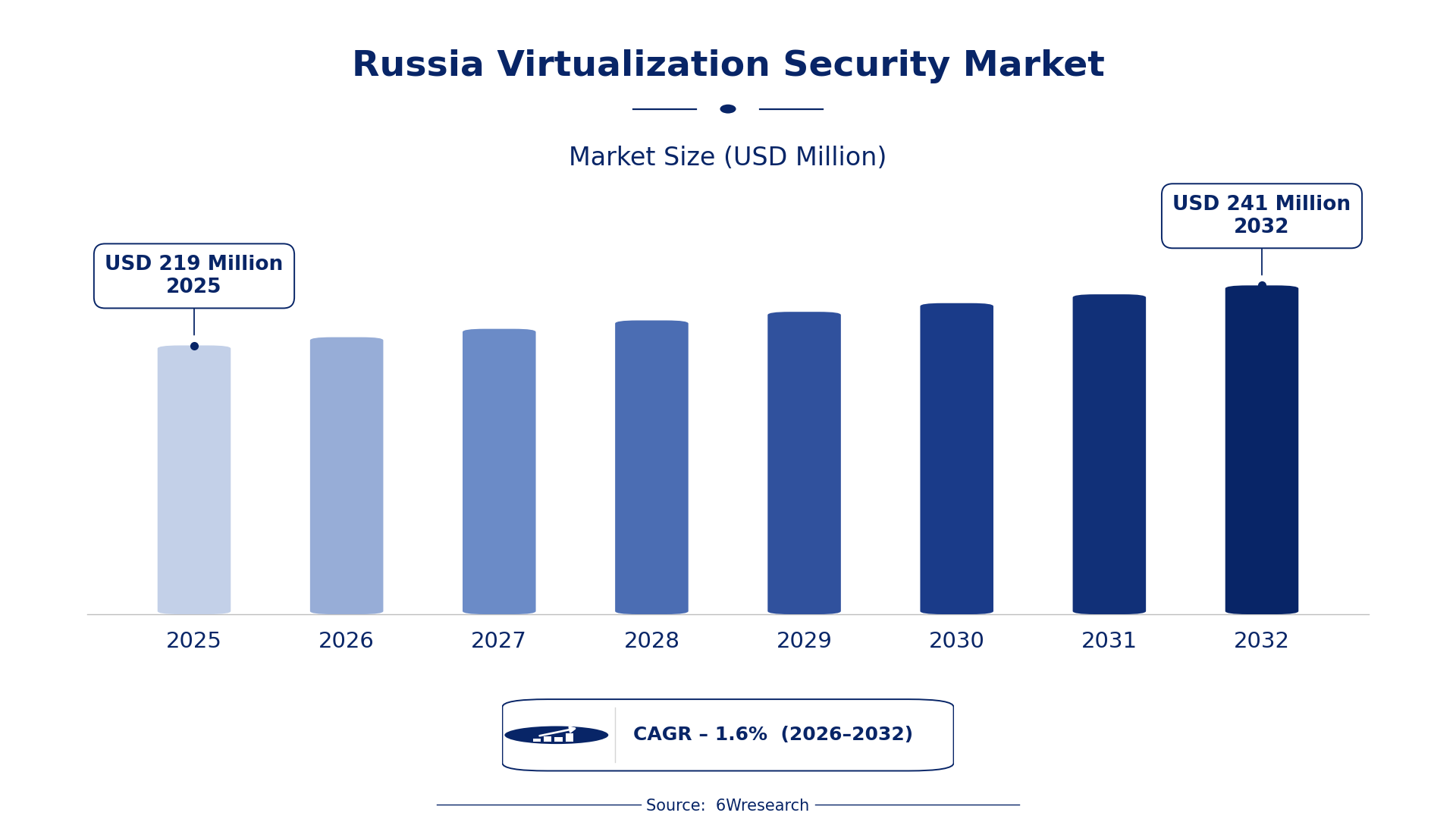
The Russia Virtualization Security Market was estimated at USD 219 Million in 2025 and is projected to reach USD 241 Million by 2032, growing at a CAGR of 1.6% from 2026 to 2032.
Russia Virtualization Security Market Synopsis
The Russia Virtualization Security Market is currently experiencing an upward trajectory, driven by heightened awareness of cybersecurity threats. Businesses are increasingly recognizing the necessity of protecting their virtualized infrastructures against potential vulnerabilities. The shift towards adopting robust security measures reflects a growing understanding that investing in virtualization security is essential to maintain operational integrity.
Looking ahead, the demand for virtualization security solutions is expected to surge as organizations grapple with evolving cyber threats and stricter compliance mandates. The market's future growth will heavily depend on the innovation of security technologies tailored to meet the unique challenges faced by Russian businesses. Enhanced cooperation among enterprises and security solution providers will be crucial in addressing these security challenges effectively.
Russia Virtualization Security Market Year-wise Growth Rate and Key Drivers
This graph illustrates the annual growth rates of the Russia Virtualization Security Market from 2021 to 2032, highlighting a steady upward trajectory and projected expansion over the forecast period.
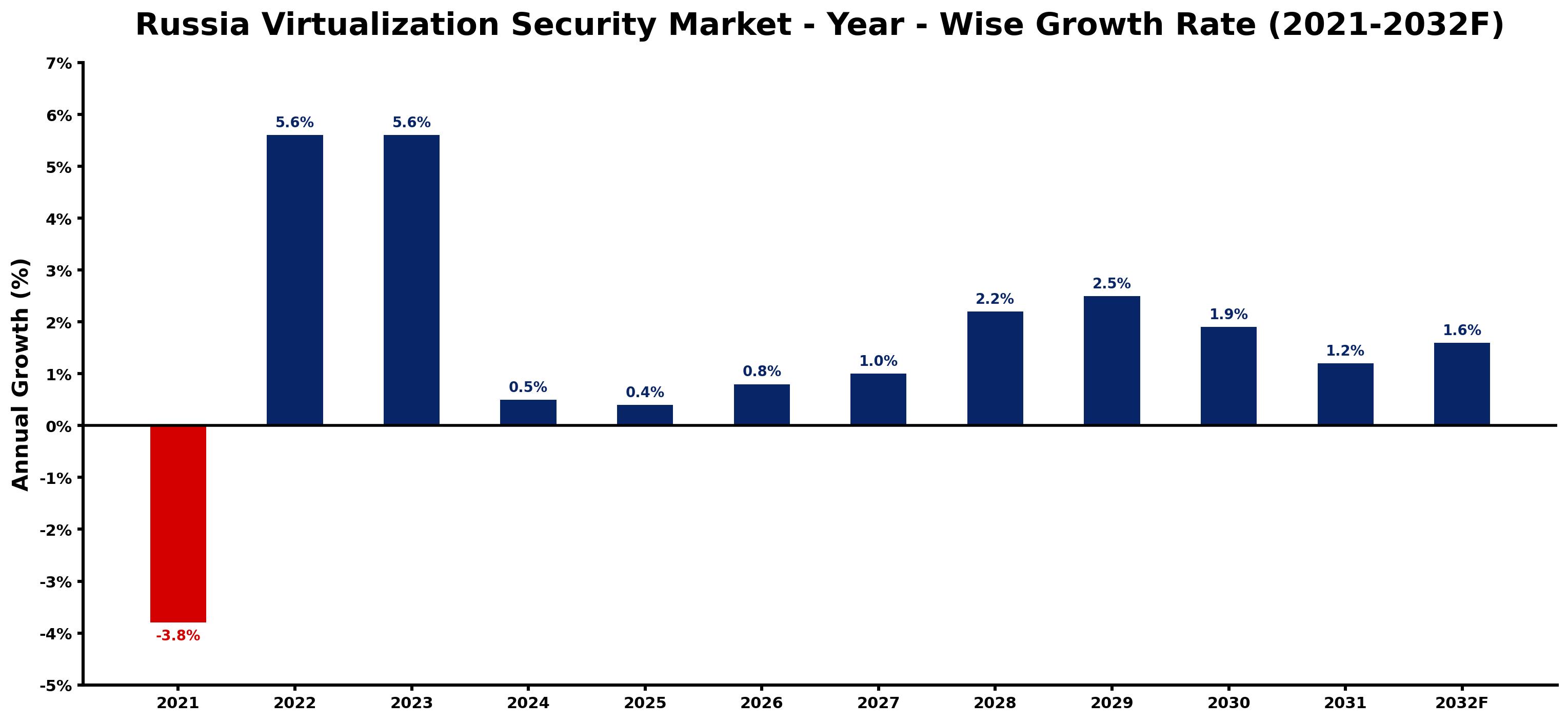
The table below presents the year‑wise growth rates along with the key drivers influencing the market
| Year | Growth Rate | Major Drivers |
| 2021 | -3.8% | Increased sanctions limiting technology imports from the West. |
| 2022 | 5.6% | Increased cybersecurity regulations from the FSB |
| 2023 | 5.6% | Government support for domestic cybersecurity technology programs |
| 2024 | 0.5% | Adoption of new data protection laws enhancing security demands |
| 2025 | 0.4% | Growing concerns over data sovereignty among Russian corporations |
| 2026 | 0.8% | Investment in anti-cyberattack measures by state-owned enterprises |
| 2027 | 1.0% | Heightened cyber threats prompting security upgrades |
| 2028 | 2.2% | Development of local cybersecurity start-ups attracting investment |
| 2029 | 2.5% | Rising awareness of virtualization security risks among SMEs |
| 2030 | 1.9% | Implementation of secure cloud strategies by major industries |
| 2031 | 1.2% | Increased budget allocations for IT security in companies |
| 2032 | 1.6% | Growing digital transformation initiatives focusing on data protection |
Note: Market size estimations and growth projections presented in this report are based on 6Wresearch's proprietary forecasting methodology, utilizing the latest available industry data, government publications, and primary research inputs.
Russia Virtualization Security Market Key Takeaways
Below are some of the specific key takeaways from the market, including:
- The market is set for steady growth due to the increasing adoption of virtualization technologies across various sectors.
- Awareness around securing virtualized environments is prompting organizations to prioritize cybersecurity investments.
- Innovative security solutions tailored to local business needs are becoming a focal point for providers.
- Compliance with data protection regulations is driving organizations to enhance their virtualization security measures.
- Investment opportunities abound, particularly in advanced security solutions such as encryption and threat detection tools.
Evaluation of Restraints in Russia Virtualization Security Market
A significant hurdle for the Russia Virtualization Security Market lies in the prevailing lack of awareness regarding the risks associated with virtualization technologies. Many businesses are still underestimating the potential security threats, resulting in insufficient investment in necessary security measures. This knowledge gap could stifle the market's growth as providers work to adapt their offerings to better align with business needs. Additionally, the fast-paced development of virtualization technologies presents a continuous challenge for security providers, making it essential to stay ahead of emerging threats and maintain compliance with increasingly stringent regulations.
Russia Virtualization Security Market Trends
Key trends shaping the Russia Virtualization Security Market include the integration of security measures directly into virtualization platforms, which reflects a shift towards a more proactive approach to cybersecurity. Companies are prioritizing the use of encryption and network segmentation to strengthen their virtual environments. on top of that, the implementation of tailored threat detection and response systems underscores a commitment to safeguarding data and applications operating on virtual machines.
Regulatory compliance continues to influence security investments, with organizations increasingly looking for solutions that align with stringent data protection and privacy mandates. As regulations become more complex, the demand for solutions that offer comprehensive compliance capabilities is likely to intensify.
Russia Virtualization Security Market Opportunities
Amidst the challenges, the Russia Virtualization Security Market presents significant investment opportunities. As virtualization technologies gain traction across industries, the necessity for advanced security solutions—such as endpoint protection, network security, and encryption tools—becomes increasingly pronounced. Companies that can offer comprehensive solutions tailored to local business needs will find themselves well-positioned for growth.
on top of that, forming strategic partnerships with local IT service providers or cybersecurity firms could facilitate the provision of integrated virtualization security services, enhancing market penetration and customer trust. A thorough understanding of the local regulatory landscape will be vital for stakeholders aiming to capitalize on these opportunities.
Government Initiatives in the Russia Virtualization Security Market
Government policy plays an influential role in shaping the Russia Virtualization Security Market, reflecting a commitment to enhancing cybersecurity within the country. Regulatory frameworks are becoming increasingly stringent, aimed at ensuring the protection of information systems utilizing virtualization technologies. The government is fostering a secure environment for businesses to adopt these technologies while safeguarding against potential cyber threats.
- A national program launched in 2023 focuses on improving digital security infrastructure across sectors, prioritizing cybersecurity initiatives.
- Current initiatives include a framework established in 2025 mandating data protection protocols for organizations operating in Russia.
- The Federal Security Service (FSB) is actively monitoring and enhancing the security of information systems, including those reliant on virtualization.
- Future plans indicate the rollout of a comprehensive cybersecurity education program aimed at increasing awareness among businesses about virtualization risks, scheduled for implementation by 2027.
- Upcoming regulatory changes are expected to further define compliance requirements for virtualization security, enhancing protections for organizations by 2028.
Future Insights of the Russia Virtualization Security Market
The outlook for the Russia Virtualization Security Market is optimistic as businesses increasingly integrate virtualization technologies to boost efficiency and reduce operational costs. The rising tide of cyber threats reinforces the need for robust security measures, driving further demand for virtualization security solutions. Factors such as widespread cloud adoption and the proliferation of mobile devices will likely accelerate market growth.
As organizations strive to comply with evolving data protection regulations, the market will benefit from innovative security solutions that address compliance challenges. Companies focused on developing tailored solutions are well-positioned to seize the growth opportunities presented by the evolving landscape.
Russia Virtualization Security Market Latest Developments
In the past year, activity within the Russia Virtualization Security Market has accelerated, reflecting an increased focus on addressing cybersecurity challenges. Companies are actively developing new solutions and enhancing existing offerings to meet rising demands for security in virtualized environments. This momentum is indicative of a broader industry response to the growing sophistication of cyber threats.
- A major technology vendor launched an advanced threat detection system in Q3 2025, specifically designed for virtualized infrastructures.
- Ongoing partnerships between cybersecurity firms and local enterprises aim to integrate comprehensive virtualization security services, enhancing client protection.
- Research and development initiatives are currently underway, focusing on innovative encryption technologies to bolster data security in virtual environments.
- A rollout of a national security awareness campaign commenced in early 2025, targeting organizations to educate them about virtualization security best practices.
- Plans are in motion for a significant cybersecurity framework expected to be announced in late 2026, which will refine compliance requirements for virtualization security.
Russia Virtualization Security Market - Key Attractiveness of the Report
- 10 Years of Market Numbers
- Historical Data Starting from 2022 to 2025
- Base Year: 2025
- Forecast Data until 2032
- Key Performance Indicators Impacting the Market
- Major Upcoming Developments and Projects
Key Highlights of the Report:
- Russia Virtualization Security Market Outlook
- Market Size of Russia Virtualization Security Market, 2025
- Forecast of Russia Virtualization Security Market, 2032
- Historical Data and Forecast of Russia Virtualization Security Revenues & Volume for the Period 2022-2032F
- Russia Virtualization Security Market Trend Evolution
- Russia Virtualization Security Market Drivers and Challenges
- Russia Virtualization Security Price Trends
- Russia Virtualization Security Porter's Five Forces
- Russia Virtualization Security Industry Life Cycle
- Historical Data and Forecast of Russia Virtualization Security Market Revenues & Volume By Component for the Period 2022-2032F
- Historical Data and Forecast of Russia Virtualization Security Market Revenues & Volume By Solution (Virtual Infrastructure & Lifecycle Protection) for the Period 2022-2032F
- Historical Data and Forecast of Russia Virtualization Security Market Revenues & Volume By Services (Professional & Managed) for the Period 2022-2032F
- Historical Data and Forecast of Russia Virtualization Security Market Revenues & Volume By Organization Size for the Period 2022-2032F
- Historical Data and Forecast of Russia Virtualization Security Market Revenues & Volume By SMEs for the Period 2022-2032F
- Historical Data and Forecast of Russia Virtualization Security Market Revenues & Volume By Large Enterprises for the Period 2022-2032F
- Historical Data and Forecast of Russia Virtualization Security Market Revenues & Volume By End User for the Period 2022-2032F
- Historical Data and Forecast of Russia Virtualization Security Market Revenues & Volume By Service Providers for the Period 2022-2032F
- Historical Data and Forecast of Russia Virtualization Security Market Revenues & Volume By Enterprises for the Period 2022-2032F
- Historical Data and Forecast of Russia Virtualization Security Market Revenues & Volume By Deployment for the Period 2022-2032F
- Historical Data and Forecast of Russia Virtualization Security Market Revenues & Volume By On-premises for the Period 2022-2032F
- Historical Data and Forecast of Russia Virtualization Security Market Revenues & Volume By Cloud for the Period 2022-2032F
- Russia Virtualization Security Import Export Trade Statistics
- Market Opportunity Assessment By Component
- Market Opportunity Assessment By Organization Size
- Market Opportunity Assessment By End User
- Market Opportunity Assessment By Deployment
- Russia Virtualization Security Top Companies Market Share
- Russia Virtualization Security Competitive Benchmarking By Technical and Operational Parameters
- Russia Virtualization Security Company Profiles
- Russia Virtualization Security Key Strategic Recommendations






































