Saudi Arabia Aquaculture & Marine Products Market Size, Share & Growth Rate
The Saudi Arabia Aquaculture & Marine Products Market was estimated at USD 358 Million in 2025 and is projected to reach USD 459 Million by 2032, growing at a CAGR of 3.6% from 2026 to 2032. This growth trajectory is primarily driven by increasing local demand for seafood products as the nation enhances its self-sufficiency in food production. Additionally, favorable government policies aimed at boosting aquaculture investments are energizing the sector, highlighting a robust shift towards sustainable food sources.
Saudi Arabia Aquaculture & Marine Products Market Year-wise Growth Rate and Key Drivers
This graph highlights how the Saudi Arabia Aquaculture & Marine Products Market has steadily grown over the years, supported by major growth factors.
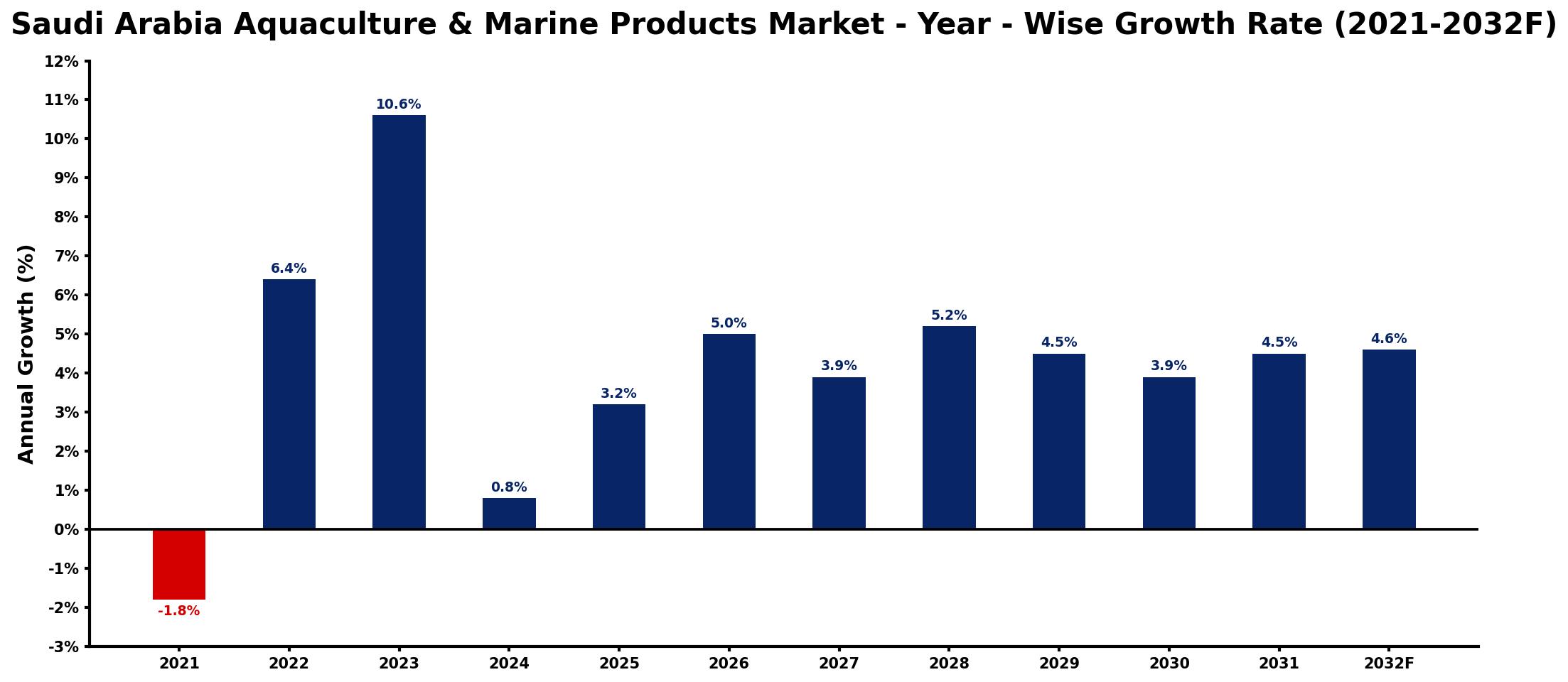
The table below presents the year‑wise growth rates along with the key drivers influencing the market
| Year | Growth Rate | Major Drivers |
| 2021 | -1.8% | decrease in consumer spending habits |
| 2022 | 6.4% | increased investment in sustainable practices |
| 2023 | 10.6% | growing demand for local sourcing |
| 2024 | 0.8% | rising health consciousness among consumers |
| 2025 | 3.2% | expansion of distribution networks |
| 2026 | 5.0% | enhanced technological advancements adoption |
| 2027 | 3.9% | increased export opportunities emerging |
| 2028 | 5.2% | growing interest in eco-friendly solutions |
| 2029 | 4.5% | strengthened partnerships with local farms |
| 2030 | 3.9% | increased government support initiatives |
| 2031 | 4.5% | growing popularity of alternative proteins |
| 2032 | 4.6% | expansion into new international markets |
Note: Market size estimations and growth projections presented in this report are based on 6Wresearch's proprietary forecasting methodology, utilizing the latest available industry data, government publications, and primary research inputs.
Saudi Arabia Aquaculture & Marine Products Market Synopsis
The strongest force shaping the Saudi Arabia Aquaculture & Marine Products Market is the governments commitment to food security through domestic seafood production. With its rich coastal resources, the country is strategically investing in the aquaculture sector, promoting initiatives that encourage both local consumption and export potential.
In recent years, there has been a noticeable increase in consumer interest for locally sourced seafood, emphasizing the nutritional benefits and sustainability of aquaculture products. This shift, combined with technological advancements in marine farming, positions Saudi Arabia as an emerging leader in the regional aquaculture landscape.
- Substantial growth driven by increasing seafood consumption and local sourcing preferences.
- Government initiatives are pivotal in fostering investment and sustainability within the sector.
- Technological advancements in aquaculture practices are enhancing production efficiency.
- The market shows resilience as it adapts to shifting consumer behaviors post-COVID-19.
- Export potential is being explored, contributing to economic diversification efforts.
While the Saudi Arabia Aquaculture & Marine Products Market is on a growth trajectory, several restraints are hindering its full potential. One major challenge lies in replicating natural marine environments for cultivation, which is essential for disease management and water quality maintenance. The need for continual innovation to tackle these issues is paramount. Furthermore, the evolving preferences of consumers necessitate streamlined supply chains and efficient storage solutions, thereby raising questions around operational viability and sustainability for producers.
Current trends in the Saudi Arabia Aquaculture & Marine Products Market reflect a growing consumer preference for sustainable and health-conscious seafood options. As awareness of the nutritional benefits of seafood rises, so does the demand for products that adhere to high-quality standards. Technologically, innovations in aquaculture, such as integrated fish farming and advanced breeding techniques, are increasingly being adopted. Additionally, e-commerce channels are gaining popularity, allowing consumers to access fresh seafood directly, bypassing traditional distribution hurdles.
There are promising opportunities for growth and investment in the Saudi Arabia Aquaculture & Marine Products Market, particularly in areas like research and development for new species cultivation. The shift towards exporting marine products presents an untapped avenue for increasing revenue and enhancing the country's economic resilience. With increasing local consumer interest, investments in sustainable practices and technology-driven solutions will likely yield significant dividends for businesses entering or expanding in this sector.
The Saudi government has been proactive in promoting the aquaculture sector through various policies and initiatives. These include regulations aimed at sustainable practices and incentives for investments in marine farming infrastructure. Public spending on research, development, and technology transfer is also being prioritized to further enhance the industry's growth. These initiatives underscore the government's long-term vision for ensuring food security and economic diversification through local aquaculture production.
Looking ahead, the Saudi Arabia Aquaculture & Marine Products Market is poised for significant advancements through 2026-2032. The combination of increasing domestic demand for seafood and government support creates a conducive environment for growth. As technological innovations continue to reshape production methods, we can expect enhanced efficiency and sustainability in aquaculture practices. The markets potential to evolve into a robust player in the global seafood arena aligns with Saudi Arabia's broader economic diversification goals, indicating a bright outlook for the coming years.
In recent months, the aquaculture industry in Saudi Arabia has witnessed strategic shifts aimed at bolstering production capabilities. This includes the introduction of innovative farming techniques and partnerships aimed at increasing seafood quality and supply chain efficiency. Efforts to expand into export markets are also on the rise, with companies exploring new distribution methods to meet international demand. The market remains agile, adapting to the changing landscape while capitalizing on opportunities for growth.
- 10 Years of Market Numbers
- Historical Data Starting from 2022 to 2025
- Base Year: 2025
- Forecast Data until 2032
- Key Performance Indicators Impacting the Market
- Major Upcoming Developments and Projects
Key Highlights of the Report:
- Saudi Arabia Aquaculture & Marine Products Market Outlook
- Market Size of Saudi Arabia Aquaculture & Marine Products Market, 2025
- Forecast of Saudi Arabia Aquaculture & Marine Products Market, 2032
- Historical Data and Forecast of Saudi Arabia Aquaculture & Marine Products Revenues & Volume for the Period 2022-2032F
- Saudi Arabia Aquaculture & Marine Products Market Trend Evolution
- Saudi Arabia Aquaculture & Marine Products Market Drivers and Challenges
- Saudi Arabia Aquaculture & Marine Products Price Trends
- Saudi Arabia Aquaculture & Marine Products Porter's Five Forces
- Saudi Arabia Aquaculture & Marine Products Industry Life Cycle
- Historical Data and Forecast of Saudi Arabia Aquaculture & Marine Products Market Revenues & Volume By Rearing Product Type for the Period 2022-2032F
- Historical Data and Forecast of Saudi Arabia Aquaculture & Marine Products Market Revenues & Volume By Equipment for the Period 2022-2032F
- Historical Data and Forecast of Saudi Arabia Aquaculture & Marine Products Market Revenues & Volume By Chemicals for the Period 2022-2032F
- Historical Data and Forecast of Saudi Arabia Aquaculture & Marine Products Market Revenues & Volume By Pharmaceuticals for the Period 2022-2032F
- Historical Data and Forecast of Saudi Arabia Aquaculture & Marine Products Market Revenues & Volume By Fertilizers for the Period 2022-2032F
- Historical Data and Forecast of Saudi Arabia Aquaculture & Marine Products Market Revenues & Volume By Others for the Period 2022-2032F
- Historical Data and Forecast of Saudi Arabia Aquaculture & Marine Products Market Revenues & Volume By Type for the Period 2022-2032F
- Historical Data and Forecast of Saudi Arabia Aquaculture & Marine Products Market Revenues & Volume By Fisheries for the Period 2022-2032F
- Historical Data and Forecast of Saudi Arabia Aquaculture & Marine Products Market Revenues & Volume By Seaweeds for the Period 2022-2032F
- Historical Data and Forecast of Saudi Arabia Aquaculture & Marine Products Market Revenues & Volume By Microalgae for the Period 2022-2032F
- Historical Data and Forecast of Saudi Arabia Aquaculture & Marine Products Market Revenues & Volume By Crustaceans for the Period 2022-2032F
- Historical Data and Forecast of Saudi Arabia Aquaculture & Marine Products Market Revenues & Volume By Molluscs for the Period 2022-2032F
- Historical Data and Forecast of Saudi Arabia Aquaculture & Marine Products Market Revenues & Volume By Others for the Period 2022-2032F
- Historical Data and Forecast of Saudi Arabia Aquaculture & Marine Products Market Revenues & Volume By Production Type for the Period 2022-2032F
- Historical Data and Forecast of Saudi Arabia Aquaculture & Marine Products Market Revenues & Volume By Small-Scale for the Period 2022-2032F
- Historical Data and Forecast of Saudi Arabia Aquaculture & Marine Products Market Revenues & Volume By Medium & Large Scale for the Period 2022-2032F
- Historical Data and Forecast of Saudi Arabia Aquaculture & Marine Products Market Revenues & Volume By Culture for the Period 2022-2032F
- Historical Data and Forecast of Saudi Arabia Aquaculture & Marine Products Market Revenues & Volume By Freshwater for the Period 2022-2032F
- Historical Data and Forecast of Saudi Arabia Aquaculture & Marine Products Market Revenues & Volume By Brackish Water for the Period 2022-2032F
- Historical Data and Forecast of Saudi Arabia Aquaculture & Marine Products Market Revenues & Volume By Marine for the Period 2022-2032F
- Saudi Arabia Aquaculture & Marine Products Import Export Trade Statistics
- Market Opportunity Assessment By Rearing Product Type
- Market Opportunity Assessment By Type
- Market Opportunity Assessment By Production Type
- Market Opportunity Assessment By Culture
- Saudi Arabia Aquaculture & Marine Products Top Companies Market Share
- Saudi Arabia Aquaculture & Marine Products Competitive Benchmarking By Technical and Operational Parameters
- Saudi Arabia Aquaculture & Marine Products Company Profiles
- Saudi Arabia Aquaculture & Marine Products Key Strategic Recommendations






































