Saudi Arabia Artificial Intelligence (AI) Market Size & Growth Rate (2026-2032)
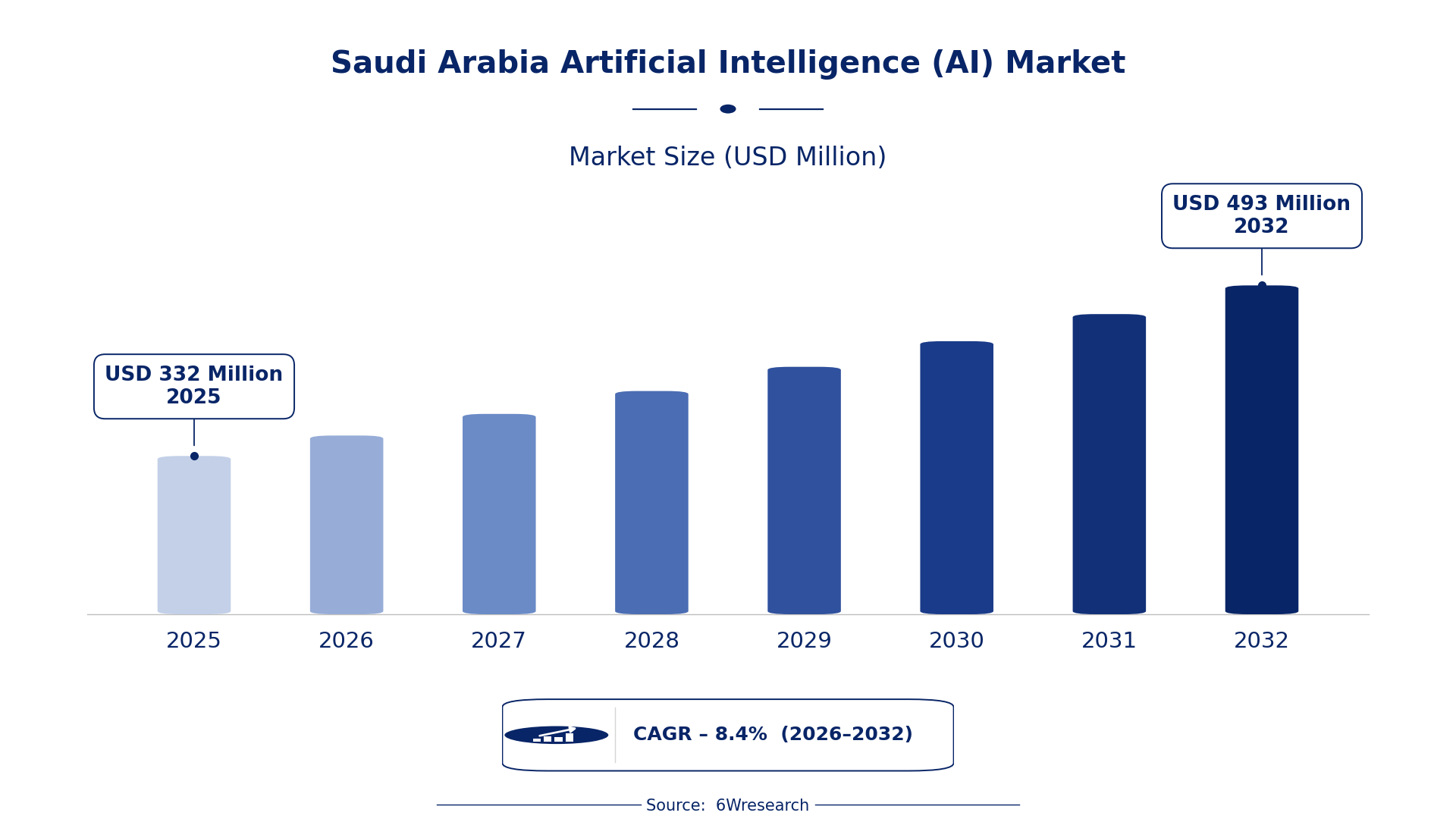
The Saudi Arabia Artificial Intelligence (AI) Market was estimated at USD 332 Million in 2025 and is projected to reach USD 493 Million by 2032, growing at a CAGR of 8.4% from 2026 to 2032.
Saudi Arabia Artificial Intelligence (AI) Market Synopsis
The driving force behind the Saudi Arabia Artificial Intelligence (AI) Market is the increasing investment from organizations across various sectors aiming to enhance productivity and innovation. This trend reflects a growing recognition of AI's potential to revolutionize processes and customer interactions.
AI applications are diversifying rapidly, with sectors ranging from healthcare to finance adopting technologies such as machine learning and predictive analytics. The pandemic has further accelerated this trend, as companies seek digital solutions to navigate the complexities of modern business environments.
Saudi Arabia Artificial Intelligence (AI) Market Year-wise Growth Rate and Key Drivers
This graph illustrates the annual growth rates of the Saudi Arabia Artificial Intelligence (AI) Market from 2021 to 2032, highlighting a steady upward trajectory and projected expansion over the forecast period.
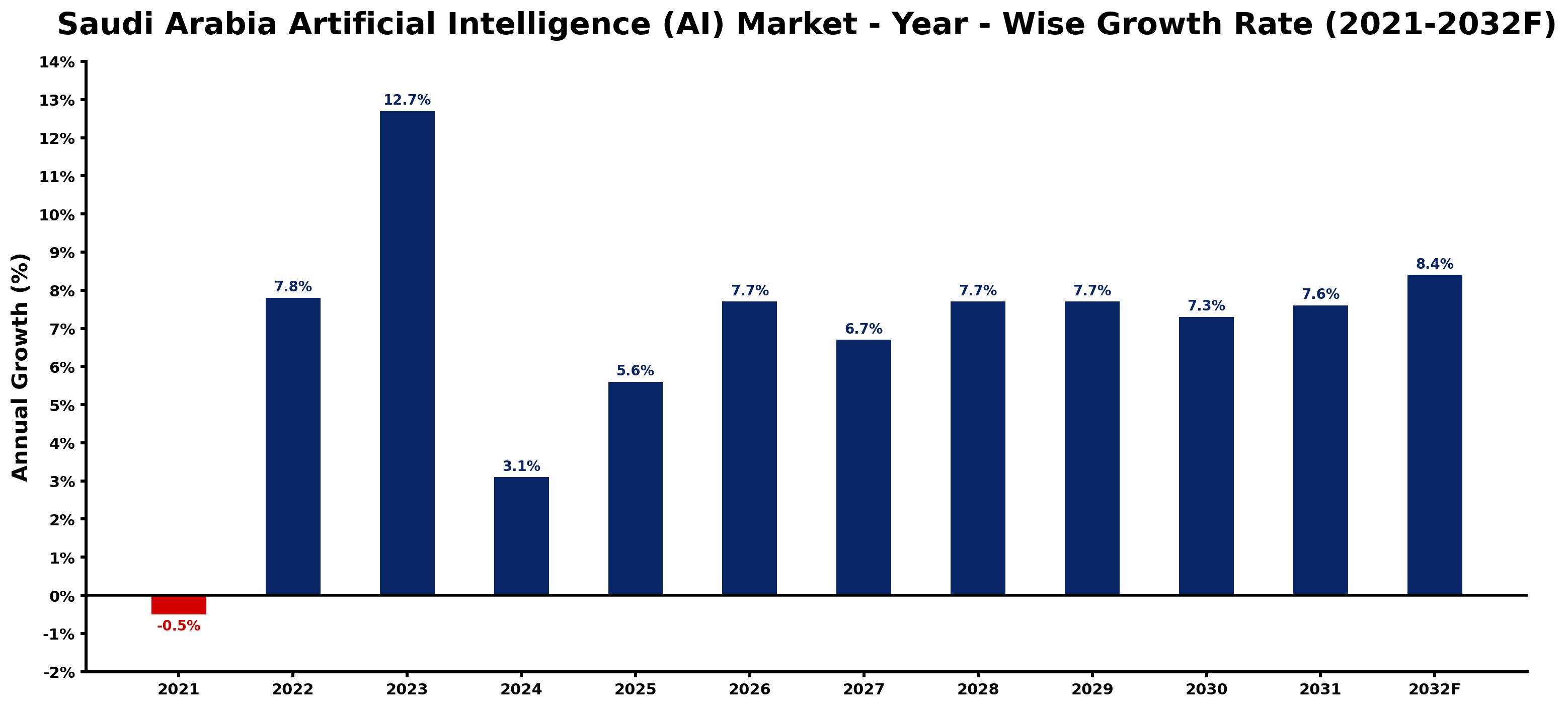
The table below presents the year‑wise growth rates along with the key drivers influencing the market
| Year | Growth Rate | Major Drivers |
| 2021 | -0.5% | Limited local AI talent pipeline in Saudi Arabia |
| 2022 | 7.8% | Launch of Saudi Data and Artificial Intelligence Authority |
| 2023 | 12.7% | Increased adoption of AI in government services |
| 2024 | 3.1% | Growth in AI-driven smart city projects in Riyadh |
| 2025 | 5.6% | Investment in AI healthcare technologies by Ministry of Health |
| 2026 | 7.7% | Local startups receiving funding for AI innovations |
| 2027 | 6.7% | Implementation of AI in education initiatives by government |
| 2028 | 7.7% | Partnerships with global tech firms for AI development |
| 2029 | 7.7% | Rising consumer interest in AI-enhanced applications |
| 2030 | 7.3% | Investment in AI-driven cybersecurity solutions by enterprises |
| 2031 | 7.6% | Government incentives for AI technology utilization in SMEs |
| 2032 | 8.4% | Strategic emphasis on AI in Vision 2030 initiatives |
Note: Market size estimations and growth projections presented in this report are based on 6Wresearch's proprietary forecasting methodology, utilizing the latest available industry data, government publications, and primary research inputs.
Saudi Arabia Artificial Intelligence (AI) Market Key Takeaways
Below are some of the specific key takeaways from the market, including:
- Significant growth driven by sector-wide investments in AI technologies.
- Emergence of diverse use cases, from chatbots to autonomous systems.
- Challenges related to data quality and ethical considerations continue to shape the market.
- COVID-19 has accelerated the adoption of AI for automation and efficiency.
- Key international players are establishing a strong presence in the region.
Evaluation of Restraints in Saudi Arabia Artificial Intelligence (AI) Market
Several factors are hindering the growth of the Saudi Arabia Artificial Intelligence (AI) Market. A primary concern is the development of advanced AI algorithms, which requires substantial expertise and resources. Organizations also face challenges in ensuring data quality and availability, which are crucial for effective AI training. on top of that, navigating the complex ethical and regulatory landscape remains a significant hurdle for companies looking to implement AI solutions responsibly.
Saudi Arabia Artificial Intelligence (AI) Market Trends
The market is currently experiencing a notable shift towards AI integration in customer service, with chatbots and virtual assistants becoming commonplace. Predictive analytics is gaining traction across various industries, helping businesses make data-driven decisions. on top of that, organizations are increasingly focusing on ethical AI practices, ensuring responsible use of technology that aligns with societal values.
Saudi Arabia Artificial Intelligence (AI) Market Opportunities
The Saudi Arabia Artificial Intelligence Market presents substantial opportunities for growth, particularly in sectors like healthcare, finance, and education. Investment in AI-driven solutions can enhance operational efficiency and customer engagement. Additionally, partnerships between tech firms and local businesses are expected to foster innovation and drive the development of tailored AI applications.
Government Initiatives in the Saudi Arabia Artificial Intelligence (AI) Market
The Saudi government is actively shaping the AI market through strategic initiatives aimed at promoting technology adoption and enhancing digital infrastructure. Recognizing the importance of AI for economic diversification, public policies are focused on fostering innovation and addressing regulatory challenges that businesses face. Such government actions are crucial for creating a supportive environment for AI development.
- A recently completed national AI strategy aimed at integrating AI across various sectors to boost productivity.
- Currently ongoing programs focused on developing AI talent through specialized training and education initiatives.
- A planned infrastructure enhancement program expected to launch by 2026 to support AI deployment in smart cities.
- Regulatory frameworks being introduced to ensure ethical AI usage and data protection.
- Public-private partnerships in development to advance AI research and application in the healthcare sector.
Future Insights of the Saudi Arabia Artificial Intelligence (AI) Market
Looking ahead to 2026-2032, the Saudi Arabia Artificial Intelligence Market is set for remarkable expansion. Organizations will increasingly prioritize AI-driven solutions to maintain competitiveness. As local businesses continue to embrace digital transformation, the demand for innovative AI applications will only intensify, creating an environment ripe for investment and technological advancement.
Saudi Arabia Artificial Intelligence (AI) Market Latest Developments
In the past year, activity in the Saudi Arabia Artificial Intelligence Market has surged, driven by both public and private sector initiatives. Companies are increasingly looking to collaborate on AI projects, reflecting a growing commitment to innovation. This surge in interest is setting the stage for new developments that will shape the market's future.
- A major technology vendor launched an AI-powered analytics platform in early 2025, aimed at enhancing business decision-making capabilities.
- Ongoing collaborations between academic institutions and tech firms focused on developing new AI training programs to address skill gaps.
- An initiative that began in mid-2025 seeks to integrate AI solutions into public services, improving efficiency and service delivery.
- A rollout expected to begin in the second half of 2026 aims to expand AI applications in the transportation sector.
- New partnerships announced in Q1 2025 between local businesses and international AI firms to co-develop innovative solutions tailored to the Saudi market.
Saudi Arabia Artificial Intelligence (AI) Market - Key Attractiveness of the Report
- 10 Years of Market Numbers
- Historical Data Starting from 2022 to 2025
- Base Year: 2025
- Forecast Data until 2032
- Key Performance Indicators Impacting the Market
- Major Upcoming Developments and Projects
Key Highlights of the Report:
- Saudi Arabia Artificial Intelligence (AI) Market Outlook
- Market Size of Saudi Arabia Artificial Intelligence (AI) Market, 2025
- Forecast of Saudi Arabia Artificial Intelligence (AI) Market, 2032
- Historical Data and Forecast of Saudi Arabia Artificial Intelligence (AI) Revenues & Volume for the Period 2022-2032F
- Saudi Arabia Artificial Intelligence (AI) Market Trend Evolution
- Saudi Arabia Artificial Intelligence (AI) Market Drivers and Challenges
- Saudi Arabia Artificial Intelligence (AI) Price Trends
- Saudi Arabia Artificial Intelligence (AI) Porter's Five Forces
- Saudi Arabia Artificial Intelligence (AI) Industry Life Cycle
- Historical Data and Forecast of Saudi Arabia Artificial Intelligence (AI) Market Revenues & Volume By Offering for the Period 2022-2032F
- Historical Data and Forecast of Saudi Arabia Artificial Intelligence (AI) Market Revenues & Volume By Hardware for the Period 2022-2032F
- Historical Data and Forecast of Saudi Arabia Artificial Intelligence (AI) Market Revenues & Volume By Software for the Period 2022-2032F
- Historical Data and Forecast of Saudi Arabia Artificial Intelligence (AI) Market Revenues & Volume By Services for the Period 2022-2032F
- Historical Data and Forecast of Saudi Arabia Artificial Intelligence (AI) Market Revenues & Volume By Technology for the Period 2022-2032F
- Historical Data and Forecast of Saudi Arabia Artificial Intelligence (AI) Market Revenues & Volume By Machine Learning for the Period 2022-2032F
- Historical Data and Forecast of Saudi Arabia Artificial Intelligence (AI) Market Revenues & Volume By Natural Language Processing for the Period 2022-2032F
- Historical Data and Forecast of Saudi Arabia Artificial Intelligence (AI) Market Revenues & Volume By Context-Aware Computing for the Period 2022-2032F
- Historical Data and Forecast of Saudi Arabia Artificial Intelligence (AI) Market Revenues & Volume By Computer Vision for the Period 2022-2032F
- Historical Data and Forecast of Saudi Arabia Artificial Intelligence (AI) Market Revenues & Volume By Business Function for the Period 2022-2032F
- Historical Data and Forecast of Saudi Arabia Artificial Intelligence (AI) Market Revenues & Volume By Finance for the Period 2022-2032F
- Historical Data and Forecast of Saudi Arabia Artificial Intelligence (AI) Market Revenues & Volume By Security for the Period 2022-2032F
- Historical Data and Forecast of Saudi Arabia Artificial Intelligence (AI) Market Revenues & Volume By Human Resources for the Period 2022-2032F
- Historical Data and Forecast of Saudi Arabia Artificial Intelligence (AI) Market Revenues & Volume By Law for the Period 2022-2032F
- Historical Data and Forecast of Saudi Arabia Artificial Intelligence (AI) Market Revenues & Volume By Marketing and Sales for the Period 2022-2032F
- Historical Data and Forecast of Saudi Arabia Artificial Intelligence (AI) Market Revenues & Volume By Other Business Function (IT operations) for the Period 2022-2032F
- Historical Data and Forecast of Saudi Arabia Artificial Intelligence (AI) Market Revenues & Volume By Deployment Mode for the Period 2022-2032F
- Historical Data and Forecast of Saudi Arabia Artificial Intelligence (AI) Market Revenues & Volume By On-premises for the Period 2022-2032F
- Historical Data and Forecast of Saudi Arabia Artificial Intelligence (AI) Market Revenues & Volume By Cloud for the Period 2022-2032F
- Historical Data and Forecast of Saudi Arabia Artificial Intelligence (AI) Market Revenues & Volume By Organization Size for the Period 2022-2032F
- Historical Data and Forecast of Saudi Arabia Artificial Intelligence (AI) Market Revenues & Volume By Large Enterprises for the Period 2022-2032F
- Historical Data and Forecast of Saudi Arabia Artificial Intelligence (AI) Market Revenues & Volume By SMEs for the Period 2022-2032F
- Historical Data and Forecast of Saudi Arabia Artificial Intelligence (AI) Market Revenues & Volume By Verticals for the Period 2022-2032F
- Historical Data and Forecast of Saudi Arabia Artificial Intelligence (AI) Market Revenues & Volume By BFSI for the Period 2022-2032F
- Historical Data and Forecast of Saudi Arabia Artificial Intelligence (AI) Market Revenues & Volume By IT/ ITES for the Period 2022-2032F
- Historical Data and Forecast of Saudi Arabia Artificial Intelligence (AI) Market Revenues & Volume By Telecommunication for the Period 2022-2032F
- Historical Data and Forecast of Saudi Arabia Artificial Intelligence (AI) Market Revenues & Volume By Government and Defense for the Period 2022-2032F
- Historical Data and Forecast of Saudi Arabia Artificial Intelligence (AI) Market Revenues & Volume By Manufacturing for the Period 2022-2032F
- Historical Data and Forecast of Saudi Arabia Artificial Intelligence (AI) Market Revenues & Volume By Healthcare and Lifesciences for the Period 2022-2032F
- Historical Data and Forecast of Saudi Arabia Artificial Intelligence (AI) Market Revenues & Volume By Retail and Ecommerce for the Period 2022-2032F
- Historical Data and Forecast of Saudi Arabia Artificial Intelligence (AI) Market Revenues & Volume By Automotive, Transportation & Logistics for the Period 2022-2032F
- Saudi Arabia Artificial Intelligence (AI) Import Export Trade Statistics
- Market Opportunity Assessment By Offering
- Market Opportunity Assessment By Technology
- Market Opportunity Assessment By Business Function
- Market Opportunity Assessment By Deployment Mode
- Market Opportunity Assessment By Organization Size
- Market Opportunity Assessment By Verticals
- Saudi Arabia Artificial Intelligence (AI) Top Companies Market Share
- Saudi Arabia Artificial Intelligence (AI) Competitive Benchmarking By Technical and Operational Parameters
- Saudi Arabia Artificial Intelligence (AI) Company Profiles
- Saudi Arabia Artificial Intelligence (AI) Key Strategic Recommendations






































