Saudi Arabia Bus Market Size, Share & Growth Rate
The Saudi Arabia Bus Market was estimated at USD 253 Million in 2025 and is projected to reach USD 323 Million by 2032, growing at a CAGR of 3.6% from 2026 to 2032. This growth trajectory is primarily driven by rapid urbanization and a rising population, both of which necessitate an expansion in public transport options. Additionally, government initiatives aimed at enhancing infrastructure and reducing traffic congestion further support the increasing demand for bus services across the nation.
Saudi Arabia Bus Market Year-wise Growth Rate and Key Drivers
This graph highlights how the Saudi Arabia Bus Market has steadily grown over the years, supported by major growth factors.
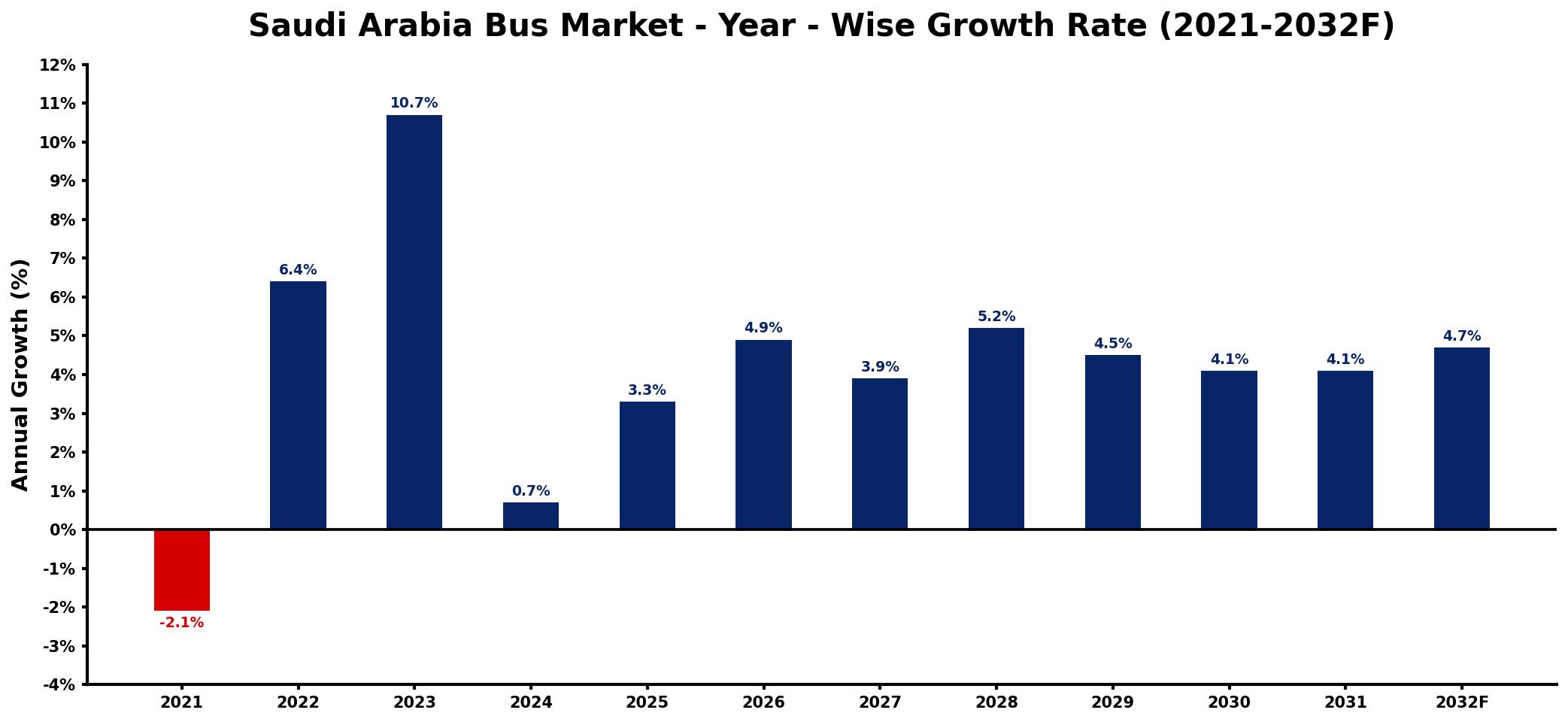
The table below presents the year‑wise growth rates along with the key drivers influencing the market
| Year | Growth Rate | Major Drivers |
| 2021 | -2.1% | decreased public transportation investments |
| 2022 | 6.4% | growing urban population demands |
| 2023 | 10.7% | increased government infrastructure spending |
| 2024 | 0.7% | rising fuel efficiency standards |
| 2025 | 3.3% | expansion of public transit networks |
| 2026 | 4.9% | enhanced environmental sustainability initiatives |
| 2027 | 3.9% | growing tourism industry support |
| 2028 | 5.2% | advancements in smart transportation technology |
| 2029 | 4.5% | increased private sector involvement |
| 2030 | 4.1% | emphasis on renewable energy sources |
| 2031 | 4.1% | growing demand for mobility solutions |
| 2032 | 4.7% | strengthening underlying market demand |
Note: Market size estimations and growth projections presented in this report are based on 6Wresearch's proprietary forecasting methodology, utilizing the latest available industry data, government publications, and primary research inputs.
Saudi Arabia Bus Market Synopsis
In Saudi Arabia, buses are a pivotal component of the public transportation framework, particularly for urban commuting and intercity travel. With a focus on safety and efficiency, modern bus fleets are being equipped with enhanced features to cater to the needs of diverse passenger demographics, promoting greater accessibility and user satisfaction.
The market showcases a variety of bus types including standard, articulated, and electric models, reflecting the countrys commitment to sustainable transport solutions. As urban centers expand, the demand for eco-friendly transportation alternatives is expected to rise, compelling manufacturers to innovate and adapt to new market conditions.
Saudi Arabia Bus Market Key Takeaways
- The market is poised for steady growth driven by urbanization and government infrastructure investments.
- Electric and hybrid buses represent a significant area of interest for both manufacturers and the government.
- Post-COVID recovery has reinvigorated demand for public transport, especially within major cities.
- Passenger comfort and safety are at the forefront of product development among bus manufacturers.
- Government regulations are increasingly focusing on reducing environmental impacts and promoting sustainable transportation.
Evaluation of Restraints in Saudi Arabia Bus Market
Despite its growth prospects, the Saudi Arabia bus market grapples with several constraints, particularly in the shift towards electric and hybrid models. The initial capital required for these technologies can be prohibitive for operators, creating a reluctance to transition from traditional buses. Furthermore, the development of a robust charging infrastructure remains a significant hurdle. Without adequate charging stations and maintenance support, the adoption of electric buses may be stymied, hindering potential advancements in environmentally friendly transportation.
Saudi Arabia Bus Market Trends
As urban landscapes in Saudi Arabia evolve, several trends are beginning to shape the bus market. An increasing focus on sustainability is driving interest in electric and hybrid buses, which promise lower emissions and operational costs over time. Moreover, the integration of technology such as real-time tracking systems and contactless payment options is enhancing the overall commuter experience. These innovations are appealing particularly to younger, tech-savvy riders who prioritize convenience and efficiency in their daily travel.
Saudi Arabia Bus Market Opportunities
The Saudi Arabia bus market presents substantial growth opportunities, particularly in the realm of electric and hybrid vehicles. As government policies increasingly favor sustainable transport solutions, manufacturers are well-positioned to capitalize on this shift. Additionally, urbanization continues to create an urgent need for efficient public transport solutions, offering prospects for new bus services and routes. Companies that prioritize passenger comfort and safety while embracing innovative technologies are likely to thrive in this competitive landscape.
Government Initiatives in the Saudi Arabia Bus Market
The Saudi government is actively investing in the enhancement of public transportation systems, aligning with Vision 2030 goals that emphasize improved infrastructure and connectivity. Various initiatives are designed to promote the adoption of electric buses, including incentives for manufacturers and subsidies for operators. Furthermore, plans to expand public transport networks are underway to alleviate traffic congestion, reduce environmental impact, and enhance overall mobility for the population.
Future Insights of the Saudi Arabia Bus Market
Looking forward to 2026-2032, the Saudi Arabia bus market is anticipated to evolve significantly. With growing urban populations and further investments in infrastructure, demand for efficient public transport solutions will likely escalate. The trend towards electrification of bus fleets will continue, supported by government incentives and technological advancements. As environmental concerns remain paramount, the shift towards sustainable transportation will not only attract consumers but also foster innovation within the industry.
Saudi Arabia Bus Market Latest Developments (2025 - 2026)
In recent months, the Saudi Arabia bus market has experienced a notable shift towards sustainability, with manufacturers increasingly showcasing electric and hybrid models at industry expos. Alongside this, partnerships between government entities and private manufacturers are being forged to enhance charging infrastructure, which is crucial for the widespread adoption of electric buses. Additionally, emerging smart transport initiatives are paving the way for integrated systems that will streamline public transit operations, further improving efficiency and user experience.
Saudi Arabia Bus Market - Key Attractiveness of the Report
- 10 Years of Market Numbers
- Historical Data Starting from 2022 to 2025
- Base Year: 2025
- Forecast Data until 2032
- Key Performance Indicators Impacting the Market
- Major Upcoming Developments and Projects
Key Highlights of the Report:
- Saudi Arabia Bus Market Outlook
- Market Size of Saudi Arabia Bus Market, 2025
- Forecast of Saudi Arabia Bus Market, 2032
- Historical Data and Forecast of Saudi Arabia Bus Revenues & Volume for the Period 2022-2032F
- Saudi Arabia Bus Market Trend Evolution
- Saudi Arabia Bus Market Drivers and Challenges
- Saudi Arabia Bus Price Trends
- Saudi Arabia Bus Porter's Five Forces
- Saudi Arabia Bus Industry Life Cycle
- Historical Data and Forecast of Saudi Arabia Bus Market Revenues & Volume By Type for the Period 2022-2032F
- Historical Data and Forecast of Saudi Arabia Bus Market Revenues & Volume By Single Deck for the Period 2022-2032F
- Historical Data and Forecast of Saudi Arabia Bus Market Revenues & Volume By Double Deck for the Period 2022-2032F
- Historical Data and Forecast of Saudi Arabia Bus Market Revenues & Volume By Application for the Period 2022-2032F
- Historical Data and Forecast of Saudi Arabia Bus Market Revenues & Volume By Transit for the Period 2022-2032F
- Historical Data and Forecast of Saudi Arabia Bus Market Revenues & Volume By Coaches for the Period 2022-2032F
- Historical Data and Forecast of Saudi Arabia Bus Market Revenues & Volume By Others for the Period 2022-2032F
- Historical Data and Forecast of Saudi Arabia Bus Market Revenues & Volume By Fuel Type for the Period 2022-2032F
- Historical Data and Forecast of Saudi Arabia Bus Market Revenues & Volume By Diesel for the Period 2022-2032F
- Historical Data and Forecast of Saudi Arabia Bus Market Revenues & Volume By Electric and Hybrid for the Period 2022-2032F
- Historical Data and Forecast of Saudi Arabia Bus Market Revenues & Volume By Others for the Period 2022-2032F
- Historical Data and Forecast of Saudi Arabia Bus Market Revenues & Volume By Seat Capacity for the Period 2022-2032F
- Historical Data and Forecast of Saudi Arabia Bus Market Revenues & Volume By 15-30 Seats for the Period 2022-2032F
- Historical Data and Forecast of Saudi Arabia Bus Market Revenues & Volume By 31-50 Seats for the Period 2022-2032F
- Historical Data and Forecast of Saudi Arabia Bus Market Revenues & Volume By More than 50 Seats for the Period 2022-2032F
- Saudi Arabia Bus Import Export Trade Statistics
- Market Opportunity Assessment By Type
- Market Opportunity Assessment By Application
- Market Opportunity Assessment By Fuel Type
- Market Opportunity Assessment By Seat Capacity
- Saudi Arabia Bus Top Companies Market Share
- Saudi Arabia Bus Competitive Benchmarking By Technical and Operational Parameters
- Saudi Arabia Bus Company Profiles
- Saudi Arabia Bus Key Strategic Recommendations






































