Saudi Arabia Edible Beans Market: Import Trend Analysis
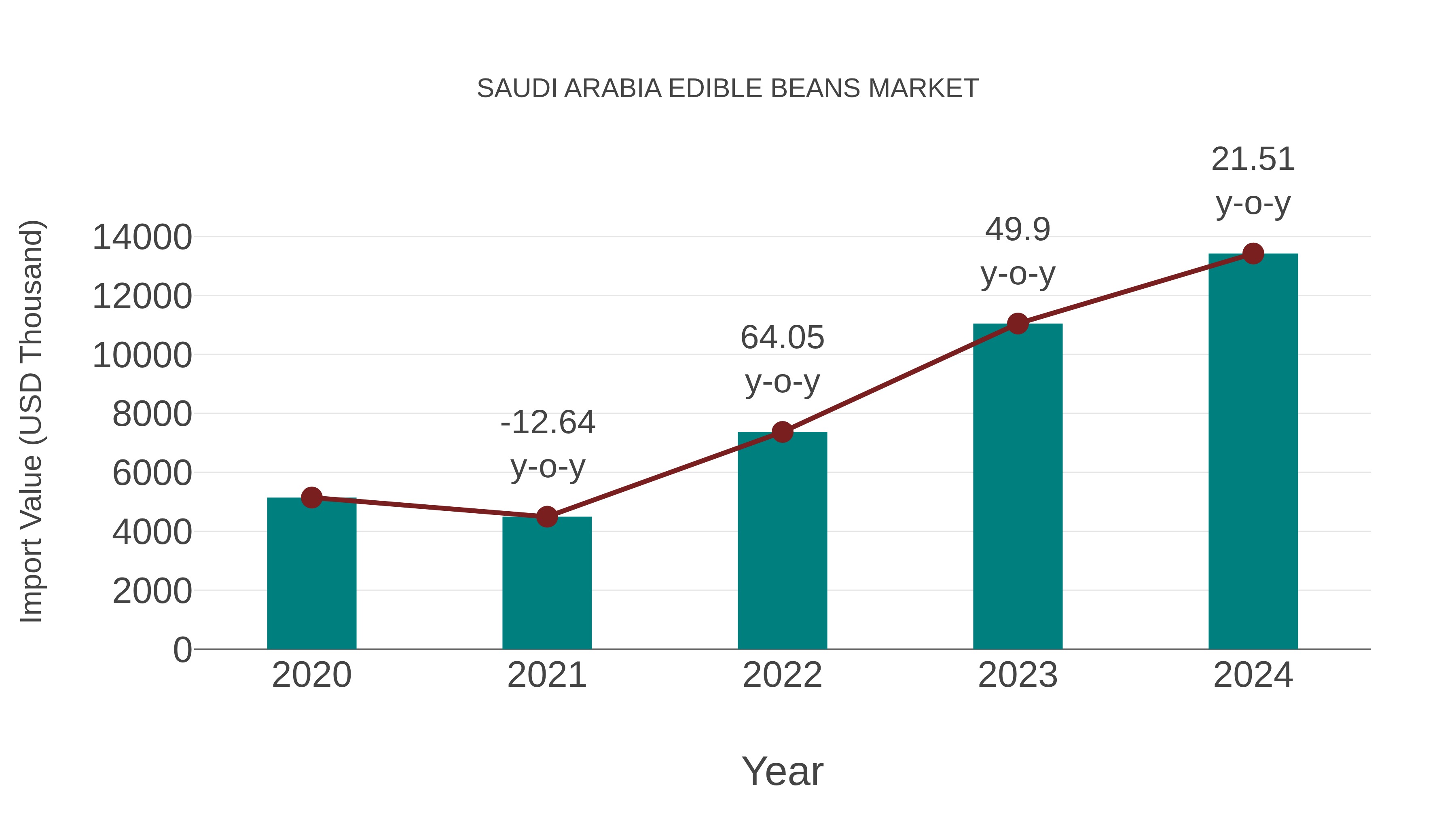
In the Saudi Arabia edible beans market, the import trend showed significant growth from 2023 to 2024, with a growth rate of 21.51%. The compound annual growth rate (CAGR) for the period 2020-2024 stood at 27.11%. This surge in imports can be attributed to a notable increase in consumer demand for diverse food products, indicating a shift in consumption patterns and preferences within the market.
Saudi Arabia Edible Beans Market Synopsis
The edible beans market in Saudi Arabia has gained prominence as dietary preferences shift towards healthier and protein-rich food options. Edible beans are valued for their nutritional content and versatility in various cuisines. The market encompasses a wide range of bean varieties, both locally cultivated and imported. As health-consciousness continues to rise and culinary habits diversify, the edible beans market is projected to experience sustained growth.
Drivers of the Market
The Saudi Arabia edible beans market has seen steady growth owing to the increasing consumption of plant-based protein sources and the growing awareness of the health benefits associated with beans. Changes in dietary preferences, urbanization, and a rising health-conscious population have driven the demand for beans as a versatile ingredient in various cuisines. Moreover, the market is supported by the government`s efforts to enhance food security and reduce dependency on imports by promoting local agricultural production, which includes bean cultivation. As consumers seek healthier and more sustainable food options, the edible beans market is expected to continue its upward trajectory.
Opportunities of the Market
Challenges of the Market
In the saudi arabia edible beans market, challenges include import restrictions and quality control. Strict regulations on food imports require compliance with quality and safety standards. Additionally, market players must cater to diverse consumer preferences and dietary restrictions.
COVID-19 Impact on the Market
The Saudi Arabia Edible Beans market faced several challenges during the COVID-19 pandemic. As restaurants and foodservice businesses temporarily closed or operated at limited capacity, the demand for edible beans initially decreased. Additionally, supply chain disruptions impacted the import and distribution of beans. This led to increased prices and limited availability of certain bean varieties. However, as consumers adapted to cooking more at home, there was a gradual resurgence in the demand for edible beans. Manufacturers and retailers in the saudi arabia market introduced online sales channels and home delivery services to cater to this shift in consumer behavior.
Key Players in the Market
In the saudi arabia edible beans market, key players include Al-Rabie Saudi Foods Co. Ltd., Al-Maraei Investment Group, Al Watania Agricultural Co., Olam International, and United Farmers Holding Company.
Key Highlights of the Report:
- Saudi Arabia Edible Beans Market Outlook
- Market Size of Saudi Arabia Edible Beans Market, 2025
- Forecast of Saudi Arabia Edible Beans Market, 2032
- Historical Data and Forecast of Saudi Arabia Edible Beans Revenues & Volume for the Period 2022-2032F
- Saudi Arabia Edible Beans Market Trend Evolution
- Saudi Arabia Edible Beans Market Drivers and Challenges
- Saudi Arabia Edible Beans Price Trends
- Saudi Arabia Edible Beans Porter's Five Forces
- Saudi Arabia Edible Beans Industry Life Cycle
- Historical Data and Forecast of Saudi Arabia Edible Beans Market Revenues & Volume By Product Type for the Period 2022-2032F
- Historical Data and Forecast of Saudi Arabia Edible Beans Market Revenues & Volume By Pinto Beans for the Period 2022-2032F
- Historical Data and Forecast of Saudi Arabia Edible Beans Market Revenues & Volume By Navy Beans for the Period 2022-2032F
- Historical Data and Forecast of Saudi Arabia Edible Beans Market Revenues & Volume By Great Northern Beans for the Period 2022-2032F
- Historical Data and Forecast of Saudi Arabia Edible Beans Market Revenues & Volume By Red Kidney Beans for the Period 2022-2032F
- Historical Data and Forecast of Saudi Arabia Edible Beans Market Revenues & Volume By Black Beans for the Period 2022-2032F
- Historical Data and Forecast of Saudi Arabia Edible Beans Market Revenues & Volume By Yellow Beans for the Period 2022-2032F
- Historical Data and Forecast of Saudi Arabia Edible Beans Market Revenues & Volume By Others for the Period 2022-2032F
- Historical Data and Forecast of Saudi Arabia Edible Beans Market Revenues & Volume By Distribution Channel for the Period 2022-2032F
- Historical Data and Forecast of Saudi Arabia Edible Beans Market Revenues & Volume By Supermarket/Hypermarket for the Period 2022-2032F
- Historical Data and Forecast of Saudi Arabia Edible Beans Market Revenues & Volume By Online Stores for the Period 2022-2032F
- Historical Data and Forecast of Saudi Arabia Edible Beans Market Revenues & Volume By Specialty Stores for the Period 2022-2032F
- Historical Data and Forecast of Saudi Arabia Edible Beans Market Revenues & Volume By Other for the Period 2022-2032F
- Historical Data and Forecast of Saudi Arabia Edible Beans Market Revenues & Volume By Application for the Period 2022-2032F
- Historical Data and Forecast of Saudi Arabia Edible Beans Market Revenues & Volume By Household for the Period 2022-2032F
- Historical Data and Forecast of Saudi Arabia Edible Beans Market Revenues & Volume By Restaurants for the Period 2022-2032F
- Historical Data and Forecast of Saudi Arabia Edible Beans Market Revenues & Volume By Others for the Period 2022-2032F
- Saudi Arabia Edible Beans Import Export Trade Statistics
- Market Opportunity Assessment By Product Type
- Market Opportunity Assessment By Distribution Channel
- Market Opportunity Assessment By Application
- Saudi Arabia Edible Beans Top Companies Market Share
- Saudi Arabia Edible Beans Competitive Benchmarking By Technical and Operational Parameters
- Saudi Arabia Edible Beans Company Profiles
- Saudi Arabia Edible Beans Key Strategic Recommendations






































