Saudi Arabia Glass Fibre Reinforced Plastic Market Size, Share & Growth Rate
The Saudi Arabia Glass Fibre Reinforced Plastic Market was estimated at USD 220 Million in 2025 and is projected to reach USD 282 Million by 2032, growing at a CAGR of 3.6% from 2026 to 2032. This upward trajectory is predominantly fueled by the increasing demand for lightweight, durable materials in the construction and automotive sectors, where performance and structural integrity are critical. Additionally, the aerospace industry is recognizing the advantages of GRP, further broadening its application horizon.
Saudi Arabia Glass Fibre Reinforced Plastic Market Year-wise Growth Rate and Key Drivers
This graph highlights how the Saudi Arabia Glass Fibre Reinforced Plastic Market has steadily grown over the years, supported by major growth factors.
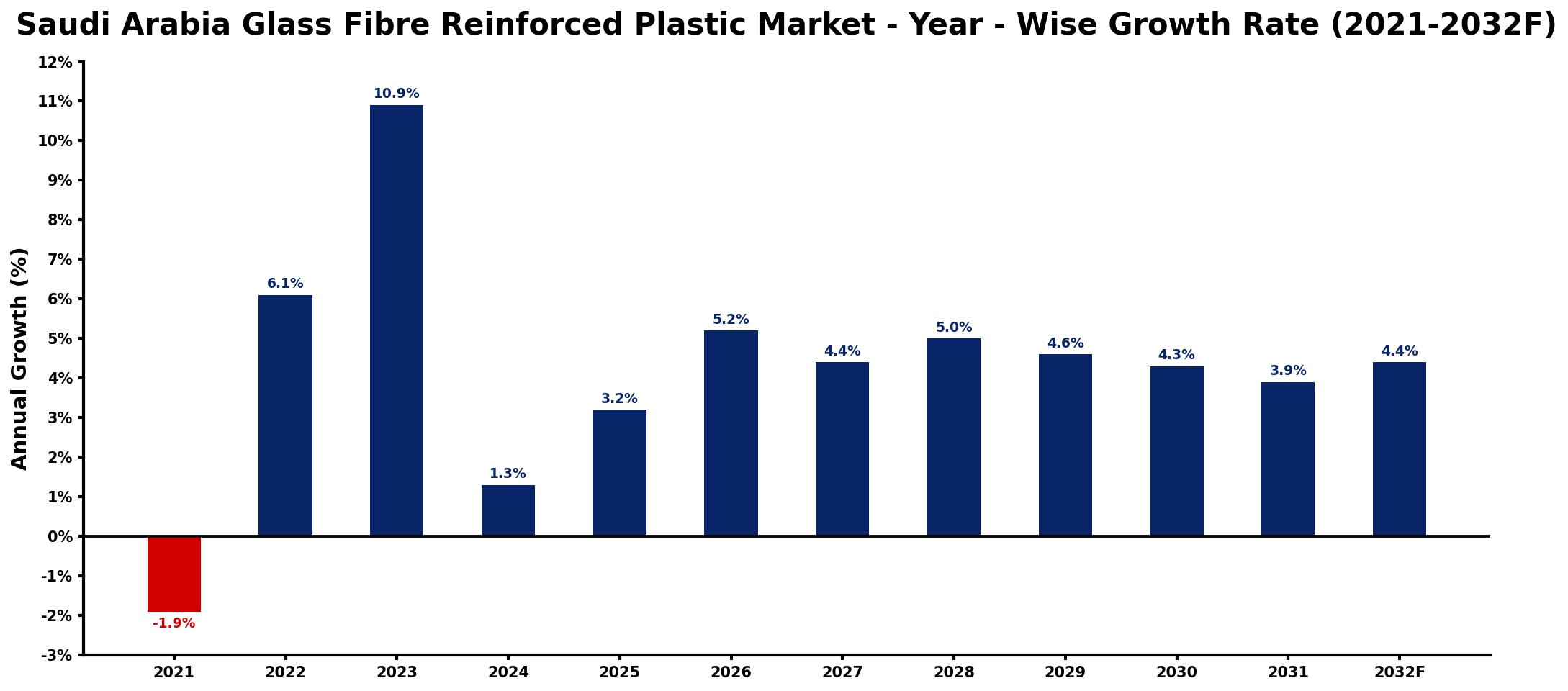
The table below presents the year‑wise growth rates along with the key drivers influencing the market
| Year | Growth Rate | Major Drivers |
| 2021 | -1.9% | decreased manufacturing activity levels |
| 2022 | 6.1% | increased construction project investments |
| 2023 | 10.9% | growing demand from automotive sector |
| 2024 | 1.3% | expansion of renewable energy projects |
| 2025 | 3.2% | rising interest in sustainable materials |
| 2026 | 5.2% | development of new industrial applications |
| 2027 | 4.4% | enhancements in distribution networks |
| 2028 | 5.0% | focus on infrastructure modernization |
| 2029 | 4.6% | increased adoption of lightweight materials |
| 2030 | 4.3% | rising infrastructure development spending |
| 2031 | 3.9% | increased production capacity utilization |
| 2032 | 4.4% | increased government infrastructure funding |
Note: Market size estimations and growth projections presented in this report are based on 6Wresearch's proprietary forecasting methodology, utilizing the latest available industry data, government publications, and primary research inputs.
Saudi Arabia Glass Fibre Reinforced Plastic Market Synopsis
The rapidly evolving construction landscape in Saudi Arabia is the strongest force currently shaping the glass fibre reinforced plastic (GRP) market. Major infrastructure projects, aimed at diversifying the economy and enhancing urbanization, are increasingly incorporating GRP due to its exceptional strength-to-weight ratio and resistance to environmental factors.
Furthermore, the automotive sector's shift towards lightweight materials to improve fuel efficiency is significantly propelling GRP adoption. As manufacturers seek innovative materials that provide both performance and sustainability, glass fibre reinforced plastic stands out as a highly effective solution.
Saudi Arabia Glass Fibre Reinforced Plastic Market Key Takeaways
- The market is primarily driven by growth in the construction and automotive sectors.
- Increasing awareness and education about the advantages of GRP are essential for market expansion.
- The aerospace industry is progressively integrating GRP for enhanced performance.
- Supply chain disruptions during the COVID-19 pandemic highlighted the market's vulnerabilities.
- Continued innovation in manufacturing processes is crucial to address industry-specific regulations.
Evaluation of Restraints in Saudi Arabia Glass Fibre Reinforced Plastic Market
Despite the promising growth trajectory, the Saudi Arabia Glass Fibre Reinforced Plastic Market faces several restraints that could hinder progress. Primarily, there is a need for increased consumer education regarding the benefits and applications of GRP, as misconceptions about its strength and durability persist. Furthermore, adapting manufacturing processes to comply with stringent industry regulations presents a significant challenge for producers. Additionally, environmental concerns related to production and disposal processes necessitate continuous advancements in technology and practices to mitigate impacts.
Saudi Arabia Glass Fibre Reinforced Plastic Market Trends
One notable trend is the shift towards sustainability, with manufacturers focusing on eco-friendly production methods and materials. Additionally, the integration of advanced technologies such as automation and digitalization in production processes is becoming more prevalent. The growing emphasis on reducing carbon footprints in construction and automotive sectors is creating further opportunities for GRP, positioning it as a sustainable choice. Finally, custom GRP solutions tailored to specific applications are gaining traction, allowing for greater flexibility in design and function.
Saudi Arabia Glass Fibre Reinforced Plastic Market Opportunities
The expansion of the Saudi Arabian infrastructure sector presents substantial growth opportunities for the GRP market. Investment in renewable energy projects, along with urban development initiatives, opens up new avenues for GRP applications. Furthermore, increased focus on lightweight automotive components for enhanced performance and fuel efficiency offers a promising segment for expansion. Companies that can innovate and provide tailored solutions will find substantial rewards in this dynamic market.
Government Initiatives in the Saudi Arabia Glass Fibre Reinforced Plastic Market
The Saudi government is actively promoting various initiatives aimed at bolstering the use of advanced materials, including glass fibre reinforced plastics, through substantial public spending on infrastructure projects. Programs designed to enhance local manufacturing capabilities and reduce dependence on imports are also in place. Additionally, government incentives focusing on sustainability are encouraging businesses to adopt environmentally friendly materials and practices, further driving GRP market potential.
Future Insights of the Saudi Arabia Glass Fibre Reinforced Plastic Market
Looking ahead to 2026-2032, the Saudi Arabia Glass Fibre Reinforced Plastic Market is expected to benefit from a combination of technological advancements and a growing inclination towards sustainable building practices. As consumer demand for high-performance materials increases, GRP will likely play a vital role in various sectors. Collaborative efforts among industry stakeholders to improve awareness and showcase GRP's advantages will be key in unlocking its full potential, driving the market towards sustained growth.
Saudi Arabia Glass Fibre Reinforced Plastic Market Latest Developments (2025 - 2026)
Recent developments in the Saudi Arabia Glass Fibre Reinforced Plastic Market indicate a marked shift towards innovation, with companies exploring novel applications and enhancing production techniques. The industry is witnessing a surge in partnerships aimed at developing sustainable GRP solutions, particularly for infrastructure and automotive applications. Additionally, increasing investments in research and development are paving the way for improved material properties and functionalities, catering to the evolving demands of various sectors.
Saudi Arabia Glass Fibre Reinforced Plastic Market - Key Attractiveness of the Report
- 10 Years of Market Numbers
- Historical Data Starting from 2022 to 2025
- Base Year: 2025
- Forecast Data until 2032
- Key Performance Indicators Impacting the Market
- Major Upcoming Developments and Projects
Key Highlights of the Report:
- Saudi Arabia Glass Fibre Reinforced Plastic Market Outlook
- Market Size of Saudi Arabia Glass Fibre Reinforced Plastic Market, 2025
- Forecast of Saudi Arabia Glass Fibre Reinforced Plastic Market, 2032
- Historical Data and Forecast of Saudi Arabia Glass Fibre Reinforced Plastic Revenues & Volume for the Period 2022-2032F
- Saudi Arabia Glass Fibre Reinforced Plastic Market Trend Evolution
- Saudi Arabia Glass Fibre Reinforced Plastic Market Drivers and Challenges
- Saudi Arabia Glass Fibre Reinforced Plastic Price Trends
- Saudi Arabia Glass Fibre Reinforced Plastic Porter's Five Forces
- Saudi Arabia Glass Fibre Reinforced Plastic Industry Life Cycle
- Historical Data and Forecast of Saudi Arabia Glass Fibre Reinforced Plastic Market Revenues & Volume By Type for the Period 2022-2032F
- Historical Data and Forecast of Saudi Arabia Glass Fibre Reinforced Plastic Market Revenues & Volume By Polyester for the Period 2022-2032F
- Historical Data and Forecast of Saudi Arabia Glass Fibre Reinforced Plastic Market Revenues & Volume By Vinyl Ester for the Period 2022-2032F
- Historical Data and Forecast of Saudi Arabia Glass Fibre Reinforced Plastic Market Revenues & Volume By Epoxy for the Period 2022-2032F
- Historical Data and Forecast of Saudi Arabia Glass Fibre Reinforced Plastic Market Revenues & Volume By Polyurethane for the Period 2022-2032F
- Historical Data and Forecast of Saudi Arabia Glass Fibre Reinforced Plastic Market Revenues & Volume By Peek Resin for the Period 2022-2032F
- Historical Data and Forecast of Saudi Arabia Glass Fibre Reinforced Plastic Market Revenues & Volume By Others for the Period 2022-2032F
- Historical Data and Forecast of Saudi Arabia Glass Fibre Reinforced Plastic Market Revenues & Volume By Application for the Period 2022-2032F
- Historical Data and Forecast of Saudi Arabia Glass Fibre Reinforced Plastic Market Revenues & Volume By Wind Energy for the Period 2022-2032F
- Historical Data and Forecast of Saudi Arabia Glass Fibre Reinforced Plastic Market Revenues & Volume By Transportation for the Period 2022-2032F
- Historical Data and Forecast of Saudi Arabia Glass Fibre Reinforced Plastic Market Revenues & Volume By Marine for the Period 2022-2032F
- Historical Data and Forecast of Saudi Arabia Glass Fibre Reinforced Plastic Market Revenues & Volume By Pipe & Tanks for the Period 2022-2032F
- Historical Data and Forecast of Saudi Arabia Glass Fibre Reinforced Plastic Market Revenues & Volume By Others for the Period 2022-2032F
- Saudi Arabia Glass Fibre Reinforced Plastic Import Export Trade Statistics
- Market Opportunity Assessment By Type
- Market Opportunity Assessment By Application
- Saudi Arabia Glass Fibre Reinforced Plastic Top Companies Market Share
- Saudi Arabia Glass Fibre Reinforced Plastic Competitive Benchmarking By Technical and Operational Parameters
- Saudi Arabia Glass Fibre Reinforced Plastic Company Profiles
- Saudi Arabia Glass Fibre Reinforced Plastic Key Strategic Recommendations






































