Saudi Arabia HR Analytics Market Size & Growth Rate (2026-2032)
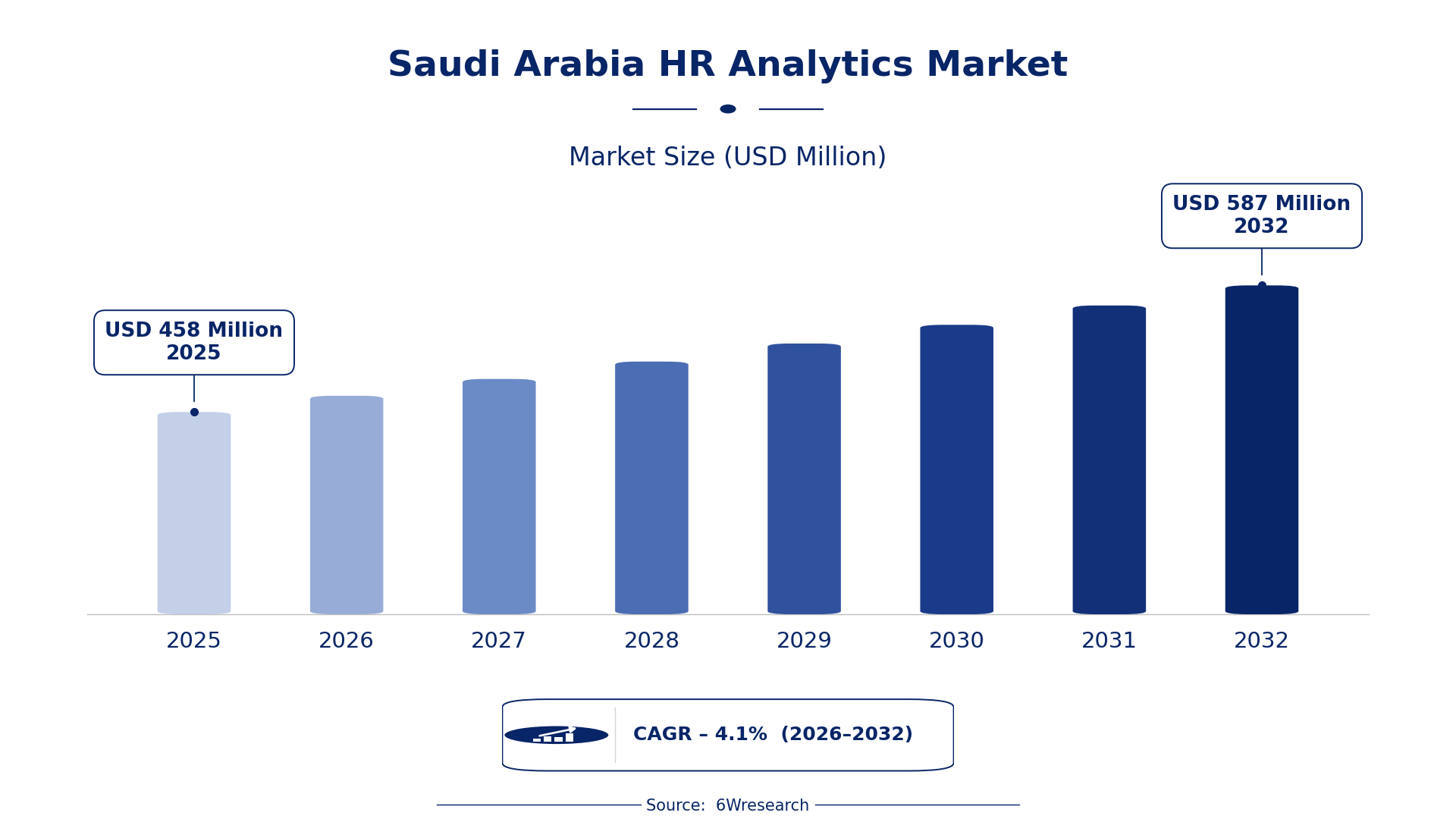
The Saudi Arabia HR Analytics Market was estimated at USD 458 Million in 2025 and is projected to reach USD 587 Million by 2032, growing at a CAGR of 4.1% from 2026 to 2032.
Saudi Arabia HR Analytics Market Synopsis
The HR Analytics market in Saudi Arabia is rapidly gaining momentum as organizations increasingly prioritize data-driven talent management. Companies are recognizing that insightful data analysis can significantly enhance decision-making processes related to recruitment, performance evaluation, and overall workforce management.
With the ongoing digital transformation across various sectors, the demand for HR analytics solutions is expected to rise. Businesses are not just looking to hire talent but are also focused on retaining it through optimized human resource operations that align closely with their strategic objectives.
Saudi Arabia HR Analytics Market Year-wise Growth Rate and Key Drivers
This graph illustrates the annual growth rates of the Saudi Arabia HR Analytics Market from 2021 to 2032, highlighting a steady upward trajectory and projected expansion over the forecast period.
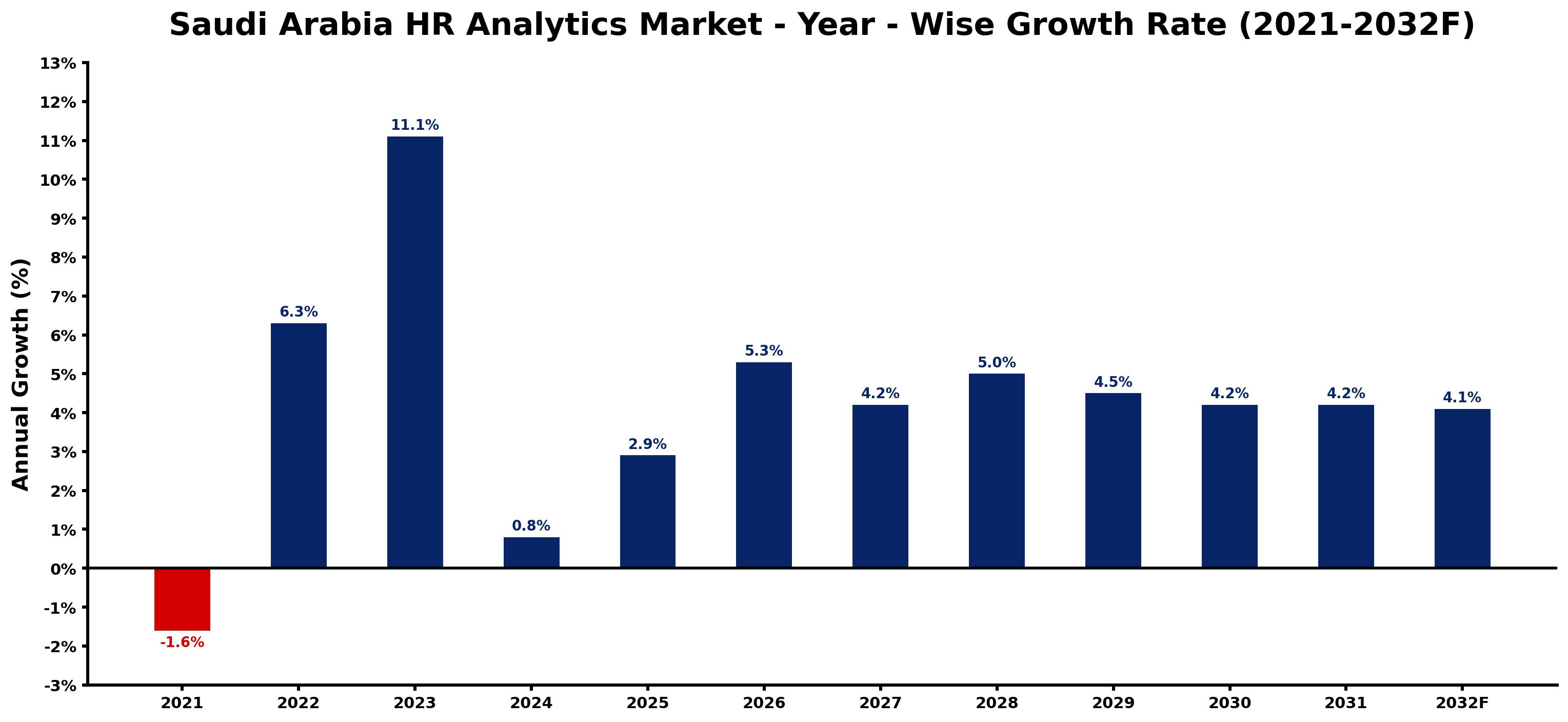
The table below presents the year‑wise growth rates along with the key drivers influencing the market
| Year | Growth Rate | Major Drivers |
| 2021 | -1.6% | Government budget cuts affect HR technology investments |
| 2022 | 6.3% | Saudi Vision 2030 promoting workforce data utilization. |
| 2023 | 11.1% | Increased digital transformation initiatives by Ministry of Human Resources. |
| 2024 | 0.8% | Rising local demand for employee performance analytics tools. |
| 2025 | 2.9% | Government incentives for HR tech adoption in businesses. |
| 2026 | 5.3% | Increased investment in workforce optimization technologies. |
| 2027 | 4.2% | Growing emphasis on workforce diversity analytics locally. |
| 2028 | 5.0% | Corporate focus on enhancing employee engagement through analytics. |
| 2029 | 4.5% | Adoption of predictive analytics by local HR departments. |
| 2030 | 4.2% | Enhanced training programs leveraging data insights increasing. |
| 2031 | 4.2% | Increased integration of AI in local HR practices. |
| 2032 | 4.1% | Shift towards remote work analytics for Saudi firms. |
Note: Market size estimations and growth projections presented in this report are based on 6Wresearch's proprietary forecasting methodology, utilizing the latest available industry data, government publications, and primary research inputs.
Saudi Arabia HR Analytics Market Key Takeaways
Below are some of the specific key takeaways from the market, including:
- Data-driven strategies are becoming essential for effective talent management.
- Organizations are increasingly adopting HR analytics to enhance employee engagement and performance insights.
- The need for compliance with data privacy regulations poses challenges for HR analytics implementation.
- The COVID-19 pandemic has accelerated the adoption of HR analytics solutions for workforce management.
- Major vendors are providing advanced solutions that cater to the unique HR needs of businesses in Saudi Arabia.
Evaluation of Restraints in Saudi Arabia HR Analytics Market
The growth of the HR analytics market in Saudi Arabia faces several restraints. Chief among these is the complexity involved in analyzing diverse workforce data effectively. Organizations often struggle to integrate various data sources and derive actionable insights due to varying data standards and formats. Additionally, ensuring data privacy and compliance with local regulations adds another layer of difficulty. Many companies remain hesitant to fully embrace these analytics solutions due to concerns over data security and the potential for misuse. This apprehension can slow the market's growth as businesses weigh the benefits against these challenges.
Saudi Arabia HR Analytics Market Trends
Several trends are shaping the HR analytics market in Saudi Arabia. The increasing emphasis on employee experience and engagement is driving organizations to adopt analytics tools that provide deeper insights into workforce sentiment. on top of that, advancements in artificial intelligence and machine learning are enhancing predictive analytics capabilities, enabling companies to anticipate workforce needs more accurately. There is also a growing trend towards integrating HR analytics with broader business intelligence platforms, which allows for a more comprehensive view of organizational performance.
Saudi Arabia HR Analytics Market Opportunities
The Saudi Arabia HR Analytics market presents numerous growth opportunities, particularly in sectors that are undergoing digital transformation. Companies looking to streamline their HR functions and improve employee retention are more likely to invest in analytics solutions. on top of that, the increasing recognition of the importance of data compliance opens avenues for specialized analytics providers that can navigate these complexities. Emerging startups focusing on niche HR analytics solutions also stand to gain a foothold in this evolving market.
Government Initiatives in the Saudi Arabia HR Analytics Market
The Saudi government is actively shaping the HR analytics market through various initiatives aimed at promoting digital transformation and workforce development. These efforts reflect a commitment to enhance the capabilities of organizations in the region, ensuring they can compete globally. The focus on public policy that encourages data utilization in HR practices is crucial for driving growth in this sector.
- A recently completed initiative introduced a national digital infrastructure upgrade program to improve data accessibility for businesses.
- Currently underway is a government-led training program aimed at enhancing data analytics skills among HR professionals across various industries.
- A planned upcoming policy in 2026 will mandate the integration of data analytics tools in public sector HR functions to improve efficiency.
- Ongoing efforts are being made to establish a regulatory framework that supports data privacy and compliance in HR analytics.
- The introduction of a public-private partnership program expected to launch by 2027 will foster innovation in HR technologies.
Future Insights of the Saudi Arabia HR Analytics Market
Looking ahead, the Saudi Arabia HR Analytics market is set to experience substantial growth driven by technological advancements and increasing demand for data-driven decision-making. As organizations continue to recognize the importance of aligning HR strategies with business goals, the adoption of analytics solutions will become more widespread. By 2032, we can expect to see a more integrated approach to HR analytics, with organizations leveraging advanced technologies to not only improve their internal processes but also to enhance the overall employee experience.
Saudi Arabia HR Analytics Market Latest Developments
In the past year, the Saudi Arabia HR Analytics market has witnessed notable developments reflecting the growing interest in data-driven HR practices. Companies are increasingly investing in advanced analytics tools to enhance their talent management strategies and overall workforce efficiency.
- A major technology vendor launched a comprehensive HR analytics solution in early 2025, aimed at helping organizations better understand employee performance metrics.
- An ongoing initiative by a leading regional operator is focused on developing user-friendly HR analytics platforms that cater to small and medium-sized enterprises.
- A partnership between several local universities and industry players began in Q1 2025, aimed at fostering research and development in HR analytics technologies.
- An upcoming product rollout is expected in late 2026, featuring advanced predictive analytics capabilities tailored for the Saudi market.
- In mid-2025, a new consultancy was established to provide organizations with customized HR analytics strategies to improve operational efficiency.
Saudi Arabia HR Analytics Market - Key Attractiveness of the Report
- 10 Years of Market Numbers
- Historical Data Starting from 2022 to 2025
- Base Year: 2025
- Forecast Data until 2032
- Key Performance Indicators Impacting the Market
- Major Upcoming Developments and Projects
Key Highlights of the Report:
- Saudi Arabia HR Analytics Market Outlook
- Market Size of Saudi Arabia HR Analytics Market, 2025
- Forecast of Saudi Arabia HR Analytics Market, 2032
- Historical Data and Forecast of Saudi Arabia HR Analytics Revenues & Volume for the Period 2022-2032F
- Saudi Arabia HR Analytics Market Trend Evolution
- Saudi Arabia HR Analytics Market Drivers and Challenges
- Saudi Arabia HR Analytics Price Trends
- Saudi Arabia HR Analytics Porter's Five Forces
- Saudi Arabia HR Analytics Industry Life Cycle
- Historical Data and Forecast of Saudi Arabia HR Analytics Market Revenues & Volume By Application Area for the Period 2022-2032F
- Historical Data and Forecast of Saudi Arabia HR Analytics Market Revenues & Volume By Payroll for the Period 2022-2032F
- Historical Data and Forecast of Saudi Arabia HR Analytics Market Revenues & Volume By Retention for the Period 2022-2032F
- Historical Data and Forecast of Saudi Arabia HR Analytics Market Revenues & Volume By Recruitment for the Period 2022-2032F
- Historical Data and Forecast of Saudi Arabia HR Analytics Market Revenues & Volume By Workforce Management for the Period 2022-2032F
- Historical Data and Forecast of Saudi Arabia HR Analytics Market Revenues & Volume By Employee Engagement for the Period 2022-2032F
- Historical Data and Forecast of Saudi Arabia HR Analytics Market Revenues & Volume By Employee Development for the Period 2022-2032F
- Historical Data and Forecast of Saudi Arabia HR Analytics Market Revenues & Volume By Vertical for the Period 2022-2032F
- Historical Data and Forecast of Saudi Arabia HR Analytics Market Revenues & Volume By Consumer goods and retail for the Period 2022-2032F
- Historical Data and Forecast of Saudi Arabia HR Analytics Market Revenues & Volume By BFSI for the Period 2022-2032F
- Historical Data and Forecast of Saudi Arabia HR Analytics Market Revenues & Volume By IT and telecom for the Period 2022-2032F
- Historical Data and Forecast of Saudi Arabia HR Analytics Market Revenues & Volume By Manufacturing for the Period 2022-2032F
- Historical Data and Forecast of Saudi Arabia HR Analytics Market Revenues & Volume By Healthcare for the Period 2022-2032F
- Historical Data and Forecast of Saudi Arabia HR Analytics Market Revenues & Volume By Education for the Period 2022-2032F
- Historical Data and Forecast of Saudi Arabia HR Analytics Market Revenues & Volume By Others for the Period 2022-2032F
- Historical Data and Forecast of Saudi Arabia HR Analytics Market Revenues & Volume By Component for the Period 2022-2032F
- Historical Data and Forecast of Saudi Arabia HR Analytics Market Revenues & Volume By Solutions for the Period 2022-2032F
- Historical Data and Forecast of Saudi Arabia HR Analytics Market Revenues & Volume By Service for the Period 2022-2032F
- Historical Data and Forecast of Saudi Arabia HR Analytics Market Revenues & Volume By Deployment Type for the Period 2022-2032F
- Historical Data and Forecast of Saudi Arabia HR Analytics Market Revenues & Volume By On-premises for the Period 2022-2032F
- Historical Data and Forecast of Saudi Arabia HR Analytics Market Revenues & Volume By Cloud for the Period 2022-2032F
- Historical Data and Forecast of Saudi Arabia HR Analytics Market Revenues & Volume By Organization Size for the Period 2022-2032F
- Historical Data and Forecast of Saudi Arabia HR Analytics Market Revenues & Volume By Large Enterprises for the Period 2022-2032F
- Historical Data and Forecast of Saudi Arabia HR Analytics Market Revenues & Volume By Small and Medium-Sized Enterprises (SMEs) for the Period 2022-2032F
- Saudi Arabia HR Analytics Import Export Trade Statistics
- Market Opportunity Assessment By Application Area
- Market Opportunity Assessment By Vertical
- Market Opportunity Assessment By Component
- Market Opportunity Assessment By Deployment Type
- Market Opportunity Assessment By Organization Size
- Saudi Arabia HR Analytics Top Companies Market Share
- Saudi Arabia HR Analytics Competitive Benchmarking By Technical and Operational Parameters
- Saudi Arabia HR Analytics Company Profiles
- Saudi Arabia HR Analytics Key Strategic Recommendations






































