Saudi Arabia Nonmetallic Mineral Product Market Size, Share & Growth Rate
The Saudi Arabia Nonmetallic Mineral Product Market was estimated at USD 440 Million in 2025 and is projected to reach USD 557 Million by 2032, growing at a CAGR of 3.4% from 2026 to 2032. This growth trajectory is primarily driven by the robust expansion of the construction sector and ongoing infrastructure projects, as Saudi Arabia aims to diversify its economy beyond oil reliance. With increasing urbanization, the demand for essential nonmetallic products, particularly cement and ceramics, is set to rise significantly.
Saudi Arabia Nonmetallic Mineral Product Market Year-wise Growth Rate and Key Drivers
This graph highlights how the Saudi Arabia Nonmetallic Mineral Product Market has steadily grown over the years, supported by major growth factors.
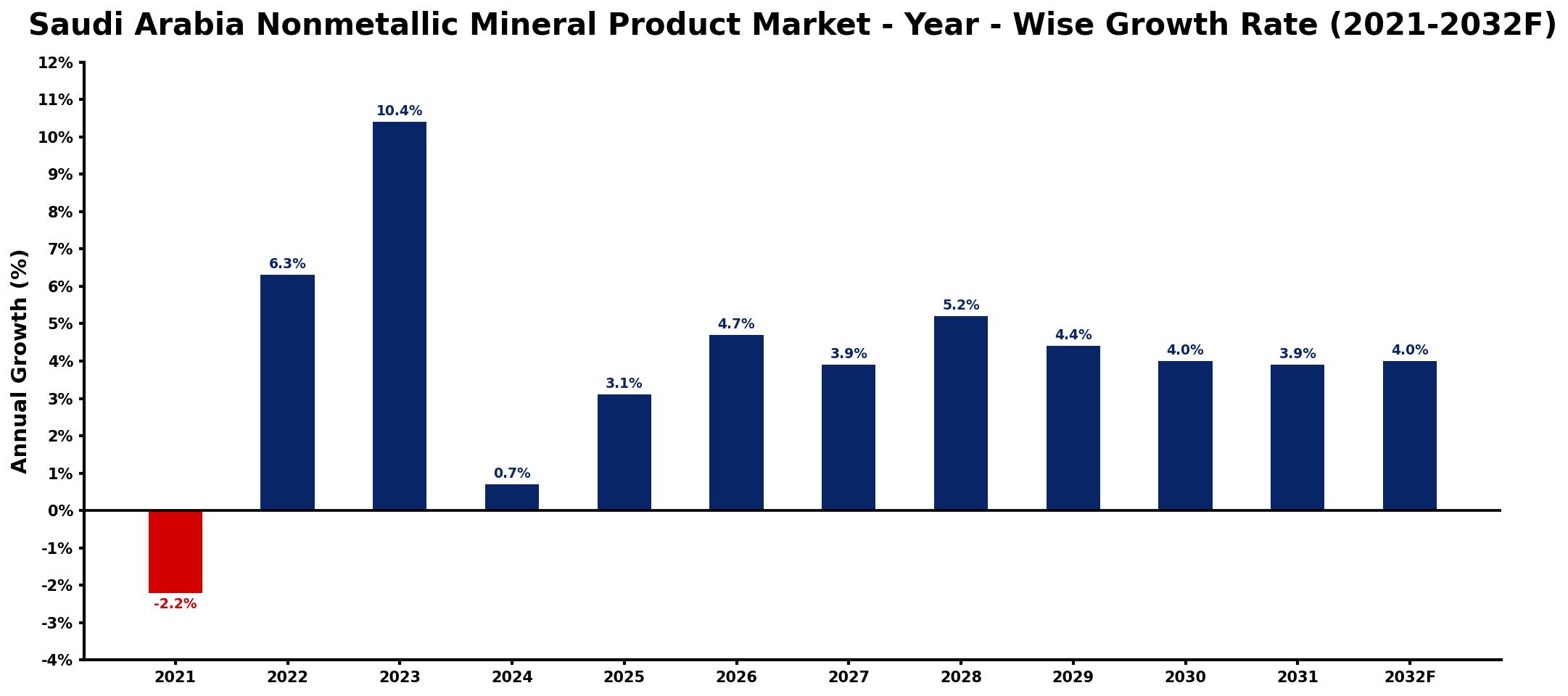
The table below presents the year‑wise growth rates along with the key drivers influencing the market
| Year | Growth Rate | Major Drivers |
| 2021 | -2.2% | decreased construction project investments |
| 2022 | 6.3% | increased demand for construction materials |
| 2023 | 10.4% | expansion of infrastructure projects |
| 2024 | 0.7% | growing residential building activities |
| 2025 | 3.1% | rising industrial sector investments |
| 2026 | 4.7% | enhanced government spending initiatives |
| 2027 | 3.9% | strengthened export opportunities emerging |
| 2028 | 5.2% | boosted urban development projects |
| 2029 | 4.4% | growing renewable energy installations |
| 2030 | 4.0% | increased focus on sustainability |
| 2031 | 3.9% | expanding logistics and transportation networks |
| 2032 | 4.0% | heightened technological advancements adoption |
Note: Market size estimations and growth projections presented in this report are based on 6Wresearch's proprietary forecasting methodology, utilizing the latest available industry data, government publications, and primary research inputs.
Saudi Arabia Nonmetallic Mineral Product Market Synopsis
The construction boom represents the most significant force shaping the nonmetallic mineral product market in Saudi Arabia. Government initiatives to enhance infrastructure, including new housing developments and transportation networks, have heightened the need for materials like cement and glass. This ongoing urban expansion is critical, reflecting the nations commitment to economic diversification.
Additionally, technological advancements in production processes are revolutionizing the market landscape. Producers are increasingly adopting sustainable practices to align with global environmental standards, thus not only meeting domestic demands but also positioning themselves for potential export opportunities.
Saudi Arabia Nonmetallic Mineral Product Market Key Takeaways
- The market is poised for steady growth due to continued investment in infrastructure projects.
- Urbanization and economic diversification strategies are driving substantial demand for nonmetallic products.
- Technological advancements are fostering innovative production processes and sustainability.
- Key challenges include stringent environmental regulations and competition from international suppliers.
- The recovery from COVID-19 disruptions indicates a resilient market poised for future expansion.
Evaluation of Restraints in Saudi Arabia Nonmetallic Mineral Product Market
The Saudi Arabia nonmetallic mineral product market faces several restraints that could inhibit its growth trajectory. One significant constraint is the increasing pressure to comply with rigorous environmental regulations, necessitating a shift towards responsible sourcing and production methodologies. Moreover, the market's vulnerability to global price fluctuations of raw materials injects a degree of uncertainty, complicating pricing strategies for local manufacturers. The competitive landscape is further intensified by international suppliers, challenging local industries to innovate and provide higher value-added products to maintain market share.
Saudi Arabia Nonmetallic Mineral Product Market Trends
Emerging trends in the Saudi Arabia nonmetallic mineral product market include a heightened focus on sustainability and eco-friendly materials. As global demand shifts toward greener alternatives, local manufacturers are investing in research and development to produce low-carbon cements and recycled glass products. Additionally, the integration of advanced technologies such as automation and AI in manufacturing processes is gaining traction, enhancing efficiency and product quality. Furthermore, the market is witnessing a growing consumer preference for innovative and aesthetically pleasing materials in both construction and design.
Saudi Arabia Nonmetallic Mineral Product Market Opportunities
The opportunities for growth within the Saudi Arabia nonmetallic mineral product market are robust. Investment in large-scale infrastructure projects, including housing developments and public transport initiatives, promises significant demand for essential materials. Furthermore, as the country shifts towards renewable energy, theres potential for growth in the production of specialized nonmetallic products tailored for the energy sector. The expansion of export capabilities also presents a lucrative avenue for companies looking to reach global markets.
Government Initiatives in the Saudi Arabia Nonmetallic Mineral Product Market
The Saudi government has launched various initiatives aimed at bolstering the nonmetallic mineral product market as part of its broader economic diversification strategy. Public spending on infrastructure projects, housing developments, and urban renewal programs signifies a commitment to enhancing the construction sector. Additionally, government policies promoting sustainability and environmental responsibility encourage manufacturers to adopt green practices. These initiatives not only help in meeting domestic needs but also position the country as a competitive player in international markets.
Future Insights of the Saudi Arabia Nonmetallic Mineral Product Market
Looking towards the future, the Saudi Arabia nonmetallic mineral product market is anticipated to experience steady growth, fueled by ongoing infrastructure investments and urbanization trends. The focus on innovation and sustainability will likely reshape production practices, allowing companies to meet both local and international demands efficiently. As the market adapts to changing consumer preferences and technological advancements, opportunities will arise for those willing to invest in modernizing their operations and expanding product offerings.
Saudi Arabia Nonmetallic Mineral Product Market Latest Developments (2025 - 2026)
Recent developments in the Saudi Arabia nonmetallic mineral product market indicate a strong recovery post-COVID-19, with increased production capacities being reported. Companies are investing in newer technologies aimed at improving efficiency and reducing environmental impact. Additionally, collaborative partnerships within the industry are emerging to enhance competitiveness and develop innovative solutions for sustainable production. As the government continues to roll out infrastructure projects, the demand for nonmetallic products is expected to surge, paving the way for future growth.
Saudi Arabia Nonmetallic Mineral Product Market - Key Attractiveness of the Report
- 10 Years of Market Numbers
- Historical Data Starting from 2022 to 2025
- Base Year: 2025
- Forecast Data until 2032
- Key Performance Indicators Impacting the Market
- Major Upcoming Developments and Projects
Key Highlights of the Report:
- Saudi Arabia Nonmetallic Mineral Product Market Outlook
- Market Size of Saudi Arabia Nonmetallic Mineral Product Market, 2025
- Forecast of Saudi Arabia Nonmetallic Mineral Product Market, 2032
- Historical Data and Forecast of Saudi Arabia Nonmetallic Mineral Product Revenues & Volume for the Period 2022-2032F
- Saudi Arabia Nonmetallic Mineral Product Market Trend Evolution
- Saudi Arabia Nonmetallic Mineral Product Market Drivers and Challenges
- Saudi Arabia Nonmetallic Mineral Product Price Trends
- Saudi Arabia Nonmetallic Mineral Product Porter's Five Forces
- Saudi Arabia Nonmetallic Mineral Product Industry Life Cycle
- Historical Data and Forecast of Saudi Arabia Nonmetallic Mineral Product Market Revenues & Volume By Form Type for the Period 2022-2032F
- Historical Data and Forecast of Saudi Arabia Nonmetallic Mineral Product Market Revenues & Volume By Powder Form for the Period 2022-2032F
- Historical Data and Forecast of Saudi Arabia Nonmetallic Mineral Product Market Revenues & Volume By Liquid Form for the Period 2022-2032F
- Historical Data and Forecast of Saudi Arabia Nonmetallic Mineral Product Market Revenues & Volume By End User for the Period 2022-2032F
- Historical Data and Forecast of Saudi Arabia Nonmetallic Mineral Product Market Revenues & Volume By Jewellery for the Period 2022-2032F
- Historical Data and Forecast of Saudi Arabia Nonmetallic Mineral Product Market Revenues & Volume By Construction for the Period 2022-2032F
- Historical Data and Forecast of Saudi Arabia Nonmetallic Mineral Product Market Revenues & Volume By Iron & Ore for the Period 2022-2032F
- Saudi Arabia Nonmetallic Mineral Product Import Export Trade Statistics
- Market Opportunity Assessment By Form Type
- Market Opportunity Assessment By End User
- Saudi Arabia Nonmetallic Mineral Product Top Companies Market Share
- Saudi Arabia Nonmetallic Mineral Product Competitive Benchmarking By Technical and Operational Parameters
- Saudi Arabia Nonmetallic Mineral Product Company Profiles
- Saudi Arabia Nonmetallic Mineral Product Key Strategic Recommendations






































