Saudi Arabia Passenger Car Motor Oil Market: Import Trend Analysis
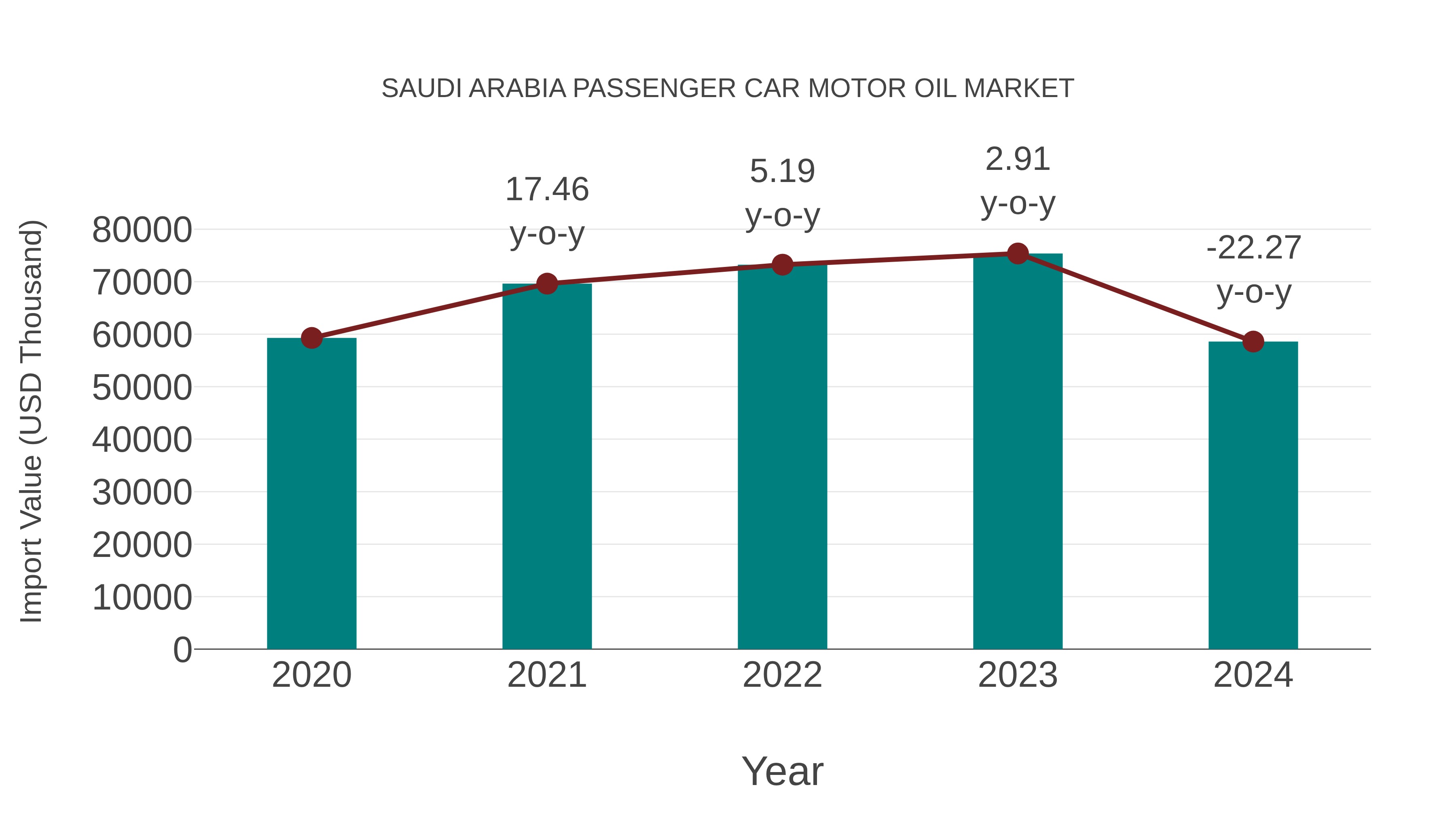
Saudi Arabia`s import trend for passenger car motor oil in 2024 experienced a decline, with a growth rate of -22.27% compared to the previous year. The compound annual growth rate (CAGR) for the period 2020-2024 stood at -0.29%. This negative import momentum could be attributed to shifting consumer preferences towards electric vehicles or changes in government regulations promoting local production of automotive lubricants.
Saudi Arabia Passenger Car Motor Oil Market Overview
The Saudi Arabia passenger car motor oil market is experiencing steady growth due to increasing vehicle ownership and a growing automotive industry. The market is driven by factors such as rising disposable income, urbanization, and a preference for high-performance vehicles. Key players in the market are focusing on product innovation, including the development of synthetic and semi-synthetic motor oils to cater to the demand for improved fuel efficiency and engine protection. The market is highly competitive, with major players such as Saudi Aramco, Shell, and ExxonMobil dominating the landscape. Regulatory initiatives aimed at reducing emissions and improving vehicle performance are also influencing market dynamics. Overall, the Saudi Arabia passenger car motor oil market is poised for further expansion as consumer awareness regarding the importance of regular maintenance and high-quality lubricants continues to grow.
Saudi Arabia Passenger Car Motor Oil Market Trends
The Saudi Arabia passenger car motor oil market is witnessing a shift towards synthetic and semi-synthetic oils due to their superior performance and longer lifespan compared to conventional oils. Consumers are increasingly looking for products that offer better fuel efficiency, engine protection, and longer service intervals. Additionally, there is a growing emphasis on environmentally friendly options, leading to a rise in demand for eco-friendly and bio-based motor oils. The market is also seeing a trend towards personalized and specialized motor oils tailored to specific vehicle types and driving conditions. Overall, the Saudi Arabia passenger car motor oil market is evolving to meet the changing needs and preferences of consumers, with a focus on performance, sustainability, and customization.
Saudi Arabia Passenger Car Motor Oil Market Challenges
In the Saudi Arabia passenger car motor oil market, challenges include intense competition among both local and international brands, price sensitivity among consumers, and the impact of fluctuating oil prices on production costs. Additionally, the market faces regulatory challenges related to environmental standards and the need for sustainable practices. Consumer preferences are also evolving, with a growing demand for high-quality synthetic oils and increased awareness of the importance of engine efficiency and performance. Furthermore, the ongoing COVID-19 pandemic has disrupted supply chains and impacted consumer purchasing behavior, leading to uncertainties in market demand and distribution channels. Overall, companies operating in the Saudi Arabia passenger car motor oil market need to navigate these challenges strategically to maintain market share and meet evolving consumer needs.
Saudi Arabia Passenger Car Motor Oil Market Investment Opportunities
Investment opportunities in the Saudi Arabia passenger car motor oil market are promising due to several factors. With a growing automotive industry and increasing vehicle ownership rates in the country, there is a consistent demand for motor oil products. Additionally, the government`s focus on diversifying the economy and promoting the automotive sector further boosts the market. Investing in the development and distribution of high-quality motor oil products tailored to the specific needs of Saudi consumers can be lucrative. Furthermore, as the country transitions towards more sustainable practices, there is a rising demand for eco-friendly and synthetic motor oil variants, presenting opportunities for innovation and market differentiation. Overall, the Saudi Arabia passenger car motor oil market offers a favorable investment landscape for companies looking to capitalize on the growing automotive industry and changing consumer preferences.
Saudi Arabia Passenger Car Motor Oil Market Government Policy
The Saudi Arabian government has implemented policies to regulate the passenger car motor oil market, aiming to ensure the quality and safety of products. These policies include setting standards for motor oil quality, labeling requirements for clear product information, and regulations for importation and distribution. Additionally, the government works to combat the sale of counterfeit motor oil products through strict enforcement measures. Importantly, the government encourages the use of high-quality motor oils that meet international standards to enhance vehicle performance and longevity. Overall, these policies aim to protect consumers, promote market transparency, and support the growth of a reliable and competitive passenger car motor oil market in Saudi Arabia.
Saudi Arabia Passenger Car Motor Oil Market Future Outlook
The Saudi Arabia passenger car motor oil market is expected to witness steady growth in the coming years due to the increasing vehicle sales and expanding automotive industry in the region. The market is likely to be driven by factors such as rising consumer awareness about the importance of regular maintenance and the emphasis on fuel efficiency and engine performance. Additionally, the government`s initiatives to boost the automotive sector and stringent regulations regarding vehicle emissions are projected to further propel the demand for high-quality motor oils. With a growing number of international players entering the market and an increasing focus on technological advancements and product innovation, the Saudi Arabia passenger car motor oil market is anticipated to experience healthy growth and offer lucrative opportunities for market players in the foreseeable future.
Key Highlights of the Report:
- Saudi Arabia Passenger Car Motor Oil Market Outlook
- Market Size of Saudi Arabia Passenger Car Motor Oil Market,2025
- Forecast of Saudi Arabia Passenger Car Motor Oil Market, 2032
- Historical Data and Forecast of Saudi Arabia Passenger Car Motor Oil Revenues & Volume for the Period 2022-2032F
- Saudi Arabia Passenger Car Motor Oil Market Trend Evolution
- Saudi Arabia Passenger Car Motor Oil Market Drivers and Challenges
- Saudi Arabia Passenger Car Motor Oil Price Trends
- Saudi Arabia Passenger Car Motor Oil Porter's Five Forces
- Saudi Arabia Passenger Car Motor Oil Industry Life Cycle
- Historical Data and Forecast of Saudi Arabia Passenger Car Motor Oil Market Revenues & Volume By Type for the Period 2022-2032F
- Historical Data and Forecast of Saudi Arabia Passenger Car Motor Oil Market Revenues & Volume By Synthetic for the Period 2022-2032F
- Historical Data and Forecast of Saudi Arabia Passenger Car Motor Oil Market Revenues & Volume By Conventional for the Period 2022-2032F
- Historical Data and Forecast of Saudi Arabia Passenger Car Motor Oil Market Revenues & Volume By Semi-Synthetic for the Period 2022-2032F
- Historical Data and Forecast of Saudi Arabia Passenger Car Motor Oil Market Revenues & Volume By High-Mileage for the Period 2022-2032F
- Historical Data and Forecast of Saudi Arabia Passenger Car Motor Oil Market Revenues & Volume By Viscosity Grade for the Period 2022-2032F
- Historical Data and Forecast of Saudi Arabia Passenger Car Motor Oil Market Revenues & Volume By 5W-30 for the Period 2022-2032F
- Historical Data and Forecast of Saudi Arabia Passenger Car Motor Oil Market Revenues & Volume By 10W-40 for the Period 2022-2032F
- Historical Data and Forecast of Saudi Arabia Passenger Car Motor Oil Market Revenues & Volume By 15W-50 for the Period 2022-2032F
- Historical Data and Forecast of Saudi Arabia Passenger Car Motor Oil Market Revenues & Volume By 0W-20 for the Period 2022-2032F
- Historical Data and Forecast of Saudi Arabia Passenger Car Motor Oil Market Revenues & Volume By Application for the Period 2022-2032F
- Historical Data and Forecast of Saudi Arabia Passenger Car Motor Oil Market Revenues & Volume By High Performance for the Period 2022-2032F
- Historical Data and Forecast of Saudi Arabia Passenger Car Motor Oil Market Revenues & Volume By Standard Driving for the Period 2022-2032F
- Historical Data and Forecast of Saudi Arabia Passenger Car Motor Oil Market Revenues & Volume By Long Mileage for the Period 2022-2032F
- Historical Data and Forecast of Saudi Arabia Passenger Car Motor Oil Market Revenues & Volume By Fuel Efficiency for the Period 2022-2032F
- Historical Data and Forecast of Saudi Arabia Passenger Car Motor Oil Market Revenues & Volume By End Use for the Period 2022-2032F
- Historical Data and Forecast of Saudi Arabia Passenger Car Motor Oil Market Revenues & Volume By Car Owners for the Period 2022-2032F
- Historical Data and Forecast of Saudi Arabia Passenger Car Motor Oil Market Revenues & Volume By Dealerships for the Period 2022-2032F
- Historical Data and Forecast of Saudi Arabia Passenger Car Motor Oil Market Revenues & Volume By Service Centers for the Period 2022-2032F
- Historical Data and Forecast of Saudi Arabia Passenger Car Motor Oil Market Revenues & Volume By Automotive for the Period 2022-2032F
- Saudi Arabia Passenger Car Motor Oil Import Export Trade Statistics
- Market Opportunity Assessment By Type
- Market Opportunity Assessment By Viscosity Grade
- Market Opportunity Assessment By Application
- Market Opportunity Assessment By End Use
- Saudi Arabia Passenger Car Motor Oil Top Companies Market Share
- Saudi Arabia Passenger Car Motor Oil Competitive Benchmarking By Technical and Operational Parameters
- Saudi Arabia Passenger Car Motor Oil Company Profiles
- Saudi Arabia Passenger Car Motor Oil Key Strategic Recommendations






































