Saudi Arabia Physical Security Market Size & Growth Rate (2026-2032)
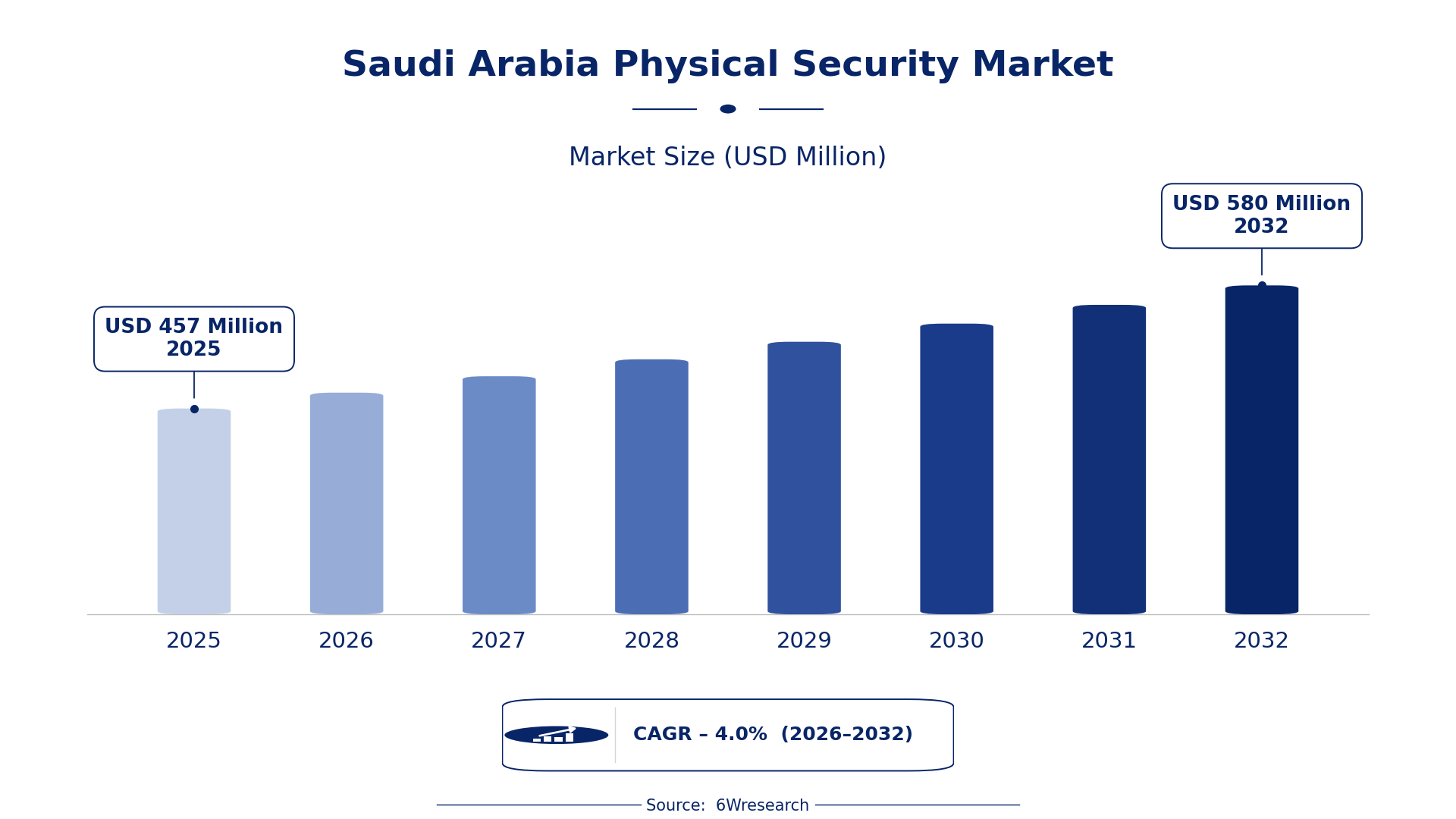
The Saudi Arabia Physical Security Market was estimated at USD 457 Million in 2025 and is projected to reach USD 580 Million by 2032, growing at a CAGR of 4.0% from 2026 to 2032.
Saudi Arabia Physical Security Market Synopsis
The Saudi Arabia Physical Security Market is witnessing a notable increase in investment as organizations focus on enhancing safety protocols. With the growing recognition of the importance of robust physical security measures, the market is set to transition from basic monitoring to advanced systems that integrate technology and innovation.
Future projections indicate that this upward trend will continue, driven by government initiatives and heightened awareness among private sectors. The shift towards comprehensive security solutions will further augment demand for advanced technologies in access control, video surveillance, and intrusion detection.
Saudi Arabia Physical Security Market Year-wise Growth Rate and Key Drivers
This graph illustrates the annual growth rates of the Saudi Arabia Physical Security Market from 2021 to 2032, highlighting a steady upward trajectory and projected expansion over the forecast period.
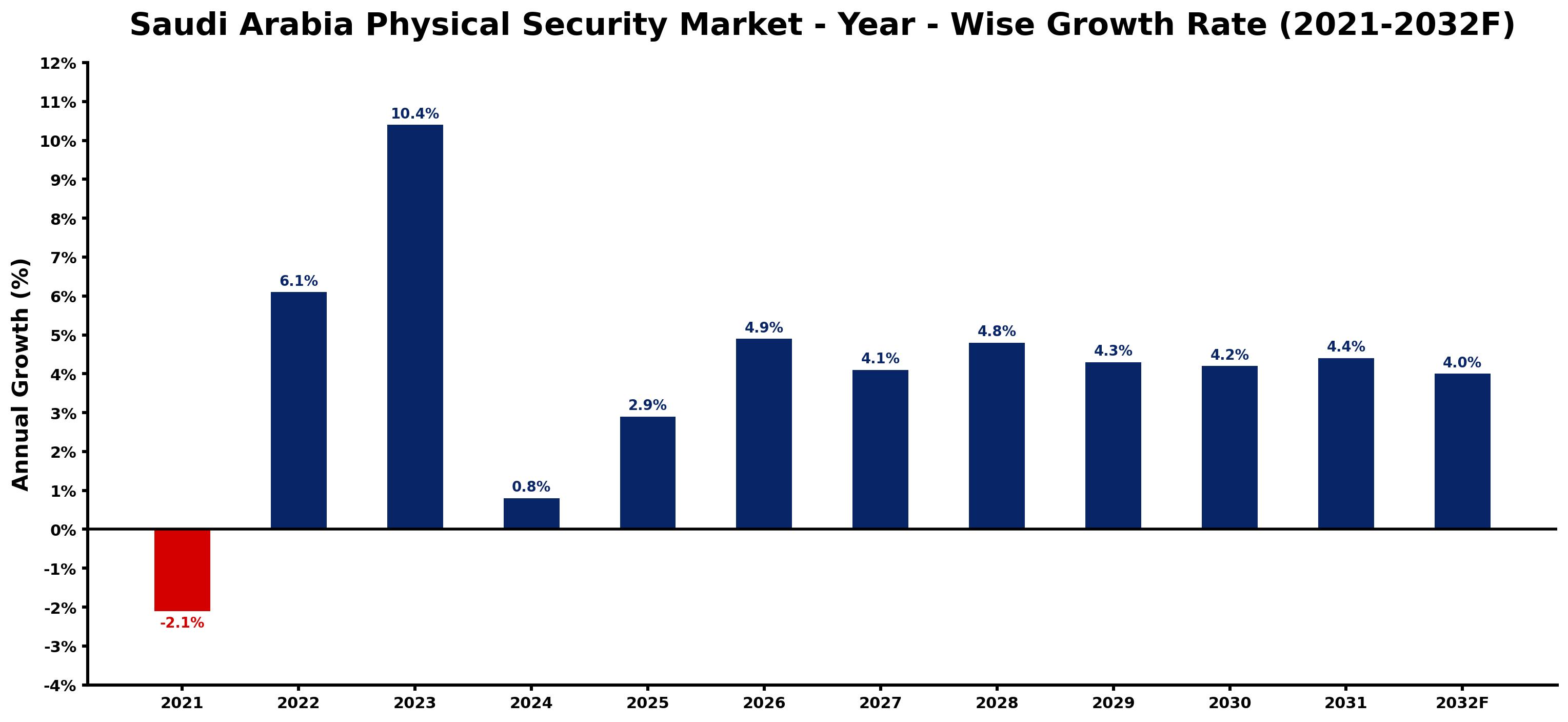
The table below presents the year‑wise growth rates along with the key drivers influencing the market
| Year | Growth Rate | Major Drivers |
| 2021 | -2.1% | Increased reliance on government cybersecurity initiatives overphysical security |
| 2022 | 6.1% | Saudi Vision 2030 boosting security infrastructure investments. |
| 2023 | 10.4% | Increased regulatory focus on cybersecurity and physical security. |
| 2024 | 0.8% | Rising tourism demands heightened public safety measures. |
| 2025 | 2.9% | Growing adoption of smart surveillance solutions in cities. |
| 2026 | 4.9% | Regulatory incentives for advanced security systems integration. |
| 2027 | 4.1% | Urbanization trends driving demand for integrated security solutions. |
| 2028 | 4.8% | Government projects enhancing security for major events. |
| 2029 | 4.3% | Increased private sector spending on facility security upgrades. |
| 2030 | 4.2% | Local manufacturing of security equipment gaining traction. |
| 2031 | 4.4% | Emergence of public-private partnerships in security enhancements. |
| 2032 | 4.0% | Ongoing threats necessitating stronger security protocols nationwide. |
Note: Market size estimations and growth projections presented in this report are based on 6Wresearch's proprietary forecasting methodology, utilizing the latest available industry data, government publications, and primary research inputs.
Saudi Arabia Physical Security Market Key Takeaways
Below are some of the specific key takeaways from the market, including:
- The Saudi Arabia Physical Security Market is experiencing consistent growth, backed by governmental support and private sector investments.
- Technological advancements in surveillance and access control are reshaping the market dynamics.
- Ongoing public safety concerns fuel the demand for comprehensive physical security solutions.
- The aftermath of COVID-19 has heightened awareness around facility security and compliance measures.
- Key players are increasingly focusing on integrating AI and analytics into physical security systems.
Evaluation of Restraints in Saudi Arabia Physical Security Market
Despite the promising growth trajectory, the Saudi Arabia Physical Security Market faces several restraints that could impede progress. One major challenge is the effective management and integration of diverse security technologies, which can lead to operational inefficiencies. on top of that, physical threats such as theft and vandalism remain prevalent, necessitating continual investment in more robust security measures. Additionally, the costs associated with upgrading existing systems and training personnel present barriers for many organizations looking to enhance their security infrastructure.
Saudi Arabia Physical Security Market Trends
Several trends are shaping the future of the Saudi Arabia Physical Security Market. The adoption of smart technologies, particularly IoT and AI, is becoming increasingly prevalent as organizations seek to enhance their surveillance capabilities. on top of that, mobile access control systems are gaining traction, reflecting a shift towards more flexible and user-friendly security solutions. The integration of cybersecurity measures with physical security is another trend, addressing the growing convergence of digital and physical threats.
Saudi Arabia Physical Security Market Opportunities
Growth opportunities in the Saudi Arabia Physical Security Market are significant. The government’s ongoing commitment to national safety and infrastructure protection creates a favorable environment for investment. With an increasing number of public and private entities recognizing the importance of securing their premises, demand for advanced security solutions is set to rise. Additionally, the push for digital transformation across various sectors opens new avenues for integrating physical and cybersecurity, presenting lucrative opportunities for technology providers.
Government Initiatives in the Saudi Arabia Physical Security Market
Government policies in Saudi Arabia are actively shaping the physical security landscape, reflecting a strong commitment to enhancing national safety and infrastructure resilience. With an increased focus on critical infrastructure protection, these initiatives are driving investments in advanced security solutions across various sectors. The regulatory environment is evolving, compelling both private and public organizations to adhere to stringent security standards.
- A national infrastructure protection initiative launched in 2023 aims to bolster security protocols for key facilities and assets.
- Current regulations are mandating upgrades to surveillance systems across educational institutions to enhance safety measures.
- A public-private partnership initiative is expected to be rolled out in 2025, focusing on upgrading city security systems with cutting-edge technology.
- Ongoing discussions surrounding the establishment of a national cybersecurity framework are on track to integrate with physical security regulations.
- New funding programs for SMEs in the security sector, introduced in mid-2024, support the development of innovative physical security solutions.
Future Insights of the Saudi Arabia Physical Security Market
The Saudi Arabia Physical Security Market is expected to evolve significantly between 2026 and 2032. As threats diversify and grow more complex, the demand for integrated security solutions that combine physical and digital safeguards will increase. Innovation will drive this sector, with advancements in AI, machine learning, and data analytics becoming standard components of security systems. Additionally, collaborative efforts between government and private sectors will enhance infrastructure resilience, fostering an environment conducive to sustained market growth.
Saudi Arabia Physical Security Market Latest Developments
Recent activity in the Saudi Arabia Physical Security Market reveals a trend toward modernization and strategic partnerships. Companies are investing heavily in technology to keep pace with evolving security demands. The market is becoming increasingly competitive as providers seek to differentiate themselves through innovative solutions and enhanced service offerings.
- A major technology vendor launched a new line of AI-powered surveillance cameras in Q3 2024, aimed at improving real-time threat detection capabilities.
- An initiative that began in early 2025 focuses on upgrading access control systems for government buildings nationwide, enhancing security protocols.
- A partnership between two leading firms was established in late 2024, targeting the development of integrated security platforms for critical infrastructure.
- An ongoing project initiated in 2023 is set to enhance the public transportation security network with advanced surveillance technologies.
- A rollout of a mobile security application, expected to commence in early 2026, aims to provide enhanced user access and control features.
Saudi Arabia Physical Security Market - Key Attractiveness of the Report
- 10 Years of Market Numbers
- Historical Data Starting from 2022 to 2025
- Base Year: 2025
- Forecast Data until 2032
- Key Performance Indicators Impacting the Market
- Major Upcoming Developments and Projects
Key Highlights of the Report:
- Saudi Arabia Physical Security Market Outlook
- Market Size of Saudi Arabia Physical Security Market, 2025
- Forecast of Saudi Arabia Physical Security Market, 2032
- Historical Data and Forecast of Saudi Arabia Physical Security Revenues & Volume for the Period 2022-2032F
- Saudi Arabia Physical Security Market Trend Evolution
- Saudi Arabia Physical Security Market Drivers and Challenges
- Saudi Arabia Physical Security Price Trends
- Saudi Arabia Physical Security Porter's Five Forces
- Saudi Arabia Physical Security Industry Life Cycle
- Historical Data and Forecast of Saudi Arabia Physical Security Market Revenues & Volume By Component for the Period 2022-2032F
- Historical Data and Forecast of Saudi Arabia Physical Security Market Revenues & Volume By Systems (PACS, PSIM, PIAM, Video Surveillance, Fire and Life Safety) for the Period 2022-2032F
- Historical Data and Forecast of Saudi Arabia Physical Security Market Revenues & Volume By Services for the Period 2022-2032F
- Historical Data and Forecast of Saudi Arabia Physical Security Market Revenues & Volume By Vertical for the Period 2022-2032F
- Historical Data and Forecast of Saudi Arabia Physical Security Market Revenues & Volume By BFSI for the Period 2022-2032F
- Historical Data and Forecast of Saudi Arabia Physical Security Market Revenues & Volume By Government for the Period 2022-2032F
- Historical Data and Forecast of Saudi Arabia Physical Security Market Revenues & Volume By Retail for the Period 2022-2032F
- Historical Data and Forecast of Saudi Arabia Physical Security Market Revenues & Volume By Transportation for the Period 2022-2032F
- Historical Data and Forecast of Saudi Arabia Physical Security Market Revenues & Volume By Residential for the Period 2022-2032F
- Historical Data and Forecast of Saudi Arabia Physical Security Market Revenues & Volume By Telecom and IT for the Period 2022-2032F
- Historical Data and Forecast of Saudi Arabia Physical Security Market Revenues & Volume By Other Verticals (Healthcare, Manufacturing, Energy and Utilities, and Education). for the Period 2022-2032F
- Historical Data and Forecast of Saudi Arabia Physical Security Market Revenues & Volume By Organization Size for the Period 2022-2032F
- Historical Data and Forecast of Saudi Arabia Physical Security Market Revenues & Volume By SMEs for the Period 2022-2032F
- Historical Data and Forecast of Saudi Arabia Physical Security Market Revenues & Volume By Large Enterprises for the Period 2022-2032F
- Saudi Arabia Physical Security Import Export Trade Statistics
- Market Opportunity Assessment By Component
- Market Opportunity Assessment By Vertical
- Market Opportunity Assessment By Organization Size
- Saudi Arabia Physical Security Top Companies Market Share
- Saudi Arabia Physical Security Competitive Benchmarking By Technical and Operational Parameters
- Saudi Arabia Physical Security Company Profiles
- Saudi Arabia Physical Security Key Strategic Recommendations






































