Saudi Arabia Typewriter Market Size, Share & Growth Rate
The Saudi Arabia Typewriter Market was estimated at USD 348 Million in 2025 and is projected to reach USD 446 Million by 2032, growing at a CAGR of 3.6% from 2026 to 2032. This growth is primarily driven by a resilient demand for typewriters among niche markets, such as legal firms and creative sectors, where their nostalgic appeal and authenticity are valued. Additionally, the restrictive use of electronic devices in certain environments further solidifies typewriters' unique position in the market.
Saudi Arabia Typewriter Market Year-wise Growth Rate and Key Drivers
This graph highlights how the Saudi Arabia Typewriter Market has steadily grown over the years, supported by major growth factors.
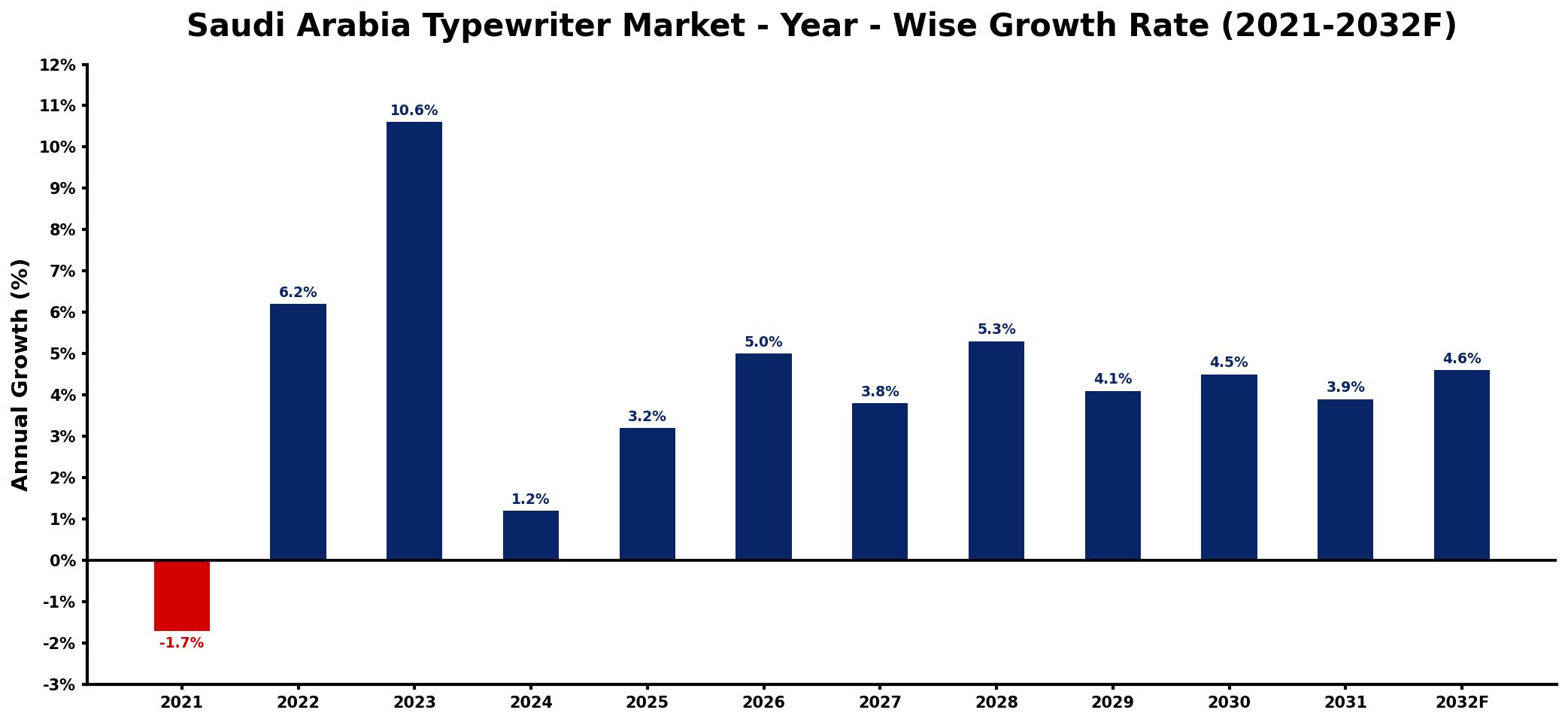
The table below presents the year‑wise growth rates along with the key drivers influencing the market
| Year | Growth Rate | Major Drivers |
| 2021 | -1.7% | decreased demand for traditional writing |
| 2022 | 6.2% | increased interest in retro products |
| 2023 | 10.6% | growing popularity of vintage aesthetics |
| 2024 | 1.2% | expansion in niche market segments |
| 2025 | 3.2% | rising consumer interest in collectibles |
| 2026 | 5.0% | growth in educational supply purchases |
| 2027 | 3.8% | increased investments in craftsmanship |
| 2028 | 5.3% | expansion of artisan manufacturing networks |
| 2029 | 4.1% | growing trend of personalized gifts |
| 2030 | 4.5% | increased online sales platforms availability |
| 2031 | 3.9% | rising demand for unique stationery |
| 2032 | 4.6% | rising infrastructure development spending |
Note: Market size estimations and growth projections presented in this report are based on 6Wresearch's proprietary forecasting methodology, utilizing the latest available industry data, government publications, and primary research inputs.
Saudi Arabia Typewriter Market Synopsis
In Saudi Arabia, the typewriter market retains a specialized segment that caters to consumers seeking tangible writing experiences. This includes legal professionals who prefer the reliability and classic nature of typewriting for official documents. Furthermore, creative individuals often gravitate toward typewriters as a source of inspiration, finding that the tactile nature of typewriting fosters concentration.
Although overshadowed by digital alternatives, the typewriter's appeal endures in certain circles, driven by both nostalgia and a preference for focused writing. Collectors and enthusiasts continue to support the market, ensuring that typewriters maintain a distinctive presence amidst the ongoing digital transformation.
Saudi Arabia Typewriter Market Key Takeaways
- The typewriter market in Saudi Arabia is characterized by a strong nostalgic demand despite the prevalence of digital devices.
- Legal and administrative sectors play a pivotal role in sustaining typewriter sales due to their specific operational needs.
- The market is largely driven by a growing community of enthusiasts and collectors dedicated to preserving typewriting traditions.
- Typewriters are recognized for their authenticity, fostering a focused writing environment in contexts where electronic distractions are limited.
- Emerging trends indicate a potential revival of interest in vintage technology, which may positively impact future market dynamics.
Evaluation of Restraints in Saudi Arabia Typewriter Market
Despite its niche appeal, the Saudi Arabia Typewriter Market is facing significant constraints stemming from the digital transformation that has fundamentally altered communication and documentation practices. The growing reliance on computers and digital devices has resulted in a diminishing customer base, further complicated by changing consumer preferences. Additionally, manufacturers are challenged to innovate while staying true to the traditional aesthetics and functionality that define typewriters. This delicate balance is essential to capture interest in a market where obsolescence looms large.
Saudi Arabia Typewriter Market Trends
The typewriter market in Saudi Arabia is witnessing several notable trends. One emerging trend is the increasing collaboration between typewriter manufacturers and local artists, resulting in customized products that appeal to contemporary creatives. Furthermore, there is a gradual resurgence in interest for vintage items among younger consumers, fueled by social media platforms showcasing retro aesthetics. These trends are helping to cultivate a sense of community among typewriter enthusiasts and are influencing purchasing behavior in favor of traditional writing tools.
Saudi Arabia Typewriter Market Opportunities
Opportunities for growth in the Saudi Arabia Typewriter Market lie in targeted marketing strategies aimed at specific demographics, such as students in creative writing programs and professionals in fields valuing traditional documentation. Expanding online sales channels could also enhance accessibility for enthusiasts and collectors across the region. Additionally, partnerships with educational institutions may further promote typewriters as a means to develop writing skills, presenting a multifaceted approach to capturing new markets.
Government Initiatives in the Saudi Arabia Typewriter Market
While direct government initiatives specifically targeting the typewriter market are limited, broader cultural programs promoting traditional crafts and heritage preservation can indirectly support the market. Public spending on education and arts often encourages the use of various writing tools, including typewriters, in educational settings. This approach aligns with a growing interest in preserving traditional methods as part of the country's cultural identity and creative expression.
Future Insights of the Saudi Arabia Typewriter Market
Looking ahead to the years 2026-2032, the Saudi Arabia Typewriter Market is expected to experience gradual growth, driven by a blend of nostalgia and authenticity. As the digital landscape continues to evolve, a segment of consumers will likely seek tangible writing experiences that foster creativity and focus. Additionally, collaboration with creative industries may serve to reinvigorate interest, ensuring that typewriters remain a cherished, albeit niche, choice among writers and collectors alike.
Saudi Arabia Typewriter Market Latest Developments (2025 - 2026)
In recent months, the Saudi Arabia Typewriter Market has seen an increase in the organization of local typewriter exhibitions and workshops, aimed at educating the public about the craftsmanship involved in typewriting. Enthusiast groups have also begun forming to share techniques and showcase typewriter art, further cementing the community's role in preserving this traditional practice. These initiatives suggest a renewed interest in typewriters as not merely tools for writing but as integral parts of artistic expression.
Saudi Arabia Typewriter Market - Key Attractiveness of the Report
- 10 Years of Market Numbers
- Historical Data Starting from 2022 to 2025
- Base Year: 2025
- Forecast Data until 2032
- Key Performance Indicators Impacting the Market
- Major Upcoming Developments and Projects
Key Highlights of the Report:
- Saudi Arabia Typewriter Market Outlook
- Market Size of Saudi Arabia Typewriter Market, 2025
- Forecast of Saudi Arabia Typewriter Market, 2032
- Historical Data and Forecast of Saudi Arabia Typewriter Revenues & Volume for the Period 2022-2032F
- Saudi Arabia Typewriter Market Trend Evolution
- Saudi Arabia Typewriter Market Drivers and Challenges
- Saudi Arabia Typewriter Price Trends
- Saudi Arabia Typewriter Porter's Five Forces
- Saudi Arabia Typewriter Industry Life Cycle
- Historical Data and Forecast of Saudi Arabia Typewriter Market Revenues & Volume By Type for the Period 2022-2032F
- Historical Data and Forecast of Saudi Arabia Typewriter Market Revenues & Volume By Standard Typewriter for the Period 2022-2032F
- Historical Data and Forecast of Saudi Arabia Typewriter Market Revenues & Volume By Portable Typewriter for the Period 2022-2032F
- Historical Data and Forecast of Saudi Arabia Typewriter Market Revenues & Volume By Noiseless Typewriter for the Period 2022-2032F
- Historical Data and Forecast of Saudi Arabia Typewriter Market Revenues & Volume By Electric Typewriter for the Period 2022-2032F
- Historical Data and Forecast of Saudi Arabia Typewriter Market Revenues & Volume By Variable Typewriter for the Period 2022-2032F
- Historical Data and Forecast of Saudi Arabia Typewriter Market Revenues & Volume By Automatic Typewriter for the Period 2022-2032F
- Historical Data and Forecast of Saudi Arabia Typewriter Market Revenues & Volume By Electronic Typewriter for the Period 2022-2032F
- Historical Data and Forecast of Saudi Arabia Standard Typewriter Typewriter Market Revenues & Volume By Typewriter with Additional Attachments for the Period 2022-2032F
- Historical Data and Forecast of Saudi Arabia Typewriter Market Revenues & Volume By Application for the Period 2022-2032F
- Historical Data and Forecast of Saudi Arabia Typewriter Market Revenues & Volume By Commerical for the Period 2022-2032F
- Historical Data and Forecast of Saudi Arabia Typewriter Market Revenues & Volume By Industrial for the Period 2022-2032F
- Historical Data and Forecast of Saudi Arabia Typewriter Market Revenues & Volume By Others for the Period 2022-2032F
- Saudi Arabia Typewriter Import Export Trade Statistics
- Market Opportunity Assessment By Type
- Market Opportunity Assessment By Application
- Saudi Arabia Typewriter Top Companies Market Share
- Saudi Arabia Typewriter Competitive Benchmarking By Technical and Operational Parameters
- Saudi Arabia Typewriter Company Profiles
- Saudi Arabia Typewriter Key Strategic Recommendations






































