Singapore Air Traffic Control Market Size, Share & Growth Rate
The Singapore Air Traffic Control Market was estimated at USD 613 Million in 2025 and is projected to reach USD 1085 Million by 2032, growing at a CAGR of 8.5% from 2026 to 2032. This robust growth trajectory is fueled by the rising demand for air travel in the Asia-Pacific region, coupled with Singapore's strategic position as a premier aviation hub. Enhanced infrastructure development, particularly at Changi Airport, is pivotal in meeting the burgeoning air traffic, driving the adoption of advanced air traffic management solutions.
Singapore Air Traffic Control Market Year-wise Growth Rate and Key Drivers
This graph highlights how the Singapore Air Traffic Control Market has steadily grown over the years, supported by major growth factors.
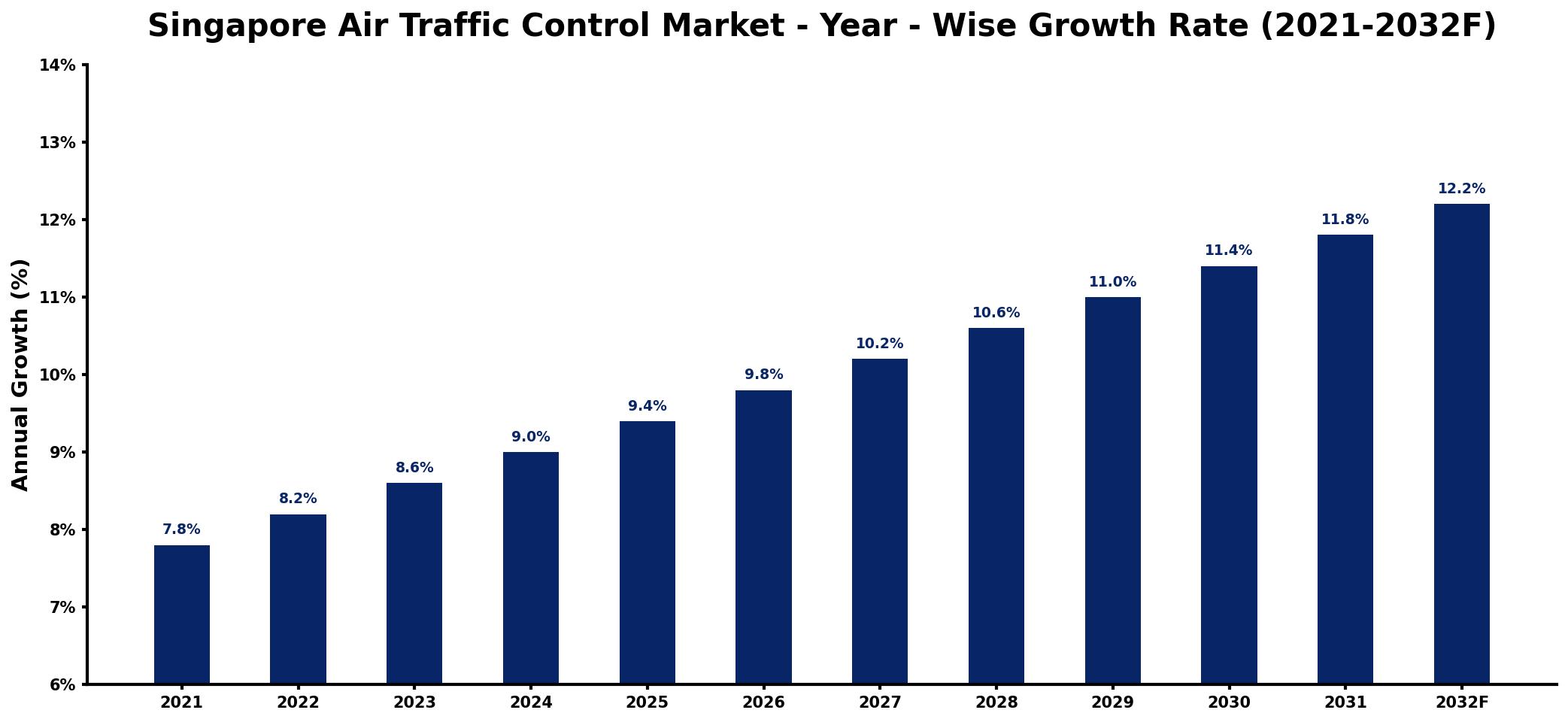
The table below presents the year‑wise growth rates along with the key drivers influencing the market
| Year | Growth Rate | Major Drivers |
| 2021 | 7.8% | Rising travel demand post pandemic |
| 2022 | 8.2% | Increased investments in infrastructure |
| 2023 | 8.6% | growing automotive sector requirements |
| 2024 | 9.0% | Growth in tourism and hospitality |
| 2025 | 9.4% | Technological advancements in navigation |
| 2026 | 9.8% | Emergence of new delivery services |
| 2027 | 10.2% | Government initiatives for modernization |
| 2028 | 10.6% | Collaborations between private sectors |
| 2029 | 11.0% | Boost in international trade activities |
| 2030 | 11.4% | Increase in freight transport requirements |
| 2031 | 11.8% | Development of smart transportation systems |
| 2032 | 12.2% | Enhanced safety regulations implementation |
Note: Market size estimations and growth projections presented in this report are based on 6Wresearch's proprietary forecasting methodology, utilizing the latest available industry data, government publications, and primary research inputs.
Singapore Air Traffic Control Market Synopsis
As one of the world's busiest airspaces, Singapore experiences a unique challenge in managing air traffic efficiently. The integration of advanced technologies, such as automation and data analytics, is crucial in optimizing airspace management and enhancing safety standards.
Singapore's commitment to providing seamless air traffic management services has led to substantial investments in modernizing its air traffic control systems. This proactive approach not only improves operational efficiency but also aligns the country's air traffic protocols with international standards.
Singapore Air Traffic Control Market Key Takeaways
- The market is expected to experience significant growth, driven by rising air travel and advancements in technology.
- Changi Airport's ongoing expansion plays a critical role in shaping the demand for modern air traffic control solutions.
- Automation and digitalization are key trends driving operational efficiency and safety in air traffic management.
- Investments in training and development for air traffic controllers are essential for maintaining high safety standards.
- The markets growth is challenged by the need for continuous modernization to keep pace with increasing air traffic volumes.
Evaluation of Restraints in Singapore Air Traffic Control Market
Despite the promising outlook, the Singapore air traffic control market faces significant restraints. The rapid increase in air traffic volume requires substantial investment in both advanced technologies and skilled personnel. The challenge lies in balancing these investments with operational efficiency and safety compliance. Moreover, ensuring the integration of new systems with existing infrastructure presents a continuous hurdle for stakeholders aiming to streamline air traffic operations.
Singapore Air Traffic Control Market Trends
Current trends indicate a growing emphasis on digitalization and automation, with air traffic controllers increasingly relying on sophisticated technologies for efficient management. Real-time data analytics are being leveraged to optimize flight paths and reduce delays, enhancing the overall travel experience. Furthermore, the increasing adoption of advanced communication networks is improving coordination between air traffic control and airlines, leading to smoother operations.
Singapore Air Traffic Control Market Opportunities
Significant growth opportunities exist within the Singapore air traffic control market. The ongoing modernization of Changi Airport and potential expansion plans present avenues for technological investments. Additionally, increasing air travel demand, both domestically and internationally, underscores the necessity for state-of-the-art air traffic management solutions. This climate of investment also opens doors for innovative companies specializing in automation technologies and safety enhancements.
Government Initiatives in the Singapore Air Traffic Control Market
The Singapore government has been proactive in promoting air safety and enhancing air traffic management systems. Through various initiatives, funding is allocated towards the modernization of air traffic control infrastructure. Programs focusing on the training and upskilling of air traffic controllers reflect the governments commitment to maintaining high safety standards. Moreover, collaborations with international aviation authorities ensure that Singapores air traffic management practices are aligned with global best practices.
Future Insights of the Singapore Air Traffic Control Market
Looking ahead to 2026-2032, the Singapore air traffic control market is poised for transformative growth. The convergence of advanced technologies such as AI and machine learning within air traffic management systems will redefine operational paradigms. Continued emphasis on sustainability and efficiency will likely drive further investments in innovative solutions. As Singapore solidifies its position as a global aviation hub, the air traffic control market will adapt to evolving demands, ensuring safety and efficiency remain at the forefront of airspace management.
Singapore Air Traffic Control Market Latest Developments (2025 - 2026)
In recent months, there has been a notable shift towards integrating AI-driven solutions into air traffic management. This trend reflects the industrys focus on enhancing decision-making processes and operational efficiency. Additionally, discussions surrounding public-private partnerships are gaining traction, with stakeholders exploring collaborative projects aimed at modernizing air traffic control technologies. Efforts to improve communication infrastructure between aircraft and control towers are also underway, promising to elevate the standard of air traffic operations.
Singapore Air Traffic Control Market - Key Attractiveness of the Report
- 10 Years of Market Numbers
- Historical Data Starting from 2022 to 2025
- Base Year: 2025
- Forecast Data until 2032
- Key Performance Indicators Impacting the Market
- Major Upcoming Developments and Projects
Key Highlights of the Report:
- Singapore Air Traffic Control Market Outlook
- Market Size of Singapore Air Traffic Control Market, 2025
- Forecast of Singapore Air Traffic Control Market, 2032
- Historical Data and Forecast of Singapore Air Traffic Control Revenues & Volume for the Period 2022-2032F
- Singapore Air Traffic Control Market Trend Evolution
- Singapore Air Traffic Control Market Drivers and Challenges
- Singapore Air Traffic Control Price Trends
- Singapore Air Traffic Control Porter's Five Forces
- Singapore Air Traffic Control Industry Life Cycle
- Historical Data and Forecast of Singapore Air Traffic Control Market Revenues & Volume By Airspace for the Period 2022-2032F
- Historical Data and Forecast of Singapore Air Traffic Control Market Revenues & Volume By Air Route Traffic Control Centers for the Period 2022-2032F
- Historical Data and Forecast of Singapore Air Traffic Control Market Revenues & Volume By Terminal Radar Approach Control for the Period 2022-2032F
- Historical Data and Forecast of Singapore Air Traffic Control Market Revenues & Volume By Air Traffic Control Tower for the Period 2022-2032F
- Historical Data and Forecast of Singapore Air Traffic Control Market Revenues & Volume By Remote Tower for the Period 2022-2032F
- Historical Data and Forecast of Singapore Air Traffic Control Market Revenues & Volume By Application for the Period 2022-2032F
- Historical Data and Forecast of Singapore Air Traffic Control Market Revenues & Volume By Communication for the Period 2022-2032F
- Historical Data and Forecast of Singapore Air Traffic Control Market Revenues & Volume By Navigation for the Period 2022-2032F
- Historical Data and Forecast of Singapore Air Traffic Control Market Revenues & Volume By Surveillance for the Period 2022-2032F
- Historical Data and Forecast of Singapore Air Traffic Control Market Revenues & Volume By Automation for the Period 2022-2032F
- Historical Data and Forecast of Singapore Air Traffic Control Market Revenues & Volume By Offerings for the Period 2022-2032F
- Historical Data and Forecast of Singapore Air Traffic Control Market Revenues & Volume By Hardware for the Period 2022-2032F
- Historical Data and Forecast of Singapore Air Traffic Control Market Revenues & Volume By Software & Solutions for the Period 2022-2032F
- Historical Data and Forecast of Singapore Air Traffic Control Market Revenues & Volume By Services for the Period 2022-2032F
- Historical Data and Forecast of Singapore Air Traffic Control Market Revenues & Volume By Airport Size for the Period 2022-2032F
- Historical Data and Forecast of Singapore Air Traffic Control Market Revenues & Volume By Large for the Period 2022-2032F
- Historical Data and Forecast of Singapore Air Traffic Control Market Revenues & Volume By Medium for the Period 2022-2032F
- Historical Data and Forecast of Singapore Air Traffic Control Market Revenues & Volume By Small for the Period 2022-2032F
- Historical Data and Forecast of Singapore Air Traffic Control Market Revenues & Volume By Sector for the Period 2022-2032F
- Historical Data and Forecast of Singapore Air Traffic Control Market Revenues & Volume By Commercial for the Period 2022-2032F
- Historical Data and Forecast of Singapore Air Traffic Control Market Revenues & Volume By Military & Defense for the Period 2022-2032F
- Singapore Air Traffic Control Import Export Trade Statistics
- Market Opportunity Assessment By Airspace
- Market Opportunity Assessment By Application
- Market Opportunity Assessment By Offerings
- Market Opportunity Assessment By Airport Size
- Market Opportunity Assessment By Sector
- Singapore Air Traffic Control Top Companies Market Share
- Singapore Air Traffic Control Competitive Benchmarking By Technical and Operational Parameters
- Singapore Air Traffic Control Company Profiles
- Singapore Air Traffic Control Key Strategic Recommendations






































