Singapore Ammonium Fluoride Market Size, Share & Growth Rate
The Singapore Ammonium Fluoride Market was estimated at USD 484 Million in 2025 and is projected to reach USD 639 Million by 2032, growing at a CAGR of 4.0% from 2026 to 2032. This robust growth trajectory is largely fueled by the expanding semiconductor industry, which relies heavily on ammonium fluoride for essential processes such as etching and cleaning. Furthermore, the escalating demand for high-performance electronic devices continues to elevate market dynamics, positioning Singapore as a key player in the region.
Singapore Ammonium Fluoride Market Year-wise Growth Rate and Key Drivers
This graph highlights how the Singapore Ammonium Fluoride Market has steadily grown over the years, supported by major growth factors.
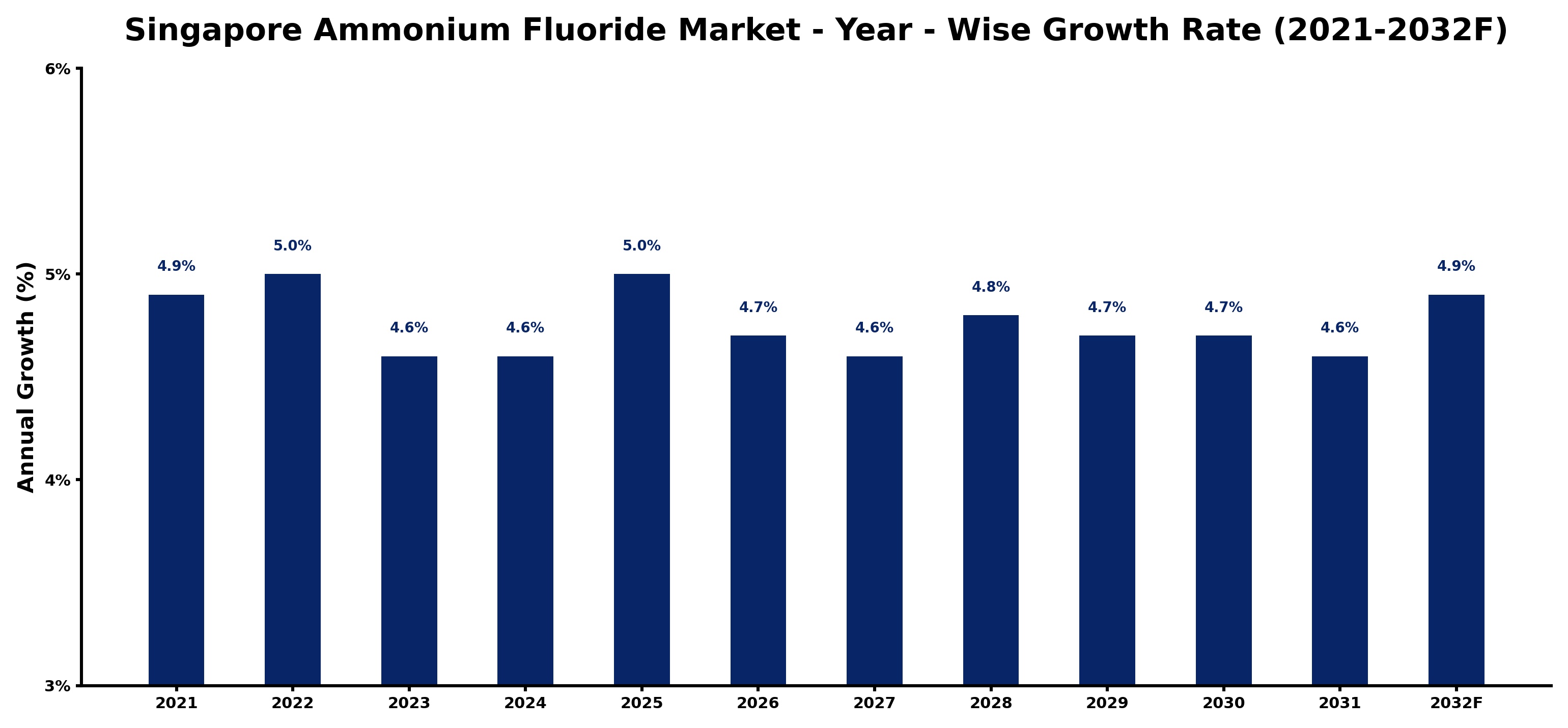
The table below presents the year‑wise growth rates along with the key drivers influencing the market
| Year | Growth Rate | Major Drivers |
| 2021 | 4.9% | Increased industrial applications demand |
| 2022 | 5.0% | Growing electronics sector drives consumption |
| 2023 | 4.6% | Rising demand from semiconductor industry |
| 2024 | 4.6% | Fluoride usage in pharmaceuticals expands |
| 2025 | 5.0% | Enhanced production technologies adopted widely |
| 2026 | 4.7% | Sustainable practices gaining market traction |
| 2027 | 4.6% | Research and development investments rise |
| 2028 | 4.8% | Innovative applications in agriculture emerge |
| 2029 | 4.7% | Collaborations with tech firms increase |
| 2030 | 4.7% | Regulatory support for fluoride usage |
| 2031 | 4.6% | Consumer awareness of fluoride benefits |
| 2032 | 4.9% | Global market trends influence growth |
Note - Market size estimations and growth projections presented in this report are based on 6Wresearch’s advanced forecasting approach, validated with industry datasets as of June 2026.
Singapore Ammonium Fluoride Market Synopsis
The most significant force currently shaping the Singapore Ammonium Fluoride Market is the burgeoning semiconductor industry. As the country solidifies its reputation as a manufacturing hub, the demand for ammonium fluoride is anticipated to rise, further strengthening its applications in electronics, glass, and ceramics.
Additionally, the market's growth is driven by various sectors beyond semiconductors. The use of ammonium fluoride in the glass and ceramics industries, along with its role in specialty coatings for construction and automotive applications, provides a diversified foundation that enhances its market stability.
Singapore Ammonium Fluoride Market Key Takeaways
- Ammonium fluoride demand is closely tied to the semiconductor and electronics industries, ensuring a consistent growth trajectory.
- Technological advancements in electronics continue to drive the need for efficient etching and cleaning solutions.
- The glass and ceramics industries contribute significantly to the market, utilizing ammonium fluoride for improved product quality.
- Market growth is supported by Singapore's strategic manufacturing position and increasing investments in R&D.
- Volatility in raw material prices poses a challenge, necessitating robust supply chain management.
Evaluation of Restraints in Singapore Ammonium Fluoride Market
Despite its promising trajectory, the Singapore Ammonium Fluoride Market faces several real restraints. Fluctuating raw material costs, particularly for ammonium sulfate and hydrogen fluoride, can disrupt pricing strategies and affect overall profitability. As companies strive to maintain competitive advantages, they must navigate these challenges while ensuring a steady supply chain. Additionally, reliance on specific industries for demand could lead to vulnerabilities in market stability, necessitating a diversified customer base to mitigate risks.
Singapore Ammonium Fluoride Market Trends
Current trends in the Singapore Ammonium Fluoride Market indicate a growing emphasis on innovation in semiconductor manufacturing processes. As technology continues to evolve, the demand for more refined and effective etching materials is increasing. Furthermore, sustainability initiatives are prompting industries to seek eco-friendly alternatives and methods for utilizing ammonium fluoride, aligning with global trends in responsible manufacturing. These developments highlight the market's adaptability and forward-thinking nature.
Singapore Ammonium Fluoride Market Opportunities
Significant growth opportunities exist within the Singapore Ammonium Fluoride Market, particularly as sectors such as electronics and construction expand. Investment in research and development offers a pathway for innovations that enhance product efficiency and application. Moreover, tapping into new markets, particularly those focused on high-performance materials, presents a lucrative avenue for companies looking to diversify their portfolios. The ongoing urbanization and infrastructure development also hold promise for increased demand in specialty coatings and glass applications.
Government Initiatives in the Singapore Ammonium Fluoride Market
The Singaporean government is committed to bolstering the manufacturing sector, particularly in electronics and chemicals. Various initiatives aimed at enhancing research capabilities and technological advancements in these industries support the ammonium fluoride market. Public spending on infrastructure and R&D is also anticipated to stimulate growth, providing favorable conditions for companies to innovate and expand their operations. Incentives for environmentally friendly manufacturing processes further align with the global push for sustainability.
Future Insights of the Singapore Ammonium Fluoride Market
Looking ahead to the 2026-2032 period, the Singapore Ammonium Fluoride Market is set for substantial evolution. As semiconductor technology advances, the compound's role in facilitating smaller, more efficient electronic devices will be paramount. Additionally, the continued exploration of diverse applications in glass, ceramics, and coatings will catalyze market growth. Emerging technologies and processes will likely drive a need for innovation, positioning the market as a critical component of Singapore's broader economic landscape.
Singapore Ammonium Fluoride Market Latest Developments (May 2025 - June 2026)
Recent developments in the Singapore Ammonium Fluoride Market indicate a significant uptick in collaborative efforts among manufacturers to enhance production efficiency. Companies are investing in new technologies aimed at optimizing the use of ammonium fluoride in semiconductor applications. Moreover, regulatory changes in response to sustainability demands are influencing production practices, prompting a shift towards greener alternatives and manufacturing processes that reduce environmental impact.
Singapore Ammonium Fluoride Market - Key Attractiveness of the Report
- 10 Years of Market Numbers
- Historical Data Starting from 2022 to 2025
- Base Year: 2025
- Forecast Data until 2032
- Key Performance Indicators Impacting the Market
- Major Upcoming Developments and Projects
Key Highlights of the Report:
- Singapore Ammonium Fluoride Market Outlook
- Market Size of Singapore Ammonium Fluoride Market, 2025
- Forecast of Singapore Ammonium Fluoride Market, 2032
- Historical Data and Forecast of Singapore Ammonium Fluoride Revenues & Volume for the Period 2022-2032F
- Singapore Ammonium Fluoride Market Trend Evolution
- Singapore Ammonium Fluoride Market Drivers and Challenges
- Singapore Ammonium Fluoride Price Trends
- Singapore Ammonium Fluoride Porter's Five Forces
- Singapore Ammonium Fluoride Industry Life Cycle
- Historical Data and Forecast of Singapore Ammonium Fluoride Market Revenues & Volume By Product Type for the Period 2022-2032F
- Historical Data and Forecast of Singapore Ammonium Fluoride Market Revenues & Volume By Industrial grade ammonium fluoride for the Period 2022-2032F
- Historical Data and Forecast of Singapore Ammonium Fluoride Market Revenues & Volume By Electronic Grade ammonium fluoride for the Period 2022-2032F
- Historical Data and Forecast of Singapore Ammonium Fluoride Market Revenues & Volume By Application for the Period 2022-2032F
- Historical Data and Forecast of Singapore Ammonium Fluoride Market Revenues & Volume By Glass Etching Agent for the Period 2022-2032F
- Historical Data and Forecast of Singapore Ammonium Fluoride Market Revenues & Volume By Electrical Components Processing for the Period 2022-2032F
- Historical Data and Forecast of Singapore Ammonium Fluoride Market Revenues & Volume By Other for the Period 2022-2032F
- Singapore Ammonium Fluoride Import Export Trade Statistics
- Market Opportunity Assessment By Product Type
- Market Opportunity Assessment By Application
- Singapore Ammonium Fluoride Top Companies Market Share
- Singapore Ammonium Fluoride Competitive Benchmarking By Technical and Operational Parameters
- Singapore Ammonium Fluoride Company Profiles
- Singapore Ammonium Fluoride Key Strategic Recommendations






































