Singapore Automotive collision repair Market Size, Share & Growth Rate
The Singapore Automotive collision repair Market was estimated at USD 1051 Million in 2025 and is projected to reach USD 1882 Million by 2032, growing at a CAGR of 8.7% from 2026 to 2032. This robust growth trajectory is primarily driven by the increasing vehicle population, necessitating more frequent collision repair services. Coupled with the country's stringent safety regulations, the demand for quality repair solutions is heightened, ensuring that vehicles remain roadworthy and safe for drivers and passengers alike.
Singapore Automotive collision repair Market Growth Rate Analysis (2021-2032)
The Singapore automotive collision repair market is exhibiting robust growth, marked by an annual increase of 8.0% in 2021, progressively rising to 12.4% by 2032. Several factors contribute to this upward trend, notably the rapid urbanization and accompanying rise in vehicle ownership, which has escalated the demand for repair services. Technological advancements, such as the integration of digital solutions for diagnostics and customer management, have further propelled investments in repair facilities. Additionally, the government's focus on enhancing infrastructure and supporting sustainable practices fosters an environment conducive to market expansion, attracting new players and driving innovation. As consumer demand continues to evolve, repairs reflecting modern standards remain a crucial area for investment.
Singapore Automotive collision repair Market Year-wise Growth Rate and Key Drivers
This graph highlights how the Singapore Automotive collision repair Market has steadily grown over the past five years, supported by major growth factors.
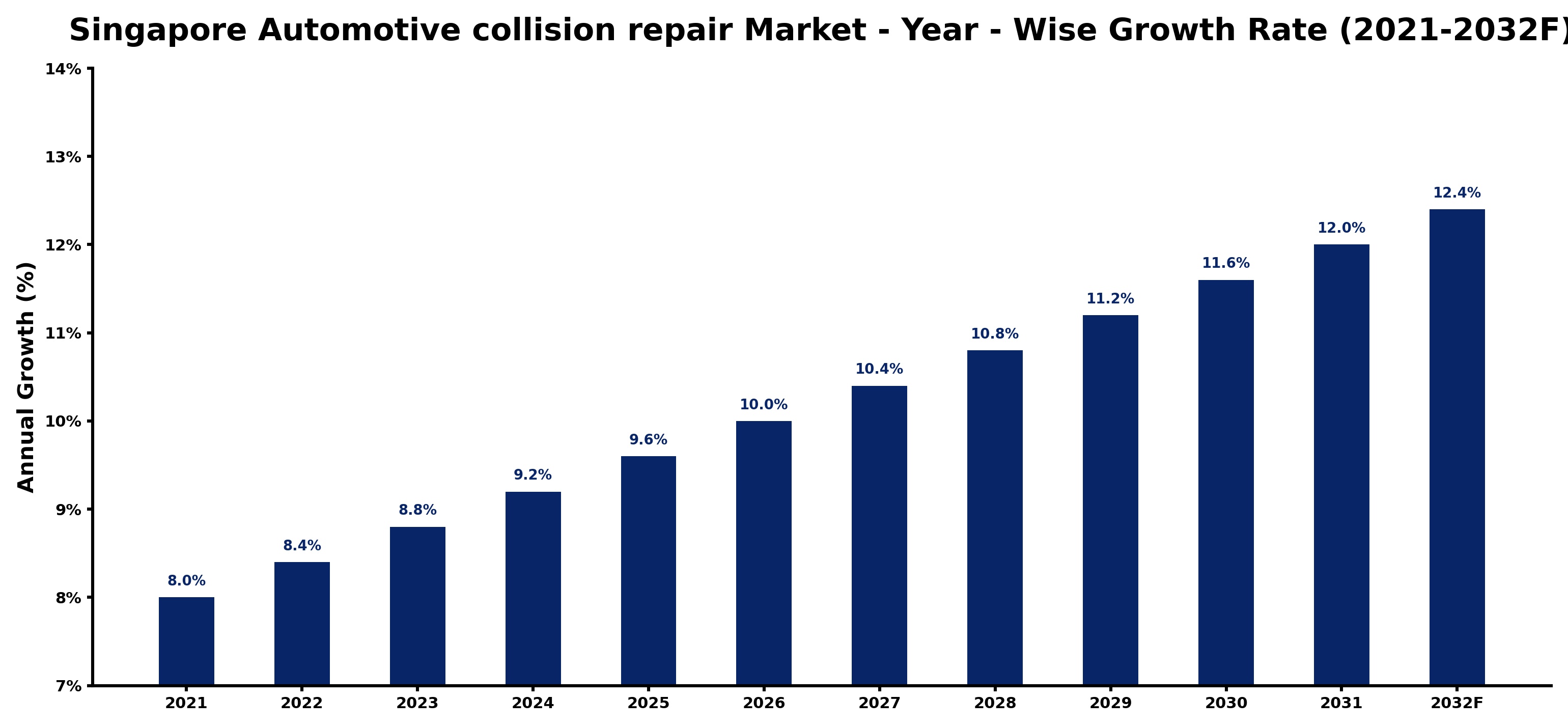
The table below presents the year‑wise growth rates along with the key drivers influencing the market
| Year | Growth Rate | Major Drivers |
| 2021 | 8.0% | Increased vehicle ownership rates |
| 2022 | 8.4% | Rising demand for collision repairs |
| 2023 | 8.8% | Technological advancements in repairs |
| 2024 | 9.2% | Growth in electric vehicle repairs |
| 2025 | 9.6% | Expansion of insurance partnerships |
| 2026 | 10.0% | Increased consumer awareness programs |
| 2027 | 10.4% | Enhanced training for technicians |
| 2028 | 10.8% | Government incentives for repairs |
| 2029 | 11.2% | Rising disposable income levels |
| 2030 | 11.6% | Industrial activity supported growth |
| 2031 | 12.0% | Improved customer service standards |
| 2032 | 12.4% | Sustainability initiatives in repairs |
Note - Market size estimations and growth projections presented in this report are based on 6Wresearch’s advanced forecasting approach, validated with industry datasets as of June 2026.
Singapore Automotive collision repair Market Synopsis
The automotive collision repair market in Singapore is rapidly evolving, reflecting the city-state's commitment to vehicle safety and compliance. As urbanization continues to rise, the frequency of vehicular accidents remains a pertinent concern, further solidifying the importance of reliable collision repair services. The intersection of advanced technology and regulatory oversight has created a landscape where high-quality repair services are essential.
Singapore's stringent regulations not only ensure safety but also demand operational excellence from collision repair shops. In this highly competitive environment, businesses are increasingly adopting innovative repair techniques and embracing technology, aiming to enhance efficiency and service quality while meeting the rising expectations of both consumers and insurance partners.
Singapore Automotive collision repair Market Key Takeaways
- The market is driven by an increasing number of vehicles, necessitating higher collision repair services.
- Technological advancements in repair processes enhance efficiency and reduce turnaround times.
- Stringent safety regulations reinforce the demand for high-quality and compliant repair services.
- Insurance partnerships significantly influence the choice of collision repair service providers.
- Emergence of electric vehicles is prompting repair shops to adapt their service offerings.
Evaluation of Restraints in Singapore Automotive collision repair Market
While the Singapore automotive collision repair market shows promising growth, several factors pose significant restraints. High operational costs, exacerbated by expensive real estate, pressure margins for repair businesses. Additionally, the stringent regulatory framework requires continuous training and expertise, contributing to further financial strain. Furthermore, the rapid evolution of vehicle technology demands ongoing investment in equipment and training, compelling shops to strike a balance between maintaining competitiveness and managing operational expenses.
Singapore Automotive collision repair Market Trends
The Singapore automotive collision repair landscape is currently influenced by several key trends. The integration of digital tools for estimates and customer communication is revolutionizing the service experience, streamlining workflows and improving customer satisfaction. Furthermore, the rise of electric vehicles requires specialized skills and tools for repairs, prompting workshops to adapt to these new technologies. Sustainability also emerges as a vital consideration, with businesses exploring eco-friendly repair materials and processes.
Singapore Automotive collision repair Market Opportunities
Significant growth opportunities exist within the Singapore automotive collision repair market. The rise of connected vehicles presents a chance for shops to expand their services by offering specialized repairs for advanced driver-assistance systems. Additionally, as insurance providers increasingly lean towards partnerships with authorized repair centers, this creates a pathway for repair shops to secure steady clientele. The ongoing shift towards sustainable practices also opens avenues for innovative repair methodologies that could set businesses apart in a competitive market.
Government Initiatives in the Singapore Automotive collision repair Market
The Singaporean government actively promotes vehicle safety and sustainability through various initiatives. Policies focused on enhancing road safety have led to strict regulations regarding vehicle maintenance and repair standards. Incentives for the adoption of eco-friendly technologies and practices in the automotive sector are also evident. Additionally, government-led training programs aim to upskill technicians, ensuring they meet the high standards required in a rapidly evolving automotive landscape.
Future Insights of the Singapore Automotive collision repair Market
Looking ahead to 2026-2032, the Singapore automotive collision repair market is poised for substantial growth driven by technological advancement and regulatory changes. The continued expansion of the vehicle fleet will invariably lead to increased demand for repair services. As electric and autonomous vehicles become more prevalent, repair shops must innovate to accommodate new technologies. Furthermore, the evolving consumer expectations for speed and quality will compel businesses to adopt more efficient, tech-driven repair solutions to maintain their competitive edge.
Singapore Automotive collision repair Market Latest Developments (May 2025 - June 2026)
In the recent months leading up to mid-2026, the Singapore automotive collision repair market has seen an uptick in technology adoption, particularly in the realm of digital repair management systems. Workshops are increasingly leveraging software for enhanced customer engagement and operational efficiency. Furthermore, collaborations between repair shops and insurance companies have strengthened, with a focus on ensuring quality repairs while managing costs effectively. Sustainability efforts are also gaining traction, with businesses exploring greener practices in repair processes.
Singapore Automotive collision repair Market - Key Attractiveness of the Report
- 10 Years of Market Numbers
- Historical Data Starting from 2022 to 2025
- Base Year: 2025
- Forecast Data until 2032
- Key Performance Indicators Impacting the Market
- Major Upcoming Developments and Projects
Key Highlights of the Report:
- Singapore Automotive collision repair Market Outlook
- Market Size of Singapore Automotive collision repair Market, 2025
- Forecast of Singapore Automotive collision repair Market, 2032F
- Historical Data and Forecast of Singapore Automotive collision repair Revenues & Volume for the Period 2022-2032F
- Singapore Automotive collision repair Market Trend Evolution
- Singapore Automotive collision repair Market Drivers and Challenges
- Singapore Automotive collision repair Price Trends
- Singapore Automotive collision repair Porter's Five Forces
- Singapore Automotive collision repair Industry Life Cycle
- Historical Data and Forecast of Singapore Automotive collision repair Market Revenues & Volume By Vehicle Type for the Period 2022-2032F
- Historical Data and Forecast of Singapore Automotive collision repair Market Revenues & Volume By Light-duty for the Period 2022-2032F
- Historical Data and Forecast of Singapore Automotive collision repair Market Revenues & Volume By Heavy-duty for the Period 2022-2032F
- Historical Data and Forecast of Singapore Automotive collision repair Market Revenues & Volume By Product for the Period 2022-2032F
- Historical Data and Forecast of Singapore Automotive collision repair Market Revenues & Volume By Paints & coatings for the Period 2022-2032F
- Historical Data and Forecast of Singapore Automotive collision repair Market Revenues & Volume By Consumables for the Period 2022-2032F
- Historical Data and Forecast of Singapore Automotive collision repair Market Revenues & Volume By Spare parts for the Period 2022-2032F
- Historical Data and Forecast of Singapore Automotive collision repair Market Revenues & Volume By Service Channel for the Period 2022-2032F
- Historical Data and Forecast of Singapore Automotive collision repair Market Revenues & Volume By DIY for the Period 2022-2032F
- Historical Data and Forecast of Singapore Automotive collision repair Market Revenues & Volume By DIFM for the Period 2022-2032F
- Historical Data and Forecast of Singapore Automotive collision repair Market Revenues & Volume By OE for the Period 2022-2032F
- Singapore Automotive collision repair Import Export Trade Statistics
- Market Opportunity Assessment By Vehicle Type
- Market Opportunity Assessment By Product
- Market Opportunity Assessment By Service Channel
- Singapore Automotive collision repair Top Companies Market Share
- Singapore Automotive collision repair Competitive Benchmarking By Technical and Operational Parameters
- Singapore Automotive collision repair Company Profiles
- Singapore Automotive collision repair Key Strategic Recommendations






































