Singapore Automotive Wheel Rims Market Size, Share & Growth Rate
The Singapore Automotive Wheel Rims Market was estimated at USD 1220 Million in 2025 and is projected to reach USD 1760 Million by 2032, growing at a CAGR of 5.4% from 2026 to 2032. This positive trajectory is primarily driven by the increasing demand for high-quality and lightweight rims, as local consumers gravitate towards premium vehicles and customization options. The automotive industry's revival post-pandemic, combined with a growing trend toward electric and hybrid vehicles, is expected to fuel further growth in this niche.
Singapore Automotive Wheel Rims Market Growth Rate Analysis (2021-2032)
The Singapore automotive wheel rims market has shown a stable growth pattern, recording annual growth rates of 6.1% in 2021 and fluctuating slightly to 6.5% in 2022. This upward trend remains robust, with projections maintaining similar growth rates through 2027, driven by increasing consumer demand for high-quality and lightweight materials. Investments in advanced manufacturing technology and infrastructure improvements are enhancing production efficiencies. Although growth dips to 6.0% in 2029 and 2031, factors such as global supply chain disruptions and evolving regulations could be influencing these fluctuations. However, a resurgence to 6.6% in 2032 indicates resilience, bolstered by an ongoing energy transition and heightened interest in sustainable automotive solutions.
Singapore Automotive Wheel Rims Market Year-wise Growth Rate and Key Drivers
This graph highlights how the Singapore Automotive Wheel Rims Market has steadily grown over the past five years, supported by major growth factors.
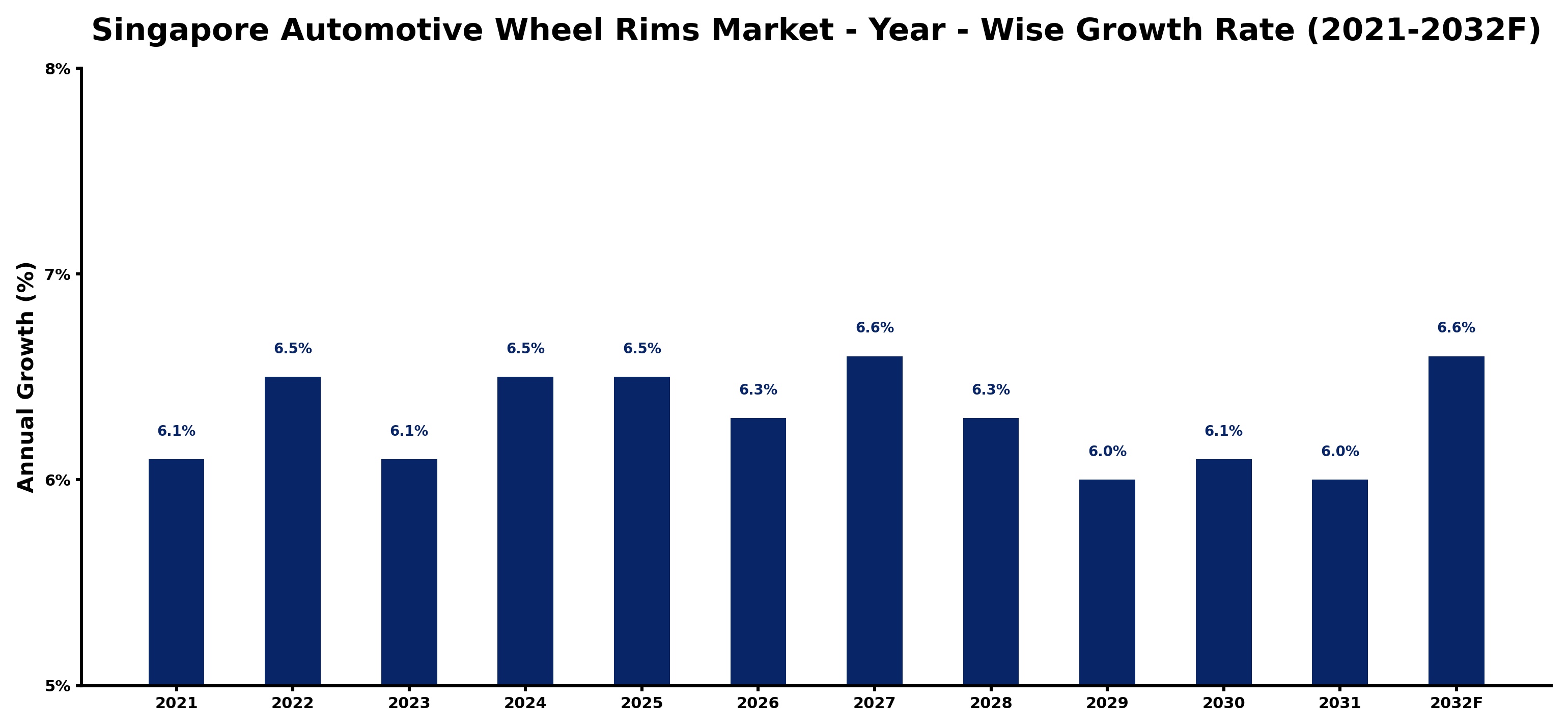
The table below presents the year‑wise growth rates along with the key drivers influencing the market
| Year | Growth Rate | Major Drivers |
| 2021 | 6.1% | Rising vehicle ownership rates |
| 2022 | 6.5% | Increased demand for customization |
| 2023 | 6.1% | Technological advancements in manufacturing |
| 2024 | 6.5% | Sustainability trends driving innovation |
| 2025 | 6.5% | Expansion of electric vehicle market |
| 2026 | 6.3% | Growing interest in lightweight materials |
| 2027 | 6.6% | Enhanced safety regulations boosting sales |
| 2028 | 6.3% | Rising performance vehicle popularity |
| 2029 | 6.0% | Increased aftermarket service opportunities |
| 2030 | 6.1% | Growth in automotive exports rising |
| 2031 | 6.0% | Urbanization trends driving demand |
| 2032 | 6.6% | Emerging markets expanding customer base |
Note - Market size estimations and growth projections presented in this report are based on 6Wresearch’s advanced forecasting approach, validated with industry datasets as of June 2026.
Singapore Automotive Wheel Rims Market Synopsis
In Singapore, the automotive wheel rims market is witnessing a dynamic evolution as consumers increasingly prioritize both aesthetics and performance. The interplay between vehicle customization and the emergence of lightweight materials has positioned wheel rims as a critical component for enhancing vehicle efficiency and style.
With a discerning population that favors luxury automobiles, the demand for premium wheel rims remains robust. As trends towards aftermarket customization gain momentum, manufacturers are prompted to innovate in design and material technology to meet the evolving preferences of consumers.
Singapore Automotive Wheel Rims Market Key Takeaways
- The market is experiencing growth driven by the affluent automotive landscape and increasing vehicle customization.
- Demand for lightweight rims is surging, particularly with the rise of electric and hybrid vehicles.
- Competition from lower-cost manufacturers presents challenges for maintaining product pricing and quality.
- The pandemic-induced slowdown is transitioning to recovery, with a renewed focus on aesthetic enhancements in the automotive sector.
- Local manufacturers are investing in advanced materials to meet new performance standards and consumer expectations.
Evaluation of Restraints in Singapore Automotive Wheel Rims Market
The Singapore automotive wheel rims market faces notable challenges, primarily driven by intense competition from international low-cost manufacturers. This competition exerts downward pressure on pricing, affecting the margins of local producers who strive to maintain quality amidst cost-cutting pressures. Additionally, the increasing consumer expectation for lightweight and high-performance products necessitates significant investments in cutting-edge manufacturing processes and materials. Finally, the rapid changes in design trends and preferences can complicate production planning and market responsiveness for manufacturers.
Singapore Automotive Wheel Rims Market Trends
Several key trends are shaping the Singapore automotive wheel rims market. The push towards sustainability and vehicle efficiency is leading to a preference for lightweight materials, which can improve the overall performance of electric and hybrid vehicles. Additionally, the rise of vehicle personalization is prompting a greater demand for unique and bespoke rim designs. Online platforms and social media are also becoming essential for showcasing customization possibilities, connecting manufacturers directly with consumers.
Singapore Automotive Wheel Rims Market Opportunities
The market presents significant opportunities for growth, particularly in the aftermarket segment. Manufacturers who focus on innovative designs and lightweight materials are well-positioned to capture market share, especially among eco-conscious consumers. Collaborations with automotive customization workshops and e-commerce platforms can enhance visibility and reach. Furthermore, the expected increase in electric vehicle sales opens up avenues for developing specialized rims tailored to the needs of these advanced vehicles.
Government Initiatives in the Singapore Automotive Wheel Rims Market
The Singapore government is actively promoting initiatives aimed at enhancing the automotive industry, including policies that encourage innovation in manufacturing processes and materials. Public spending on infrastructure improvements further supports the automotive sector, fostering an environment conducive to growth. Programs that incentivize the adoption of electric vehicles also indirectly benefit the automotive wheel rims market by increasing demand for lightweight and efficient rim solutions.
Future Insights of the Singapore Automotive Wheel Rims Market
Looking ahead to 2026-2032, the Singapore automotive wheel rims market is expected to continue its upward trajectory, driven by evolving consumer preferences and technological advancements. The shift towards electric and hybrid vehicles will likely intensify the demand for lightweight rims, enhancing overall vehicle efficiency. As manufacturers innovate to meet changing design trends, the market will not only recover from pandemic-related disruptions but also evolve into a more competitive and diverse landscape.
Singapore Automotive Wheel Rims Market Latest Developments (May 2025 - June 2026)
Recent developments in the Singapore automotive wheel rims market highlight a growing focus on sustainability and innovative designs. Manufacturers are increasingly incorporating advanced materials to cater to the demand for lightweight rims. Concurrently, consumer interest in customization options is being met with a wider array of styles and finishes, driven by technological advancements in manufacturing techniques. Overall, the market landscape is evolving to align with new consumer preferences and industry standards.
Singapore Automotive Wheel Rims Market - Key Attractiveness of the Report
- 10 Years of Market Numbers
- Historical Data Starting from 2022 to 2025
- Base Year: 2025
- Forecast Data until 2032
- Key Performance Indicators Impacting the Market
- Major Upcoming Developments and Projects
Key Highlights of the Report:
- Singapore Automotive Wheel Rims Market Outlook
- Market Size of Singapore Automotive Wheel Rims Market, 2025
- Forecast of Singapore Automotive Wheel Rims Market, 2032F
- Historical Data and Forecast of Singapore Automotive Wheel Rims Revenues & Volume for the Period 2022-2032F
- Singapore Automotive Wheel Rims Market Trend Evolution
- Singapore Automotive Wheel Rims Market Drivers and Challenges
- Singapore Automotive Wheel Rims Price Trends
- Singapore Automotive Wheel Rims Porter's Five Forces
- Singapore Automotive Wheel Rims Industry Life Cycle
- Historical Data and Forecast of Singapore Automotive Wheel Rims Market Revenues & Volume By Material Type for the Period 2022-2032F
- Historical Data and Forecast of Singapore Automotive Wheel Rims Market Revenues & Volume By Alloy for the Period 2022-2032F
- Historical Data and Forecast of Singapore Automotive Wheel Rims Market Revenues & Volume By Steel for the Period 2022-2032F
- Historical Data and Forecast of Singapore Automotive Wheel Rims Market Revenues & Volume By Carbon Fiber for the Period 2022-2032F
- Historical Data and Forecast of Singapore Automotive Wheel Rims Market Revenues & Volume By Sales Channel for the Period 2022-2032F
- Historical Data and Forecast of Singapore Automotive Wheel Rims Market Revenues & Volume By OEM for the Period 2022-2032F
- Historical Data and Forecast of Singapore Automotive Wheel Rims Market Revenues & Volume By Aftermarket for the Period 2022-2032F
- Historical Data and Forecast of Singapore Automotive Wheel Rims Market Revenues & Volume By Vehicle Type for the Period 2022-2032F
- Historical Data and Forecast of Singapore Automotive Wheel Rims Market Revenues & Volume By Passenger Cars for the Period 2022-2032F
- Historical Data and Forecast of Singapore Automotive Wheel Rims Market Revenues & Volume By Commercial Vehicles for the Period 2022-2032F
- Singapore Automotive Wheel Rims Import Export Trade Statistics
- Market Opportunity Assessment By Material Type
- Market Opportunity Assessment By Sales Channel
- Market Opportunity Assessment By Vehicle Type
- Singapore Automotive Wheel Rims Top Companies Market Share
- Singapore Automotive Wheel Rims Competitive Benchmarking By Technical and Operational Parameters
- Singapore Automotive Wheel Rims Company Profiles
- Singapore Automotive Wheel Rims Key Strategic Recommendations






































