Singapore Aviation Market Size, Share & Growth Rate
The Singapore Aviation Market was estimated at USD 550 Million in 2025 and is projected to reach USD 801 Million by 2032, growing at a CAGR of 5.5% from 2026 to 2032. This trajectory is propelled by the city-state's strategic geographical location, which bolsters its role as a major transit hub for global travelers. Additionally, a surge in regional air traffic, along with increasing investments in maintenance, repair, and overhaul (MRO) services, further underpins the market's growth prospects.
Singapore Aviation Market Year-wise Growth Rate and Key Drivers
This graph highlights how the Singapore Aviation Market has steadily grown over the years, supported by major growth factors.
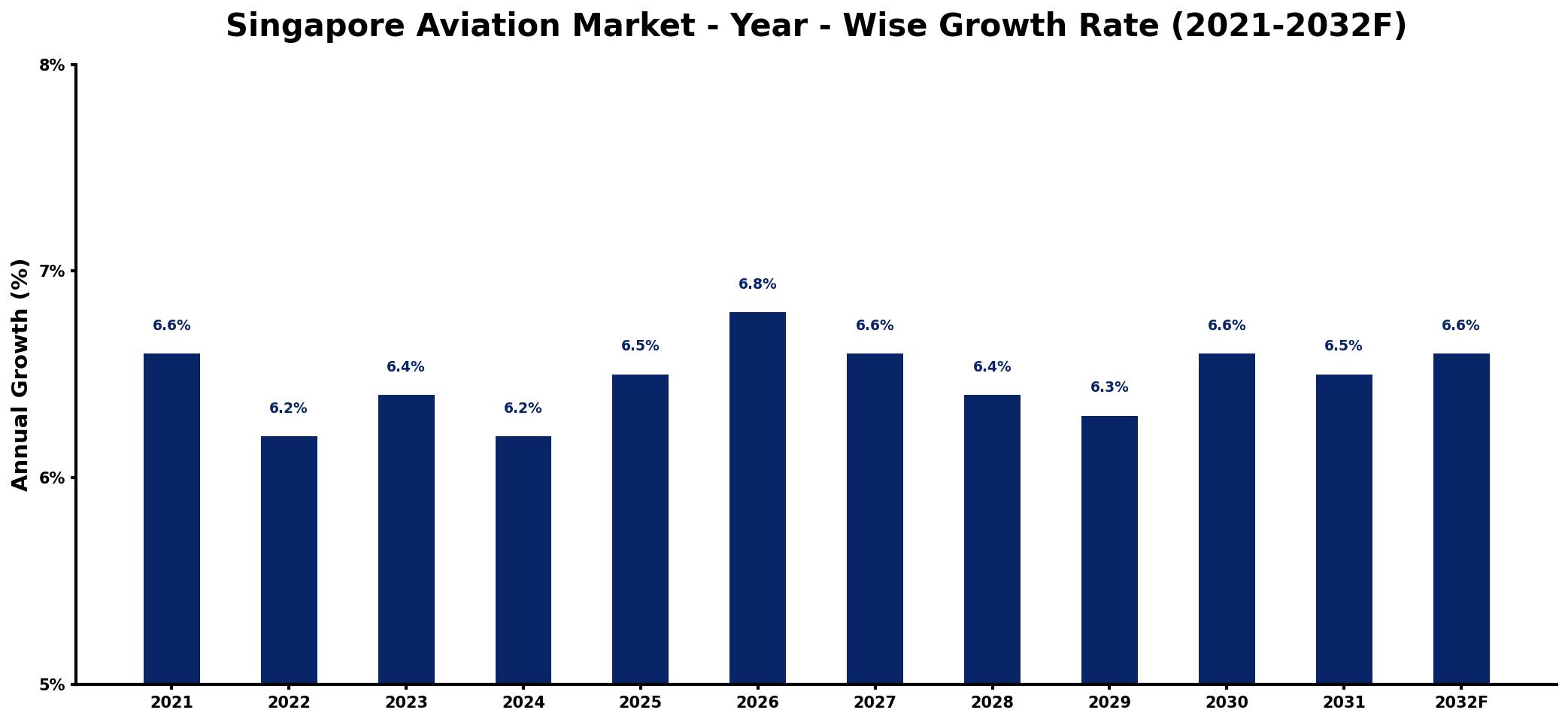
The table below presents the year‑wise growth rates along with the key drivers influencing the market
| Year | Growth Rate | Major Drivers |
| 2021 | 6.6% | Rising travel demand from tourists |
| 2022 | 6.2% | Increased cargo shipping activities |
| 2023 | 6.4% | Expansion of regional airline networks |
| 2024 | 6.2% | Growth in business travel segments |
| 2025 | 6.5% | Investment in airport infrastructure upgrades |
| 2026 | 6.8% | Surge in low-cost carrier options |
| 2027 | 6.6% | Enhancements in customer service experiences |
| 2028 | 6.4% | Emergence of sustainable travel initiatives |
| 2029 | 6.3% | Strengthening of international trade agreements |
| 2030 | 6.6% | Development of new flight routes |
| 2031 | 6.5% | Advancements in air traffic technology |
| 2032 | 6.6% | Rising interest in luxury travel |
Note: Market size estimations and growth projections presented in this report are based on 6Wresearch's proprietary forecasting methodology, utilizing the latest available industry data, government publications, and primary research inputs.
Singapore Aviation Market Synopsis
The aviation industry in Singapore has experienced a notable rebound in recent years, driven by a resurgence in air travel demand post-COVID-19. Looking forward, the market is positioned for sustained growth, as a diverse range of services—from commercial airlines to aerospace manufacturing—continues to thrive. Singapores commitment to enhancing its aviation capabilities further cements its reputation as a vital hub in Southeast Asia.
As the market expands, it faces evolving safety regulations and the pressing need for environmental sustainability. Aviation stakeholders in Singapore are adapting by investing in innovative technologies and sustainable practices that ensure compliance while meeting the growing demand for air travel. This dual focus on growth and responsibility will shape the future of the aviation landscape in Singapore.
Singapore Aviation Market Key Takeaways
- Projected market growth from USD 550 Million in 2025 to USD 801 Million by 2032 reflects robust demand.
- Strategic investments in MRO services are critical for maintaining Singapore's competitive edge.
- Environmental sustainability initiatives are increasingly becoming a priority for aviation stakeholders.
- Post-pandemic recovery strategies are essential for restoring traveler confidence and operational stability.
- Innovative technologies play a pivotal role in addressing evolving safety standards and enhancing service delivery.
Evaluation of Restraints in Singapore Aviation Market
While the Singapore aviation market is poised for growth, it contends with significant restraints that could impede its progress. The industry faces mounting pressure to comply with stringent safety regulations that evolve rapidly in response to new threats and challenges. Additionally, environmental concerns are leading to calls for sustainability practices that may require substantial investment and operational changes. The lingering effects of the COVID-19 pandemic, although diminishing, continue to influence traveler behavior and operational capabilities, necessitating adaptive strategies from all stakeholders involved in the aviation ecosystem.
Singapore Aviation Market Trends
Current trends in the Singapore aviation market reflect a commitment to modernization and efficiency. The integration of digital technologies in operations, such as automation and artificial intelligence, is transforming passenger experiences and operational efficiency. Furthermore, the industry's increasing focus on sustainability, such as the development of sustainable aviation fuels (SAFs), is responding to global environmental concerns. These trends not only enhance the market's appeal but also align with broader global initiatives aimed at reducing the carbon footprint of aviation.
Singapore Aviation Market Opportunities
Opportunities abound in the Singapore aviation market, particularly in sectors such as aircraft maintenance, repair, and overhaul (MRO), where demand is projected to escalate significantly. The rising number of aircraft in operation in Asia-Pacific provides a fertile ground for investment in MRO services, driving technological advancements and operational efficiencies. Additionally, the push for sustainable practices opens avenues for innovation in fuel alternatives and eco-friendly aircraft designs. Stakeholders who seize these opportunities will be well-positioned to capitalize on the evolving market landscape.
Government Initiatives in the Singapore Aviation Market
The Singapore government plays a crucial role in fostering a robust aviation sector through a variety of initiatives. Public investments are focused on enhancing infrastructure, improving airport facilities, and promoting innovation in aviation technologies. Programs aimed at sustainability, such as incentives for the adoption of green technologies, further underline the governments commitment to a sustainable aviation future. These initiatives not only encourage growth but also align with global efforts to bolster the aviation industry's resilience and sustainability.
Future Insights of the Singapore Aviation Market
From 2026 to 2032, the Singapore aviation market is expected to witness transformative changes driven by technological advancements and sustainability initiatives. The implementation of smart technologies will enhance operational efficiencies, while the growth of regional tourism and business travel will contribute significantly to passenger traffic. The market's evolution will hinge on how effectively stakeholders embrace innovation and address environmental challenges, positioning Singapore as a leading aviation hub well into the next decade.
Singapore Aviation Market Latest Developments (2025 - 2026)
Recent developments in the Singapore aviation market indicate a strong recovery trajectory post-COVID-19, with airlines resuming routes and increasing flight frequencies. Investment in technology-driven solutions is becoming more pronounced, as firms prioritize digital transformation to enhance customer experiences. Additionally, initiatives focused on environmental sustainability are gaining traction, with various stakeholders exploring innovative solutions to reduce the carbon footprint associated with aviation operations.
Singapore Aviation Market - Key Attractiveness of the Report
- 10 Years of Market Numbers
- Historical Data Starting from 2022 to 2025
- Base Year: 2025
- Forecast Data until 2032
- Key Performance Indicators Impacting the Market
- Major Upcoming Developments and Projects
Key Highlights of the Report:
- Singapore Aviation Market Outlook
- Market Size of Singapore Aviation Market, 2025
- Forecast of Singapore Aviation Market, 2032
- Historical Data and Forecast of Singapore Aviation Revenues & Volume for the Period 2022-2032F
- Singapore Aviation Market Trend Evolution
- Singapore Aviation Market Drivers and Challenges
- Singapore Aviation Price Trends
- Singapore Aviation Porter's Five Forces
- Singapore Aviation Industry Life Cycle
- Historical Data and Forecast of Singapore Aviation Market Revenues & Volume By Type for the Period 2022-2032F
- Historical Data and Forecast of Singapore Aviation Market Revenues & Volume By Commercial Aviation for the Period 2022-2032F
- Historical Data and Forecast of Singapore Aviation Market Revenues & Volume By Military Aviation for the Period 2022-2032F
- Historical Data and Forecast of Singapore Aviation Market Revenues & Volume By General Aviation for the Period 2022-2032F
- Singapore Aviation Import Export Trade Statistics
- Market Opportunity Assessment By Type
- Singapore Aviation Top Companies Market Share
- Singapore Aviation Competitive Benchmarking By Technical and Operational Parameters
- Singapore Aviation Company Profiles
- Singapore Aviation Key Strategic Recommendations






































