Singapore Cryptocurrency Market Size, Share & Growth Rate
The Singapore Cryptocurrency Market was estimated at USD 440 Million in 2025 and is projected to reach USD 600 Million by 2032, growing at a CAGR of 4.5% from 2026 to 2032. This growth trajectory is driven by increasing acceptance of digital currencies as viable alternatives for investment and payment solutions. Additionally, innovations in blockchain technology are bolstering market confidence, as regulatory frameworks evolve to foster a secure environment for cryptocurrency transactions.
Singapore Cryptocurrency Market Year-wise Growth Rate and Key Drivers
This graph highlights how the Singapore Cryptocurrency Market has steadily grown over the years, supported by major growth factors.
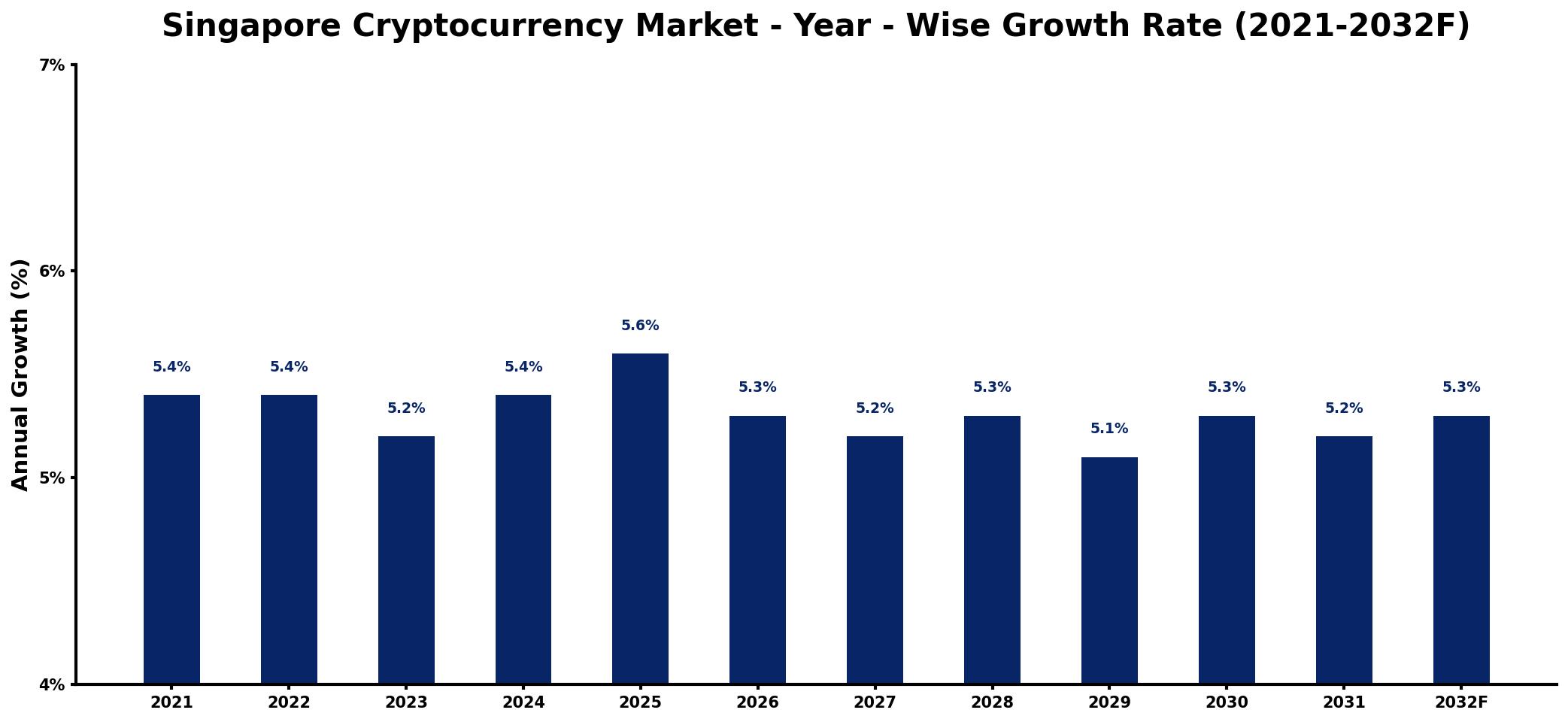
The table below presents the year‑wise growth rates along with the key drivers influencing the market
| Year | Growth Rate | Major Drivers |
| 2021 | 5.4% | Increased institutional investment interest |
| 2022 | 5.4% | Rising retail investor participation |
| 2023 | 5.2% | Growing blockchain technology adoption |
| 2024 | 5.4% | Expansion of regulatory frameworks |
| 2025 | 5.6% | Increased global market accessibility |
| 2026 | 5.3% | Development of innovative financial products |
| 2027 | 5.2% | Enhanced technological infrastructure support |
| 2028 | 5.3% | Growing demand for decentralized finance |
| 2029 | 5.1% | Increased integration with traditional finance |
| 2030 | 5.3% | Strengthening of community engagement initiatives |
| 2031 | 5.2% | growing commercial sector adoption |
| 2032 | 5.3% | Rising interest in sustainable investing |
Note: Market size estimations and growth projections presented in this report are based on 6Wresearch's proprietary forecasting methodology, utilizing the latest available industry data, government publications, and primary research inputs.
Singapore Cryptocurrency Market Synopsis
The regulatory landscape is currently the strongest force shaping the Singapore cryptocurrency market. The governments progressive stance on cryptocurrency adoption has positioned Singapore as a hub for blockchain innovation and investment, attracting both local and international players. This openness to new financial technologies is fostering a vibrant ecosystem where digital assets can thrive.
The COVID-19 pandemic has further catalyzed interest in cryptocurrencies, highlighting their potential as alternative safe-haven assets. This shift in investor sentiment is encouraging more Singaporeans to explore digital currencies like Bitcoin and Ethereum, contributing to the overall growth of the market.
Singapore Cryptocurrency Market Key Takeaways
- Strong regulatory support is fostering a conducive environment for cryptocurrency growth in Singapore.
- Market sentiment is increasingly positive, driven by the adoption of cryptocurrencies as alternative investments.
- Blockchain innovation continues to pave the way for new financial products and services.
- COVID-19 has accelerated the shift towards digital assets, enhancing their appeal among investors.
- The market is expected to grow steadily, with increasing recognition of cryptocurrencies in the financial ecosystem.
Evaluation of Restraints in Singapore Cryptocurrency Market
Despite the promising outlook, the Singapore cryptocurrency market faces certain restraints. Chief among these is the need for stringent regulatory compliance, as shifting regulations can create uncertainty for market participants. Security remains a paramount concern, with ongoing threats of cyberattacks that have the potential to undermine investor confidence. Furthermore, market volatility continues to challenge the stability that potential investors seek, making it crucial for stakeholders to navigate these complexities with diligence and strategic foresight.
Singapore Cryptocurrency Market Trends
A notable trend in the Singapore cryptocurrency market is the increasing integration of blockchain technology across various sectors. As industries recognize the efficiencies and security benefits of decentralization, demand for innovative blockchain applications is rising. Additionally, the entry of institutional investors into the cryptocurrency space signals a maturation of the market, lending it credibility and stability.
Another emerging trend is the growing interest in decentralized finance (DeFi) products, which offer alternatives to traditional financial services. This trend reflects a broader shift towards more democratic and accessible financial solutions, further solidifying the role of cryptocurrencies in the evolving financial landscape.
Singapore Cryptocurrency Market Opportunities
The Singapore cryptocurrency market presents numerous growth opportunities, particularly in the development of regulatory-compliant crypto financial products. As more individuals and institutions seek to diversify their investment portfolios, there is significant potential for cryptocurrency wealth management services and crypto-backed loans. Furthermore, educational initiatives aimed at demystifying cryptocurrencies can enhance adoption rates, positioning Singapore as a leader in cryptocurrency literacy and innovation.
Government Initiatives in the Singapore Cryptocurrency Market
The Singapore government has implemented several initiatives to support the growth of the cryptocurrency market. These include establishing clear regulatory frameworks that provide guidance for businesses and investors. Public spending on technological advancements and infrastructure related to blockchain is also a key focus, aimed at fostering innovation. Additionally, various government-backed programs encourage startups and established firms to engage in blockchain development, enhancing Singapore's reputation as a global fintech hub.
Future Insights of the Singapore Cryptocurrency Market
Looking ahead to 2026-2032, the Singapore cryptocurrency market is expected to continue its upward momentum, propelled by an evolving regulatory landscape that balances innovation with security. As more traditional financial institutions enter the space, the alignment between conventional finance and digital currencies will likely deepen, paving the way for hybrid financial products. With increasing public and private sector collaboration, Singapore is poised to solidify its position as a leader in the global cryptocurrency ecosystem.
Singapore Cryptocurrency Market Latest Developments (2025 - 2026)
Recent developments in the Singapore cryptocurrency market reflect an ongoing commitment to innovation and security. Regulatory bodies are actively refining guidelines to accommodate new technologies, promoting a safer trading environment. Meanwhile, increased collaboration between financial institutions and blockchain startups is fostering the creation of novel solutions designed to enhance the utility and accessibility of cryptocurrencies. The market landscape is evolving rapidly, signaling a robust future for digital assets in Singapore.
Singapore Cryptocurrency Market - Key Attractiveness of the Report
- 10 Years of Market Numbers
- Historical Data Starting from 2022 to 2025
- Base Year: 2025
- Forecast Data until 2032
- Key Performance Indicators Impacting the Market
- Major Upcoming Developments and Projects
Key Highlights of the Report:
- Singapore Cryptocurrency Market Outlook
- Market Size of Singapore Cryptocurrency Market, 2025
- Forecast of Singapore Cryptocurrency Market, 2032
- Historical Data and Forecast of Singapore Cryptocurrency Revenues & Volume for the Period 2022-2032F
- Singapore Cryptocurrency Market Trend Evolution
- Singapore Cryptocurrency Market Drivers and Challenges
- Singapore Cryptocurrency Price Trends
- Singapore Cryptocurrency Porter's Five Forces
- Singapore Cryptocurrency Industry Life Cycle
- Historical Data and Forecast of Singapore Cryptocurrency Market Revenues & Volume By Offering for the Period 2022-2032F
- Historical Data and Forecast of Singapore Cryptocurrency Market Revenues & Volume By Hardware for the Period 2022-2032F
- Historical Data and Forecast of Singapore Cryptocurrency Market Revenues & Volume By ASIC for the Period 2022-2032F
- Historical Data and Forecast of Singapore Cryptocurrency Market Revenues & Volume By Full Custom ASIC for the Period 2022-2032F
- Historical Data and Forecast of Singapore Cryptocurrency Market Revenues & Volume By Semi-custom ASIC for the Period 2022-2032F
- Historical Data and Forecast of Singapore Cryptocurrency Market Revenues & Volume By Programmable ASIC for the Period 2022-2032F
- Historical Data and Forecast of Singapore Cryptocurrency Market Revenues & Volume By GPU for the Period 2022-2032F
- Historical Data and Forecast of Singapore Cryptocurrency Market Revenues & Volume By FPGA for the Period 2022-2032F
- Historical Data and Forecast of Singapore Hardware Cryptocurrency Market Revenues & Volume By Others for the Period 2022-2032F
- Historical Data and Forecast of Singapore Cryptocurrency Market Revenues & Volume By Process for the Period 2022-2032F
- Historical Data and Forecast of Singapore Cryptocurrency Market Revenues & Volume By Mining for the Period 2022-2032F
- Historical Data and Forecast of Singapore Cryptocurrency Market Revenues & Volume By Transaction for the Period 2022-2032F
- Historical Data and Forecast of Singapore Cryptocurrency Market Revenues & Volume By End User for the Period 2022-2032F
- Historical Data and Forecast of Singapore Cryptocurrency Market Revenues & Volume By Trading for the Period 2022-2032F
- Historical Data and Forecast of Singapore Cryptocurrency Market Revenues & Volume By Retail and E-commerce for the Period 2022-2032F
- Historical Data and Forecast of Singapore Cryptocurrency Market Revenues & Volume By Banking for the Period 2022-2032F
- Historical Data and Forecast of Singapore Cryptocurrency Market Revenues & Volume By Others for the Period 2022-2032F
- Historical Data and Forecast of Singapore Cryptocurrency Market Revenues & Volume By Type for the Period 2022-2032F
- Historical Data and Forecast of Singapore Cryptocurrency Market Revenues & Volume By Bitcoin (BTC) for the Period 2022-2032F
- Historical Data and Forecast of Singapore Cryptocurrency Market Revenues & Volume By Ethereum (ETH) for the Period 2022-2032F
- Historical Data and Forecast of Singapore Cryptocurrency Market Revenues & Volume By Tether (USDT) for the Period 2022-2032F
- Historical Data and Forecast of Singapore Cryptocurrency Market Revenues & Volume By Binance Coin (BNB) for the Period 2022-2032F
- Historical Data and Forecast of Singapore Cryptocurrency Market Revenues & Volume By Cardano (ADA) for the Period 2022-2032F
- Historical Data and Forecast of Singapore Cryptocurrency Market Revenues & Volume By Ripple (XRP) for the Period 2022-2032F
- Historical Data and Forecast of Singapore Cryptocurrency Market Revenues & Volume By Others for the Period 2022-2032F
- Singapore Cryptocurrency Import Export Trade Statistics
- Market Opportunity Assessment By Offering
- Market Opportunity Assessment By Process
- Market Opportunity Assessment By End User
- Market Opportunity Assessment By Type
- Singapore Cryptocurrency Top Companies Market Share
- Singapore Cryptocurrency Competitive Benchmarking By Technical and Operational Parameters
- Singapore Cryptocurrency Company Profiles
- Singapore Cryptocurrency Key Strategic Recommendations






































