Singapore Equipment for Telephone Networks Market: Import Trend Analysis
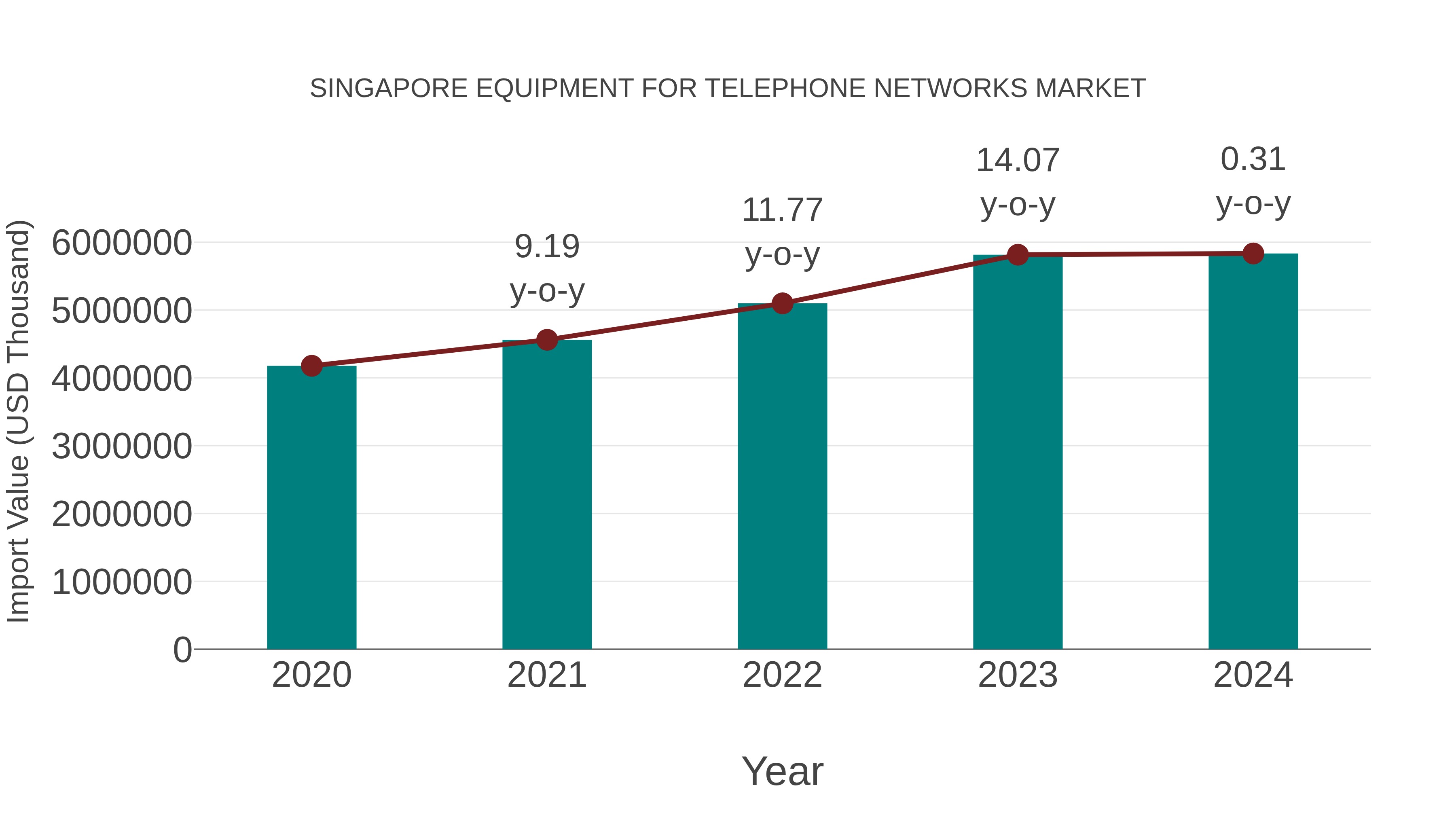
In the Singapore equipment for telephone networks market, the import trend exhibited a growth rate of 0.31% from 2023 to 2024, with a compound annual growth rate (CAGR) of 8.71% for the period 2020-2024. This modest growth could be attributed to stable demand and market maturity in the sector.
Singapore Equipment for Telephone Networks Market Synopsis
Singapore is one of the most advanced and modern nations in the world, with a highly developed telecommunications infrastructure. Due to its strategic location at the heart of Southeast Asia, Singapore has become an important regional hub for companies that provide telecommunication services. As such, there is a growing demand for equipment and products related to telephone networks in Singapore. The market for telephone network equipment in Singapore is expected to grow steadily over the forecast period 2020-2026 due to increasing investments in telecoms infrastructure from both private and public sectors as well as increasing demand for high quality voice and data services from businesses, consumers and other emerging trends such as Internet of Things (IoT).
Market Drivers
The key drivers propelling growth of the telephone networks market in Singapore are rapid urbanization, rising disposable incomes among households boosting growth prospects; government initiatives promoting adoption of latest technologies; increasing number mobile subscribers paired with rising demand for faster data speeds driving investment towards 5G deployments; proliferation of smart devices connected on IoT network creating opportunity for efficient communication solutions; increased adoption digitalization across different industry verticals providing massive opportunities for telecommunication service providers also adding up positively into growth prospects.
Market challenges
Despite strong growth potential offered by this sector some major challenges impeding market???s expansion include high cost associated installation & maintenance telecom infrastructures coupled with stringent regulatory compliances set forth by governing bodies hampering efficiency operations undertaken by leading players operating within this space. Additionally, limited availability spectrum frequency hindering overall broadband speed also impacting revenue contribution earned through these services negatively thereby restraining long term sustainability exhibited by leading participants present within this space.
Key players
Some prominent players operating in Singapore Telephone Networks Market are Ericsson AB (Sweden), Nokia Corporation (Finland), Huawei Technologies.
Covid-19 Impact
The COVID-19 pandemic has created shock waves throughout global economy resulting shutdown multiple industries including building & construction sector resulting disruption production activities taking place within markets worldwide which further resulted negative impact development projects involving creation new telecom infrastructure thus adversely affecting overall performance witnessed across phone networks equipment sales during midst pandemic outbreak taking place globally.However post lockdown scenario projected witness considerable rise order flow considering higher level work being carried out enable remote working facilities amongst employees working corporate organisations thereby supplementing overall revenue contribution generated through sale phone networking equipments likely promote healthy growth trajectory being observed during foreseeable future time frame.
Key Highlights of the Report:
- Singapore Equipment for Telephone Networks Market Outlook
- Market Size of Singapore Equipment for Telephone Networks Market, 2023
- Forecast of Singapore Equipment for Telephone Networks Market, 2030
- Historical Data and Forecast of Singapore Equipment for Telephone Networks Revenues & Volume for the Period 2020-2030
- Singapore Equipment for Telephone Networks Market Trend Evolution
- Singapore Equipment for Telephone Networks Market Drivers and Challenges
- Singapore Equipment for Telephone Networks Price Trends
- Singapore Equipment for Telephone Networks Porter's Five Forces
- Singapore Equipment for Telephone Networks Industry Life Cycle
- Historical Data and Forecast of Singapore Equipment for Telephone Networks Market Revenues & Volume By Infrastructure for the Period 2020-2030
- Historical Data and Forecast of Singapore Equipment for Telephone Networks Market Revenues & Volume By Wire for the Period 2020-2030
- Historical Data and Forecast of Singapore Equipment for Telephone Networks Market Revenues & Volume By Wireless for the Period 2020-2030
- Historical Data and Forecast of Singapore Equipment for Telephone Networks Market Revenues & Volume By Offerings for the Period 2020-2030
- Historical Data and Forecast of Singapore Equipment for Telephone Networks Market Revenues & Volume By Product for the Period 2020-2030
- Historical Data and Forecast of Singapore Equipment for Telephone Networks Market Revenues & Volume By Software for the Period 2020-2030
- Historical Data and Forecast of Singapore Equipment for Telephone Networks Market Revenues & Volume By Services for the Period 2020-2030
- Historical Data and Forecast of Singapore Equipment for Telephone Networks Market Revenues & Volume By End-users for the Period 2020-2030
- Historical Data and Forecast of Singapore Equipment for Telephone Networks Market Revenues & Volume By Consumer Electronics for the Period 2020-2030
- Historical Data and Forecast of Singapore Equipment for Telephone Networks Market Revenues & Volume By Bfsi for the Period 2020-2030
- Historical Data and Forecast of Singapore Equipment for Telephone Networks Market Revenues & Volume By Retail for the Period 2020-2030
- Historical Data and Forecast of Singapore Equipment for Telephone Networks Market Revenues & Volume By Media for the Period 2020-2030
- Historical Data and Forecast of Singapore Equipment for Telephone Networks Market Revenues & Volume By Defense for the Period 2020-2030
- Historical Data and Forecast of Singapore Equipment for Telephone Networks Market Revenues & Volume By Others for the Period 2020-2030
- Singapore Equipment for Telephone Networks Import Export Trade Statistics
- Market Opportunity Assessment By Infrastructure
- Market Opportunity Assessment By Offerings
- Market Opportunity Assessment By End-users
- Singapore Equipment for Telephone Networks Top Companies Market Share
- Singapore Equipment for Telephone Networks Competitive Benchmarking By Technical and Operational Parameters
- Singapore Equipment for Telephone Networks Company Profiles
- Singapore Equipment for Telephone Networks Key Strategic Recommendations






































