Singapore Fennel Seeds Market Size, Share & Growth Rate
The Singapore Fennel Seeds Market was estimated at USD 226 Million in 2025 and is projected to reach USD 317 Million by 2032, growing at a CAGR of 5.0% from 2026 to 2032. This growth trajectory is supported by the increasing incorporation of fennel seeds into both traditional and contemporary culinary practices. As awareness of their health benefits, particularly in digestion and herbal remedies, expands, more consumers are expected to integrate fennel seeds into their diets.
Singapore Fennel Seeds Market Growth Rate Analysis (2021-2032)
The Singapore fennel seeds market has exhibited stable growth, recording a 5.9% increase in 2021 and slightly moderating to 5.5% in 2022, largely due to supply chain challenges. However, demand rebounded in 2023, achieving 5.8% growth as culinary trends leaned towards natural flavors. Projections indicate a consistent upward trend, with a robust 6.1% expected in both 2024 and 2025, driven by rising consumer awareness of health benefits. Despite a slight dip to 5.5% in 2026, the market is anticipated to stabilize around 5.8% through 2031, underscored by ongoing investments in digital marketing and enhanced distribution infrastructures. These dynamics reflect a strong commitment to meeting consumer demand while adapting to evolving culinary preferences.
Singapore Fennel Seeds Market Year-wise Growth Rate and Key Drivers
This graph highlights how the Singapore Fennel Seeds Market has steadily grown over the past five years, supported by major growth factors.
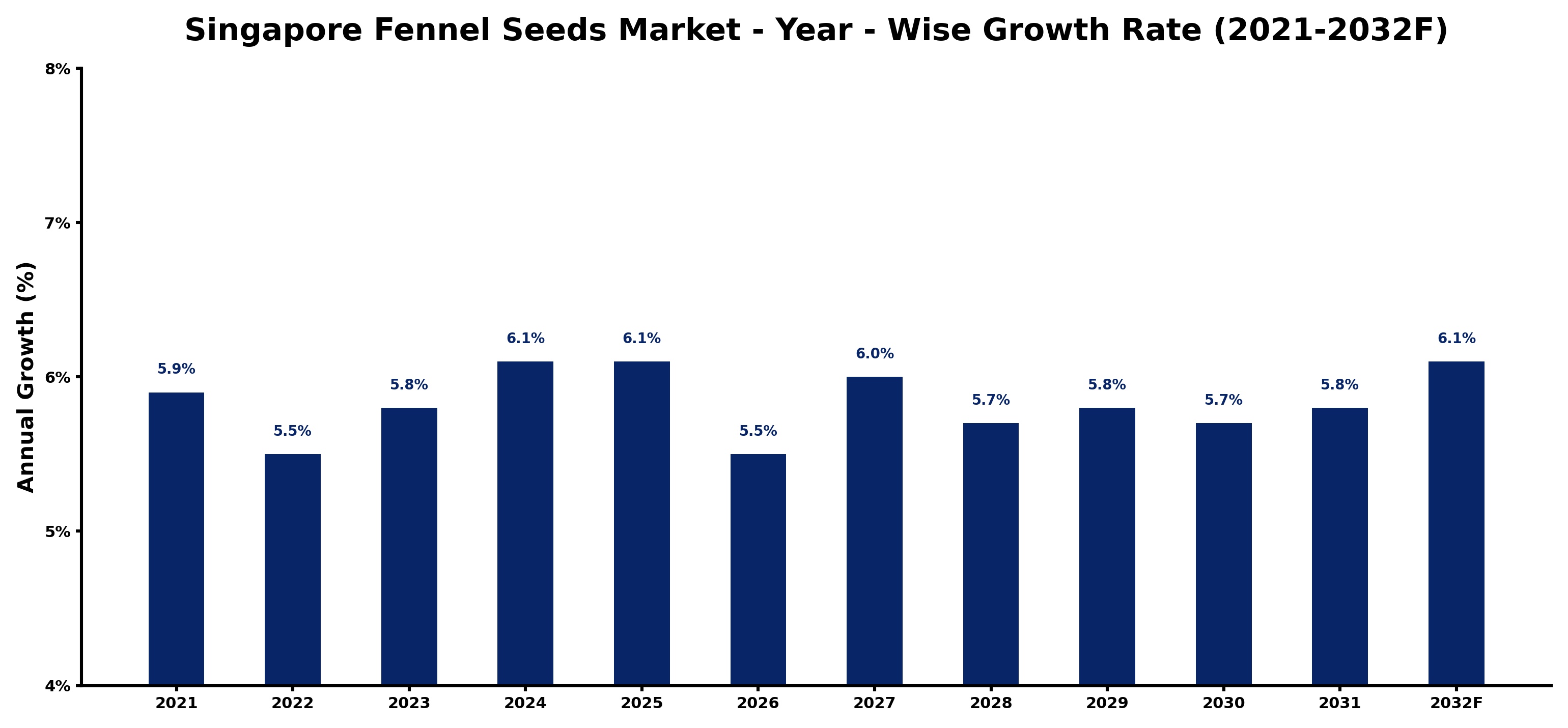
The table below presents the year‑wise growth rates along with the key drivers influencing the market
| Year | Growth Rate | Major Drivers |
| 2021 | 5.9% | Health benefits gained consumer attention |
| 2022 | 5.5% | Culinary trends embraced fennel seeds |
| 2023 | 5.8% | Organic product demand increased significantly |
| 2024 | 6.1% | E-commerce platforms expanded reach |
| 2025 | 6.1% | Culinary education promoted usage |
| 2026 | 5.5% | Local sourcing initiatives gained popularity |
| 2027 | 6.0% | Cultural cuisine integration enhanced demand |
| 2028 | 5.7% | Sustainability practices attracted consumers |
| 2029 | 5.8% | Innovative packaging improved shelf appeal |
| 2030 | 5.7% | Wellness trends drove product interest |
| 2031 | 5.8% | Food bloggers influenced purchasing decisions |
| 2032 | 6.1% | Culinary festivals showcased fennel seeds |
Note - Market size estimations and growth projections presented in this report are based on 6Wresearch's advanced forecasting approach, validated with industry datasets as of June 2026.
Singapore Fennel Seeds Market Synopsis
In Singapore, fennel seeds play a crucial role in various recipes, particularly in enhancing the flavor of soups, curries, and biryanis. The spice's unique aroma and taste have made it a staple in local cuisine, appealing to both home cooks and the foodservice sector alike. Furthermore, as Singaporeans increasingly seek natural ingredients, fennel seeds are gaining recognition for their potential health benefits.
While fennel seeds enjoy consistent demand, their market presence is still limited compared to more commonly used spices. Education about their culinary versatility and health properties is essential for fostering greater consumer acceptance and usage. The ongoing exploration of innovative products containing fennel seeds also hints at future growth avenues.
Singapore Fennel Seeds Market Key Takeaways
- The market is positioned for steady growth, influenced by an increasing demand for health-conscious culinary ingredients.
- Fennel seeds are recognized for their digestive health benefits, enhancing their appeal in wellness-focused consumer segments.
- Ongoing consumer education will be pivotal in expanding the use of fennel seeds beyond niche culinary applications.
- Emerging trends in plant-based diets are likely to create new opportunities for fennel seed applications in various food products.
- Local spice shops remain integral to the distribution of fennel seeds, catering to diverse culinary traditions.
Evaluation of Restraints in Singapore Fennel Seeds Market
Despite the promising growth of the Singapore fennel seeds market, there are notable constraints that may hinder its expansion. A significant challenge lies in the limited consumer awareness regarding the unique flavor profile and culinary applications of fennel seeds. Many Singaporeans still view these seeds as a niche ingredient, leading to underutilization. Businesses must proactively promote the versatility of fennel seeds through targeted marketing strategies and culinary education to mitigate these restraints.
Singapore Fennel Seeds Market Trends
Current trends indicate a growing popularity of fennel seeds, particularly among health-conscious consumers. The rise of herbal and natural ingredients in daily diets is fostering an environment where fennel seeds are increasingly incorporated into recipes beyond traditional uses. Furthermore, the trend towards plant-based diets is opening doors for innovative products featuring fennel seeds, as they align well with the clean-eating movement.
Singapore Fennel Seeds Market Opportunities
The Singapore fennel seeds market presents several lucrative opportunities for businesses willing to invest in education and marketing. By highlighting the health benefits of fennel seeds, companies can attract wellness-focused consumers. Additionally, the exploration of new product formats—such as fennel-infused oils or snack items—can capture the interest of a broader audience. Collaborations with local chefs and food influencers may further enhance visibility and acceptance in the culinary landscape.
Government Initiatives in the Singapore Fennel Seeds Market
The Singapore government has shown a commitment to promoting local agriculture and supporting the food sector, which indirectly benefits the fennel seeds market. Through various initiatives focused on enhancing food security and encouraging the use of natural and healthy ingredients, the government is fostering an environment conducive to the growth of the spice market. Programs aimed at educating consumers about traditional herbs and spices are also contributing to increased interest in fennel seeds.
Future Insights of the Singapore Fennel Seeds Market
Looking ahead, the Singapore fennel seeds market is poised for continued growth from 2026 to 2032. As consumer preferences shift towards more holistic health approaches, the interest in spices like fennel is likely to rise. With strategic marketing and an emphasis on education, businesses can capitalize on this momentum, ensuring that fennel seeds become a more recognized and utilized ingredient in both home cooking and professional kitchens.
Singapore Fennel Seeds Market Latest Developments (May 2025 - June 2026)
In recent months, the Singapore fennel seeds market has seen a gradual recovery following the disruptions caused by the COVID-19 pandemic. Companies have focused on streamlining supply chains to ensure consistent availability of fennel seeds. Additionally, there have been increased marketing efforts aimed at educating consumers about the culinary versatility and health benefits of fennel, paving the way for potential new product launches that cater to evolving dietary trends.
Singapore Fennel Seeds Market - Key Attractiveness of the Report
- 10 Years of Market Numbers
- Historical Data Starting from 2022 to 2025
- Base Year: 2025
- Forecast Data until 2032
- Key Performance Indicators Impacting the Market
- Major Upcoming Developments and Projects
Key Highlights of the Report:
- Singapore Fennel Seeds Market Outlook
- Market Size of Singapore Fennel Seeds Market, 2025
- Forecast of Singapore Fennel Seeds Market, 2032F
- Historical Data and Forecast of Singapore Fennel Seeds Revenues & Volume for the Period 2022-2032F
- Singapore Fennel Seeds Market Trend Evolution
- Singapore Fennel Seeds Market Drivers and Challenges
- Singapore Fennel Seeds Price Trends
- Singapore Fennel Seeds Porter's Five Forces
- Singapore Fennel Seeds Industry Life Cycle
- Historical Data and Forecast of Singapore Fennel Seeds Market Revenues & Volume By Types for the Period 2022-2032F
- Historical Data and Forecast of Singapore Fennel Seeds Market Revenues & Volume By Organic for the Period 2022-2032F
- Historical Data and Forecast of Singapore Fennel Seeds Market Revenues & Volume By Conventional for the Period 2022-2032F
- Historical Data and Forecast of Singapore Fennel Seeds Market Revenues & Volume By Application for the Period 2022-2032F
- Historical Data and Forecast of Singapore Fennel Seeds Market Revenues & Volume By Essential for the Period 2022-2032F
- Historical Data and Forecast of Singapore Fennel Seeds Market Revenues & Volume By Flavors for the Period 2022-2032F
- Historical Data and Forecast of Singapore Fennel Seeds Market Revenues & Volume By Seasoning Ingredient for the Period 2022-2032F
- Historical Data and Forecast of Singapore Fennel Seeds Market Revenues & Volume By Beverages for the Period 2022-2032F
- Historical Data and Forecast of Singapore Fennel Seeds Market Revenues & Volume By End-user for the Period 2022-2032F
- Historical Data and Forecast of Singapore Fennel Seeds Market Revenues & Volume By Households for the Period 2022-2032F
- Historical Data and Forecast of Singapore Fennel Seeds Market Revenues & Volume By Food Industry for the Period 2022-2032F
- Historical Data and Forecast of Singapore Fennel Seeds Market Revenues & Volume By Personal Care Industry for the Period 2022-2032F
- Singapore Fennel Seeds Import Export Trade Statistics
- Market Opportunity Assessment By Types
- Market Opportunity Assessment By Application
- Market Opportunity Assessment By End-user
- Singapore Fennel Seeds Top Companies Market Share
- Singapore Fennel Seeds Competitive Benchmarking By Technical and Operational Parameters
- Singapore Fennel Seeds Company Profiles
- Singapore Fennel Seeds Key Strategic Recommendations






































