Singapore Fruit Market: Import Trend Analysis
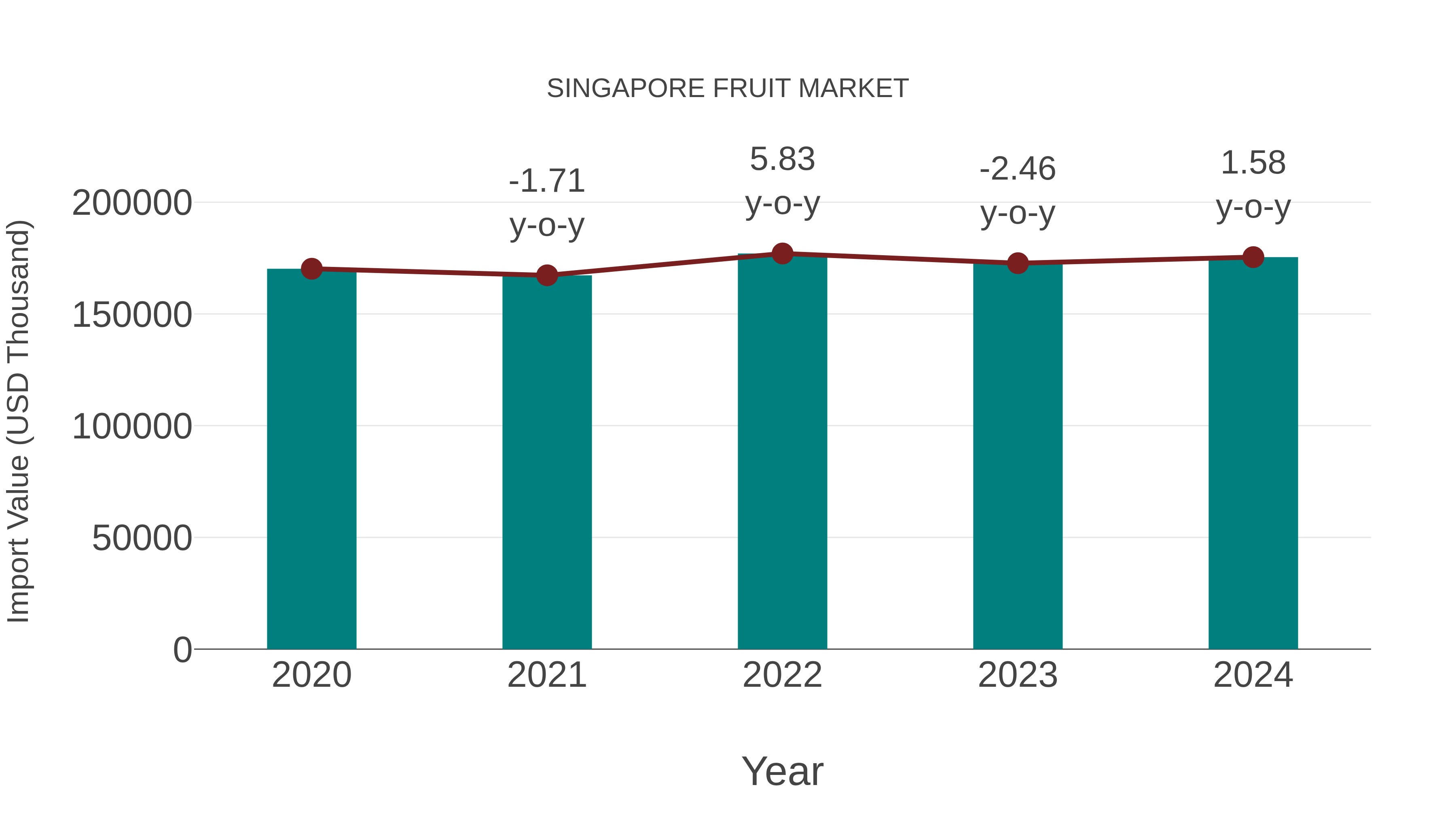
Singapore`s import trend for the fruit market saw a growth rate of 1.58% from 2023 to 2024, with a compound annual growth rate (CAGR) of 0.76% from 2020 to 2024. This indicates a steady but moderate increase in import momentum, likely driven by evolving consumer preferences or stabilized market conditions.
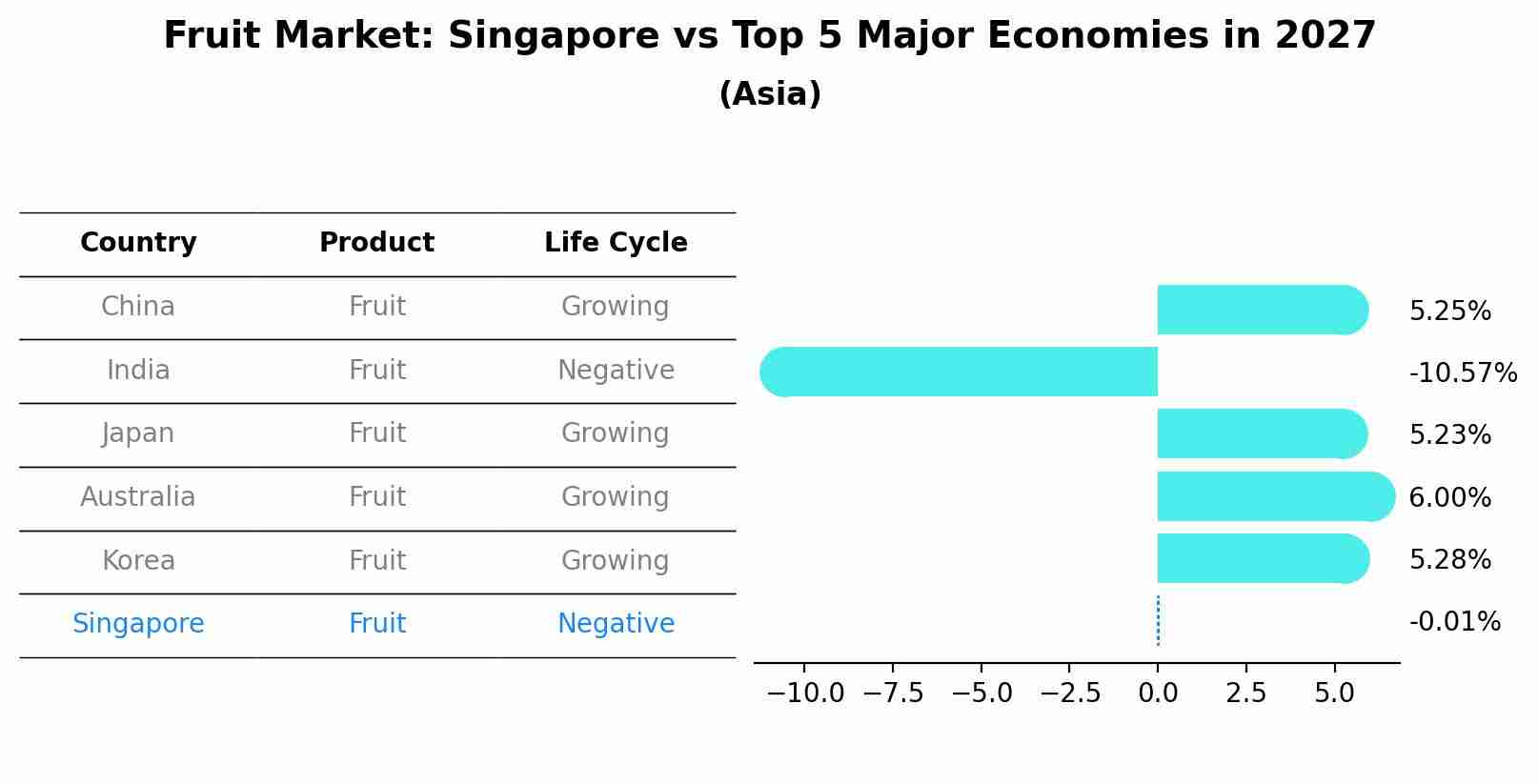
Fruit Market: Singapore vs Top 5 Major Economies in 2027 (Asia)
The Fruit market in Singapore is projected to grow at a negative growth rate of -0.01% by 2027, highlighting the country's increasing focus on advanced technologies within the Asia region, where China holds the dominant position, followed closely by India, Japan, Australia and South Korea, shaping overall regional demand.
Singapore Fruit Market Synopsis
The Singapore Fruit Market is a major hub for the production and distribution of fruits across Southeast Asia. The market has seen steady growth over recent years, with an estimated value of US$2 billion in 2020. It is one of the most important fruit markets in the region, supplying to countries such as China, India, Thailand, Indonesia and Malaysia. The market consists of local farmers as well as importers and exporters from all across the world.
Market Drivers
Growing population - A rising population in Singapore means that more people are demanding fresh produce from this region to meet their dietary requirements. This has led to increased demand for food products which have helped drive up profits for suppliers in this industry.Ease of access - With improved transportation links between Singapore and its regional neighbors, it has become easier for producers and traders alike to access the market quickly and efficiently at competitive prices.
Market challenges
Seasonal fluctuation ??? Fruits have seasonal availability due to varying climatic conditions; therefore supply can be unpredictable at times resulting in higher costs or lower quality products being available on certain occasions throughout the year.Price competition ??? There are numerous competitors within this sector who offer similar products at cheaper prices leading some players to reduce their own margins further or switch out costlier items on their product range altogether.
Key players
Major players operating in this sector include local farms, retailers, wholesalers & supermarkets like Sheng Shiong Supermarket Group, NTUC Fairprice Co-operative Ltd & Dairy Farm International Holdings among others who along with smaller vendors contribute significantly towards maintaining healthy trade dynamics within Singapore fruit market.
Covid-19 Impact
The Covid-19 pandemic had a significant impact on the Singapore Fruit Market by disrupting supply chains around Asia Pacific region due to travel restrictions imposed by various governments during lockdown periods.This resulted into reduced orders for imports/exports , falling sales volumes & decreased profit margins thus negatively impacting many stakeholders involved directly or indirectly with this industry.
Key Highlights of the Report:
- Singapore Fruit Market Outlook
- Market Size of Singapore Fruit Market, 2023
- Forecast of Singapore Fruit Market, 2030
- Historical Data and Forecast of Singapore Fruit Revenues & Volume for the Period 2020-2030
- Singapore Fruit Market Trend Evolution
- Singapore Fruit Market Drivers and Challenges
- Singapore Fruit Price Trends
- Singapore Fruit Porter's Five Forces
- Singapore Fruit Industry Life Cycle
- Historical Data and Forecast of Singapore Fruit Market Revenues & Volume By Applications for the Period 2020-2030
- Historical Data and Forecast of Singapore Fruit Market Revenues & Volume By Supermarkets and Hypermarkets for the Period 2020-2030
- Historical Data and Forecast of Singapore Fruit Market Revenues & Volume By Specialty Stores for the Period 2020-2030
- Historical Data and Forecast of Singapore Fruit Market Revenues & Volume By Online for the Period 2020-2030
- Historical Data and Forecast of Singapore Fruit Market Revenues & Volume By Type for the Period 2020-2030
- Historical Data and Forecast of Singapore Fruit Market Revenues & Volume By Fresh for the Period 2020-2030
- Historical Data and Forecast of Singapore Fruit Market Revenues & Volume By Dried for the Period 2020-2030
- Historical Data and Forecast of Singapore Fruit Market Revenues & Volume By Frozen for the Period 2020-2030
- Historical Data and Forecast of Singapore Fruit Market Revenues & Volume By Others for the Period 2020-2030
- Singapore Fruit Import Export Trade Statistics
- Market Opportunity Assessment By Applications
- Market Opportunity Assessment By Type
- Singapore Fruit Top Companies Market Share
- Singapore Fruit Competitive Benchmarking By Technical and Operational Parameters
- Singapore Fruit Company Profiles
- Singapore Fruit Key Strategic Recommendations






































