Singapore Household Furniture Market: Import Trend Analysis
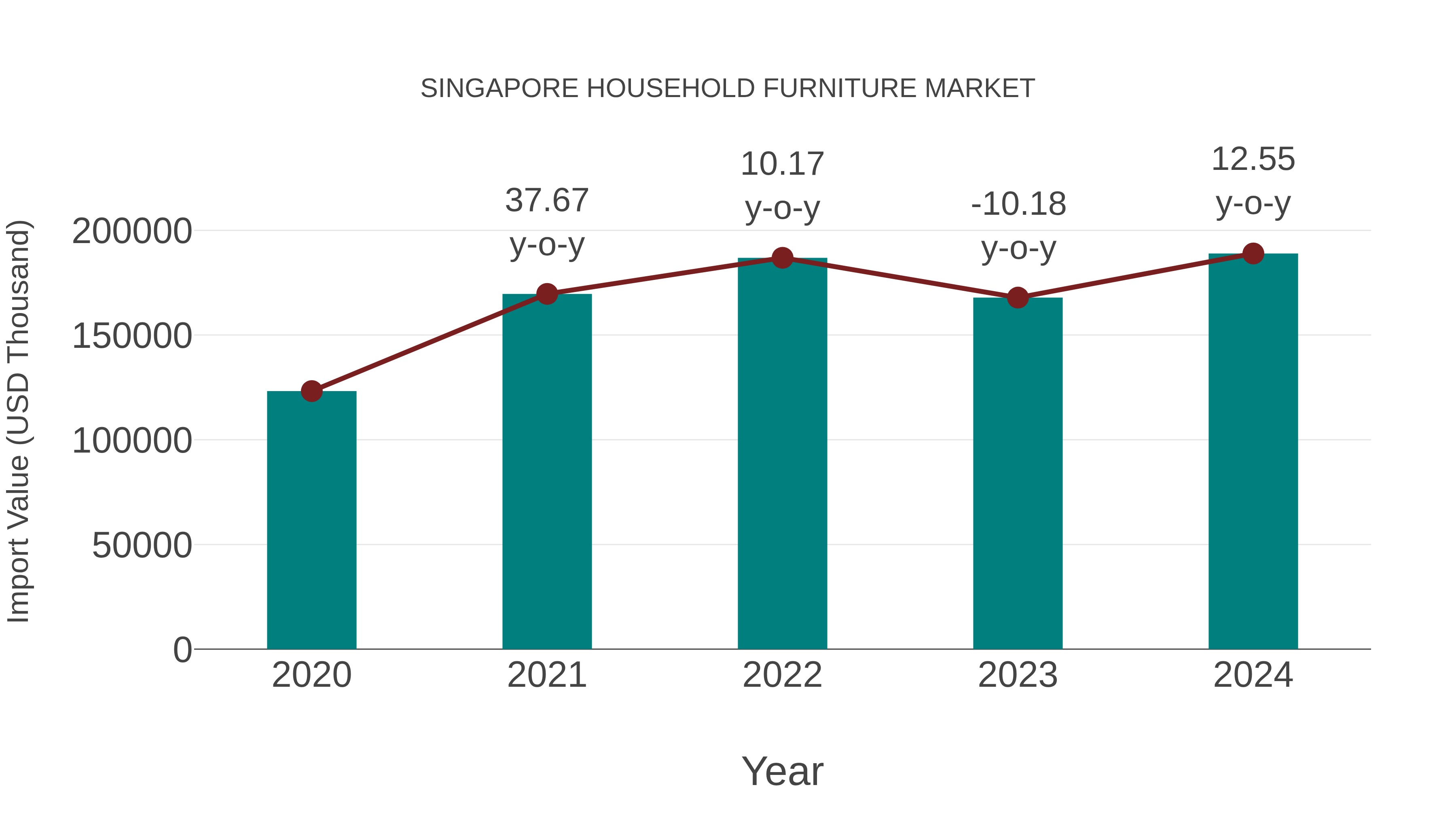
In the Singapore household furniture market, the import trend exhibited significant growth from 2023 to 2024, with a growth rate of 12.55%. The compound annual growth rate (CAGR) for imports from 2020 to 2024 stood at 11.28%. This uptick in import momentum can be attributed to shifting consumer preferences towards high-quality imported furniture offerings, indicating a potential demand shift towards more diverse and premium product ranges in the market.
Singapore Household furniture Market Synopsis
The Singapore furniture market is expected to witness the significant growth during 2020-2026 owing to increasing demand from residential and hospitality sectors. Increasing disposable income, rapid urbanization, rising trend of nuclear families and growing technologies are some of the major drivers for the market growth in Singapore. Moreover, people preference towards modern designs and styles in furniture is further boosting the market growth. However, high cost associated with customised products as well as availability of substitutes may hamper the furniture market growth during forecast period.
Market Drivers
Growing middle-class population & Rising Disposable Income.Rapid Urbanization & Increasing Demand From Hospitality Sector.Growing Technologies In Furniture Industry Rising Trend Of Nuclear Families.
Market challenges
High Cost Associated With Customized Products.Availability Of Substitutes Such As Second Hand Furniture.Strict Government Regulations On Raw Material Usage.
Key players
Some key players operating in Singapore Household Furniture Market include IKEA (Sweden), Ashley Homestore (US), French Connection Group Plc (UK), King Koil Asia Pacific.
Covid-19 Impact
The Covid-19 pandemic has had a mixed impact on the Singapore household furniture industry. Due to restrictions imposed by social distancing guidelines and lockdowns resulting from government regulations meant to contain the spread of Covid-19, production levels have been reduced significantly throughout 2020 leading to depressed sales figures across most companies in this sector. Further consumer sentiment has also been adversely affected due to economic uncertainty making them more hesitant when it comes to spending money buying new items such as furniture or appliances that are deemed nonessential or discretionary purchases at this time. Despite these challenges however there has also been an increase in demand for certain types of home office/ study related products due largely because many individuals must now work remotely while under lockdown restrictions which means they require adequate workspace setups at home if they are able be productive while isolated indoors along with other factors like increased online shopping activity driven by ecommerce platforms providing stay at home delivery services ETC Overall it is expected that despite a short term dip caused by disruptions stemming from Covid - 19 infections rates remaining relatively low overall compared globally speaking should result in a bounce back within this sector over medium term outlooks going into 2021 onwards provided no second wave breaks out again causing renewed lockdown measures impacting supply chains ETC
Key Highlights of the Report:
- Singapore Household furniture Market Outlook
- Market Size of Singapore Household furniture Market, 2023
- Forecast of Singapore Household furniture Market, 2030
- Historical Data and Forecast of Singapore Household furniture Revenues & Volume for the Period 2020-2030
- Singapore Household furniture Market Trend Evolution
- Singapore Household furniture Market Drivers and Challenges
- Singapore Household furniture Price Trends
- Singapore Household furniture Porter's Five Forces
- Singapore Household furniture Industry Life Cycle
- Historical Data and Forecast of Singapore Household furniture Market Revenues & Volume By Types for the Period 2020-2030
- Historical Data and Forecast of Singapore Household furniture Market Revenues & Volume By Wood Furniture for the Period 2020-2030
- Historical Data and Forecast of Singapore Household furniture Market Revenues & Volume By Metal Furniture for the Period 2020-2030
- Historical Data and Forecast of Singapore Household furniture Market Revenues & Volume By Plastic Furniture for the Period 2020-2030
- Historical Data and Forecast of Singapore Household furniture Market Revenues & Volume By Others for the Period 2020-2030
- Historical Data and Forecast of Singapore Household furniture Market Revenues & Volume By Area of Use for the Period 2020-2030
- Historical Data and Forecast of Singapore Household furniture Market Revenues & Volume By ?Bedroom Furniture for the Period 2020-2030
- Historical Data and Forecast of Singapore Household furniture Market Revenues & Volume By Living Room Furniture for the Period 2020-2030
- Historical Data and Forecast of Singapore Household furniture Market Revenues & Volume By Dining Room Furniture for the Period 2020-2030
- Historical Data and Forecast of Singapore Household furniture Market Revenues & Volume By Household Furniture for the Period 2020-2030
- Historical Data and Forecast of Singapore Household furniture Market Revenues & Volume By Others for the Period 2020-2030
- Singapore Household furniture Import Export Trade Statistics
- Market Opportunity Assessment By Types
- Market Opportunity Assessment By Area of Use
- Singapore Household furniture Top Companies Market Share
- Singapore Household furniture Competitive Benchmarking By Technical and Operational Parameters
- Singapore Household furniture Company Profiles
- Singapore Household furniture Key Strategic Recommendations






































