Singapore HR Analytics Market Size & Growth Rate (2026-2032)
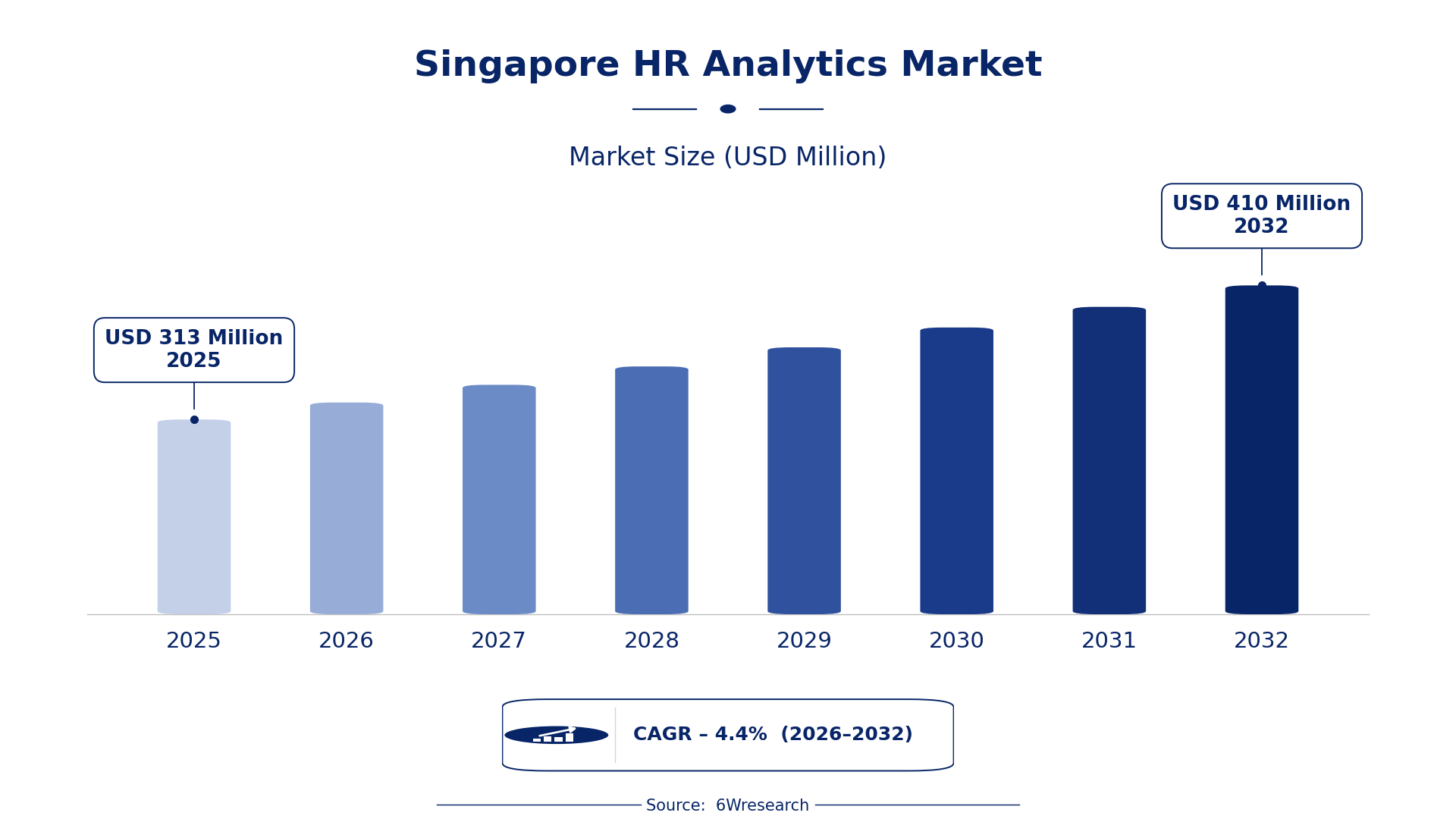
The Singapore HR Analytics Market was estimated at USD 313 Million in 2025 and is projected to reach USD 410 Million by 2032, growing at a CAGR of 4.4% from 2026 to 2032.
Singapore HR Analytics Market Synopsis
The demand for data-driven HR solutions is fundamentally reshaping the Singapore HR Analytics Market. Organizations are increasingly recognizing the importance of utilizing analytics to enhance workforce management and employee engagement, translating data into actionable insights.
As remote work becomes a fixture in the business environment, the need for advanced HR analytics tools has surged. Companies are leveraging these solutions not only for talent acquisition and retention but also for understanding employee performance and well-being, which is crucial in the current competitive market.
Singapore HR Analytics Market Year-wise Growth Rate and Key Drivers
This graph illustrates the annual growth rates of the Singapore HR Analytics Market from 2021 to 2032, highlighting a steady upward trajectory and projected expansion over the forecast period.
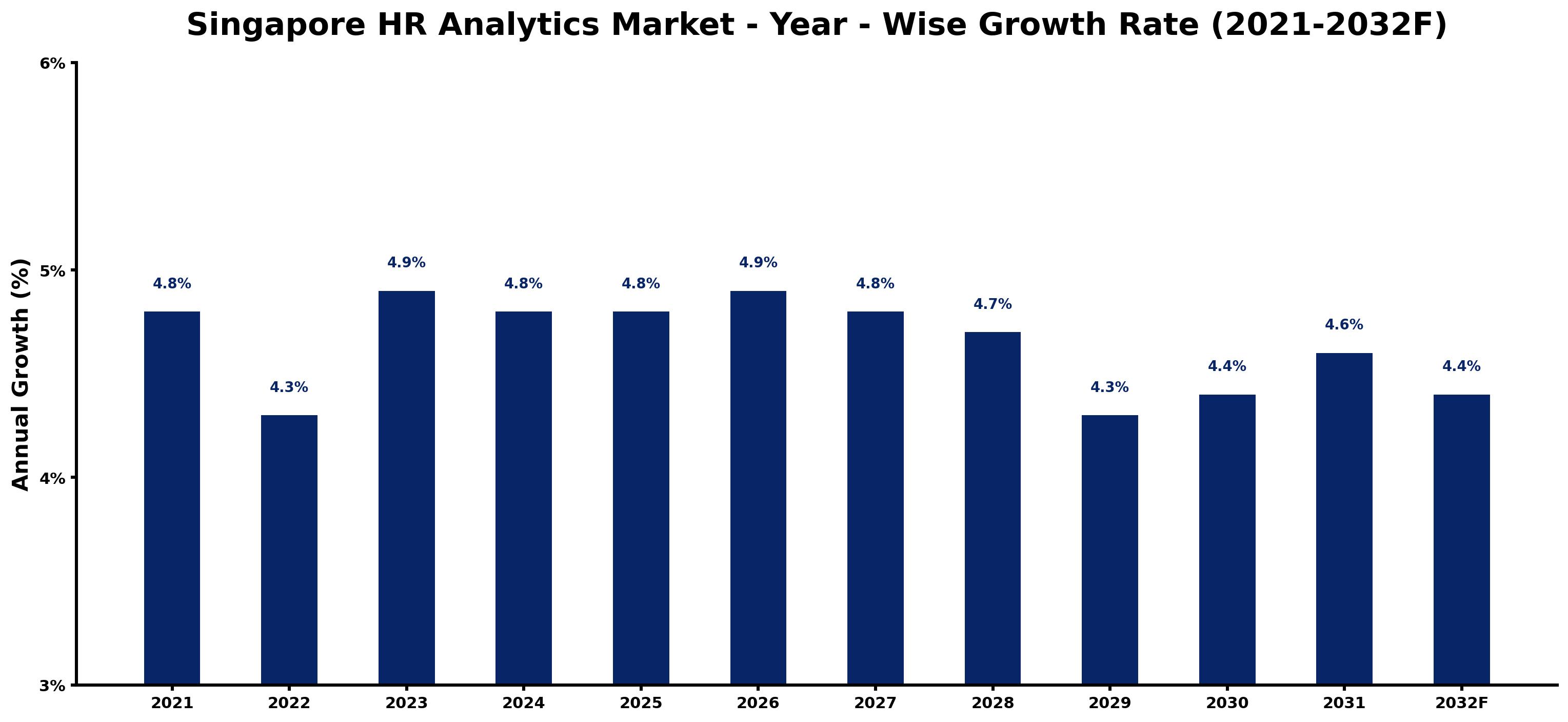
The table below presents the year‑wise growth rates along with the key drivers influencing the market
| Year | Growth Rate | Major Drivers |
| 2021 | 4.8% | Growing workforce analytics adoption among Singaporean SMEs. |
| 2022 | 4.3% | Government push for digital transformation in HR practices. |
| 2023 | 4.9% | Increased demand for talent analytics post-COVID recovery. |
| 2024 | 4.8% | Rising need for employee engagement solutions in startups. |
| 2025 | 4.8% | Emerging focus on data-driven decision making in HR. |
| 2026 | 4.9% | Supportive policies from Ministry of Manpower for HR tech. |
| 2027 | 4.8% | Upsurge in remote work analytics tools usage. |
| 2028 | 4.7% | Integration of AI in HR analytics solutions. |
| 2029 | 4.3% | Local universities enhancing HR analytics curriculum offerings. |
| 2030 | 4.4% | Corporate emphasis on diversity analytics for workforce planning. |
| 2031 | 4.6% | Investment in predictive analytics among large enterprises. |
| 2032 | 4.4% | Increased compliance requirements for workforce data management. |
Note: Market size estimations and growth projections presented in this report are based on 6Wresearch's proprietary forecasting methodology, utilizing the latest available industry data, government publications, and primary research inputs.
Singapore HR Analytics Market Key Takeaways
Below are some of the specific key takeaways from the market, including:
- Data-driven decision-making is becoming essential for effective HR management in Singapore.
- Increased remote work is driving demand for robust analytics tools to manage workforce dynamics.
- Organizations are prioritizing employee engagement and satisfaction through enhanced analytics.
- Challenges around data accuracy and ethical considerations are pressing issues in the market.
- Major technology providers are shaping the market with innovative HR analytics solutions.
Evaluation of Restraints in Singapore HR Analytics Market
While the Singapore HR Analytics Market is growing, several restraints hinder its full potential. One of the primary challenges is the complexity involved in analyzing and interpreting workforce data. Organizations often grapple with ensuring the accuracy and quality of their data. Decisions based on flawed analytics can lead to adverse effects on overall performance.
on top of that, the tension between harnessing data for strategic HR practices and maintaining employee privacy remains an ongoing concern. Companies must navigate these ethical dilemmas while striving to implement effective analytics solutions.
Singapore HR Analytics Market Trends
Several trends are shaping the Singapore HR Analytics Market. The integration of artificial intelligence (AI) in HR analytics is becoming more prevalent, allowing for predictive insights that drive better talent management. Organizations are also shifting towards employee-centric approaches, prioritizing well-being and engagement metrics.
Cloud-based HR analytics solutions are gaining traction, providing flexibility and scalability for businesses of all sizes. This shift is particularly relevant for companies adapting to hybrid work environments, as it offers real-time data access and enhanced collaboration capabilities.
Singapore HR Analytics Market Opportunities
The future of the Singapore HR Analytics Market is ripe with opportunities. Companies are increasingly seeking innovative solutions that can provide deeper insights into workforce behavior and performance. There's a notable demand for platforms that offer seamless integration with existing HR systems, allowing for a comprehensive view of employee data.
Additionally, there is potential for growth in specialized analytics that focus on niche areas such as diversity and inclusion metrics, which are becoming focal points for organizations striving for a more equitable workplace.
Government Initiatives in the Singapore HR Analytics Market
The Singapore government has been proactive in fostering a favorable environment for HR analytics through various policies and initiatives. Recognizing the importance of data-driven HR practices, public-sector priorities emphasize digital transformation and workforce innovation. Such initiatives are crucial for enhancing productivity and maintaining Singapore's competitive edge in the global market.
- A recently completed initiative focused on creating a national framework for data governance, enhancing the quality and security of workforce data.
- A current program aimed at incentivizing companies to adopt digital HR solutions is underway, providing financial support for technology investments.
- A planned public-private partnership expected to launch in 2026 will focus on developing HR analytics training programs for professionals in the sector.
- The government is also promoting a regulatory framework that encourages transparency in HR data usage, ensuring ethical considerations are met.
Future Insights of the Singapore HR Analytics Market
Looking ahead to 2026-2032, the Singapore HR Analytics Market is set to evolve significantly. The increasing emphasis on data-driven strategies will drive organizations to invest more heavily in analytics solutions. Companies that can effectively harness data to enhance employee experience and operational efficiency will likely lead the pack.
on top of that, as businesses continue to adapt to changing workforce dynamics, the demand for customized analytics solutions tailored to specific industry needs will grow. This trend will create avenues for both established providers and new entrants to innovate and capture market share.
Singapore HR Analytics Market Latest Developments
In the past year, the Singapore HR Analytics Market has witnessed a surge in activity, with organizations accelerating their adoption of analytics tools to adapt to evolving workforce needs. The focus has been on integrating advanced technologies to enhance HR processes and improve employee engagement.
- A major technology vendor launched a new HR analytics platform in early 2025, aimed at providing real-time insights into employee performance and engagement.
- An ongoing collaboration between educational institutions and industry leaders is currently underway to develop specialized training programs for HR analytics professionals.
- A rollout of an upgraded analytics tool is expected to begin in Q3 2025, featuring enhanced predictive capabilities for talent management.
- A recent partnership between two leading firms was established to co-develop innovative solutions tailored to the unique challenges of the Singaporean market.
Singapore HR Analytics Market - Key Attractiveness of the Report
- 10 Years of Market Numbers
- Historical Data Starting from 2022 to 2025
- Base Year: 2025
- Forecast Data until 2032
- Key Performance Indicators Impacting the Market
- Major Upcoming Developments and Projects
Key Highlights of the Report:
- Singapore HR Analytics Market Outlook
- Market Size of Singapore HR Analytics Market, 2025
- Forecast of Singapore HR Analytics Market, 2032
- Historical Data and Forecast of Singapore HR Analytics Revenues & Volume for the Period 2022-2032F
- Singapore HR Analytics Market Trend Evolution
- Singapore HR Analytics Market Drivers and Challenges
- Singapore HR Analytics Price Trends
- Singapore HR Analytics Porter's Five Forces
- Singapore HR Analytics Industry Life Cycle
- Historical Data and Forecast of Singapore HR Analytics Market Revenues & Volume By Application Area for the Period 2022-2032F
- Historical Data and Forecast of Singapore HR Analytics Market Revenues & Volume By Payroll for the Period 2022-2032F
- Historical Data and Forecast of Singapore HR Analytics Market Revenues & Volume By Retention for the Period 2022-2032F
- Historical Data and Forecast of Singapore HR Analytics Market Revenues & Volume By Recruitment for the Period 2022-2032F
- Historical Data and Forecast of Singapore HR Analytics Market Revenues & Volume By Workforce Management for the Period 2022-2032F
- Historical Data and Forecast of Singapore HR Analytics Market Revenues & Volume By Employee Engagement for the Period 2022-2032F
- Historical Data and Forecast of Singapore HR Analytics Market Revenues & Volume By Employee Development for the Period 2022-2032F
- Historical Data and Forecast of Singapore HR Analytics Market Revenues & Volume By Vertical for the Period 2022-2032F
- Historical Data and Forecast of Singapore HR Analytics Market Revenues & Volume By Consumer goods and retail for the Period 2022-2032F
- Historical Data and Forecast of Singapore HR Analytics Market Revenues & Volume By BFSI for the Period 2022-2032F
- Historical Data and Forecast of Singapore HR Analytics Market Revenues & Volume By IT and telecom for the Period 2022-2032F
- Historical Data and Forecast of Singapore HR Analytics Market Revenues & Volume By Manufacturing for the Period 2022-2032F
- Historical Data and Forecast of Singapore HR Analytics Market Revenues & Volume By Healthcare for the Period 2022-2032F
- Historical Data and Forecast of Singapore HR Analytics Market Revenues & Volume By Education for the Period 2022-2032F
- Historical Data and Forecast of Singapore HR Analytics Market Revenues & Volume By Others for the Period 2022-2032F
- Historical Data and Forecast of Singapore HR Analytics Market Revenues & Volume By Component for the Period 2022-2032F
- Historical Data and Forecast of Singapore HR Analytics Market Revenues & Volume By Solutions for the Period 2022-2032F
- Historical Data and Forecast of Singapore HR Analytics Market Revenues & Volume By Service for the Period 2022-2032F
- Historical Data and Forecast of Singapore HR Analytics Market Revenues & Volume By Deployment Type for the Period 2022-2032F
- Historical Data and Forecast of Singapore HR Analytics Market Revenues & Volume By On-premises for the Period 2022-2032F
- Historical Data and Forecast of Singapore HR Analytics Market Revenues & Volume By Cloud for the Period 2022-2032F
- Historical Data and Forecast of Singapore HR Analytics Market Revenues & Volume By Organization Size for the Period 2022-2032F
- Historical Data and Forecast of Singapore HR Analytics Market Revenues & Volume By Large Enterprises for the Period 2022-2032F
- Historical Data and Forecast of Singapore HR Analytics Market Revenues & Volume By Small and Medium-Sized Enterprises (SMEs) for the Period 2022-2032F
- Singapore HR Analytics Import Export Trade Statistics
- Market Opportunity Assessment By Application Area
- Market Opportunity Assessment By Vertical
- Market Opportunity Assessment By Component
- Market Opportunity Assessment By Deployment Type
- Market Opportunity Assessment By Organization Size
- Singapore HR Analytics Top Companies Market Share
- Singapore HR Analytics Competitive Benchmarking By Technical and Operational Parameters
- Singapore HR Analytics Company Profiles
- Singapore HR Analytics Key Strategic Recommendations






































