Singapore Modular Data Center Market Size, Share & Growth Rate
The Singapore Modular Data Center Market was estimated at USD 1349 Million in 2025 and is projected to reach USD 2496 Million by 2032, growing at a CAGR of 9.2% from 2026 to 2032. This robust growth trajectory is fueled by the escalating demand for scalable and efficient data center solutions as businesses across Singapore ramp up their digital transformation efforts. The necessity for immediate deployment and adaptability in IT infrastructure further amplifies the appeal of modular data centers in this dynamic environment.
Singapore Modular Data Center Market Year-wise Growth Rate and Key Drivers
This graph highlights how the Singapore Modular Data Center Market has steadily grown over the years, supported by major growth factors.
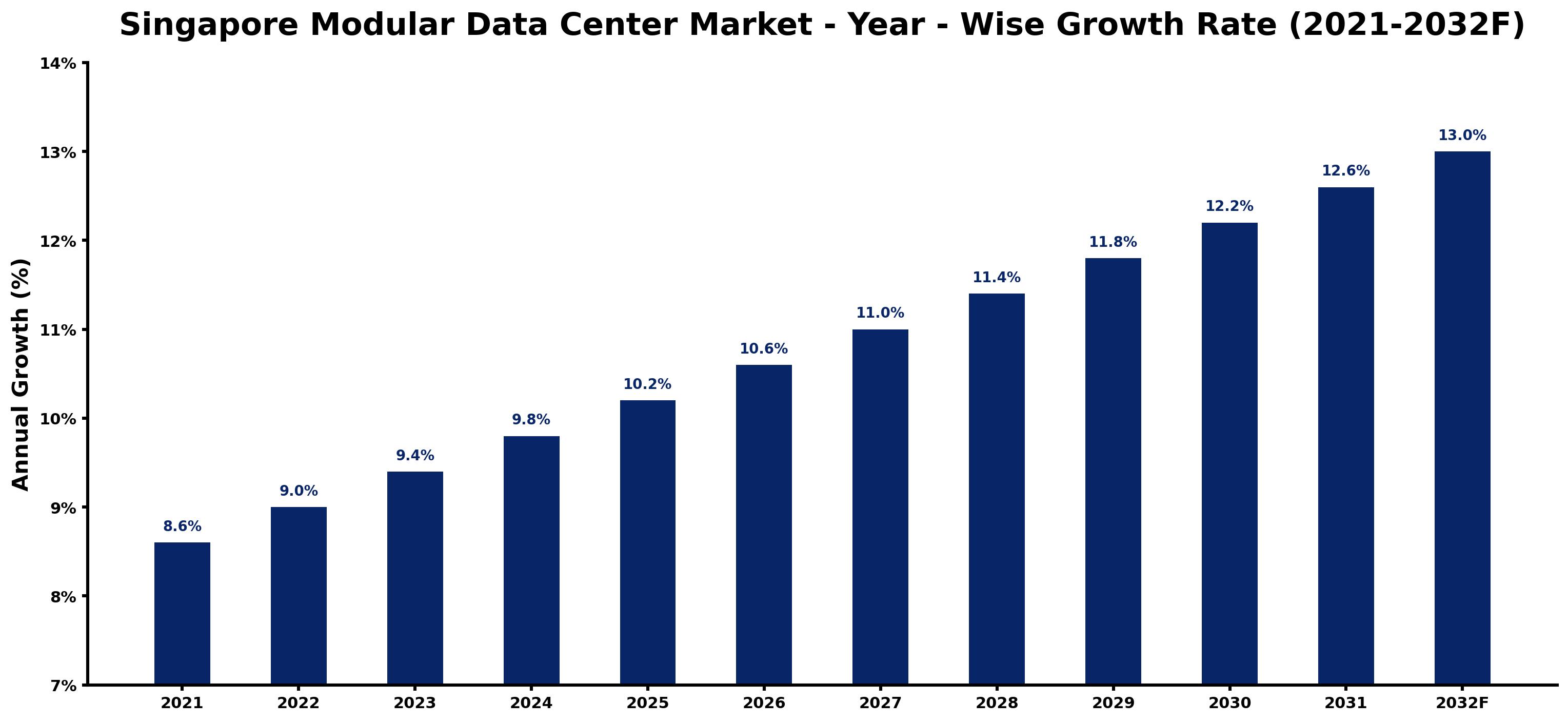
The table below presents the year‑wise growth rates along with the key drivers influencing the market
| Year | Growth Rate | Major Drivers |
| 2021 | 8.6% | Rapid growth in telecom and data center sectors |
| 2022 | 9.0% | Rising electricity demand across industries |
| 2023 | 9.4% | Government infrastructure modernization initiatives |
| 2024 | 9.8% | Government infrastructure modernization initiatives |
| 2025 | 10.2% | Expansion of manufacturing activities |
| 2026 | 10.6% | Expansion of transportation and logistics networks |
| 2027 | 11.0% | Increasing adoption of advanced technologies |
| 2028 | 11.4% | Increasing adoption of advanced technologies |
| 2029 | 11.8% | Increasing adoption of advanced technologies |
| 2030 | 12.2% | Growing renewable energy integration projects |
| 2031 | 12.6% | Increasing smart city development projects |
| 2032 | 13.0% | Expansion of commercial construction activities |
Note - Market size estimations and growth projections presented in this report are based on 6Wresearch’s advanced forecasting approach, validated with industry datasets as of June 2026.
Singapore Modular Data Center Market Synopsis
The most significant force shaping the Singapore Modular Data Center Market today is the rapid growth in data generation across multiple sectors, including IoT, cloud services, and digital media. As companies increasingly rely on high-capacity storage and processing solutions, modular data centers emerge as a viable answer, offering both flexibility and scalability to meet evolving operational demands.
Moreover, the push for energy-efficient technologies has resulted in the design and implementation of modular data centers that not only reduce operational costs but also minimize environmental impact. This dual focus on efficiency and adaptability positions the Singapore Modular Data Center Market as a leader in the Asia-Pacific region.
Singapore Modular Data Center Market Key Takeaways
- Strong demand for scalable and flexible data center solutions driven by business expansion.
- Significant growth potential due to increasing data storage requirements in various industries.
- Focus on energy efficiency leads to reduced operational costs and improved sustainability.
- Integration complexities with legacy systems pose challenges for operators.
- Regulatory compliance remains crucial for market participants to ensure data security and privacy.
Evaluation of Restraints in Singapore Modular Data Center Market
Despite the positive market outlook, several restraints hinder the growth of the Singapore Modular Data Center Market. A primary concern is the challenge of integrating modular data centers with existing IT infrastructure, which often involves complex planning and adaptation. Furthermore, operators must navigate stringent local regulations regarding data center operations, security standards, and environmental policies. Additionally, the vital need to safeguard sensitive data against breaches creates another layer of difficulty, requiring ongoing investment in security solutions and compliance measures.
Singapore Modular Data Center Market Trends
Current trends in the Singapore Modular Data Center Market include a noticeable shift towards hybrid cloud solutions, as businesses look to leverage both on-premise and cloud resources effectively. This trend is complemented by advancements in AI and machine learning, which are being integrated into data center operations to optimize performance and enhance decision-making processes. Another significant trend is the rising focus on sustainability, with operators actively pursuing green certifications and energy-efficient technologies to meet both market demands and regulatory expectations.
Singapore Modular Data Center Market Opportunities
The Singapore Modular Data Center Market offers substantial growth and investment opportunities, particularly in the realms of AI-driven automation and the development of sustainable infrastructure. As more enterprises adopt a hybrid approach to their IT strategies, there is increased potential for modular data center solutions that support rapid scalability. Furthermore, the ongoing digital transformation efforts across sectors such as finance, healthcare, and manufacturing present opportunities for specialized modular solutions designed to meet specific industry requirements.
Government Initiatives in the Singapore Modular Data Center Market
The Singapore government has introduced several initiatives aimed at fostering a conducive environment for data center growth. These include public investments in advanced infrastructure and policies that promote the use of renewable energy within data centers. Additionally, various funding programs and incentives are designed to encourage operators to adopt innovative technologies that enhance energy efficiency and overall performance. Such supportive measures help position Singapore as a competitive data center hub in the region.
Future Insights of the Singapore Modular Data Center Market
Looking ahead to 2026-2032, the Singapore Modular Data Center Market is expected to undergo significant evolution, driven by ongoing advancements in technology and shifts in business needs. The market will likely witness increased adoption of advanced cooling solutions and energy-efficient designs, as companies strive for greater sustainability. Furthermore, the rise of edge computing will necessitate a rethinking of data center configurations to support real-time data processing at the network's periphery, presenting new avenues for growth and innovation in modular solutions.
Singapore Modular Data Center Market Latest Developments (May 2025 - June 2026)
In the latest industry direction, the focus has shifted towards enhancing data center resiliency and optimizing operational efficiencies. New partnerships and collaborations are emerging to leverage cutting-edge technologies, such as AI and machine learning, to improve data management and reduce costs. Operators are also exploring innovative designs that incorporate green technologies, aiming to align with sustainability goals while meeting increasing demand for data services.
Singapore Modular Data Center Market - Key Attractiveness of the Report
- 10 Years of Market Numbers
- Historical Data Starting from 2022 to 2025
- Base Year: 2025
- Forecast Data until 2032
- Key Performance Indicators Impacting the Market
- Major Upcoming Developments and Projects
Key Highlights of the Report:
- Singapore Modular Data Center Market Outlook
- Market Size of Singapore Modular Data Center Market, 2025
- Forecast of Singapore Modular Data Center Market, 2032F
- Historical Data and Forecast of Singapore Modular Data Center Revenues & Volume for the Period 2022-2032F
- Singapore Modular Data Center Market Trend Evolution
- Singapore Modular Data Center Market Drivers and Challenges
- Singapore Modular Data Center Price Trends
- Singapore Modular Data Center Porter's Five Forces
- Singapore Modular Data Center Industry Life Cycle
- Historical Data and Forecast of Singapore Modular Data Center Market Revenues & Volume By Functional module solution for the Period 2022-2032F
- Historical Data and Forecast of Singapore Modular Data Center Market Revenues & Volume By All-in One Functional Module for the Period 2022-2032F
- Historical Data and Forecast of Singapore Modular Data Center Market Revenues & Volume By Individual Functional Module for the Period 2022-2032F
- Historical Data and Forecast of Singapore Modular Data Center Market Revenues & Volume By Service for the Period 2022-2032F
- Historical Data and Forecast of Singapore Modular Data Center Market Revenues & Volume By Infrastructure Management for the Period 2022-2032F
- Historical Data and Forecast of Singapore Modular Data Center Market Revenues & Volume By Integration & Deployment for the Period 2022-2032F
- Historical Data and Forecast of Singapore Modular Data Center Market Revenues & Volume By Consulting for the Period 2022-2032F
- Historical Data and Forecast of Singapore Modular Data Center Market Revenues & Volume By Industry for the Period 2022-2032F
- Historical Data and Forecast of Singapore Modular Data Center Market Revenues & Volume By BFSI for the Period 2022-2032F
- Historical Data and Forecast of Singapore Modular Data Center Market Revenues & Volume By Retail for the Period 2022-2032F
- Historical Data and Forecast of Singapore Modular Data Center Market Revenues & Volume By Government for the Period 2022-2032F
- Historical Data and Forecast of Singapore Modular Data Center Market Revenues & Volume By Healthcare for the Period 2022-2032F
- Historical Data and Forecast of Singapore Modular Data Center Market Revenues & Volume By Telecommunication for the Period 2022-2032F
- Historical Data and Forecast of Singapore Modular Data Center Market Revenues & Volume By Utilities for the Period 2022-2032F
- Historical Data and Forecast of Singapore Modular Data Center Market Revenues & Volume By Others for the Period 2022-2032F
- Singapore Modular Data Center Import Export Trade Statistics
- Market Opportunity Assessment By Functional module solution
- Market Opportunity Assessment By Service
- Market Opportunity Assessment By Industry
- Singapore Modular Data Center Top Companies Market Share
- Singapore Modular Data Center Competitive Benchmarking By Technical and Operational Parameters
- Singapore Modular Data Center Company Profiles
- Singapore Modular Data Center Key Strategic Recommendations






































