Singapore Online Grocery Market Size, Share & Growth Rate
The Singapore Online Grocery Market was estimated at USD 1028 Million in 2025 and is projected to reach USD 1488 Million by 2032, growing at a CAGR of 5.4% from 2026 to 2032. This growth trajectory is largely fueled by the increasing integration of technology in grocery shopping, with consumers favoring the ease and efficiency of digital platforms. Additionally, an expanding range of product offerings and heightened consumer demand for convenience continue to strengthen this market.
Singapore Online Grocery Market Year-wise Growth Rate and Key Drivers
This graph highlights how the Singapore Online Grocery Market has steadily grown over the years, supported by major growth factors.
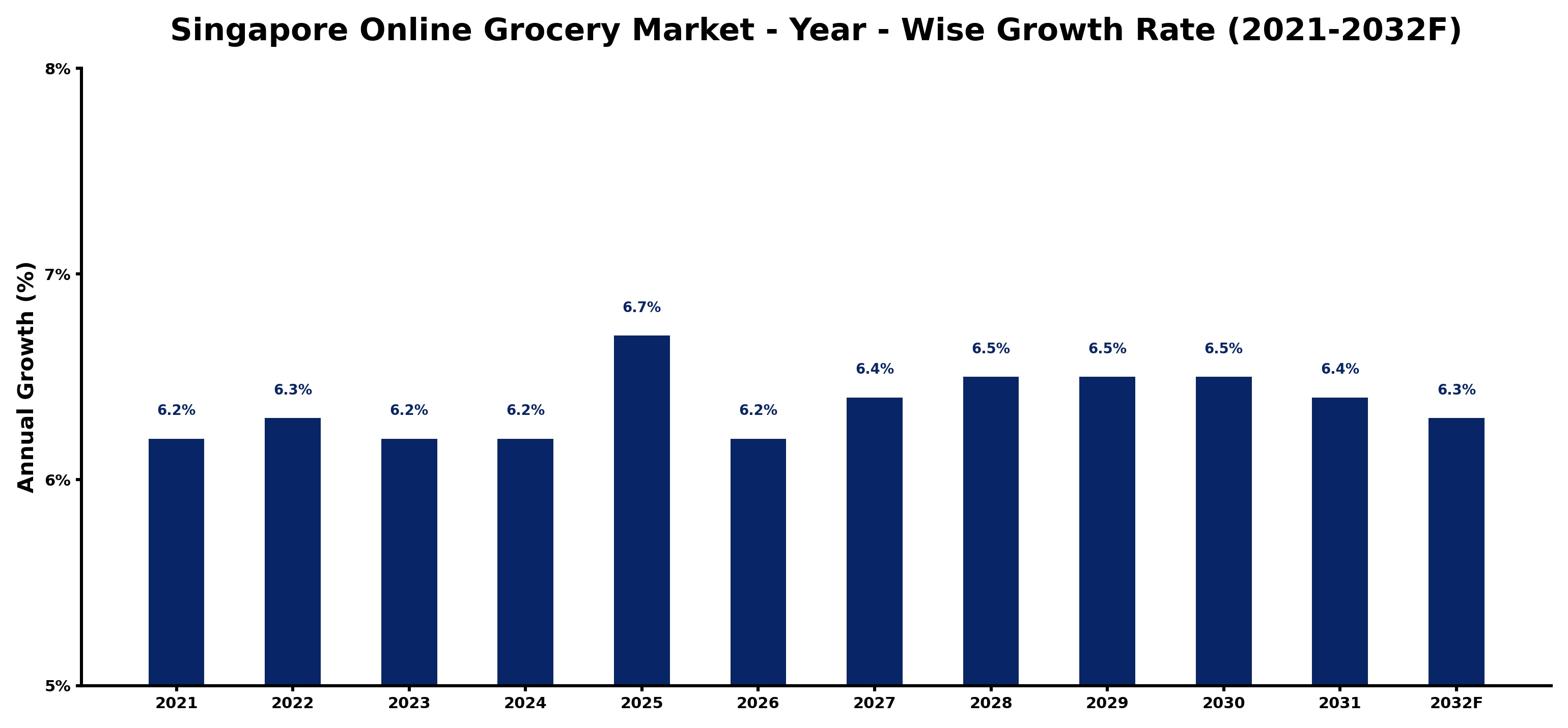
The table below presents the year‑wise growth rates along with the key drivers influencing the market
| Year | Growth Rate | Major Drivers |
| 2021 | 6.2% | Increased smartphone penetration enabled shopping |
| 2022 | 6.3% | Consumer preference shifted online rapidly |
| 2023 | 6.2% | Delivery service options expanded significantly |
| 2024 | 6.2% | Subscription models gained consumer traction |
| 2025 | 6.7% | Health-conscious products saw rising demand |
| 2026 | 6.2% | Sustainable packaging initiatives attracted shoppers |
| 2027 | 6.4% | Local sourcing trends enhanced appeal |
| 2028 | 6.5% | Promotions and discounts drove purchases |
| 2029 | 6.5% | User-friendly interfaces improved engagement |
| 2030 | 6.5% | Social media marketing increased visibility |
| 2031 | 6.4% | Loyalty programs enhanced customer retention |
| 2032 | 6.3% | Innovative payment solutions facilitated transactions |
Note - Market size estimations and growth projections presented in this report are based on 6Wresearch’s advanced forecasting approach, validated with industry datasets as of June 2026.
Singapore Online Grocery Market Synopsis
The most potent force currently shaping the Singapore Online Grocery Market is the consumer preference for convenience. As lifestyles in Singapore become increasingly hectic, the option to have groceries delivered straight to their doors is highly appealing to many consumers. This shift has been significantly accelerated by the COVID-19 pandemic, which compelled even the most traditional shoppers to explore online alternatives.
In this evolving landscape, retailers are stepping up their game. Investments in advanced logistics and technology are making it easier for consumers to enjoy a seamless shopping experience. With more users engaging with online grocery platforms, the variety of products and services is set to expand further, reflecting the diverse needs of the Singaporean population.
Singapore Online Grocery Market Key Takeaways
- The market is experiencing robust growth due to the rising convenience of online shopping.
- Consumer habits have shifted dramatically towards e-commerce, a trend fueled by the pandemic.
- Retailers are investing heavily in technology and logistics to enhance service efficiency.
- Competition remains intense, requiring continuous adaptation and innovation among retailers.
- Product freshness and quality assurance are paramount concerns for consumers.
Evaluation of Restraints in Singapore Online Grocery Market
Despite the positive outlook for the Singapore Online Grocery Market, several limitations persist that may hinder growth. The market is characterized by fierce competition, which can drive down prices and compress margins. Additionally, the complexity of ensuring efficient delivery logistics poses a significant challenge, particularly in urban settings where traffic congestion is common. Furthermore, addressing consumer apprehensions regarding product freshness and quality is vital; online retailers must invest in strategies to assure customers that they will receive high-quality goods, thereby fostering trust and loyalty.
Singapore Online Grocery Market Trends
Current trends indicate a shift towards personalization in online grocery shopping. Retailers are employing data analytics to offer tailored recommendations, enhancing the consumer experience. Furthermore, sustainability practices are becoming increasingly important, with consumers seeking eco-friendly packaging and sourcing methods. Social media influence is also notable, as consumers are drawn to platforms that showcase product offerings visually and engage them effectively.
Singapore Online Grocery Market Opportunities
The opportunities for growth within the Singapore Online Grocery Market are substantial. Expanding partnerships with local farms and producers can diversify product offerings, appealing to the growing consumer interest in sustainable and locally sourced goods. Additionally, innovative delivery solutions, such as on-demand delivery services, can cater to consumers looking for quicker turnaround times. Enhanced mobile applications and loyalty programs present further avenues to attract and retain a wider consumer base.
Government Initiatives in the Singapore Online Grocery Market
The Singapore government has been proactive in encouraging the growth of the digital economy, which includes online grocery services. Various initiatives and policies aimed at enhancing e-commerce infrastructure and supporting digital transformation are in place. These efforts involve investment in technology, improving logistics capabilities, and promoting the adoption of e-payment systems, ultimately fostering an environment conducive to the expansion of the online grocery sector.
Future Insights of the Singapore Online Grocery Market
Looking ahead to 2026-2032, the Singapore Online Grocery Market is set to continue its upward trajectory. Consumer expectations will drive retailers to innovate constantly, focusing on improving delivery efficiencies and enhancing overall user experience. The growing reliance on digital solutions, coupled with changing consumer lifestyles, ensures that the momentum gained during the pandemic will likely persist. As technology continues to evolve, the landscape of online grocery shopping will become increasingly sophisticated, offering even greater convenience and personalization.
Singapore Online Grocery Market Latest Developments (May 2025 - June 2026)
In recent months, the online grocery market in Singapore has seen significant advancements, particularly in terms of logistics and customer engagement. Retailers are exploring new delivery models and enhancing their mobile platforms to better meet consumer needs. Collaboration with tech firms has also increased, focusing on optimizing the supply chain and improving the accuracy of delivery times. As e-commerce continues to evolve, expect to see innovative strategies that further integrate technology into the online grocery shopping experience.
Singapore Online Grocery Market - Key Attractiveness of the Report
- 10 Years of Market Numbers
- Historical Data Starting from 2022 to 2025
- Base Year: 2025
- Forecast Data until 2032
- Key Performance Indicators Impacting the Market
- Major Upcoming Developments and Projects
Key Highlights of the Report:
- Singapore Online Grocery Market Outlook
- Market Size of Singapore Online Grocery Market, 2025
- Forecast of Singapore Online Grocery Market, 2032
- Historical Data and Forecast of Singapore Online Grocery Revenues & Volume for the Period 2022-2032F
- Singapore Online Grocery Market Trend Evolution
- Singapore Online Grocery Market Drivers and Challenges
- Singapore Online Grocery Price Trends
- Singapore Online Grocery Porter's Five Forces
- Singapore Online Grocery Industry Life Cycle
- Historical Data and Forecast of Singapore Online Grocery Market Revenues & Volume By Product Type for the Period 2022-2032F
- Historical Data and Forecast of Singapore Online Grocery Market Revenues & Volume By Food Grains for the Period 2022-2032F
- Historical Data and Forecast of Singapore Online Grocery Market Revenues & Volume By Bread, Bakery and Dairy Products for the Period 2022-2032F
- Historical Data and Forecast of Singapore Online Grocery Market Revenues & Volume By Fruits and Vegetables for the Period 2022-2032F
- Historical Data and Forecast of Singapore Online Grocery Market Revenues & Volume By Personal Care for the Period 2022-2032F
- Historical Data and Forecast of Singapore Online Grocery Market Revenues & Volume By Dry and Baking Products for the Period 2022-2032F
- Historical Data and Forecast of Singapore Online Grocery Market Revenues & Volume By Household Products for the Period 2022-2032F
- Historical Data and Forecast of Singapore Online Grocery Market Revenues & Volume By Meat and Meat Products for the Period 2022-2032F
- Historical Data and Forecast of Singapore Food Grains Online Grocery Market Revenues & Volume By Others for the Period 2022-2032F
- Historical Data and Forecast of Singapore Online Grocery Market Revenues & Volume By Platform for the Period 2022-2032F
- Historical Data and Forecast of Singapore Online Grocery Market Revenues & Volume By App-based for the Period 2022-2032F
- Historical Data and Forecast of Singapore Online Grocery Market Revenues & Volume By Web-based for the Period 2022-2032F
- Singapore Online Grocery Import Export Trade Statistics
- Market Opportunity Assessment By Product Type
- Market Opportunity Assessment By Platform
- Singapore Online Grocery Top Companies Market Share
- Singapore Online Grocery Competitive Benchmarking By Technical and Operational Parameters
- Singapore Online Grocery Company Profiles
- Singapore Online Grocery Key Strategic Recommendations






































